A Marx Brothers Political Uprising: DUCK SOUP Serves Up a Perfect Bowl of Comedy and International Relations at the Movie Tavern!

Posted on: Aug 6th, 2013 By:

DUCK SOUP (1933); Dir. Leo McCarey; Starring the Marx Brothers (Groucho, Chico, Harpo and Zeppo) and Margaret Dumont; Tuesday, Aug. 6 and Thursday, Aug. 9 @ 7:30 p.m.; Wednesday, Aug. 8 @ 11:30 a.m.; Movie Tavern; Tickets here; Trailer here.

By Aleck Bennett
Contributing Writer

The Movie Tavern’s Retro Cinema series is devoting the entire month of August to classic comedies! And it’s hard to think of a more classic comedy than the Marx Brothers masterpiece DUCK SOUP!

Growing up, I had two obsessions: horror movies and Groucho Marx. In the small town of Lanett, Alabama, we were able to get a handful of Atlanta UHF stations (kids, ask your folks what UHF stations were). WTCG 17—later to become WTBS—had the horror movie front covered. And WHAE 46 had Groucho, with reruns of YOU BET YOUR LIFE that I’d watch every night before bed. That’s where I first discovered the waggling eyebrows, sardonic humor and unmatched wordplay of the mustachioed Marx. I thought he was the funniest human being to ever walk the face of this puny planet. And from there, I worked backwards. When I couldn’t see a Marx Brothers movie, I’d pore over the Richard J. Anobile-edited stills-and-dialogue collection WHY A DUCK? and learn the quips by heart.

All of this is prelude to why I’m tempted to just say “DUCK SOUP is perfect,” drop the mic and walk off stage. What else need be said? It’s perfect, it’s playing, go see it.

But that wouldn’t be a review, now would it? It’s barely an opinion. It’s just this side of being a sentence.

Now, there will be those who will claim that other Marx Brothers movies, particularly their films made at MGM, are better. There will be those who’ll sing the praises of A NIGHT AT THE OPERA or trot out A DAY AT THE RACES. These people are, how do you say, wrong. Sure, those may be more accomplished films. They did pull off the feat of placing the Brothers’ anarchic humor in a traditional Hollywood movie framework. But like Joe Bob Briggs would say, there’s too much plot getting in the way of the story. Too much romantic frou-frou between Allan Jones and whatever leading lady had to be subjected to his bland appeal. And these movies do the unspeakable: they make the Brothers nice. The Marxes are interested in helping people by, say, keeping two love-struck opera singers together or by saving a sanitarium from being foreclosed upon.

DUCK SOUP—like the Brothers’ other, earlier Paramount pictures—has no interest in making the Brothers likeable. All the Brothers want to do is cause disorder and discord. Every Marx Brothers character in the film is either ineffectual or irresponsible, or both. None of them actually want to do what their characters are assigned to do. Groucho plays Rufus T. Firefly, the newly-appointed head of the bankrupt nation of Freedonia. He, of course, has no interest in governing. All he has an interest in is the compound interest in the bank accounts of Mrs. Gloria Teasdale (Margaret Dumont, at her Margaret Dumont-iest), whom he is determined to marry. He’s being spied upon by Chicolini (Chico Marx) and Pinky (Harpo Marx) from the neighboring country of Sylvania. They, of course, have no interest in spying on Firefly. They don’t really have much interest in doing anything except pestering the local lemonade vendor (Edgar Kennedy) or going to baseball games on their employer’s dime. Then there’s the forever-to-be-underrated Zeppo Marx, who—as Firefly’s secretary Bob Roland—is mostly there to provide the “straight man” role for Groucho to lob jokes at. He’s the only person there who seemingly wants to do the job he’s assigned (though Firefly sees him as being incompetent), but that’s Zeppo for you. Say what you will, though, the Marxes never had a better straight man than Zeppo.

There’s so much to love in this movie. There’s the break-in scene, where Chico and Harpo don greasepaint and pajamas and are virtually indistinguishable from Groucho. (There’s no need in referring to them by character name—they’re playing the Marx Brothers here, as they always do.) There’s the Groucho/Harpo mirror scene. The war, in which every character’s costume changes between edits. The “We’re Going to War!” musical number. Groucho’s constant failure to leave the capitol building by motorcycle. The glorious back-and-forth that occurs whenever Groucho and Chico share a scene. The reality-shattering existence of Harpo Marx, who is presented as an almost supernatural agent of chaos (how else does a live, barking dog emerge from the doghouse tattooed on his chest?). I could go on and on all night. Get to know me for longer than a week, and I probably will.

Like most great pieces of art, it wasn’t well-received in its time. During the Depression, filmgoers were put off by the mean-spirited and anti-authoritarian tone of the movie. And critics felt the story too disjointed and harsh, too sour and unpleasant. Pure, uncut Marxism was too much for many to deal with in those dark days. Even Groucho thought little of the movie (but he was, you have to remember, a grouch). But in ensuing years, it’s been reappraised, and for good reason. Its ridicule of war and the Powers That Be helped it gain a foothold in the minds of rebellious youth in the decades since, and appealed to the steadily growing cynicism of the American psyche. It’s now considered a masterpiece and one of the most influential film comedies of all time.

When Woody Allen’s character Mickey, in his 1986 film HANNAH AND HER SISTERS, searches for meaning after an unsuccessful suicide attempt, he walks into a chance screening of DUCK SOUP during the “We’re Going to War” sequence. He recounts:

“I just needed a moment to gather my thoughts and be logical and put the world back into rational perspective. And I went upstairs to the balcony, and I sat down, and the movie was a film that I’d seen many times in my life since I was a kid, and I always loved it. I’m watching these people up on the screen and I started getting hooked on the film. I started to feel, how can you even think of killing yourself? I mean, isn’t it so stupid? Look at all the people up there on the screen. They’re real funny, and what if the worst is true? What if there is no God and you only go around once and that’s it? Well, ya know, don’t you wanna be part of the experience? You know, what the hell? It’s not all a drag. And I’m thinking to myself, ‘Jeez, I should stop ruining my life searching for answers I’m never gonna get, and just enjoy it while it lasts.’ And after, who knows? I mean maybe there is something. Nobody really knows. I know ‘maybe’ is a very slim reed to hang your whole life on, but that’s the best we have. And then I started to sit back, and I actually began to enjoy myself.”

DUCK SOUP, ladies and gentlemen. It’s one of those things that make life worth living.

Because it’s perfect.

*Drops mic, walks off stage.*

Category: Retro Review | Tags: , , , , , , , , , , , , , , , , , , , , , , , , , , ,

Who You Gonna Call? GHOSTBUSTERS! Landmark Midtown Art Cinema Gets Some Frightfully Funny Midnight Madness Fri. Aug 2 and Sat. Aug 3

Posted on: Jul 31st, 2013 By:

GHOSTBUSTERS (1984); Dir. Ivan Reitman; Starring Bill Murray, Dan Aykroyd, Harold Ramis, Ernie Hudson, Sigourney Weaver, Rick Moranis and Annie Potts; August 2 & 3 @ Midnight; Landmark Midtown Art Cinema; Tickets here; Trailer here.

By Aleck Bennett
Contributing Writer

Midnight Madness has descended upon the Landmark Midtown Art Cinema! This time, they’re bringing you one of the greatest comedies of the 1980s, the spook-stravaganza, GHOSTBUSTERS!

Sometimes you need a film that challenges your belief system. Sometimes you need a film that will rouse you to action. Sometimes you need a film that makes you ask tough questions about the world we live in.

And sometimes you just need a film that’s only out to entertain you in the biggest possible way. Few films accomplish this like GHOSTBUSTERS.

Three New York City parapsychologists—Peter Venkman (Bill Murray), Raymond Stanz (Dan Aykroyd) and Egon Spengler (Harold Ramis)—after being kicked out of their tony Columbia University gigs, decide to monetize their research by setting up a “ghost extermination” service out of an old firehouse. Business is slow, but a successful capture at the Sedgewick Hotel leads to huge demand for their services and rock-star status in the city. Meanwhile, they are hired by Dana Barrett (Sigourney Weaver), whose apartment is being haunted by a entity known as Zuul. Her neighbor, Louis Tully (Rick Moranis), becomes possessed by Zuul’s companion demigod, Vinz Clortho. That would be bad enough, but the arrival of these two beings on this plane, along with the rise in supernatural phenomena, signals the coming destruction of this planet at the hands of Sumerian deity Gozer the Gozerian. Assisted by new hire Winston Zeddemore (Ernie Hudson), the team must try to find a way to stop the apocalyptic plans of Gozer and round up the hordes of suddenly-freed spirits plaguing NYC.

Yeah, I know. It reads as incredibly complicated and far-fetched, and peppered with names that sound ripped from some late-night Dungeons & Dragons campaign. But frankly, none of this matters because all this mythological-sounding hoosafudge is just there to be in service to the kind of inspired, wacky comedy that was the stock-in-trade of Dan Aykroyd, Harold Ramis and Bill Murray at the time. Sure, it’s a movie about ghosts, but there’s no sentimentality in their treatment of them (unlike, say, Peter Jackson’s similarly-themed THE FRIGHTENERS) and not even any real fright involved in their treatment. The ghosts on parade are rarely even remotely spooky: they’re just neon-green-colored pranksters for the most part. And even the agent of the ultimate destruction of humankind gets played for laughs at the very end. It’s the direct spawn of Bob Hope’s 1942 comedy THE GHOST BREAKERS and the Bowery Boys’ 1946 farce SPOOK BUSTERS.

GHOSTBUSTERS sports one of the great comic screenplays. Tightly constructed, it never spins wildly out of control the way that Aykroyd’s THE BLUES BROTHERS (1980) does, but his flights of fancy elevate the reality-based comedy that his co-writer Harold Ramis frequently deals in. Ramis grounds Aykroyd, while Aykroyd provides Ramis with an excuse to play in a more fantastic milieu. And the entire process is aided by Murray’s keen sense of improvisational skills in performance. Tonally speaking, the movie is probably closest to director Ivan Reitman’s previous collaboration with Bill Murray and Harold Ramis, STRIPES (1981). Like that film, GHOSTBUSTERS is primarily centered on the semi-improvised performance of Murray and the comic chemistry of the team around him.

Bill Murray examines a possessed Sigourney Weaver in GHOSTBUSTERS (Columbia Pictures, 1984).

The downside to this approach is that brilliant comic actors like Harold Ramis and Dan Aykroyd get overshadowed by Murray’s dominating presence (Ramis, as the deadpan Egon, makes a more lasting impression than Aykroyd), but they work solidly as a team in support of—and providing the necessary “straight man” grounding for—Murray’s performance. And without their sense of camaraderie, the whole film would likely fall apart. Standing out and holding their own against Murray, though, are Rick Moranis and Sigourney Weaver. Moranis deftly works his nebbish character (honed in his days at SCTV and given a more sympathetic treatment in 1986’s LITTLE SHOP OF HORRORS) against type as Louis becomes possessed by Vinz Clortho, and makes it seem just through the physicality of his acting as if his tiny frame is an ill-fitting suit for some huge and monstrous beast. Sigourney Weaver likewise plays dual roles strongly—both as the independent musician who is simultaneously repelled and attracted by Peter Venkman’s overtures, and as possessed by the…erm…extremely sexually agressive Zuul.

Visually, the movie is BIG. There are great practical, animation and optical effects on display throughout. The sets are amazing, ranging from the humble firehouse location to the climactic skyscraper rooftop extravaganza designed for Gozer’s arrival. Miniature work and puppetry are handled expertly. The cinematography by László Kovács (veteran of CLOSE ENCOUNTERS OF THE THIRD KIND [1977] and THE INCREDIBLY STRANGE CREATURES WHO STOPPED LIVING AND BECAME MIXED-UP ZOMBIES [1964]) is gorgeous.

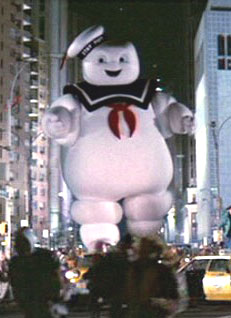
A haunted supersized Stay-Puft Marshmallow Man terrorizes Manhattan in GHOSTBUSTERS (Columbia Pictures, 1984).

And then, we have to mention the soundtrack. Not only is the score by Elmer Bernstein (THE MAGNIFICENT SEVEN [1960], TO KILL A MOCKINGBIRD [1962]) among his best, Ray Parker, Jr.’s title song has proven to be as endlessly quotable as the movie itself. Even if you’ve never seen the movie (and I’m speaking to all 12 of you who haven’t), you likely recognize “Who you gonna call?” and “I ain’t afraid of no ghosts!” instantly.

What I’m trying to say, people, is that this is one of those nearly perfect comedies. The whole thing works like, well, gangbusters. It’s constantly fun, consistently hilarious and incredibly engaging. There’s not a down moment in the movie, not a minute where it lags. If it’s not a Grand Statement by one of cinema’s great auteurs, it’s a masterfully-crafted piece of pop entertainment.

And sometimes, that’s all that’s called for.

Aleck Bennett is a writer, blogger, pug warden, pop culture enthusiast, raconteur and bon vivant from the greater Atlanta area. Visit his blog at doctorsardonicus.wordpress.com

Category: Retro Review | Tags: , , , , , , , , , , , , , , , , , , , , , , , , , , , , , , , ,

Dark and Dangerous: Revisiting the Dalton Duet as The Plaza Theatre’s 50 Years of Bond Celebration Continues!

Posted on: Jul 14th, 2013 By:

THE LIVING DAYLIGHTS (1987); Dir. John Glen; Starring Timothy Dalton, Maryam D’Abo, John Rhys-Davies and Joe Don Baker; Monday, July 15 @ 7:30 p.m.; Plaza Theatre; Tickets here; Trailer here.

LICENSE TO KILL (1989); Dir. John Glen; Starring Timothy Dalton, Carey Lowell, Robert Davi and Joe Don Baker; Tuesday, July 16 @ 7:30 p.m.; Plaza Theatre; Tickets here; Trailer here.

By Aleck Bennett
Contributing Writer

The celebration of James Bond’s 50th anniversary at the Plaza Theatre continues throughout the month of July, and as we hit the middle of the month, we find ourselves at another crossroads in the Bond series. So once again I’d like to draw your attention to a couple of movies you may have overlooked in favor of the higher-profile Sean Connery, Roger Moore, Pierce Brosnan and Daniel Craig entries.

Unexpected developments in casting the Bond series always lead to interesting results. Prior to 1969’s ON HER MAJESTY’S SECRET SERVICE (OHMSS; see our Retro Review here), Albert “Cubby” Broccoli and Harry Saltzman’s Eon Productions had unsuccessfully wooed Roger Moore to take over the role of James Bond. Instead, they cast George Lazenby as a more grounded and serious protagonist compared to the increasingly gadget-reliant Sean Connery Bond.

The eventual Roger Moore entries, likewise, became increasingly criticized as the 1970s progressed and the series entered the 1980s. The Bond films had seemingly embraced the decade’s love of camp, and also appeared over-reliant on current cinematic trends. By the time of 1985’s A VIEW TO A KILL, the nearly 60-year-old Moore had already been upstaged by the unofficial return of Connery in the non-Eon NEVER SAY NEVER AGAIN (1983)—a film that at least addressed Bond’s increasing age (and Connery was three years Moore’s junior!). Eon then turned its bullet-sights on Pierce Brosnan, who was then starring in the about-to-be-cancelled TV series REMINGTON STEELE. With the Bond interest raising Brosnan’s cache, however, NBC renewed the program and put a kibosh on Eon’s efforts.

In a move as unexpected as Eon’s offer of the role to George Lazenby, the part was extended to relatively little-known film and TV actor Timothy Dalton. Dalton—most recognized for his roles in 1978’s mini-series CENTENNIAL and 1980’s FLASH GORDON—may have been more of a known quantity than Lazenby in his day, but was untested in comparison to the more-established Roger Moore or Pierce Brosnan prior to their castings.

In a parallel with Eon’s desires to take the character back to basics after Connery’s departure, Dalton’s Bond was an attempt to return to the early Connery days and to bring back realism to the series. And with 1987’s THE LIVING DAYLIGHTS, the series delivered the darkest Bond to date: a tense tale of espionage between MI6 and the KGB in the waning days of the Cold War and the Soviet occupation of Afghanistan.

Timothy Dalton and Maryam D'Abo in THE LIVING DAYLIGHTS.

Looking at the film today, Dalton brings a grim seriousness to his Bond, obviously still haunted by the death of his wife Tracy and channeling his violent energy into the work. His self-performed stunt work is also excellent. The direction by veteran Bond helmsman John Glen is tight, yet still preserves the gloss and slickness long associated with the franchise. It’s a solid effort all around, with a screenplay that rises to the demand of re-establishing Bond in the contemporary world nearly as successfully as OHMSS. While some critics went after the film’s lack of humor, I feel that it’s one of the most underrated Bonds: a hard-hitting take on the character with a keen intensity not generally seen in the series. The only downside to the film is its dated score (the last by John Barry, incorporating glaringly ‘80s sequenced rhythm tracks) and a truly unfortunate title song by A-Ha.

Sadly, a confluence of events derailed what looked to be a developing good thing and cast a shadow on the fortunes of 1989’s LICENSE TO KILL. The fall of the Soviet empire ended the Cold War and suddenly made traditional Bondian international espionage seem dated: the very fate that Ian Fleming worried would impact the series in the mid-’60s. In response, the film focused on an international cocaine-smuggling ring, a storyline which made the film seem to be jumping on the bandwagon of nearly every other successful action-adventure franchise of the time. In addition, a writers’ strike led to difficulties in scripting the film as long-time Bond screenwriter Richard Maibaum was largely removed from its creation. If that weren’t enough, budget problems resulted in this being the first Bond not to feature locations filmed in the U.K. Instead, the movie was shot largely in Florida and Mexico. The success of LIVING DAYLIGHTS’ darker take on Bond led to this film offering an even darker and more violent look at the character, but instead of extending what worked about Dalton’s performance, it further removed Bond from his previous depictions and rendered him almost unrecognizable.

Critically speaking, LICENSE TO KILL self-consciously takes things too far, resulting in a James Bond movie that doesn’t really feel anything like a James Bond movie. Dalton succeeds much as he did in the previous film, but his good efforts are in service to a compromised vision and merely echo the previous, better film. In an ill-advised attempt to recall an OHMSS plot point (and perhaps to justify the lack of London locations and keep official MI6 spy work out of the picture), Bond unsuccessfully attempts to resign from MI6. (In OHMSS, Bond is instead given leave, and in LICENSE Bond is temporarily suspended and his license to kill revoked.) It may have been an attempt to link this depiction of the character to his source, but it simply shows how much better this plot turn was handled in the 1969 entry. Even as a general action film, LICENSE falls flat in comparison to other contemporary efforts such as 1987’s LETHAL WEAPON or 1988’s DIE HARD. Is it a horrible film? Not hardly. Even the worst films of the Bond series are still entertaining. But it’s definitely a disheartening effort when compared to the entry that immediately preceded it.

Unfortunately, Dalton was never able to star in another Bond film. Legal problems put a hiatus on the series, and it would be six years before another Bond film would be made. During the break and with the future of the franchise in doubt, Dalton decided to hang up his hat and move on to other projects. Because of his limited run, Dalton’s films have been largely overlooked (another echo of Lazenby’s turn), but they deserve a closer inspection. His approach to Bond lays the seeds for Daniel Craig’s eventual more gritty portrayal, and beyond the pleasures that both films offer (though admittedly harder to come by in the second), it’s interesting to view them now in light of the recent Bond films.

Aleck Bennett is a writer, blogger, pug warden, pop culture enthusiast, raconteur and bon vivant from the greater Atlanta area. Visit his blog at doctorsardonicus.wordpress.com

Category: Retro Review | Tags: , , , , , , , , , , , , , , , , , , , , , , , , , , , , , , , , , , , ,

Retro Review: All the Time in the World: James Bond Hits a Crossroads High as The Plaza Theatre presents ON HER MAJESTY’S SECRET SERVICE

Posted on: Jul 4th, 2013 By:

ON HER MAJESTY’S SECRET SERVICE (1969); Dir. Peter Hunt; Starring George Lazenby, Diana Rigg and Telly Savalas; Plaza Theatre; Saturday, July 6 @ 7:30 p.m.; Tickets here; Trailer here.

By Aleck Bennett
Contributing Writer

Throughout the month of July, the historic Plaza Theatre is paying tribute to 50 years of James Bond. And while much will be made of the many great entries starring Sean Connery, Roger Moore, Pierce Brosnan and Daniel Craig, I’d like to focus some attention on one film you may have written off: 1969’s ON HER MAJESTY’S SECRET SERVICE (OHMSS).

The tumult of the 1960s came to a head in that decade’s final year. The optimism of the Kennedy era and multi-national political intrigue had given birth to the cinematic Bond. But as the decade progressed and global politics came to be viewed in increasingly complex shades of grey, the Bond series changed as well. The films began departing freely from Ian Fleming’s novels and relying more and more on spectacular gadgetry and hyper-stylized set design, which reflected the culture’s growing fascination with pop art. The pairing of pop art and the burgeoning psychedelic art movement came to a head with 1967’s colorful and nearly cartoonish YOU ONLY LIVE TWICE (1967, YOLT for short) [Ed. note: plays Friday July 5 at The Plaza]. And if the onset of the late ‘60s were when change really began to ramp up, this too was reflected in Bond: series stalwart Sean Connery announced during YOLT’s filming that he was retiring from the role.

Aesthetically speaking, 1968-69 was a time of pulling back. Music from The Beatles, Bob Dylan, Creedence Clearwater Revival and The Band reflected a retreat from the rococo excesses of psychedelia. Meanwhile, movies like BONNIE AND CLYDE (1967) and THE WILD BUNCH (1969) inspired a newfound emphasis on realism in film. Politically speaking, the rise of the feminist movement and its influence offered a vocal critique of the seemingly disposable nature of the neverending series of “Bond girls” presented in the series thus far. Bond—with his fantastic toys and rampant womanizing—was rapidly becoming dangerously old-fashioned.

It was time to do something different.

“This never happened to the other fellow.” — James Bond, ON HER MAJESTY’S SECRET SERVICE

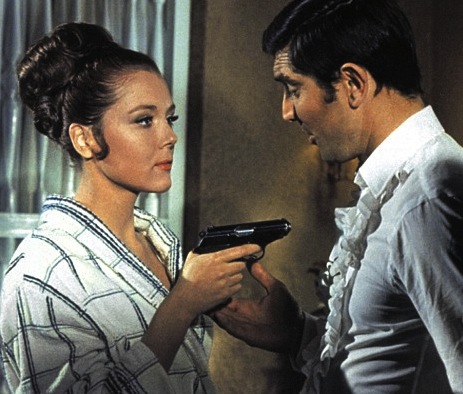
Tracy (Diana Rigg) is every bit the equal of James Bond (George Lazenby) in ON HER MAJESTY'S SECRET SERVICE (1969).

After attempting to woo eventual Bond lead Roger Moore for an adaptation of THE MAN WITH THE GOLDEN GUN, development on that title stalled and Moore returned to the TV series THE SAINT. Series producers Harry Saltzman and Albert “Cubby” Broccoli, along with director Peter Hunt, then decided to revive earlier plans to adapt OHMSS. And for their new Bond, turned to a relative unknown: Australian commercial actor George Lazenby.

The pairing of Lazenby and Bond started off on a bad note. Lazenby had been offered a seven-picture deal by Broccoli, but his agent advised against signing. The times were changing, the agent reasoned, and predicted that Bond couldn’t continue into the ‘70s. To add to the problem, by all accounts Lazenby and co-star Diana Rigg didn’t get along, and the actor complained of a lack of communication and coaching (this being his first feature film) from director Hunt.

Despite the unsure footing of the new star, every effort was made to try to make this the definitive Bond picture. The creative team decided to make this film hew as closely as possible to Fleming’s original novel, to the point of having Telly Savalas’ Blofeld (who had already been introduced in YOLT) not recognize Bond upon meeting him—a result of the novel having predated the previously-adapted YOLT. The movie also stripped back Bond’s reliance on gadgetry and returned to a more realistic depiction (for Bond, anyway) of spy work. Most significantly, though, OHMSS reflected the changing sexual politics of the time and presented Bond with a “Bond girl” that was his equal; in return, Bond eschewed his promiscuity and devoted himself to her.

In an epic tale that reached from the beaches of Portugal to the Swiss Alps, Bond must join forces with Marc-Ange Draco (Gabriele Ferzetti), the head of a European crime syndicate, in order to track down Ernst Stavro Blofeld, head of the international terrorist organization SPECTRE. In doing so, he went undercover to reveal a sinister plot at Blofeld’s clinical allergy-research institute, put his position as a 007 agent with MI6 at risk, and found that he was falling deeply in love with Draco’s daughter, the Contessa Teresa “Tracy” di Vicenzo.

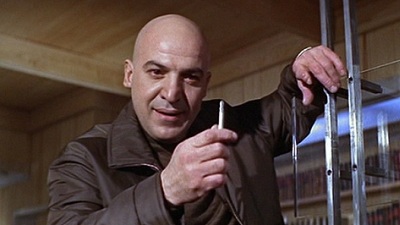
Telly Sevalas’ malevolence as villain Ernst "Stavro" Blofeld shines through even his most subdued scenes.

In my eyes, the filmmakers succeeded at their task. This truly is the definitive Bond film. It presents a James Bond who is both confident and vulnerable. Unlike any Bond outing before, the character is allowed to show fear and express true love while simultaneously providing a no-nonsense and strong presence. If anything, his depicted vulnerabilities strengthen his resolution and character. Though these elements are present in Fleming’s novel, to allow them in the film was a brave turn by the Bond team.

Despite Lazenby’s lack of experience and occasional lack of finesse, his performance was solid. A formidable presence, he retained some of  Connery’s suavity while still offering a more serious and sinewy take on the character. Savalas’ Blofeld was allowed to be a truly physical threat, unlike Donald Pleasence’s “evil genius” take on the role, and Savalas’ malevolence shone through even his most subdued scenes. Finally THE AVENGERS star Diana Rigg was perfect as Tracy. Displaying a complexity that matched this complex movie, she delivered a Tracy in turns melancholy, witty, intelligent and joyous. She captured the emotional arc of the character pitch-perfectly.

And for all the film’s distance from by-that-point traditional Bondian high-tech wizardry, OHMSS didn’t skimp on action in the slightest. For its length (it’s the second-longest Bond title), it plays lean and muscular. While the film wasn’t received well upon its release and still divides critics more so than probably any other Bond film, it delivers everything a Bond movie should.

That Lazenby did little to help his relationship with Saltzman and Broccoli (his appearing at the film’s premiere with shoulder-length hair and a beard was probably the last straw) probably served to hurt the film’s reputation more than anything else. Bad blood on both sides led to this film always being served up as something of the black sheep of the Bond family. It’s long been viewed as only slightly more legitimate than the 1967 parody CASINO ROYALE or the unofficial 1983 THUNDERBALL re-hash NEVER SAY NEVER AGAIN. But latter-day viewers and critics have finally started to come around and give the film its due. And it’s about time.

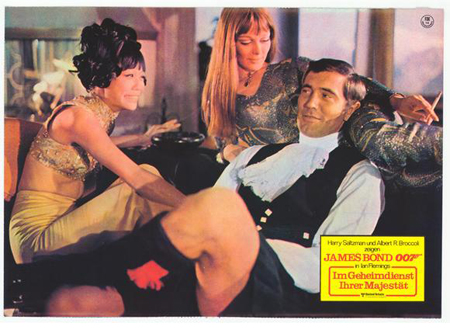
Are these Bond girls asking what's under George Lazenby's kilt?! Yes, while Sean Connery was a Scot, Lazenby, the stiffest Bond, was the only 007 to put that new meaning to not shaken but stirred.

Some will argue for 1965’s GOLDFINGER. Some may argue for 2006’s CASINO ROYALE. Some even will argue for Timothy Dalton’s short run as 007. But I root for the underdog. Both Lazenby and ON HER MAJESTY’S SECRET SERVICE are that underdog. GOLDFINGER is a close second, tied with last year’s SKYFALL (2012; laugh if you must, but SKYFALL is going to hold up far better than any of the Moore outings, mark my words). However, there’s nothing like MAJESTY.

Aleck Bennett is a writer, blogger, pug warden, pop culture enthusiast, raconteur and bon vivant from the greater Atlanta area. Visit his blog atdoctorsardonicus.wordpress.com

Category: Retro Review | Tags: , , , , , , , , , , , , , , , , , , , , , , , , , , , , , , , , ,

Retro Review: Neat Ideas and Savage Candy: Deeply, Cooly Sicko TOTAL RECALL Pushes Boundaries for a Perfect Last Good-Bye to 1980s Sci-Fi Cinema

Posted on: Jun 3rd, 2013 By:

Splatter Cinema presents TOTAL RECALL (1990); Dir. Paul Verhoeven; Starring Arnold Schwarzenegger, Sharon Stone, Ronny Cox and Michael Ironside; Tuesday, June 11 @ 9:30 p,m.; Plaza Theatre; Trailer here.

By Robert Emmett Murphy
Contributing Writer

TOTAL RECALL, released at the dawn of the new decade of the 1990s, is without a doubt the capstone of the SF film aesthetic of the decade it was leaving behind. It is also one of the finest of the Arnold Schwarzenegger vehicles and earned the distinction of being, up to that point, one of the most expensive, and profitable, films ever made. Just the next year, another Arnie flick, TERMINATOR 2: JUDGEMENT DAY, would define the aesthetic of the coming decade, and dwarf both TOTAL RECALL’s $60 million dollar budget and $260 million worldwide gross.

Paired, these two films represent remarkable transitional pieces, demonstrated in how they pushed the then-contemporary limits in FX technologies. TOTAL RECALL’s special makeup effects were by Rob Bottin, and its visual effects by Eric Brevig. Their labor represents very nearly the last mega-budget efforts of techniques and technologies about to be made obsolete when computer graphics (only nominally represented in this film) took over the whole industry. They were eye-popping at the time, but somewhat rubber and plastic looking now. T2, with the silver-liquid-metal killer robot, was the fist masterpiece of the revolution. Though CG made the canvas of what could be realized, and how well it could be realized, almost infinitely larger, if you leave the new tech’s masterpieces aside, there’s no doubt that a rubbery solid has a more real feel than today’s most-often-run-of-the-mill pixelation.

Both films also pushed the boundaries of narrative sophistication allowed in the escapist. T2 is undeniably the greater of the two, featuring richer characterization, a more complex plot with fewer loopholes, and more maturity in its take on a shared anti-authoritarian credo. T2 didn’t asset that our dependency on the maintenance of systems and hierarchies were injustices in-of-themselves and didn’t embrace the ideology of scarcity-as-myth. It recognized that the motives of those who commit (often inadvertent) harm often have legitimacy, nor did it deny the reality of the imperfectness in conduct of even the good guys. Yet TOTAL RECALL, so richly cheesy, so lavishly textureless (except the slick texture of spraying blood), and so deeply, morally corrupt in such a friendly, innocent way, is the better time-capsule of the society that produced it.

The Schwarenegger Effect and a Passion for Perversity

As an actor, Arnie was beloved by directors who wanted an appealing hero embodied in someone who wouldn’t distract from visual ideas by creating inappropriately humanistic identities. He was perfectly matched with TERMINATOR director James Cameron, but even more so here with Paul Verhoeven. I should make it clear, though, that Arnie hired Verhoeven, not the other way around. Arnie bought the rights after the film had languished in production hell for almost 15 years. Still, clearly his casting of himself was a defter choice than other, better, actors who’d been considered like Richard Dreyfuss and William Hurt (to say nothing of Patrick Swayze). Of course, those actors would’ve been cast in much different versions of the script, which had been rewritten some 40 times. Reportedly the final version was very close to the first version, while all those in-between had strayed into inappropriate attempts at distracting psychological depth.
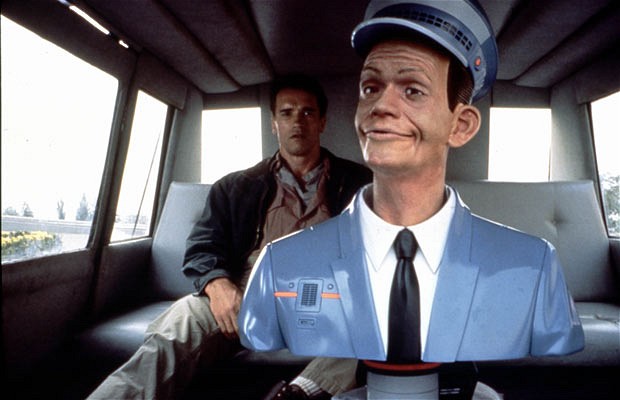
Quaid/Hauser (Arnold Schwarzenegger) takes a ride in a Johnny Cab in TOTAL RECALL. TriStar Pictures, 1990.

Both Verhoeven and Cameron have demonstrated a passion for the SF genre and world-building detail (my favorite in TOTAL RECALL was the Johnny Cabs, which even in 1990 provided a charming anachronistic poke at what the future likely won’t be). They also share a flair for offhanded satire and sleekly complex executions of muscular action scenes. However, Verhoeven had something Cameron lacked – a penchant for perversity. Perversity is what Arnie’s films always seemed to want to wallow in but were generally too timid to indulge. In T2, Cameron’s only perversity was to make the most violent pacifist film in history. TOTAL RECALL is much more deeply, cooly, sicko.

To call the violence gratuitous is like calling water wet, but Verhoeven showed a gift for an over-the-top comic-book harmlessness that camouflaged all but a whiff of the film’s obsessive sadism. He’d done it before, with ROBOCOP, but the movie was more serious-minded, more humanistic, and modestly more restrained. He did it after, in STARSHIP TROOPERS, but that film demanded something more serious-minded and humanistic than Verhoeven could pull off that week, so the balance was thrown off. TROOPERS ended up seeming uglier and meaner than this film, even though if you’re actually paying attention to its moral underpinnings, TOTAL RECALL should’ve been the more condemnable. TOTAL RECALL’s ability to make such unrestrained venality seem man-child-friendly is probably why it’s the most fondly remembered of the three (that, and it wasn’t demeaned by crappy sequels, but I’ll come back to the whole story behind that later).

Misty Watercolor Memories  of the Way We Weren’t

Arnie plays the improbable everyman, Douglas Quaid – who has too good a body, with too breathtakingly beautiful a wife, too fabulous an apartment, in too clean a city – to be what we are told he is: a construction worker. But he’s dissatisfied and distracted by vivid dreams of the planet Mars, so he goes to the movies and watches a fantasy about a James-Bond-type secret agent on the Red Planet. Except that this is the future, and instead of passively sitting in theater seats as we sad contemporaries do, he goes to the offices of Rekal Inc. and purchases elaborate fictional memories that are implanted in his head, so he can experience the fantasy as if it were real.

As they said on the poster to another SF classic, and nothing can go wrong…go wrong…go wrong…
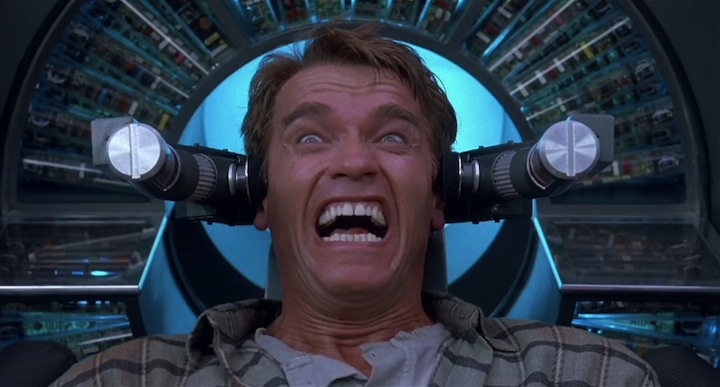
Arnold goes to movies, Rekal-style! TriStar Pictures, 1990.

Nothing except maybe the fictional memories are too similar to real ones that have been deliberately, artificially, locked somewhere in Quaid’s subconscious where he can’t get them. The entertainment technology partially opens the doors of perception, and Quaid is now in touch with another identity, a real-but-forgotten self named Hauser, who actually is a James-Bond-type secret agent. Now that Quaid’s somewhat awake, of course, the bad guys want him dead. Quaid, the innocent, receives prerecorded instructions from his alter-self Hauser, and actually makes the trip to Mars to discover the truth about his identity and the conspiracy in which he’s all wrapped up.

Or alternately, Quaid’s still in the fantasy, suffering from something called a schizoid embolism, and the longer he plays out the fantasy scenario, the harder it will be to get back to the real world.

A Short and Clever Tale by Philip K. Dick Gets Bigger, Bolder

TOTAL RECALL is a loose adaptation of Philip K. Dick’s short story, “We Can Remember It for You Wholesale.” It preserves Dick’s main themes remarkably well, but in making a bigger, bolder, epic out of the short and clever tale, it shifts emphasis. Both film and story have great fun with the “is-it-real-or-is-it-not?” theme, but the always tortured Dick was more interested in the vulnerability and terror of middle-ground between the two, while here the script writers (there were five, but primarily Ronald Shusett and Dan O’Bannon) and even more Verhoeven, focus on a he-man liberation from all moral constraints that only a wholly invented world can secure. The first terrible revelation to our hero comes when his wife admits she never really loved him, saying: “Sorry Quaid, your whole life is just a dream.” But in truth, he really doesn’t start enjoying himself until the curtains fall on that reality, as lifted on the newer, nastier, one.

Most of Verhoeven’s films speak of a man who longs for such a venue. ROBOCOP is the only one I can think of that was convincingly moralistic; most don’t even try. His cynicism about human nature is demonstrated even before the plot gets rolling. There’s a scene where Quaid’s impossibly beautiful wife, Lori (Sharon Stone) is coming on to him, kissing him and literally climbing on top of him, but he can’t take his eyes off the TV news. He’s mesmerized by a politely fanatical speech by Vilos Cohaagen (Ronny Cox), Mars’ wicked, corporate, planetary emperor, who is condemning a violent insurrection by vile mutants on Mars. It’s a typical Verhoeven scene, with no faith in love or relationship and insisting that all our familiar pleasures will become insufferable because of their familiarity, that we are constantly driven to the edge by our desire for newer, more terrible sensations.
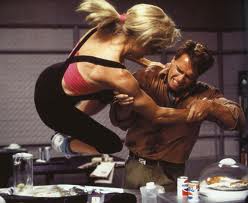
Divorce TOTAL RECALL-style. Sharon Stone and Arnold Schwarzenegger in TOTAL RECALL. TriStar Pictures, 1990.

There’s also a lot of foreshadowing in this scene. Quaid’s distraction is honest, but Lori’s bitch-in-heat behavior is as fake as a whore’s orgasm, which, in a very convoluted way, it will turn out to be exactly what she is.We’ll also soon learn that everything is really about Cohaagen.

Verhoeven’s politics are disingenuously leftist and perfectly in tune with the twilight of Reaganism. Though the real-world Arnie would eventually become the wholly incompetent Republican Governor of California, his fictional counterpart would prove to be a liberator of the proletariat from the shackles of capitalism and display such a soulless penchant for terrorististic, mass-murdering virtue that he makes Che Guevara look like Mitt Romney. However, while the film’s manifesto is anti-corporate-hegemony and pro-labor, its heart is materialistic and misogynistic, an ideology where sex means nothing without dominating power, and dominating power isn’t sexy unless it’s brutally corrupt.

A mere 12 months later, when Arnie would return in T2, we were already in a more innocent era, anticipating Bill Clinton and a decade so honest, sincere, and without sin that even something as trivial as a blow-job could blow-up into a constitutional crisis.

Sophisticated SF Narrative Vs. Special Effects

The script of TOTAL RECALL is remarkably information dense. Though almost every shot seems to embody some sort of special effect, smart writing trumps the spectacle in many places. In several instances, characters get trapped outside Mars’ artificial environments, and the so-thin-it-is-almost-non-existent Martian atmosphere does the predictable nastiness to their bodies (predictable, but not especially scientifically accurate). These scenes featured eye-bulging, artery-bursting, FX dummies that were just plain silly-looking. On the other hand, in a dialogue-driven scene, Dr. Edgemar (Roy Brocksmith) tries to talk Quaid down from his delusion (“You’re not here, and neither am I”) – unless it’s not a delusion and the good doctor is trying to poison him. That scene proves to be one of the high points of the film.
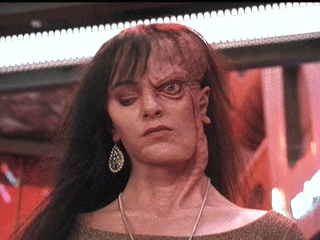
Mutant Mother (Monica Steuer) in TOTAL RECALL. TriStar Pictures, 1990

And the narrative evolves in a sophisticated way, changing venues and accumulating characters that set motivation on a path of constant evolution. Quaid starts only wanting to know who he really is and how to stay alive. This quest leads him into a situation where he needs to take on the mantel of the leader of the revolution. Cohaagen’s abuse of workers in Mars’ artificial environments has produced a spectacular underclass of weird mutants including dwarves, co-joined twins, those disfigured by tumors, those sporting extra-limbs, the telepathic, and most memorably a whore named Mary (more about her later). Quaid will forget self-preservation and fight to end Cohaagen’s monopoly over resources that should be shared collectively by these huddled masses. Each step towards messianic-pseudo-Marxist-leadership is also a step closer to the secrets of his forgotten identity.

Without doubt, Verhoeven can do plot. It’s appropriately twisty, or as another review put it, “There are so many of them, you could probably miss one or two and grab another box of popcorn.”  But Verhoeven skillfully avoids tripping over his own threads.

Strong Casting for a Sci-Fi Film

Verhoeven is slick – but not without thought; soulless – but not without character. In fact, Verhoeven has a fine track record of drawing strong performances from actors playing very artificial parts. Arnold Schwarzenegger is the case in point. Never an accomplished actor, he rarely did more than use jokes to cover his inability to emote, but he still had tremendous screen presence. He could sell a Superman the way more talented thespians couldn’t. Here, almost shockingly, he even displays a very modest hint of semi-nuance that is lacking in any of his other roles except, well, T2. Underneath his “Superman” persona, he’s confused and frightened and vulnerable, a man betrayed by the structure of reality itself. “Who da hell em I?” says Quaid in a thick, heart-tugging, unaffected accent.

It helps that the rest of the cast is so very strong.
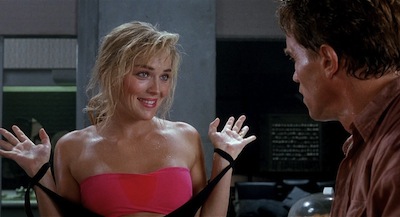
Lori (Sharon Stone) can be such a tease. TOTAL RECALL, TriStar Pictures, 1990.

Sharon Stone’s film career was already a decade old at this point, meaning that it was very likely nearing its end since her primary selling points were that she was beautiful and blonde. Though in IRRECONCILABLE DIFFERENCES (1984), she demonstrated she was a gifted comic actress, no one seemed to notice, and she couldn’t elevate herself out of B (or C) movies and TV mediocrity. Here, her role was not only small, but exploitive and nasty – a lying lynx who offers sex, then tries to kill, then comes back an hour later and tries to kill again, gets in a cat-fight with another sexy whore, then gets dead. Yet absolutely every man was blown away by her ice-cold, predatory athleticism and tight-fitting and barely present wardrobe.

Verhoeven, who likes to use the same people both in front and behind the camera in film after film (TOTAL RECALL is ripe with ROBOCOP alumni) later gave her the lead in BASIC INSTINCT (1992), which was even sicker than this puppy, and overnight she achieved her long overdue super-stardom. She’d leave roles like this behind quickly (and in the process garner 13 awards and 20 nominations, including an Oscar nod), but there was a moment when she was the definition of the Hollywood Ice-Princess reborn and that moment started here.
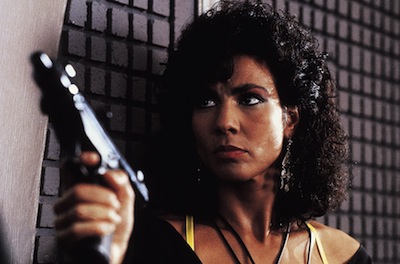
Kickass Melina (Rachel Ticothin) is far better suited to Arnold Schwarenegger's action hero in TOTAL RECALL. TriStar Pictures, 1990.

Rachel Ticotin played Melina, the female romantic lead and other participant in the hot-and-bothered cat-fight with Sharon Stone. Her prescription, per the “Rekal” fantasy that Quaid dictated in the film’s opening scenes, was to be “dark-haired, athletic, sleazy and demure.” She pulled it off perfectly, notably being convincing while speaking the most lunatic romantic dialogue in history. In her first scene, she grabs Quaid’s crotch and hisses, “What have you been feeding this?” To which Quaid, more Hauser by the minute, quips, “Blondes.” Her luminous smile in response is as close to true love as you’ll ever see in a Verhoeven film. Up to a point, she’s as a perfect Verhoeven girl as Stone, one part empowered/two parts vice/seven parts objectified. But unlike Stone, he won’t use her again, possibly because she comes off a few degrees more real, and many times more street, than Stone’s (then) Ice-Princess persona. Perhaps she was not quite artificial enough for Verhoeven’s exquisitely surfacy aesthetics.

Ronny Cox wasn’t the first choice for Cohaagen. It was offered to Kurtwood Smith, who, with Cox, played one of the two main villains in ROBOCOP. Though the lion’s share of Cox’s roles are warm, noble and paternalistic, he clearly enjoyed the corporate baddies Verhoeven repeatedly cast him as. In this film, he and Michael Ironside are the two main villains. In obvious deference to Arnie’s acting talents, these two, not the hero, got the film’s few dramatic scenes.

Neat Ideas and Savage Candy

But enough about human talent in a film so inhumane, TOTAL RECALL was all about neat ideas and savage candy. The highlights:

  • In a plot point early on,Quaid has a tracking device in his head. The recorded Hauser tells him how to remove it – Reach into your nose with tweezers and pull really hard and really painfully. Rated high on the ICK! Factor.
  • There are endless, loud shoot-outs with big-assed automatic weapons plus explosives, both inappropriate choices in a pressurized environment. These conflicts justified the frequency of sucking people into the Martian near-vacuum which then justified the close-ups of the forementioned, eye-bulging, rubber FX dummies. It also justified the extreme body count; one review counted (yes, some reviewers sit in front of their TVs  and actually count this stuff) 77 dead bad guys. And that’s onlythe bad guys. The film showed rare indifference to the lives of innocent bystanders. It likely had an even higher collateral damage rate than the invasions of Grenada and Panama combined. The most memorable of these was during a shootout on an escalator, when cornered Arnie grabs some poor, random, commuter and uses him as a human shield. That guy gets reduced to Swiss cheese, and Arnie goes off to continue his one-man-war against wicked corporatism
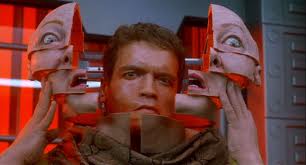
    The Fat Lady loses her head and reveals Arnold Schwarenegger in TOTAL RECALL. TriStar Pictures, 1990.

  • Literally the only female in the film who is not a whore is a disgustingly obese tourist arriving at the Mars Spaceport inanely saying “Two weeks” over and over. Except she isn’t even a woman, but a cybernetic fat suit that malfunctions. In the eyeball-kick heavy film, the single best effect is the costume coming apart like a high-tech flower blossoming, revealing Quaid beneath. Quaid then throws the lady-head at a cop. The head speaks a snappy line and explodes, killing at least three people.
  • The dispatching of Sharon Stone is the stuff of woman-despising-legend. After Ms. Stone engages in three fights in five minutes, she’s prone helplessly before Arnie and pleading for her life. “We’re married,” she says. Arnie snickers, “Conseeder dis a divorce,” and machine-guns her.
  • Arnie has many such bloodthirsty quips. In one scene, he dispatches another friend who betrayed him with a miner’s hydraulic drill to the gut, gleefully shouting, “Screw you!”
  • Mary the whore with the three tits, every fanboy's fantasy in TOTAL RECALL. TriStar Pictures, 1990.

    And let’s not forget Lycia Naff, who has the smallest of parts, but secured much of the film’s fame. She played a whore (what else) named Mary who was in only two scenes, totaling less than four lines of dialogue, and exposed her breasts to strangers both times. Yet ask any man who was an adolescent in 1990 if he remembers the film, and he’ll no doubt answer, “Yeah, that’s the one with the chick with three boobies.” (If you watch the DVD version, don’t miss out on the commentary track where Verhoeven nobly attempts to intellectualize the triceratits). Mary is killed by Michael Ironside’s character Richter in a manner that is both callous and sexually demeaning.

  • Richter gets his comeuppance in a fistfight on an elevator platform. He loses his balance, falls, saves himself by grabbing the edge—until the platform rises to the next floor, cutting both of his arms off, leaving his forearms with Arnie as souvenirs. And of course, the noble hero calls to the falling man, “See you at the party, Richter!”

And I should say, this is only the sickness we got AFTER the film was cut to avoid an X-Rating. God knows what the unrestrained version looked like.

All this mayhem and no real people does eventually take its toll. There’s no denying the last third is warmed-over and derivative. For a movie that had delivered so many surprises both in plot and inventive detail, the routine conclusion is banal, protracted, idiocy. Arnie/Quaid/Hauser’s saving all the good people of the planet is logically feasible only to some schmuck who also ascribes to Young-Earth Creationism. But if you pay close attention though the explosions and thunderous score (by Jerry Goldsmith, who considers it one of his personal favorites), plenty of clues suggest on which side over the what-is-reality fence you should be standing and that the seeming dopiness of the last several minutes might actually be meta-fiction Easter egging.

The Sequel That Never Was or Was It? And the Remake That Shouldn’t Have Been

TOTAL RECALL grossed almost 100 million over budget outlay, so why wasn’t there a sequel? Well…

There was supposed to be. The idea was to take another Dick story as the launching point and tell the tale of Quaid getting in trouble with authorities again. You see, properly integrated in society, those telepathic mutants are useful. They can bring down the homicide rate by solving crimes and punishing the guilty before the killing even takes place.

Does this plot sound somewhat familiar?

With Verhoeven returning to the Netherlands after a string of commercial disappointments (starting with 1995’s SHOWGIRLS, perhaps the most sexually exploitive and misogynistic feminist film in history) and Arnie entering politics by the end of that decade, the project proceeded without them. It mutated into something unrecognizable and was released in 2004 as MINORITY REPORT. The script by Scott Frank and Jon Cohen was tight and hugely ambitious, the film was beautifully directed by Steven Spielberg, and Tom Cruise is simply a more talented lead. Yet the greater film did not burn into our collective memory the way TOTAL RECALL did.

TOTAL RECALL’s place in our culture was probably additionally secured by how it towered over its ill-conceived remake of last year. That stared Colin Farrell who is clearly a better actor than Arnie, but does not have as much charisma. Overall the characterization is flatter than the original, odd given how the original was almost smug about its lack of character depth. This new movie sold itself as “darker,” but that wasn’t really accurate. What they really meant to say was that it was humorless, and the violence, now mostly committed against robots, was heavily sanitized. The politics in the original was disingenuous, but also bolder in its relationship to real-world class conflict. In the remake, the good-guys vs bad-guys is a more nationalistic battle modeled on the aggressive wars of 19th century imperialism and Australia’s struggles with the British Commonwealth; thus it is far more nostalgic and far less provocative. It’s also wholly Earth-bound, losing the original story’s dreams of Mars and the first film’s Mars locations. The remake also ditches every single mutant except the “chick with three boobies,” who now has little explanation for being there. No aliens either – I didn’t mention them above, but aliens were important in both the original story and the first film. The $125 million dollar budget, adjusted for inflation, was really not much more than the 1990 release, but the movie grossed a mere $199 million, or less than half the original film’s inflation-adjusted business.

Robert Emmett Murphy Jr. is 47 years old and lives in New York City. Formerly employed, he now has plenty of time to write about movies and books and play with his cats.

Category: Retro Review | Tags: , , , , , , , , , , , , , , , , , , , , , , , , , , , , , , , , , , , , , , , , , , , , , , , , , , , , , ,

Retro Review: Sometimes Filth Can Be Divine! PINK FLAMINGOS Nest at Blast-Off Burlesque’s TABOO-LA-LA at the Plaza Theatre!

Posted on: May 30th, 2013 By:

Blast-Off Burlesque’s TABOO-LA-LA presents PINK FLAMINGOS (1972); Dir. John Waters; Starring Divine, Mink Stole, David Lochary, Cookie Mueller, Edith Massey, Danny Mills and Mary Vivian Pearce; Saturday, June 1 pre-show entertainment starts @ 9:00 p.m.; Plaza Theatre; Ages 18+ only; Tickets $12; Trailer here.

By Aleck Bennett
Contributing Writer

It’s time once again to push across the boundaries of good taste and delve head-first into the outré, the out-of-bounds and the delightfully wrong as Blast-Off Burlesque and the Plaza Theatre bring us another heaping helping of TABOO-LA-LA!

This is it. The film that put John Waters and Divine on the map. The film that made Baltimore famous. The filthiest film in the world. PINK FLAMINGOS.

It’s crude, it’s angry and it wants to rub you the wrong way. It wants to offend you. It wants to provoke you. It wants to push you face-down in the ugliness that lurks just under the surface of everything and laugh at you. It will poke you with a stick. And you don’t know where that stick’s been.

All that, and it’s hilarious to boot.

“I’m all dressed up, and I’m ready to fall in love!” – Divine / Babs Johnson

The entire film is centered on the fact that Divine (played by Divine, as only she could), who is living under the alias of “Babs Johnson,” has been named the Filthiest Person Alive. This angers her arch-nemeses, Connie and Raymond Marble (Mink Stole and David Lochary). The Marbles are running an entire criminal empire entirely dedicated to being filthy. They force their gay servant Channing to artificially inseminate kidnapped women. They then sell the babies to lesbian couples. Then, the money they make from their black market baby ring is used to push heroin to elementary school students and fund their chain of pornography shops. Meanwhile, Raymond has a nice sideline going in flashing unsuspecting females and then stealing their purses. Understandably, the Marbles think that they are more deserving of this major award, so they set out to destroy Divine and unwittingly start a war that can only end in the destruction of all life on this planet. Or at least the lives of a few people in the Maryland boondocks.

PINK FLAMINGOS' Egg Lady (Edith Massey).

PINK FLAMINGOS takes the unusual step of making its heroine someone who has no moral qualms with killing anybody or everybody who dares look at her the wrong way. Someone whose raison d’être is summed up in the quote “Kill everyone now! Condone first degree murder! Advocate cannibalism! Eat shit! Filth is my politics! Filth is my life!” Divine is not just an anti-heroine, but an anti-human. You are dared to root for her, and you acquiesce because you fear that she may hack you to pieces with an axe for not doing so.

From a sex scene in which a live chicken is crushed to death to an orgy of oral sex spurred on by licking furniture; from one woman’s insatiable love of eggs to an anal sphincter singing Surfin’ Bird; from a trailer fire to, yes, the actual on-screen consumption of dog shit…PINK FLAMINGOS is not for the weak of heart, stomach, mind or constitution.

This was John Waters’ third feature film after MONDO TRASHO and MULTIPLE MANIACS, and featured his much-beloved Dreamland Productions ensemble. To get a handle on the Dreamlanders’ retro-trash aesthetic, imagine the B-52’s if they’d joined the Manson Family. Driven largely by a lack of money and a surplus of a camp sense of flash, their thrift store style was cemented by the Baltimoreans’ shared memories of the city back when it was the hairdo capitol of the world, and their sensibility shaped by Waters’ fascination with those who live outside the law. The Dreamlanders’ performances are all perfect. They exist beyond criticism. There’s nothing natural about them, but there’s nothing natural about the characters either, so who are we to judge? And while it’s not Waters’ most technically proficient film, its raw and blunt stylistic approach is the only thing suitable to capture the intense taboo-shattering of the subject matter. Anything prettier would take away from the transgressive attitude on display. And, quite literally, you can’t polish a turd…

Divine archnemeses Connie and Raymond Marble (Mink Stole and David Lochary).

Did I just say “taboo-shattering?” Because that’s what TABOO-LA-LA is about. And as such, this film practically screams to be shown. Because as transgressive and deliberately offensive as this film is, it’s also unbelievably positive. Remember, this was a mere three years after the Stonewall riots, where drag queens, lesbians and poverty-stricken gay street kids were on the front line against armed squadrons representing a society that would rather beat them down. In the wake of this, John Waters dared to turn a drag queen named Divine into a larger-than-life symbol of rebellion against anyone who’d dare take away anything that she claimed as hers. And in becoming the Goddess of Bad Taste, Divine was almost saying, “so you think all of us outsiders—drag queens, lesbians and gay men—are disgusting? Let me show you what disgusting really is, you prigs.”

It’s not just a fist in the face of a world that deserves it. It’s a celebration.

And it’s a celebration that Blast-Off Burlesque and TABOO-LA-LA are fully prepared to bring off the screen and into your faces. Enjoy complimentary cocktails in the lobby starting at 9 p.m.! A titillating live stage show featuring Blast-Off Burlesque, Baby-Doll and Poly Sorbate! A Filthy Fashion Contest and Sexy Doggie-Doo Eating Contest with prizes provided by Libertine and Cherry Blossom Salon! A raffle for PINK FLAMINGOS artwork by Zteven! And then, AS IF THAT WASN’T ENOUGH, the movie itself! How can you NOT go? If you decide to go anywhere else, know that I and my gang of fellow filth fanatics will sneak into your home and lick your furniture so that it will reject you when you return.

Now, if you’ll excuse me, I’ve got some hard-boiled eggs to eat.

Aleck Bennett is a writer, blogger, pug warden, pop culture enthusiast, raconteur and bon vivant from the greater Atlanta area. Visit his blog atdoctorsardonicus.wordpress.com

Category: Retro Review | Tags: , , , , , , , , , , , , , , , , , , , , , , , , , , , , ,

Retro Review: Shatner and Borgnine Give Satan His Due: THE DEVIL’S RAIN Will Fall on the 11th Annual Rock & Roll Monster Bash!

Posted on: May 28th, 2013 By:

Rock & Roll Monster Bash presents THE DEVIL’S RAIN (1975); Dir. Robert Fuest; Starring William Shatner, Ernest Borgnine, Ida Lupino, Eddie Albert, Tom Skerritt, Keenan Wynn and Joan Prather; Sunday, June 2; Starlight Six Drive-In; Buy tickets here. Trailer here.

By Aleck Bennett
Contributing Writer

It’s Rock & Roll Monster Bashin’ time, kiddiwinkies! And if you’ve spent all day celebrating at the Starlight Six Drive-In, there’s no better way to cap off the night than with a double-bill of diabolical delights. And it doesn’t get more diabolical or delightful than THE DEVIL’S RAIN.

Okay, I’m biased. Let’s get that straight from the start. Around my house, if there’s a movie made in the ‘60s or ‘70s about a bunch of folks worshipping Our Downstairs Neighbor, I’m giving that sucker the benefit of the doubt. And likewise, if your name is Robert Fuest, and you’ve directed a movie about anything, I’m giving that sucker the benefit of the doubt.

This is why it’s constantly puzzled me that folks give THE DEVIL’S RAIN such short shrift. Even in the limited genre that is Satanic Cinema of the Sixties and Seventies, it gets relatively little love. And I’m not talking about pitting its reputation against that of established classics like ROSEMARY’S BABY. I’m talking stuff like THE BROTHERHOOD OF SATAN, THE WITCHMAKER, BEYOND THE DOOR, ALUCARDA, and on and on and on. I mean, sure, huge chunks of the movie don’t make a lick of sense. But that’s never stood in the way of a film building up a cult following.

Partially, I think it’s got to have something to do with the prevailing notion that anything touched by the Hand of Shatner outside of the STAR TREK franchise is somehow shameful at worst, and best appreciated as camp at best. And maybe it’s got something to do with so much of the cast being composed of actors either well past their prime and heading for the Irwin Allen Disaster Movie Retirement Home (Ida Lupino, Keenan Wynn, Eddie Albert) or so early on in their careers that they don’t make much impact (Tom Skerritt, John Travolta). Maybe it’s because Ernest Borgnine spends most of the movie going so over-the-top that you can’t see bottom anymore. Maybe it’s because the movie’s promotional tagline is so grammatically incorrect that I’ve been trying to decipher it for decades (“Heaven help us all when…The Devil’s Rain!” Huh? When the Devil’s Rain does what? Are you trying to say “when the Devils rain?” or “when the Devils reign?” Are you confusing your plurals and possessives?)

Or maybe it’s because some people don’t like to have fun, for crying out loud. Because this is one fun movie.

Re-hashing the plot won’t help anybody, so I’ll just say this: Ernest Borgnine is the reincarnation of a devil-worshipping warlock burned at the stake long ago, and he’s back (and holed up in a church in the desert) to obtain a book kept hidden over these many years by William Shatner’s family. There’s a Snowglobe of the Damned called “The Devil’s Rain” that contains the souls of those Borgnine has ensnared. There’s some pseudo-scientific gobbeldy-gook about ESP that brings Shatner’s extended family of Tom Skerritt, Eddie Albert and Joan Prather into the mix. There are flashbacks to the burnings. There are lots of folks in black robes with no eyes (including John Travolta) running around doing Borgnine’s bidding. And maybe they’re made of wax or something because they all tend to melt.

Like I said: big chunks that don’t make a lick of sense.

Ernest Borgnine in THE DEVIL'S RAIN.

But what works in this movie, works like crazy. Fuest’s direction is—as always—stylish and visually fascinating. Don’t forget, this is the guy who directed THE ABOMINABLE DR. PHIBES and DR. PHIBES RISES AGAIN, the Michael Moorcock adaptation THE FINAL PROGRAMME (aka THE LAST DAYS OF MAN ON EARTH) and numerous episodes of THE AVENGERS. The guy’s got flash if he’s got anything. There’s a prevailing sense of dread cast over the entire film from its opening frames, with the stage being set by the opening titles presented over the hellishly hallucinatory artwork of Hieronymus Bosch. There’s the unique in media res opening that delivers the sense that we’ve been dropped into the movie after its first reel, leaving the audience disoriented as they try to piece together what’s happening. There’s Ernest Borgnine invoking the spirit of Satan and turning into a Baphomet-headed beast. There’s the presence of the High Priest of the Church of Satan, Anton Szandor LaVey (ANTON FREAKIN’ LAVEY, people!) as both the film’s technical advisor and Borgnine’s High Priest, playing the pipe organ and sporting a diabolically groovy helmet for some reason. There’s fantastic makeup work from Ellis Burman, Jr. There’s an insanely great score by Al De Lory. And it ends exactly like it ought to end.

Let me say this: if this movie had been made in Italy, the horror community at large would be salivating over THE DEVIL’S RAIN like it was Edwige Fenech in STRIP NUDE FOR YOUR KILLER (Italian exploitation fans represent!). But because of its familiarity—being ever-present on late-night TV, the drive-in circuit and relatively easy to get on home video through the years—it’s easily overlooked. Don’t make this mistake, dear readers! This movie deserves a re-evaluation and a re-appreciation. Much like Shatner’s career has developed a post-TREK rehabilitation, we should go back and give the Devil his due.

Aleck Bennett is a writer, blogger, pug warden, pop culture enthusiast, raconteur and bon vivant from the greater Atlanta area. Visit his blog atdoctorsardonicus.wordpress.com

Category: Retro Review | Tags: , , , , , , , , , , , , , , , , , , , , , , , , , , , , , , , , , , , , , ,

Retro Review: A Funny Thing Happened on the Way to the Cabin in the Woods: EVIL DEAD 2 Is a Vicious, Nasty, Bloody, Frightening and Smart Movie!

Posted on: May 28th, 2013 By:

Rock & Roll Monster Bash presents EVIL DEAD 2 (1987); Dir. Sam Raimi; Starring Bruce Campbell, Sarah Berry and Dan Hicks; Sunday, June 2; Starlight Six Drive-In; Buy tickets here; Trailer here.

By Aleck Bennett
Contributing Writer

It’s Rock & Roll Monster Bashin’ time, ladies and gents! And if you’ve spent all day celebrating at the Starlight Six Drive-In, there’s no better way to cap off the night than with a double-bill of fright featuring folks messing around with books they ought not be messin’ around with. And they don’t come any better than Sam Raimi’s EVIL DEAD 2.

It was 1983 and I had started sailing awkwardly into teenagerhood. FAMOUS MONSTERS OF FILMLAND was on the verge of closing up shop, and I had been steadily supplementing my reading material with FANGORIA. A video rental store named Video Land had just opened up in town to provide stiff competition to the local movie house (the Royal Rocking Chair Cinema), and my main after-school preoccupation was scouring the shelves of the horror section to rent whatever I hadn’t seen yet. And one day, there it was: the Thorn/EMI plastic clamshell case for THE EVIL DEAD. In the coming years, I must have paid for half of Video Land’s entire inventory just from renting that movie over and over again. It was mindblowing. Just a vicious, nasty, bloody, frightening and smart movie—not just script-wise, but so audacious visually that it was like few things I’d seen to that point.

So when FANGO started reporting that Sam Raimi was teaming back up with Bruce Campbell to make EVIL DEAD 2, I was rabid. And then, the Royal put up the poster for it as a coming attraction. I pestered the hell out of the people running the place about when they were going to get it, and every time, they’d say “soon.” Maybe it would be that they were holding over that week’s show. Or maybe it would be that a big release was coming in the next week that they had to run instead. But every time, something different. And they must have had that poster up for a year. Like they were doing it out of spite, just to taunt me or something.

So, like so many others like me who were living out in the pits of Nowheresvilles all across the country, I had to wait for it to come out on video to see it. And when I finally got my grubby mitts on it…it was a comedy?

Because how can you follow up a movie whose own closing credits describe it as “the ultimate experience in grueling terror?” By piling on the excesses of the first until it becomes so overloaded with the wacky that it collapses in hysterics. (And by describing the result in its closing credits as “the sequel to the ultimate experience in grueling terror.”) Where the first film was visually inventive, this took every lesson learned from that first movie and asked the question, “how can we do this BIGGER?” If THE EVIL DEAD used the whip pan as a stylistic device, let’s do everything in whip pans. Lots of blood all over the place in the first movie? Let’s shoot it out of fire hoses at Bruce Campbell. The first movie has Bruce wielding a chainsaw? Let’s give Bruce a chainsaw for a hand! The first film has violence so over-the-top that it borders on the absurd? Let’s demonstrate that Bruce Campbell is an incredibly agile physical comedian and have him beat the living daylights out of himself with everything but the kitchen sink, like he’s both Moe and Curly trapped inside the same body.

Groovy.

This became my new gospel. I’d sit and pick over the minutiae of this movie like I was in seminary and this was the Codex Sinaiticus. Like I was Wilbur Whateley poring over my John Dee translation of the NECRONOMICON. This was now part of my personal canon, alongside THE BRIDE OF FRANKENSTEIN, THE TEXAS CHAIN SAW MASSACRE or…well…THE EVIL DEAD.

Capsule recap: Ash Williams and his girlfriend Linda head out to a secluded cabin for a quiet getaway. Ash plays a tape recording found which was made by the professor staying there previously, and which contains translations of the bound-in-flesh NECRONOMICON EX MORTIS (which was also found in the cabin). It summons up evil forces from beyond that possess Linda, Ash, his hand, and soon threaten to possess the people heading to the cabin, mistakenly believing that they’re meeting the now-late professor.

Bruce Campbell in EVIL DEAD 2.

There are few sequels that are better than the first movie. You can probably count them on your fingers. Both hands, if you’re feeling generous. You know it. I know it. More importantly, Sam Raimi knew it. He knew that since the first film was celebrated as a straight-up horror movie, that the second movie could only disappoint in comparison. So he made a different movie. A movie that didn’t even try to do what the first one did so well, but aimed for something he knew he could pull off: the first splatstick comedy. I mean, Sam Raimi had never wanted to be just a horror film director anyway; he just saw horror as an easy way to get his foot in the door. Most of his own short films were comedies, and he had followed up THE EVIL DEAD with an attempt to make a live-action LOONEY TUNES / Tex Avery-styled comedy in collaboration with Joel and Ethan Coen, CRIMEWAVE. That it flopped seemed to only strengthen his resolve to take a bigger risk by making EVIL DEAD 2 a comedy.

And it worked. Oh, man, how it worked. It quickly became the MONTY PYTHON AND THE HOLY GRAIL for the horror geek scene. Whereas the first film presented Bruce Campbell as Ash, a likeably bland lead, this movie established Bruce Campbell in my mind (and that of anyone else who saw it) as Bruce Campbell, Movie God. This was the movie where he finally came into his own, delivering a tour de force performance that would have killed a lesser man to give. And the guts of Raimi to essentially condense the entire first movie into the first half-hour of the second, retelling it and streamlining it (removing any character other than Ash and his girlfriend Linda). It was like Raimi explicitly saying, “this is not that movie. This is a whole different thing.” The only thing about the movie that suffers is the collective performances of the secondary cast members, which are generally either a little too broad or a little too wooden. But it’s hard to really judge them because they are unfortunately cast alongside the marvel that is BRUCE F’ING CAMPBELL. Olivier might have suffered in comparison. (We’ll never know. He wisely stayed away, and never suffered those slings and arrows, the coward.)

Some movies are fun. Some of those movies are described as “a roller coaster ride.” EVIL DEAD 2 is like Disneyland riding a roller coaster through Knott’s Scary Farm while the Ramones are playing on top of a blood-filled Splash Mountain. Strap in, kids, because it’s gonna get MESSY.

Aleck Bennett is a writer, blogger, pug warden, pop culture enthusiast, raconteur and bon vivant from the greater Atlanta area. Visit his blog atdoctorsardonicus.wordpress.com

Category: Retro Review | Tags: , , , , , , , , , , , , , , , , , , , , , , , , , , , , , , , ,

Retro Review: RAGING BULL, the Best Film of the 80s, Hits the Big Screen at the Plaza

Posted on: May 25th, 2013 By:

RAGING BULL (1980); Dir. Martin Scorsese; Starring Robert DeNiro, Cathy Moriarty, Joe Pesci; Starts Friday, May 24 @Plaza Theatre (visit website for ticket prices and showtimes); Trailer here.

By Andrew Kemp
Contributing Writer

When surveying the scope of American cinema history, some film lovers find it easy to overlook the 1980s. Sandwiched between the artistic heights of the New Hollywood 70s and the indie revolution of the 90s, the “decade of greed” suffers from a film reputation as a cocaine-crusted tangent into corporate excess, amounting to little more than a pile of moribund slashers, musclebound war films, and cringe-worthy sex comedies that schemed to push art aside to make way for unchecked corporate commerce. The notion doesn’t stand up to scrutiny—not least because so many of the so-called corporate blockbusters managed to find artistic merit of their own—and film lovers hoping to find the one, definitive killer app of the decade need look no further than its very first year, when Martin Scorsese delivered not only the best film of the 80s, but one of the best American films ever made, the 1980 boxing drama RAGING BULL, which starts a full revival run tonight at the Plaza Theatre.

Don’t care for sports movies? That’s fine, because neither does Martin Scorsese, which is why RAGING BULL is a boxing movie like JAWS is a story about a fish. Based on middleweight Jake LaMotta’s memoirs, the film stars Robert DeNiro as the troubled boxer whose brutal, battering ring style was just an extension of his destructive personality. Even as his career rises in the ring, LaMotta’s terrifying temper and insecurity chip away at his sanity and create rifts between the boxer and the people he cares about, including his wife, Vicky (Cathy Moriarty), and his devoted brother Joey (Joe Pesci, in the role that made him famous). Beautifully shot in black and white, RAGING BULL is as much about madness as it is fighting, and Scorsese’s virtuoso direction finds poetry in the violence and makes a tragic hero out of a man who in a lesser film would be a monster, just another paranoid palooka.

Scorsese wasn’t the obvious choice to guide RAGING BULL to the screen, having suffered two major strikes against his career in the wake of his 1976 success, TAXI DRIVER. The first strike was a near-fatal overdose of cocaine, but the bigger issue (at least as far as the Hollywood suits were concerned) was the devastating box office failure of NEW YORK NEW YORK (1977), Scorsese’s ode to movie musicals. By most accounts, when DeNiro approached Scorsese with LaMotta’s book, the director initially refused the project, but soon went all-in, convinced it would be the last film he’d ever get to make. He and DeNiro brought in TAXI DRIVER collaborator Paul Schrader to breathe life into the script, and Schrader helped transform LaMotta’s bruised prose into a focused, thoughtful, and even elegant exploration of the inner darkness that can destroy a person or sometimes drive them into greatness. Jake LaMotta was a tortured, violent man, but his demons drove him in the ring just as surely as they ground him to a pulp in his personal life. RAGING BULL is not about a man trying to find a balance between his personal and professional life, but rather a man who can’t distinguish the difference. Jake always sees an opponent, whether there is one or not.

(The film’s most famous image is DeNiro as LaMotta in the ring, warming up. The image says it all—LaMotta is always alone, always preparing to fight.)

That same passion drives Scorsese, who once seriously considered a life as a priest before committing full time to his love of cinema, a love so consuming that it drove him into the extreme lifestyle that nearly killed him. Of course, RAGING BULL would not be the final film of Scorsese’s career, but he couldn’t have known that, and the film plays as if guided by a man who is using every ounce of his considerable talent and every trick in his head, learned from a lifetime of cinematic obsession, to bring the story home. As the film chronicles LaMotta’s struggles with his demons, we feel Scorsese wrestling with his, and the final product is as much a work of redemption for the director as it is the film’s protagonist. The boxing scenes are poetry in motion, all harsh lights and dark blood against light ropes and canvas. Ever the film proselytizer, Scorsese shot RAGING BULL in black and white partly to protest the loss of older color films to shoddy, degrading film stock, but it also lends the boxing scenes a dreamy horror that’s lost in a color film with its red, visceral, and more-immediate gore. Scorsese also plays with time in the ring, taking turns speeding up and slowing down the violence to put the audience in the mindset of the boxers, dismissing the strategy of the athlete and emphasizing the struggles of the man. In one of the film’s most famous sequences, Jake staggers against the ropes taking punches from Sugar Ray Robinson that begin slowly before demolishing Jake at high speed, splattering blood and sweat across his body and shattering his bones, but when the moment is over, all Jake can mumble through the ruins of his face is the line “You never got me down.”

The same phrase applies to the courtship scene between LaMotta and his wife, Vicky, in which Jake treats the interplay and flirtations of young romance like jabs and punches that must be endured to “win.” Jake sets out with a purpose to make Vicky his girl, and no matter what she says, Jake moves the conversation to his apartment, to his bedroom, and beyond, until Vicky is with him and nobody else. Is she unwilling? The scene is ambiguous, but succeeds in establishing Jake’s charm as well as his calm menace. This also applies to the iconic scene with his brother, where DeNiro communicates pure murder and paranoia without any of the usual clichés. It’s a misunderstanding that spirals out of control, a rhyme of Joe Pesci’s similar famous scene from GOODFELLAS (1990) a decade later.

Just look at him!

There are adults alive today who have no idea of the powerhouse Robert DeNiro was at his peak, who may only know him as the grumpy dad in MEET THE PARENTS (2000), or other such dread material. His role in the recent SILVER LININGS PLAYBOOK (2012) was overpraised precisely because it contained just enough of the spark he once brought to his characters to remind reviewers of the actor he once was during this, his artistic peak. DeNiro established his talent in MEAN STREETS (1973) and TAXI DRIVER, but RAGING BULL is a culmination of the actor’s method approach and sees DeNiro gaining a massive, unhealthy amount of weight just to play LaMotta in a few bookending scenes in his older age. There’s shocking, and then there’s transformative, and then there’s this holy shit change. Just look at him.

If I haven’t made it clear yet, RAGING BULL is worth your time. Simply put, it’s one of cinema’s great miracles, a movie that redeemed its director, cemented the legend of its star, and made a marginal book into one of the greatest cinematic spectacles of all time. Scorsese shot the film with a big screen in mind, and no television can properly communicate the stark black and white photography and the pure power of Scorsese’s beautiful compositions. Jake LaMotta may have been a brutal man, but the story of his life is a powerful work of beauty.

Andrew Kemp is a screenwriter and game writer who started talking about movies in 1984 and got stuck that way. He writes at www.thehollywoodprojects.com and hosts a bimonthly screening series of classic films at theaters around Atlanta.


Category: Retro Review | Tags: , , , , , , , ,

Fritz Lang’s METROPOLIS: Fully Restored and Bigger Than Ever in Two Special Atlanta Engagements!

Posted on: May 23rd, 2013 By:

METROPOLIS (1927); Dir. Fritz Lang; Starring Brigitte Helm, Gustav Fröhlich and Alfred Abel; Starts Friday, May 24 @ Plaza Theatre (visit website for ticket prices and showtimes); Tuesday, May 28 @ Woodruff Arts Center (free outdoor screening w/ live accompaniment); Trailer here.

By Aleck Bennett
Contributing Writer

It’s a Fritz Lang kind of Spring, I suppose. That feeling is helped along by two venues showing the most recent restoration of Lang’s pioneering science fiction classic, METROPOLIS, which finally brings the film as close to its original state as possible. The historic Plaza Theatre has booked the film for a full week, and there’s a special outdoor screening of the restoration at Woodruff Arts Center featuring the US debut of a specially-composed score performed live by Georgia Tech’s Sonic Generator.

Last time we talked Fritz Lang, it was about M (1931), the first serial killer-themed horror film. But now, we’re going four years earlier and looking at METROPOLIS, the first feature-length science fiction movie. And in the ensuing years, METROPOLIS continues to be relevant to contemporary life, its themes resonating through the ages as our industrialized society becomes more and more technocratic.

The sprawling plot of METROPOLIS speaks mostly to the topic of class division. In the year 2026, the wealthy preside over the city of Metropolis and lead lives of decadence, while a teeming underclass of workers toil day in and day out, slaves to the machines that provide the power that drives the city above. Freder (Gustav Fröhlich)—the son of Joh Fredersen (Alfred Abel), the city’s aristocratic Master—falls in love with a labor organizer named Maria (Brigitte Helm) and enters the underground city of the workers. There, he just may serve to fulfill the prophesied role of the city’s “heart”: the man who will help Maria unite the workers and join the city’s “hands” (its workers) with its “head” (the ruling aristocracy). But the ruling class has other plans to keep the underclass down: to kidnap Maria and use a robotic doppelganger to sow seeds of discord among the laborers.

Add in a love triangle, espionage, sabotage, disaster, riots, beautiful art deco set design, Biblical references, hints of occultism, expert use of miniatures and pioneering special effects, and not only do you have an epic that presents a morality play and political polemic depicting class struggle with the rhythm of everyday life, but also a bustling action picture designed to keep viewers enthralled with the kind of futuristic grand spectacle not seen on the screen before.

Unfortunately, that balance was largely destroyed by cuts to the film that took place shortly after its premiere. The film was funded and its distribution controlled by a partnership between MGM, Paramount and German film studio UFA, which was known as Parufamet (a portmanteau of the three studios’ names). Parufamet cut the film from its 153-minute running time to 115 minutes, and later that year it was cut down further by UFA to a brief 91 minute running time. Huge chunks of character exposition and plot points were lost completely. This left much of the spectacle but presented seemingly one-dimensional characters inhabiting the film, which only emphasized the heavy-handedness of the film’s message-laden storyline. A film about people and ideas became simply a film about ideas.

Over the decades, numerous attempts at restoration took place using whatever could be found. The high (or low, depending on your stance) point of 20th-century efforts came with the 1984 release of a version compiled by songwriter/producer Giorgio Moroder. Moroder’s restoration was, at that point, the most complete version of the film available, incorporating all footage known to exist at the time. However, the film was tinted throughout, with its intertitles replaced with subtitles for continuity’s sake, with a pop soundtrack (featuring Freddie Mercury, Pat BenatarBonnie Tyler, Adam Ant, Loverboy, etc.) in place of a traditional score and with its frame rate increased to 24 frames per second (which resulted in an artificially-shortened running time of 82 minutes).

In 2002, Kino Lorber and the F.W. Murnau Foundation released a 124-minute restoration that seemed to be the final word on the film, as all remaining footage was believed to have been lost to the ravages of time. Missing footage was described in newly-designed title cards to fill in the blanks. But shortly afterward, film prints were found in New Zealand and Argentina that contained scenes not included in any existing copy. In fact, the Argentine print was a 16mm reduction of the entire original cut of the film. With these new sources in hand, METROPOLIS was restored to 95% completion (only two short sequences could not be included due to extensive damage). Settling on an acceptable frame rate (the actual frame rates of many silent films are hard to determine), and with the additional sequences restored to their rightful places, the final running time of the now-nearly-complete METROPOLIS is 145 minutes.

And those restored scenes restore a coherency and depth to the film that has not been experienced since its premiere some 86 years ago. The character of Freder becomes heroic rather than a cipher. Maria becomes a fully-rounded character rather than an archetype. Sure, the highly stylized acting familiar to German Expressionist silent filmmaking is still present, which may stand as a roadblock to viewers raised on the naturalistic acting of modern cinema, but the operatic tenor of the performances is almost necessary to keep the actors from being overwhelmed by the sheer size and spectacle of the film’s sets and effects (adjusted for inflation, the film’s budget in today’s numbers would be $200 million, making it one of the most expensive movies ever made, equal to James Cameron’s TITANIC). Without the benefit of speech, the sheer BIGNESS of the movie demands performances as visually loud as the sets are huge.

Though the film was panned upon first wide release (in my opinion, largely due to its being butchered and available only in compromised form), METROPOLIS has since become one of the highest-regarded films in existence, with its influence felt in movies ranging from BLADE RUNNER to DR. STRANGELOVE; from STAR WARS to BACK TO THE FUTURE; from DARK CITY to THE FIFTH ELEMENT. Oddly enough, though, it has found more frequent homage in the field of popular music. The music videos for Queen’s Radio Ga Ga,” Nine Inch NailsWe’re in This Together and Madonna’s Express Yourself have all been inspired by the movie’s themes and visuals. Meanwhile, Atlanta’s own Janelle Monáe has released two fantastic concept albums inspired by the film: 2007’s METROPOLIS: SUITE I (THE CHASE) and 2010’s THE ARCHANDROID. (Based on the title, I’m guessing that this year’s upcoming album, THE ELECTRIC LADY, will round out the trilogy.)

For very different experiences in viewing METROPOLIS this week, let me recommend that you take the film in twice. Firstly, it’s playing a week-long engagement at the Plaza Theatre, where you can sit in the enshrouding darkness and get caught up in the purely visual storytelling of this masterwork as the towering images wash over you to the accompaniment of the gorgeous original score by Gottfried Huppertz. Secondly, though, the film is the subject of a free outdoor screening at the Woodruff Arts Center on Tuesday, May 28, projected on the Anne Cox Chambers Wing of the High Museum. There, the film will be accompanied by a live performance by Georgia Tech’s contemporary music ensemble Sonic Generator (augmented by several additional performers from Atlanta’s vast musical spectrum), performing a score composed by renowned Argentine composer Martin Matalon which is making its US debut. For more details about this singular event, check out this great in-depth write-up in CREATIVE LOAFING by Doug DeLoach.

Either way (or both!) you take it, METROPOLIS is both a film of its time and film of all time; a movie that speaks to the concerns of Weimar-era Germany in 1927 and the “one percent vs. the 99 percent” fights of today. It’s a landmark in science fiction, a landmark in the development of special effects and a landmark in cinematic history, and in its restored condition, it commands the attention like few films ever made.

Aleck Bennett is a writer, blogger, pug warden, pop culture enthusiast, raconteur and bon vivant from the greater Atlanta area. Visit his blog atdoctorsardonicus.wordpress.com

Category: Retro Review | Tags: , , , , , , , , , , , , , , , , , , , , , , , , , , , , , , , , , , , , , , , , , , , , , , , , , , , , ,

© 2025 ATLRetro. All Rights Reserved. This blog is powered by Wordpress