Retro Review: If the Dead Come, Can We Learn to Live with Them?! Splatter Cinema Presents DAY OF THE DEAD at The Plaza

Posted on: May 13th, 2013 By:

DAY OF THE DEAD (1985); Dir. George Romero; Starring Lori Cardille and Joe Pilato; Tuesday, May 14, 9:30 p.m.; Plaza Theatre; Trailer here. Presented by Splatter Cinema.

By Andrew Kemp
Contributing Writer

George A. Romero’s 1968 classic NIGHT OF THE LIVING DEAD warned audiences that when there was no more room in Hell, the dead would walk the earth. It was a strong and resonating nightmare for Americans who, after a decade of unrest and war, had begun to wonder if Hell was truly spilling over. Romero’s 1985 film DAY OF THE DEAD has an entirely different thought for people living through the last days of the Cold War: if the dead come, can we learn to live with them? Can we learn to live with ourselves?

DAY OF THE DEAD, which arrives at the Plaza Theatre on Tuesday night for the Splatter Cinema series, is the third film in Romero’s Dead trilogy, following the nihilistic NIGHT and 1978’s satirical classic DAWN OF THE DEAD. Unlike most movie franchises, the films in Romero’s Dead series have no direct connections to one another. Each film is an isolated story located within the same world where a plague of zombies has destroyed civilization and where the best and worst instincts of the human race clash against each other in the last, desperate clutch for survival. Fans of THE WALKING DEAD may recognize that world, and may or may not know that they owe a debt to Romero: NIGHT OF THE LIVING DEAD invented the modern concept of the zombie, and Romero perfected using the dead to explore the dark side of the living. In NIGHT OF THE LIVING DEAD, racial tensions and domestic violence tears at a small band of survivors; DAWN OF THE DEAD skewers the lure of commerce and capitalism as zombies descend on a shopping mall; 2005’s LAND OF THE DEAD shows a group of wealthy survivors crawling to safety on the backs of the poor.

DAY OF THE DEAD is more of a closed system, a bottle episode that puts two opposing ideologies into an tight space and shakes them up. Sarah (Lori Cardille) is part of a dwindling team of scientists in an underground military compound charged with finding a cure for the zombie plague. The soldiers assigned to protect them are led by Captain Rhodes (Joe Pilato), who barks orders and grows increasingly hostile to the science team as the hopelessness of their situation becomes clear. The fuse in the powderkeg is the cache of zombies the scientists are drawing from for their experiments, especially a dead guy named “Bub” who may be learning to be human again.

Always considered something of a problem child in the Romero series because it compares unfavorably to the (let’s admit it) superior DAWN, fans and critics initially kicked DAY OF THE DEAD down the street, leading to an agonizing 20-year delay before Romero returned to zombies in LAND. But DAY has been picking up attention from critics lately and the signs point to what could eventually be a complete rehabilitation. Yes, the movie’s problems are hard to ignore—for an apocalyptic movie, it sure feels very small, and the performances are grating—but Romero crafts the story and stages his world with his trademark critic’s eye. The signature conflict between progress and aggression, between building and destroying, is slathered on pretty thick, but the film is also an intriguing analogy about forming camps to shoot at one another when the enemy is, quite literally, at the gates. The movie could be about climate change or a financial collapse—all that really matters is the struggle about who gets to be leader on a sinking ship.

But DAY OF THE DEAD is a zombie horror movie, let’s not forget, and it’s the visuals that really help the film pop next to the rest of the b-horror crowd. This is a Splatter Cinema screening, which means there’s plenty of outrageous gore and some of the best of Tom Savini’s famous zombie effects. Romero has a particular gift for encouraging great monster makeup and then finding inventive and iconic ways to shoot it. DAY OF THE DEAD has plenty of munchy, crunchy effects, but it also has one of the most infamous disembowelings in movie history. And here I sit, 10 years after I first saw the film, never able to shake the opening image, where a zombie walks past sporting only the least-useful half of its jaw while an old rotting newspaper declares in its headline that “THE DEAD WALK!”

The NIGHT OF THE LIVING DEAD was a literal evening of horrors, but the DAWN of its sequel was more of a metaphor, a way to describe the gradual realization that the world had changed and would never be the same. DAY OF THE DEAD continues that metaphor. The long day is here and the survivors have only the bleak reality that arrives and lingers—we’re all alone, on our own, and fodder for the cold inevitable.

Andrew Kemp is a screenwriter and game writer who started talking about movies in 1984 and got stuck that way. He writes at www.thehollywoodprojects.com and hosts a bimonthly screening series of classic films at theaters around Atlanta.

Category: Retro Review | Tags: , , , , , , , , ,

Retro Review: Fritz Lang’s M: The Birth of the Psychological Horror Film in a Gorgeous Digital Restoration at the Plaza Theatre!

Posted on: May 9th, 2013 By:

M (1931); Dir. Fritz Lang; Starring Peter Lorre, Otto Wernicke and Gustaf Gründgens; Starts Friday, May 10; Plaza Theatre; Trailer here.

By Aleck Bennett
Contributing Writer

Starting this Friday, the Plaza Theatre allows us a look at where an entire subgenre of cinema—the psychological horror film—emerged by presenting a beautiful digital restoration of Fritz Lang’s pioneering classic M.

Hannibal Lecter and Jame “Buffalo Bill” Gumb. Norman Bates and Patrick Bateman. Frank Zito and Mark Lewis. Fictional serial killers of cinema, all driven by deeply cast and untamable desires to murder. Each one has their set of forebears and influences, but the family tree for the entire group springs from a single source. Not just a single source, but a single letter: M.

A series of child killings is plaguing Berlin, perpetrated by the seemingly mild-mannered Hans Beckert. As Beckert’s crimes intensify, police presence on the streets of the city increases in response. The relatively “good” criminals of Berlin—the pickpockets, beggars, safecrackers, pimps and prostitutes of the city’s streets—see their professions being stifled by the police raids carried out in search for Beckert, and they organize a manhunt of their own. Hans Beckert becomes a man pursued by both sides of the law, impotent to stop the drive to kill that fuels his crimes, and his time is rapidly running out.

The primary feeling that pervades M is an overwhelming sense of societal unease. The murder of innocent children has set neighbor violently against neighbor. Those in charge of upholding the law are seen as no different from the criminal underworld of Berlin. Practically everybody in the film, save for the children, is physically repulsive and morally suspect. The entire city seems to be in shadows, every bar and meeting place a dive grubby with the accumulation of decades of cigar smoke, spilled drinks and half-eaten food. The glamour of Berlin in the 1920s has passed into the pulse-pounding hangover of the early 1930s. It’s the waning days of the Weimar Republic, and the decadence of the era has given birth to monsters. And the monster in our crosshairs is Hans Beckert. And yet he’s one of the only truly relatable characters in the film.

Unlike those who would pursue him, though, Beckert is a man without a choice. He’s filled with self-loathing at the unspeakable acts that he is compelled to carry out, yet he is unable to stop himself. Those on his tail have chosen their vices and created their own fates. Beckert’s fate is foisted upon him by either an accident of genetics or by the society into which he was born, and from the ugly way Fritz Lang paints German society circa 1931, we can safely assume that the author intends society to be on the hook for this one.

Lang and the film’s writer Thea von Harbou (Lang’s wife at the time) created the modern serial killer-themed psychological horror film with this landmark piece of cinema. By removing all sense of mystery from the story and showing the guilty party in practically the first frame, the movie is allowed to delve into Beckert’s damaged psyche, to witness how his actions resonate within the greater society and to generate suspense not from the uncovering of clues, but from seeing the forces on either side of the law slowly closing in on the film’s protagonist and wondering how they will eventually catch up with him. It’s a genius move, and the end result is a film that feels contemporary in its sensibility rather than one that treads the well-worn path of detective fiction.

And unlike most early talkies, Lang’s use of sound is complex and evocative. The film’s opening sequence, in which Beckert pursues the young Elsie Beckmann as his latest victim (a sequence in which we do not see his face, but hear his voice), is cross-cut with another scene playing out at Elsie’s apartment building as the girl’s mother waits for her. As the sequence concludes, Elsie’s mother calls out for her repeatedly. With each call we are shown a different, empty location, and each time the mother’s voice becomes fainter and fainter until it’s clear that Elsie can no longer hear that call. It’s a purely sound-driven sequence that was incredibly forward-thinking for its time. Similarly, Lang depicts two meetings in visually similar locations—one, a meeting of the policemen and the second, a meeting of the criminals—and cross-cuts between them on dialogue cues to create a sort of counterpoint which drives the parallel action. Lang also lifted the concept of the leitmotif from opera as a sound-based storytelling device. Beckert has a habit of whistling a few bars of “In the Hall of the Mountain King” by Edvard Grieg, and as the film progresses, the use of the music becomes an announcement to the audience that Beckert is nearby.

And finally, Peter Lorre delivers a performance that few actors of any generation could approach. As Beckert, Lorre segues from joviality to intense self-loathing, from desperate pleading to furious anger, with nary a seam showing and never seeming artificial or overly theatrical in his approach. He makes Beckert a fully rounded human character, practically alone among the grotesques that populate the Berlin of the movie. It’s a tour-de-force, with his climactic confrontation and breakdown being one of the most effective performances he would ever deliver. It’s the performance that made him a star, as he would flee Germany in 1933 to find international success waiting for him in Paris, London and Hollywood.

M is both contemporary in its feel and a snapshot of a particular place at a particular time. And it’s not a pretty picture. Lang had first-hand experience of the changing weather of Germany: production on the film was nearly shut down based on the Nazi party’s reading of the original title—MÖRDER UNTER UNS (MURDERER AMONG US)—as an attack on the then-growing party. And he translated his horror at what he saw as festering within German society into not only what is considered a psychological horror classic, but the first film of its kind. Consistently engrossing, tightly wound and entirely thrilling, it’s not a movie to be missed.

Aleck Bennett is a writer, blogger, pug warden, pop culture enthusiast, raconteur and bon vivant from the greater Atlanta area. Visit his blog atdoctorsardonicus.wordpress.com

Category: Retro Review | TAGS: None

Retro Review: HARLEY LOCO Takes Readers Back to a Darker Side of New York’s Lower East Side inthe Experimental ’80s

Posted on: Apr 25th, 2013 By:

HARLEY LOCO: A MEMOIR OF HARD LIVING, HAIR AND POST-PUNK, FROM THE MIDDLE EAST TO THE LOWER EAST SIDE 
By Rayya Elias
Viking Penguin

By Clare McBride
Contributing Writer

I adore the ’80s—the colors, the androgyny, the everything. This is mostly due to watching VH1‘s I LOVE THE ’80s ad nauseum at a formative age, which also means that my vision of the ’80s is a particularly sanitized one. I didn’t realize that until I was watching PARIS IS BURNING (1990), the documentary about queer New York’s drag ball culture in the late ‘80s, and saw, briefly, the old Times Square. As much as I love the ’80s, there’s still much to learn, and that’s when HARLEY LOCO popped up on NetGalley for me. A memoir by a queer woman of color-cutting hair and struggling with drug addiction in New York in the ’80s? Sometimes the universe is kind.

HARLEY LOCO is the story of Rayya Elias. In the ’60s, when Elias was a little girl, her family fled the political strife in Syria for the (relative) safety of Detroit, where she grew up. Struggling with the conflict between the American culture she desperately wanted to fit into, her own sexuality, and her traditional family, she fell into drug and alcohol use at a young age. After high school, she began working in a salon and working on her own music, two occupations that eventually brought her to New York. Things were looking up—a girlfriend, a record deal—until Elias’ drug use got the better of her and she spiraled into addiction. It robbed her of her friends, her family, and her dignity, and her struggles to overcome her addiction were herculean.

This memoir opens with an introduction from Elizabeth Gilbert, author of EAT, PRAY, LOVE, praising both close friend Elias herself and Elias’ writing style to high heaven. I’ll be honest, it made me a little nervous. I’ve not read any Gilbert at all, but it did feel a little like someone quite popular assuring everyone that their friend was totally cool. It struck me as slightly nepotistic, which is sort of a poor way to start with a book. But, soon enough, we’re with Elias herself and, as promised by Gilbert, her writing style does feel natural and unforced, straightforward and human. This does mean that there’s very rarely moments of sparkling wordplay; my commonplace entry for this book is quite sparse (but, it must be said, present, which I can’t say for every book I read). But the plainness of the style makes way for Elias’ life.

And what a life! It’s absolutely stuffed with material—dealing with one’s sexuality in the ’70s, being a successful hair stylist in the let’s-call-it experimental ’80s, being a moderately successful music act at the same time in New York, negotiating two cultures, her jail time, struggling with toxic relationship after toxic relationship, and, of course, the all-consuming drug addiction and her multiple lapses.

Unfortunately, Elias’ jam-packed life doesn’t quite all fit into HARLEY LOCO. Her plain, natural style keeping out of the way of the content is admirable, but it also means it feels like a Cliffs Notes version of her life. Her relationship with the polyamorous Lana is examined in great detail, but the succeeding women in her life are written about in less and less detail, until she opens a chapter mentioning a girl she’d been getting serious with. Everything is touched on, but precious little is examined—she praises her own music without getting too far into the creative process beyond “magical” (a similar thing occurs with hairstyling), she glosses over returning to Syria in the midst of a seven-year struggle to get sober, and she doesn’t even go into enough detail about the fact that she shared a bathroom with Quentin Crisp. She’s got a fantastic handle on why she turned to drugs—there’s a passage where she compares walking into the hotel lobby of a nice hotel with her sister while she’s disgusting after spending weeks homeless and high to her experience in high school. It’s fear-based. Getting high is the only way Elias could relax. There’s a staggering moment when Elias gives you the number of years she spent strung-out versus years sober, and you realize she’s including her childhood. But this reflection doesn’t extend to the rest of the memoir, which ends with her final wake-up call and doesn’t examine the process of putting her life back together again. Given the rich material here, it’s frustrating.

On a much, much lighter note, it definitely served its function as a means of ’80s voyeurism. Elias finds her people among new wave and dark wave freaks, all intriguingly dressed, but it’s the Lower East Side you really get a feel for. Late in the memoir, Elias maps her own journey to get clean against how the neighborhood was cleaned up, and it’s a particularly rich and beloved background. Her style means that you don’t get too much into it, but you can catch the taste of it.

Elias mentions her music in the memoir, for obvious reasons (and in increasingly glowing terms), and you can listen to a few of her songs at her Website. Five of the songs are, although begun at different points in her life, completed fairly recently, but “Nothing Matters” is an actual track from circa 1985/1986. It’s a fascinating window into Elias’ life at the time; I recommend giving it a listen.

Bottom line: An interesting life is hurt by the author’s plain style in HARLEY LOCO—everything is so interesting, but there’s little actual reflection. An interesting portrait of the Lower East Side in the ‘80s, but other than that, I’d give it a pass.

This article was originally published on The Literary Omnivore and is reprinted with permission.

Category: Retro Review | Tags: , , , , , , , , , , , , , , , , , , , , , , , ,

Grindhouse Meets Art House in FLESH GORDON, or When Is the Last Time You Talked to Your Mother About Porn?

Posted on: Apr 24th, 2013 By:

FLESH GORDON (1974); Dirs: Michael Benveniste, Howard Ziehm; Starring Jason Williams, Suzanne Fields; Cineprov Presents on Sunday April 284, 7:30 p.m.; The Plaza Theatre, Trailer here.

By Andrew Kemp
Contributing Writer

When is the last time you talked to your mother about porn?

Yeah, OK. That’s a weird question. Let’s back up for a little context.

This Friday, the Plaza begins a run of one of the weirdest relics of the 1970s, softcore porn spoof FLESH GORDON. If you’ve ever doubted the commitment and film credentials of the new Plaza ownership, it may be time to suspend your disbelief, because I honestly don’t know another theatre in the city brave enough to put a softcore title on the screen just because they can. And GORDON is more than just a silly porno. It’s a genuine oddity, a movie with a unique role in film history and a gateway into that bizarro time in the 20th century when it was cool to watch porn.

When film projectors were invented over 100 years ago, the first bulb wasn’t cool before people found a way to use it for porn. Many of the earliest films we know about were skin flicks and erotica, because, then-as-now, that’s where the money was. But porn was always an outsider in the entertainment business, buried and segregated by strict, sometimes-draconian interpretations of obscenity laws. Porn was the film industry’s dirty secret, the seedy cousin nobody wants to talk about.

An unusual and powerful combination of events radically reshaped the porn industry in the late 1960s and early 1970s. The Sexual Revolution of the 60s became a point of cultural pride for the many young people living through civil unrest, a way to fully distinguish themselves from the conservative generation of their parents. For some, freer sex equated to progress, and that notion led to some strange experiments in the name of moving forward. This shift in the culture caused a general relaxing of local and federal obscenity laws, which in turn opened the door for wider distribution of porno publications and, eventually, the opening of theaters exclusively and proudly devoted to pornographic films. All of those screens needed content, and a batch of eager filmmakers rushed into the new market, filmmakers with big ideas inspired by a larger trend of European art films which happened to be arriving on American shores at about the same time, sexy films like BLOW-UP (1966), PERSONA (1966) and the arthouse thrillers of Roman Polanski. Those films had blurred the line between smut and art in a way that seemed to point to a number of possibilities: if films with sex could be art, well, then sex films could be art, too!

This resulted in an extremely brief, but intensely weird trend dubbed by some as “porno-chic.” The trend began in 1970 with Michael Benveniste’s MONA THE VIRGIN NYMPH, the first major narrative hardcore porno film, and the first porn movie to receive widespread release in America. The success of MONA brought more attention to porn, and within two years, the genre had its first real “masterpieces” and mainstream box office smashes with BEHIND THE GREEN DOOR (1972) and the phenomenon DEEP THROAT (1972). As if the world hadn’t gone topsy turvy enough, porn films became the talk of mainstream film critics and big-city intellectuals, and many felt as if they couldn’t keep up with the water cooler conversation unless they were up to date on the latest stag flicks. Some porn stars—most famously Marilyn Chambers—threatened to break out of porn and into Hollywood.

It was into this environment that FLESH GORDON arrived. FLESH was an attempt at a big, mainstream porn comedy, co-directed by the father of porno-chic himself, MONA director Benveniste, but by the time FLESH was released, the trend was already slinking back into the shadows. FLESH takes as its target the original FLASH GORDON serials of the 1930s (not the more-famous FLASH GORDON film, which came six years after its porno progenitor) and places its hero on the planet Porno Mongo, ruled by the evil Wang the Perverted. Flesh’s mission: to stop a sex ray that could turn all of Earth into sex fiends. (A similar story, it turns out, to 1968’s BARBARELLA.) To give you a window into the film’s sense of humor, when Flesh and his crew arrive on Porno Mongo, they are attacked by a large, throbbing monster. It’s called, of course, a Penisaurus.

So it’s not high art, but FLESH GORDON is more of a pleasure for film fans than a pain. While we may look at porn parodies today as hopelessly cheap and shlocky, nobody told the FLESH GORDON crew that they weren’t making a real film. The movie has a goofy sense of humor that gets it through the creaky plot, and it features incredibly-cool and inventive special effects, including a series of stop-motion critters designed and executed by future industry legends like Mike Minor (STAR TREK: THE MOTION PICTURE [1979]) and one of the all-time great movie monster makers, Rick Baker. FLESH GORDON exists at that one narrow crossroads in film history where porno ambitions met mainstream talent, and it provides a glimpse into a different direction that American movies might have gone. Despite the tendency of porn to exploit its stars, there’s nothing mean-spirited in FLESH GORDON’s softcore spirit. The film is packed with nudity from end to end, but often feels more like admiration than exploitation, more Russ Meyer than Chuck Traynor.

There’s some confusion as to the different versions of FLESH GORDON available to the public. For many years, the only version of the film available was a heavily-edited 72 minutes long, and rumors persisted of a longer hardcore cut. But when the restored, uncut version appeared years later, it remained softcore. (This uncut version is the one playing at the Plaza) Co-director Howard Ziehm has stated that there were hardcore scenes filmed, but that they were nabbed by police in an obscenity-law sting and have been permanently lost. This is probably for the best. Part of the fun of FLESH GORDON is the way that, despite its rampant nudity and bawdy sexuality, the film somehow retains its gee-whiz innocence. Penetration tends to ruin that illusion.

The moment of the mainstream porn film was basically gone by the time FLESH GORDON arrived, but the film’s legacy is still felt today. GORDON was the first porn spoof, and its success in, frankly, getting away with it blazed a trail for decades of porno spoofs that have become the most famous version of the form. If you’ve ever sat around wondering what the “porn name” of your favorite mainstream film would be, you owe a debt, however small, to FLESH GORDON. Sadly, today’s pornos have give up on the clever titles and funny rebranding in favor of just putting “parody” right in the name. I know it’s porn we’re talking about here, but come on. “Batman: The Porn Parody?” Where’s the fun in that?

So how did I wind up talking with my mother about porn? Well, I realized that Mom would have been in her 20s at the peak of porno-chic. Surely she knew about it. Was she aware it was going on? Did she *gasp* see DEEP THROAT? I approached the subject with some caution and, after some explaining, she agreed to answer my question. She looked me right in the eye and said, “Son, I don’t know what you’re talking about.”

Thank you, Mom. I wouldn’t have it any other way.

Andrew Kemp is a screenwriter and game writer who started talking about movies in 1984 and got stuck that way. He writes at www.thehollywoodprojects.com and hosts a bimonthly screening series of classic films at theaters around Atlanta.

Category: Retro Review | Tags: , , , , , , , , , , , , , , , , , , , , , , , , , , , , , ,

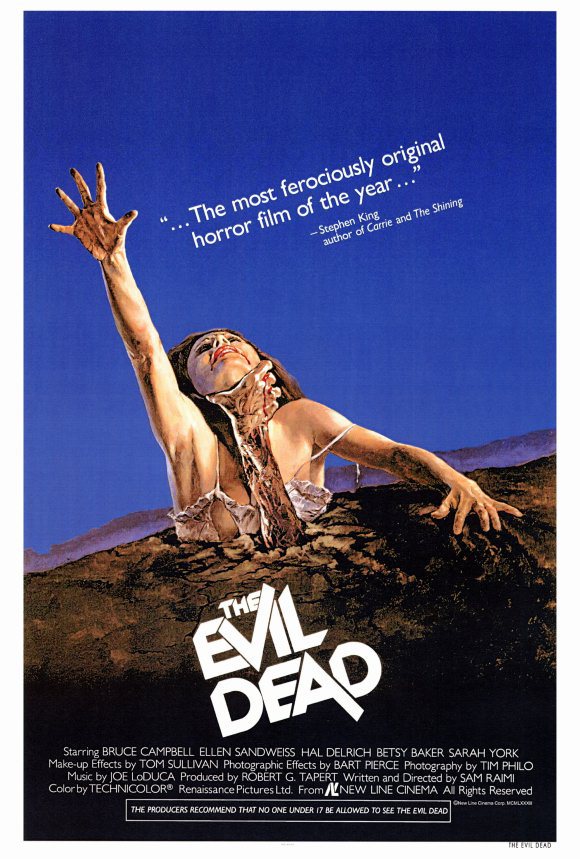
Retro Review: Comparing Corpses: Two EVIL DEAD Go Head-To-Blood-and-Gory-Head!

Posted on: Apr 24th, 2013 By:

THE EVIL DEAD (1981); Dir. Sam Raimi; Starring Bruce Campbell, Ellen Sandweiss, Hal Delrich, Betsy Baker and Sarah York; Available on DVD and Blu-Ray from Anchor Bay Entertainment; Trailer here.

By Aleck Bennett
Contributing Writer

There’s such a hue and cry over the seemingly unending parade of remakes coming out of the Hollywood horror entertainment complex. It’s increasingly hard to approach one on its own terms without feeling like you’re betraying all that is good and true in this world. And when it comes to a beloved horror classic like Sam Raimi’s 1981 gorefest THE EVIL DEAD, the stakes are raised even higher.

But here’s the complication: THE EVIL DEAD has already been remade. Not once, but twice. The film’s plot was summarized and streamlined into the first quarter hour or so of 1987’s EVIL DEAD II, which was then subsequently summarized and streamlined into the opening segment of the series’ third film, 1992’s ARMY OF DARKNESS. Further complicating matters is the fact that THE EVIL DEAD is itself a remake. Raimi’s 1978 short film WITHIN THE WOODS was developed as a prototype horror film to draw investors, and it successfully led to Raimi raising the nearly $100,000 needed to develop a feature-length version of the short.

To be clear: THE EVIL DEAD is far from being some sacred, untouchable text. Not even Raimi sees it as being one, as he’s been futzing around with the same story since 1978. And even then it wasn’t that original an idea: though Raimi denies having seen the film prior to production, the storyline of THE EVIL DEAD is relatively close to that of the 1967-70 drive-in classic EQUINOX. Both involve scientists who have unwittingly opened a portal between this world and a demonic realm, a mysterious occult text and a handful of early-20s youths who visit the scientist’s cabin and wind up fighting off demons. It’s become such an archetypal setup that the “five kids in a cabin” trope is the basis for Joss Whedon and Drew Goddard’s ultimate meta horror-comedy, 2012’s THE CABIN IN THE WOODS.

That being said, how does Fede Alvarez’s 2013 version compare with the 1981 model? Let’s take a look.

Both stories are superficially similar: a group of five kids in their 20s visit a remote cabin, wherein they stumble upon a mysterious tome, the NATURON DEMONTO, which contains passages intended to open a portal and summon demons to this realm. The spells are read aloud (in the original, played via a scientist’s tape recording; in the 2013 version, directly read from the book), and said demons are summoned. One by one, the five are picked off and controlled by the ancient evil called forth by the book.

The first thing you’ll notice as different is the film’s immediate stylization. In the original, there’s a sense of everything being normal until we get to the cabin. In the remake, a pre-credit sequence of sacrifice casts a shadow over the proceedings, and to reflect that, there’s a consistent color desaturation which gives everything a sickly pallor and darkens the tone of the film. While I miss the gradual move away from “reality” that the original possesses, the point stands that the remake is, well, a remake. We know that bad stuff is about to go down and we know where it’s located (and if you didn’t know, the establishing sacrifice informs you).

The second thing is a deviation from the original’s storyline that affects the audience’s relationship with the characters: in the original, Bruce Campbell’s Ash is part of an ensemble and emerges as the film’s lead over time. In the remake, Jane Levy’s Mia (a recovering drug addict who has chosen the isolated cabin as a place to detox) is quickly established as the film’s focal character. By announcing right out of the gate who the film’s protagonist is, the sensation at the original’s outset that anybody could die at any time is somewhat lessened. We already know which character is established as the hero, but the question remains: how long will our hero last? Both films take their own path to establishing that question, but the original’s route creates more audience empathy. The remake’s approach results in a decrease in the sense of danger, meaning that no matter how many times the film pulls this rug out from under the viewer, the viewer is still inclined to think, “well, sure, but they can’t kill her; she’s the star!”

One thing in which both films succeed is the application of gore. Though budget kept the original’s prosthetic appliances looking like anything but prosthetic appliances, they made up for any shortcomings with a shocking amount of blood. And not just blood spurting from wounds, but from everywhere. And Raimi’s bravura direction pulled maximum shock out of every instance. Alvarez’s higher budget has resulted in more successful practical effects (he boasts that every effect was done on-set using practical effects, with CGI only used for touch-ups and more general uses such as manipulating the film’s color palette), and his insistence on not backing down from the original’s bloody reputation has resulted in this being quite probably the most gore-filled major studio film I’ve ever seen.

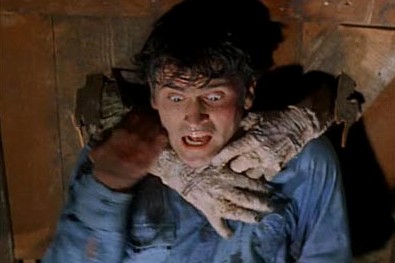
Bruce Campbell in the original EVIL DEAD. New Line Cinema, 1981. Available on DVD from Anchor Bay Entertainment.

Meanwhile, let me address something that I’ve seen crop up elsewhere in comparing the two: criticism that the 2013 film lacks the comedy of the original. The original film IS. NOT. FUNNY. Sure, there are one or two intentionally comedic moments in the first few minutes of the film as we follow our gang to the cabin. But the “splatstick” comedy that so many people associate with the EVIL DEAD franchise was something that popped up in the sequel, EVIL DEAD II. The first EVIL DEAD movie is every bit as serious about what’s going on as the remake. Got it? Good.

The main question, though, is this: does the film stand on its own two legs? I’d argue that it does, unequivocally. It does lack some of the sense of fun that the original had, particularly in its first half. But when the possession starts going and the blood starts flowing, it’s too easy to get caught up in the unbridled enthusiasm of the movie to not enjoy it from that point onward. Sure, there are plot holes and contrivances that might bring down any attempt to reason with the film, but in a movie like this, reason is the last thing you want to bring into the theater with you. The entire point of either film is to show what happens when reason can no longer be applied. And both films succeed and fail at showing that in probably equal amounts. And the remake might lack some of the bizarro flourishes that made Raimi’s film stand out that much more in that regard. But you can walk into this film not knowing of Bruce Campbell’s existence (I can’t imagine living such a life, but to each their own) and come away happy.

And I—knowing and loving the original, which I’ve probably owned more copies of in my life than any other film—walked away having enjoyed myself thoroughly. It’s a nice complement to the original, which it references enough to question whether it might be some kind of sequel: not only are the superficial elements in place (the cabin and the book, though the book has been redesigned due to copyright problems), but Ash’s 1973 Oldsmobile Delta 88 Royale is still present outside the cabin. (Nerds like myself might chime in with “…but Ash’s car was transported through the portal to ancient Sumeria in 1300 at the end of EVIL DEAD II!” To which I award you the coveted No-Prize, and direct you to the lobby to collect it.)

The new EVIL DEAD equals the original in blood and gore. Sony Pictures Entertainment, 2013.

It’s certainly the best of the recent crop of horror movie remakes. And while that might sound like damning with faint praise, it’s not intended to be. It works as both a celebration of the original and a successful horror film on its own. It doesn’t shy away from its visceral roots in order to deliver a PG-13 rating, or preemptively compromise itself so as to not invoke the MPAA’s wrath. Surprisingly, something this brutal made it through unscathed.

Five kids in a cabin. Deceptively easy to screw up. Thankfully, Fede Alvarez has kept things simple.

Blood simple.

Aleck Bennett is a writer, blogger, pug warden, pop culture enthusiast, raconteur and bon vivant from the greater Atlanta area. Visit his blog atdoctorsardonicus.wordpress.com

Category: Retro Review | Tags: , , , , , , , , , , , , , , , , , , , , , , , , , , , , , ,

Retro Review: DON’T LOOK IN THE BASEMENT or You May Find Another Horror Cult Classic at The Plaza

Posted on: Apr 12th, 2013 By:

DON’T LOOK IN THE BASEMENT (1974); Dir: S.F. Brownrigg; Starring Rosie Holotik, Bill McGhee, Annabelle Weenick; Fri. Apr. 12-Thurs. Apr. 18; The Plaza Theatre; Trailer here.

By Andrew Kemp
Contributing Writer

It feels like I’ve been writing a lot about the Plaza Theatre lately, but there’s a damn good reason for that. When ownership at the Plaza recently changed hands, the new owners’ first act was to remove the old 35mm film projectors in favor of a crisp, clean but decidedly digital presentation. For cine-junkies like me, this was supposed to be the kiss off, but the Plaza, as it turns out, knows their market. While the face of the Plaza changes, the heart of the old girl still beats the same, maybe even stronger, as the theatre has gone absolutely nuts with its programming, booking all kinds of rare gems and oddities to its screens and convincing the film nerds to withhold judgment just a little longer. With recent full runs for THE PIT AND THE PENDULUM, REEFER MADNESS, RE-ANIMATOR, and FLESH GORDON, The Plaza is now the best spot in Atlanta to catch a vintage film pretty much any night of the week.

Joining the roster of “holy shit” this week at the Plaza is DON’T LOOK IN THE BASEMENT (1973), otherwise known to horror fans by the way-less-awesome title of THE FORGOTTEN. Filmed in Texas in that same sweltering, gritty grindhouse style that THE TEXAS CHAINSAW MASSACRE (1974) would make infamous one year later, DON’T LOOK IN THE BASEMENT concerns a young nurse named Charlotte (Rosie Holotik) who starts a new job at a mental asylum, only to learn that the head doctor has been murdered by the patients. The new doctor in charge, Dr. Masters (Annabelle Weenick), tries to help Charlotte settle in, but the unruly, batshit patients begin to target and harass their new nurse. There’s plenty of blood, a dark secret or two, and an absolutely ludicrous third act twist. The filmmaking is less than impressive, but the overall effect is enough to rake you over the coals a bit, if that’s what you’re into. There’s a reason this movie still gets play 40 years after its release.

DON’T LOOK IN THE BASEMENT is a grinding little workhorse of a horror film, made all the more famous by its associations with other horror classics. One year earlier, Wes Craven’s grimy THE LAST HOUSE ON THE LEFT (1972) dropped a nuke on the horror scene with its near-snuff approach to tale of rape and revenge. That movie had one of the most famous taglines in film history, and well-earned: “Just keep repeating to yourself; ‘it’s only a movie, it’s only a movie, it’s only a movie…” The next year, distributors tried to pass DON’T LOOK IN THE BASEMENT off as being from the same batch of people by showing it on a double bill with LAST HOUSE, but the films have no real connection. Instead, DON’T LOOK IN THE BASEMENT comes from the mind of S.F. Brownrigg, a journeyman of the Texas horror circuit who had a flair for amazing titles, like DON’T OPEN THE DOOR! (1975) and KEEP MY GRAVE OPEN (1976). He also had a role in creating THE EYE CREATURES (1965), later made infamous by MYSTERY SCIENCE THEATRE 3000.

DON’T LOOK IN THE BASEMENT is not a film that comes to screens very often, and when it does, maybe it plays more for the devoted than for the unconverted. But that’s what’s been so impressive about the new scheduling at the Plaza. There are plenty of catalog titles that could draw in the mainstream, but the Plaza is in the middle of an all-out bid for the cultists and movie fetishists, and the theatre is working hard to plant themselves at the center of Atlanta’s developing film culture. I, for one, hope there’s more like this in the basement.

Andrew Kemp is a screenwriter and game writer who started talking about movies in 1984 and got stuck that way. He writes at www.thehollywoodprojects.com and hosts a bimonthly screening series of classic films at theaters around Atlanta.

Category: Retro Review | Tags: , , , , , , , , , , , , , , , , , ,

Retro Review: Splatter Cinema Takes You Straight to Sci-Fi Hell with EVENT HORIZON Tues. April 9 at The Plaza Theatre

Posted on: Apr 8th, 2013 By:

Splatter Cinema presents EVENT HORIZON (1997); Dir. Paul W.S. Anderson; Starring Laurence Fishburne, Sam Neill, Kathleen Quinlan; Tuesday, April 9 @ 9:30 p,m. (come early at 9 p.m. for photo op with a realistic recreation of a scene from the film); Plaza Theatre; Facebook event page here; Trailer here.

By Robert Emmett Murphy
Contributing Writer

I remember when EVENT HORIZON first came out in 1997, and specifically I remember the context of its contemporaries in SF filmmaking. A large handful of undeniable classics notwithstanding, 1990s SF filmmaking was showing clear signs of exhausting itself. There were a bumper crop of major releases with improving budgets, consistently breathtaking in their special effects and all other aspects of design, and more prestigious casts; but many, many of those films proved remarkably disappointing. Concepts that seemed ambitious were dumbed down badly, and then rendered in near incoherent form even after they were simplified. We started to pine for less bloated and more energetic B movies, but those B movies were now competing with big budget films for what was once their exclusive audience share, As a result they often got cowardly, losing their sense of “nothing to lose and everything to prove” and trapping themselves in the rehashing of major releases. The films most rehashed in that era were already a decade or more old, TERMINATOR (1984) and ALIEN (1979).

Because EVENT HORIZON did do many things right, it was ultimately far more frustrating than the very many far worse films around it. Among its virtues, the most important was that it was a SF horror film set entirely on a spaceship, but it wasn’t yet another ALIEN knock-off. In retrospect, it anticipates the recent ALIEN prequel PROMETHEUS (2012) in its tremendous narrative ambition, crippled by far from coherent storytelling, but then bolstered by strong set pieces and even better performances, only to again be undercut by not knowing what to do with the people they have wandering around the uncertain plot.

EVENT HORIZON does reference ALIEN, recapturing aspects of the look and the wonderful claustrophobic feel, and taking advantage of the more famous film’s opening ploy – our heros are traveling deep into the void in response to a distress call, and none are prepared for what they will find.

The year is 2047, and the rescue ship, “Lewis and Clark,” is piloted by an under-developed hero named Captain Miller, who is thankfully played by Laurence Fishburne, an actor whose career is notable for how many times he’s had to breathe life into under-developed characters. For the most part, his crew is similarly under-written, yet in almost every case exceptionally well-played. In fairness to the script, they do have a collective identity based on loyalty, professionalism and camaraderie that they as individuals lack.
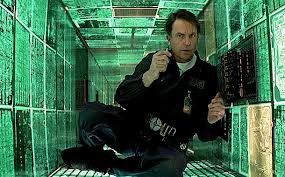
Dr. Weir (Sam Neill) in EVENT HORIZON. Paramount Pictures, 1997

Among them is a resented stranger, Dr. William Weir, played quite well by Sam Neill. He’s the most developed of the nine significant members of the dramatis personae. Weir is carefully trying to cover how personally haunted he is. He’s suffering from nightmares of his wife’s suicide, and it was his experimental Faster-Than-Light drive (in this film, they use the hyperspace template for that future technology) is definitely at the root of the crisis, though even he can’t know how or why.

They are there to rescue the crew and research from the ship the “Event Horizon,” which seven years prior literally disappeared from the universe while testing Dr. Weir’s technology. Now, suddenly and mysteriously, it has returned. What the crew of the “Lewis and Clark” find is a gory mess, the “Event Horizon’s” crew were driven mad by their trip out of our universe and back, and slaughtered each other in a remarkable orgy of murder-suicide. Our heroes also discover the derelict ship brought something back from the other universe, an ambiguous but implacably hostile entity that can do bad things to the human mind.

“Event Horizon” is a haunted house in space, and as every school child knows, those who are most haunted entering the door are most vulnerable to the haunting once inside. The crew is right to distrust Dr. Weir, because he’s going to prove to be nothing but trouble.

The film’s most explicit references aren’t to other Science Fiction Horror films, but to Supernatural Horror films, notably THE SHINING (1980) and DON’T LOOK NOW (1973). (One film it was especially careful not to visually reference is SOLARIS (1972) because it doesn’t want to remind the audience that this over-the-top-gore-fest stole all its major plot points from that slow, meditative, art-house film.)
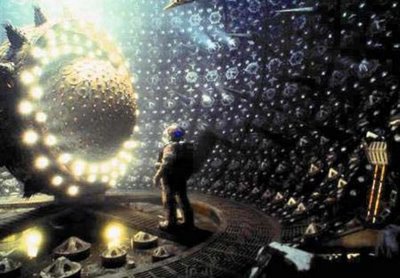
EVENT HORIZON. Paramount Pictures, 1997

Many (most?) of the film’s virtues are in its production which is remarkably rich and coherent through the exquisite special effects, exceptional set design and best of all, its sound editing by veteran sounds effects editor Ross Adams. The film’s suspense is heightened tremendously by the always intrusive ambient noises which never let you forgot the oppressiveness and implicit threat of a wholly artificial environment. That year, TITANIC took that (and every other) Oscar, but in comparison to this largely disregarded film, TITANIC’s sound is just a lot of smartzy bullshit.

This classy production led strength to the large number of marvelous set pieces, such as the opening scene where we are pulled back from the window of a space station and rotated as we pass through its vast structure, and keep on pulling back until the huge habitat is dwarfed by the giant Earth behind it. Another good one is the Lewis and Clark’s approach to the Event Horizon, spectacularly skimming the storm clouds of Neptune’s upper atmosphere.

Best of all was Capt. Miller’s desperate race to rescue his young crew member Justin, played by Jack Noseworthy, who is about to be sucked out of an airlock. What I was most impressed with this scene was its rare fidelity to the science, and the way it used the physical realities for dramatic effect. The imperfect, but unusually good, scientific literacy of the script strengthens the first half of the film tremendously. Unfortunately, by the last third, all concepts of natural laws and forces hves become as cartoonishly incompetent as Disney’s notorious BLACK HOLE (like ALIEN, also released in 1979, and also a clear influence on this film).

The scene that best evokes how very ambitious EVENT HORIZON was is the climax [Ed. note: SPOILER ALERT], where we have the destruction, and at same time, survival, of the title vessel, with two very different escapes, and two very different entrapments, all unfolding at the same moment. Too bad by that point the script had degenerated into complete chaos and incoherence.
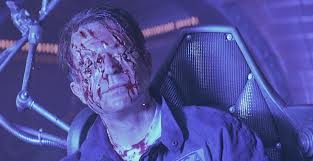
EVENT HORIZON. Paramount Pictures, 1997

It seems like someone forgot to ask themselves what the golden thread really was, but who is the guilty party? Definitely director Paul W.S. Anderson, whose career is studded with ably executed, visual striking and surprisingly lavish movie-making, but who is not known for either substantive ideas or characterization. He’s been the writer and/or director on 14 films, six of which were based on video games, and another five were constructed in such a way as to facilitate video game tie-ins.

Also clearly one or both of the writers are at fault. Philip Eisner developed the initial script, but there were extensive, uncredited, rewrites by Andrew Kevin Walker at Anderson’s request.

A post-production decision to cut out 30 minutes of storytelling to make room for more special effects probably didn’t help much either.

Here’s the deal: The humans who pass through the interdimensional portal are psychicly shattered and reduced to homicidal and suicidal insanity. Implicitly, the alien who was accidently dragged through the same portal in the other direction has suffered the same. Had that been made explicit, it could’ve been explored – the monster is as much a victim as the crew, and specifically was the unintended victim of Dr. William Weir. Sympathetic monsters, like the Frankenstein monster, are horror’s most emotionally potent trope. And when the sympathy is discovered through process of rational investigation, the story stands on the firmament of legitimately mature science fiction, as in the classic STAR TREK episode “The Devil In The Dark” (1967).
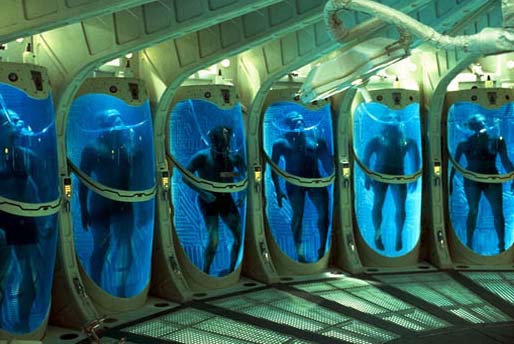
EVENT HORIZON. Paramount Pictures, 1997

But instead we get a promising premise ship-wrecked by what is inevitably evoked whenever a script is peppered with phrases like “the ultimate evil” and “something infinitely more terrifying than Hell;” and a future spaceship crewed by English-speaking scientists start spontaneously babbling Church Latin and decorate their cabins with cabalistic runes painted in blood.

Probably the best guide to how terribly it all went wrong was what was done to the two best developed characters:

Lt. Peters (Kathleen Quinlan) is one of only three who gets any kind of back-story, and unlike Capt. Miller and Dr. Weir, her history isn’t evoked with excessive melodrama or ham-fisted exposition. Moreover, Quinlan provides, hands-down, the film’s best performance. She also gets killed before contributing anything to the plot. ARE YOU KIDDING ME! That’s not the character you treat as cannon fodder! Joely Richardson, as the wholly forgettable Lt. Strark who somehow manages to survive to the final credits, should’ve been cannon fodder. I suspect age-ism; Quinlan was 43 at the time, compared to Richardson’s 32, making her better prepared to run around in her underwear.

Then there’s Dr. Weir, so ably played by Neill until the script stops making sense. After that, he’s transformed into an utterly ridiculous monster. An important plot point is that Weir, though he is most vulnerable to the influence of the alien, hasn’t been through the interdimensional gate. He’s stalked, like Dr. Frankenstein, by the consequences of his defiance of nature. In the end, he is the alien’s super-human puppet, and a lot of the stuff coming out of his mouth is completely inexplicable if he hasn’t already been over to the other side. The film evokes demonic possession as an excuse, but it’s a poor excuse because there was no honest effort to tie that concept to the already well-established and fascinating environment, or the already clearly established mechanics of interdimentional travel. It just kind of leaps head first into the realm of mid-1980s straight-to-video NIGHTMARE ON ELM STREET knockoffs.

A gorier moment in EVENT HORIZON. Paramount Pictures, 1997.

EVENT HORIZON was a financial bomb, recouping less than half its $60 million dollar budget domestically. It temporarily derailed the director’s career, but he made a comeback by studiously avoiding all smartness ever since (he’s the main guy behind the RESIDENT EVIL film franchise). It was also brutalized by the critics, many of whom had a lot of fun making it out to be much worse than it was. I imagine Stephen Hunter rubbing hands and cackling with glee as he wrote this:

“If you want to have that EVENT HORIZON experience without spending the seven bucks, try this instead: Put a bucket on your head. Have a loved one beat on it vigorously with a wrench for 100 minutes. Same difference, and think of the gas you’ll save.”

Now that’s just plain mean.

The late, great Roger Ebert was far more on target (as usual):

“It’s all style, climax and special effects. The rules change with every scene…But then perhaps it doesn’t matter. The screenplay creates a sense of foreboding and afterboding, but no actual boding.”

The retro/cult market eventually redeemed this film. It’s almost perfect for that nitch, because when forewarned, the film’s self-destructiveness is actually pretty amusing. Also, cult cinema has always thrived on the ambitious failures, the shoulda, coulda, woulda’s of Hollywood, and this movie is all of them wrapped up into one.

Robert Emmett Murphy Jr. is 47 years old and lives in New York City. Formerly employed, he now has plenty of time to write about movies and books and play with his cats.

Category: Retro Review | Tags: , , , , , , , , , , , , , , , , , , , , , , , , , , , , , , , , ,

Retro Review: Cult ’80s Fantasy Movie KRULL Makes a Comeback as a Genial, Albeit Deeply Ironic, Pleasure

Posted on: Apr 4th, 2013 By:

KRULL (1983); Dir: Peter Yates; Starring Ken Marshall, Lysette Anthony; Starts Friday, April 5.; The Plaza Theatre; Trailer here.

By Andrew Kemp
Contributing Writer

A few years ago I attended a science-fiction double feature (woo-oo-oo) at the Carolina Theatre in Durham. This particular series had been running monthly for over 10 years at that point and the theatre was packed with die hards, who I assumed were, like me, there to see David Lynch‘s DUNE (1984), a theory I confirmed when the host of the series stood up and begged the audience to stay for the night’s second film, the infamous fantasy flop KRULL. The host pointed at a guy in the front row. “It’s his fault,” the host shouted. “He’s begged me to program this movie for years!” The guy in question raised his hands in the air and took a small ovation. I had always planned to stay—who goes to a double-feature just to see one film?—but I immediately guessed that Krull Fan and I were going to be sharing an empty room.

Shows what I know. Nobody left. In fact, I’d wager the crowd even grew a little as some KRULL fans wandered in late, apparently happy to dodge David Lynch to get to their main event. KRULL, I learned, has its fans. And, as the movie chugged along to its laugh-out-loud finale, I became a bit of a fan myself. Now, Atlanta audiences get their own chance to rediscover KRULL when it starts a big-screen run at the Plaza on Friday.

If STAR WARS (1977) was the huge stone thrown into the Hollywood water, KRULL was that last tiny ripple on the other side of the lake, marrying science fiction and fantasy together from a similar recipe, but achieving dramatically different results. KRULL, an American production shot in England at the legendary Pinewood Studios, concerns a mythic alien beast, creatively named The Beast, who descends onto a peaceful planet populated by fantasy characters—think Druidia from Mel Brooks’s SPACEBALLS (1987) and you’re halfway there. After The Beast wrecks the planet’s ruling kingdom, survivor Prince Colwyn (Ken Marshall) goes about the business of rescuing a captured princess (Lysette Anthony) in the usual way, by gathering a band of allies and pursuing a quest for a mythical weapon of legend known as The Glaive. This weapon, a five-bladed throwing star, is the only thing capable of slaying The Beast, which is pretty darned convenient when you think about it, since the critter’s not even from around there.

If the plot sounds right out of a game, that’s no coincidence. Plenty of rumors link KRULL to a pitch for a Dungeons & Dragons movie that never happened (D&D creator Gary Gygax denied this, but it’s unclear whether he would have even known), and KRULL was one of the earliest films to attempt the cross-platform synergy marketers swoon for today, with a KRULL video game adaptation appearing in arcades and on the famed Atari 2600 home system soon after the film’s release. In fact, pretty much everything about KRULL suggests a charmingly misguided belief that the creators were building a world people would want to return to again and again. Instead, KRULL was a major box office disappointment and dropped into obscurity, wearing the label of “failed franchise” as if on a sandwich board over the words “please help.”

But enthusiasts like Krull Fan have helped the movie make a comeback as a genial, albeit deeply ironic, pleasure.  While the sum of its parts may add up to very little, the parts are often enough fun to help viewers overlook the film’s rough patches. KRULL has imagination, and it’s chock full of bits that could have been iconic in a better movie, none more so than Colwyn’s Glaive, the film’s answer to the lightsaber. The weapon sits at the center of the film’s plot and marketing, but poor Prince Colwyn barely gets to use the thing, as if the production had only one to spare and couldn’t risk breaking it. (Or perhaps the Glaive’s non-presence is an attempt to duck the logistics of the thing. It seems as if though one should only throw a five-bladed star if one is absolutely certain of having no future as a piano player.)

The film also boasts a suitably gruesome main monster, encounters with giant spiders and sorcerers, a bumbling wizard (all 1980s fantasy films were required to have a bumbling something or other), a friendly Cyclops and even a future Hollywood star—pre-fame Liam Neeson appears as a surly convict enlisted to Colwyn’s quest. There’s much to love about KRULL, even if it’s pretty hard to love KRULL. Frankly, the movie can be a bit of a slog at times. But there’s something to be said for ingenuity and imagination, both of which KRULL has in plenty. The film came from a time before special effects made it easy to create whatever world you could imagine, and from a time when fans of the fantastical had to settle for whatever they could get. KRULL is hardly one of the best fantasy films of the era, but it’s endearingly goofy, hand-made and eager to please.

Unless, of course, you’re hoping to see Colwyn really cut loose with that Glaive. If so, you just have to keep waiting for the inevitable sequel. It’s got to be coming along any day now, right?

Andrew Kemp is a screenwriter and game writer who started talking about movies in 1984 and got stuck that way. He writes at www.thehollywoodprojects.com and hosts a bimonthly screening series of classic films at theaters around Atlanta.

Category: Retro Review | Tags: , , , , , , , , , , , , , , , , , ,

Blast-Off Burlesque’s TABOO-LA-LA and the Plaza Theatre Ask: Have You Visited Your MOMMIE DEAREST Lately?

Posted on: Apr 4th, 2013 By:

Blast-Off Burlesque’s TABOO-LA-LA Presents MOMMIE DEAREST (1981); Dir. Frank Perry; Starring Faye Dunaway and Diana Scarwid; Saturday, April 6 @ 9:00 p.m.; Ages 18+ only; Plaza Theatre; Trailer here.

By Aleck Bennett
Contributing Writer

The historic Plaza Theatre and Blast-Off Burlesque have joined forces once again for another round of TABOO-LA-LA! This time, take a trip to the Golden Age of Hollywood via the excesses of the early ‘80s, and watch as Faye Dunaway goes gloriously over the top in the role of Joan Crawford in MOMMIE DEAREST!

“This is the West, sir. When the legend becomes fact, print the legend.”THE MAN WHO SHOT LIBERTY VALANCE

In 1978, Christina Crawford published her memoir MOMMIE DEAREST, in which she revealed the private face of her mother: Tinseltown legend Joan Crawford. Rather than the standard glowing Hollywood biography, Christina’s told a sordid tale of alcoholism and abuse that few suspected lurked behind the carefully stylized façade of Joan Crawford’s public image.

While many of Joan’s closest friends called Christina’s claims into question—that though her mother’s alcoholism was undeniable, the abusive acts chronicled by Christina were embellishments—other long-time friends of Joan’s said that they had witnessed some of the events of abuse and supported Christina’s side of the story. Whichever side is closest to the truth, though, the fact remains that the enormous success of Christina’s book created an entirely new public perception of Joan Crawford, helped to usher in the phenomenon of the “celebrity tell-all” biography and resulted in a film that quickly became known as a high camp classic.

Now, I’ve long held a particular philosophy when it comes to film: the most important question that should be asked when evaluating a movie’s worth is “was it entertaining?” By typical standards, it’s hard to make the case that MOMMIE DEAREST is a good movie. The tone is pitched far too high for it to be taken seriously as a biopic. Faye Dunaway somehow manages to overact before even speaking a word. (In fact, the only real reference she makes to the movie in her autobiography is to say that she wished that director Frank Perry knew how to rein in his actors’ performances.) But despite all of this, the movie works and has gained a cult following because it’s just so giddily entertaining.

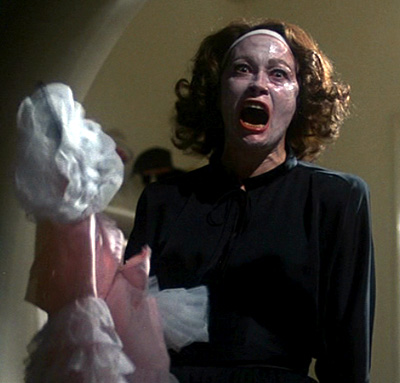
Faye Dunaway in one of the more crazed moments in her performance as Joan Crawford in MOMMIE DEAREST. Paramount Pictures, 1981

Because MOMMIE DEAREST draws from the classic Hollywood film and the made-for-TV movie, the movie feels more like an exaggerated melodrama than a traditional biopic. Characters are abstracted to fit into particular stereotypes (the repressive and tyrannical family head, the resolute and self-sacrificing heroine). Themes center on familial turmoil and emotional struggle. Emotions within the film are heightened to an almost surreal point. However, when you’re dealing with a persona as tightly wound and stylized as Joan Crawford, to abstract what is already something of an abstraction of a “real person”—while wildly amping up emotional levels to the John Waters setting—results in something close to (if not smack dab in the middle of) caricature. And while caricature is likely not what Frank Perry or Faye Dunaway was intending, the resulting cartoon is 10 times more captivating than a realistic depiction.

For instance, it requires a facile skill and considerable contemplation to film scenarios that turn a harrowing depiction of child abuse into something hilarious. It’s a fine line to tread between hysterical tastelessness and offensive tastelessness. But in the celebrated “no more wire hangers!” scene—a fractal-like smaller moment that perfectly captures and represents the larger whole—Frank Perry falls bass-ackwards into hilarity without even trying. He’s like the Fool in the Tarot deck: blissfully stepping off a precipice into the jaws of a grand journey while his attention is drawn elsewhere, unwittingly creating a sublime parody of the melodrama without even thinking about it.

Meanwhile, what can be said about Faye Dunaway? She’s one of the great actresses, whose performance in 1967’s BONNIE AND CLYDE helped define the “new Hollywood” of the late 1960s and ‘70s, portraying one of the defining actresses of the “old Hollywood.” And she physically transforms herself into…not Joan Crawford, but the idea of a Joan Crawford. A concept of what a Joan Crawford might be. She’s all eyebrows, lips, nostrils and shoulder pads, fueled by viciousness and liquor. A ranting, raging simulacrum of a human being. It’s a role that Divine was practically born to play, but somehow I doubt that even the divine Divine could pull off the required over-the-top theatrics of the part while maintaining the gravitas that comes with an actress like Dunaway in the role. It’s the only thing that keeps the performance from flying through the ceiling as it is.

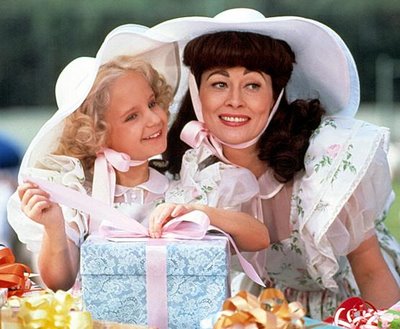
Christina Crawford (Diane Scarwid) and her MOMMIE DEAREST put on a cheery public face. Paramount Pictures, 1981

Shortly after the film was released, Paramount realized that nobody was seeing this film because of the story’s real-life compelling drama; they were seeing it for the unintentional comedy it had become. A month into its release, they changed promotional tactics, telling audiences to “meet the biggest MOTHER of them all!” Even that same year, rock band Blue Öyster Cult took advantage of the inherent comedy of MOMMIE DEAREST and released their single Joan Crawford from the album FIRE OF UNKNOWN ORIGIN. The song details the resurrection of Joan Crawford as a harbinger of the apocalypse and features the voice of a zombified Joan calling out “Christina, Mother’s home! Come to Mother!”

Blast-Off Burlesque brings the inadvertent work of genius that is MOMMIE DEAREST to the Plaza’s big screen in a celebratory bash as gloriously over the top as the film itself. DJ Westwood-A-GoGo will be spinning tunes in the lobby, where patrons can enjoy complimentary cocktails and mingle before the show begins. Once seated, the audience will be treated to a riotous performance by Blast-Off Burlesque, with guest performers Kristiva Diva, Poly Sorbate, Chico Nunez, and the Baphomettes. Audience members are encouraged to dress like their favorite character, and to enter contests to win prizes provided by Libertine and Cherry Blossom Salon.

So get dolled up in your old-school finery and get down to the Plaza on Saturday, April 6. You wouldn’t want to get on this Mommie’s bad side.

Aleck Bennett is a writer, blogger, pug warden, pop culture enthusiast, raconteur and bon vivant from the greater Atlanta area. Visit his blog atdoctorsardonicus.wordpress.com

Category: Retro Review | Tags: , , , , , , , , , , , , , , , , , , , , , , ,

‘80s Horror Bringin’ the ‘70s With It into the Now: THE DEMON’S ROOK Test Screening At Newly Renovated Plaza Theatre on Wed. April 3

Posted on: Apr 2nd, 2013 By:

THE DEMON’S ROOK (2013); Dir. James Sizemore; Prod. Tim Reis; Starring Ashleigh Jo Sizemore, James Sizemore, John Chatham; Test Screening; Wed. Apr. 3, 9:30 p.m., Plaza Theatre, Suggested donation $5; Trailer here.

By Josh Lowder
Contributing Writer

There are slap-happy, slimy, death-masked, gassed-out, creeper-features – as well as other such hyphenated, superlative-worthy schlock-mares that we’ve all known and loved since first sight, so long before my dog CeeGee and I killed crocs with sharks on SyFy. Then there are our most nurtured, formative dreams that reach out to us from our collective pasts to where we sit in the blissful ignorance of adulthood, slapping us into a working fervor. No? Well, fortunately the Black Riders are in this business of making awesome, chief among them is named Loup’Rah Garomore (a.k.a. James Sizemore, but what boring rubbish are Christian names when it is the darker palate from which we draw our pigments…we’ll stick with Loup’Rah Garomore).

When confronted about this sinister priory of Black Riders by Rondal at the Strange Kids Club website way back in 2011, nothing was held back and things got super-serious:

“I formed a secret art society with a couple close friends back in 2006 known as The Black Riders. We all had four things in common that we wanted to have fun celebrating in the society: our love for righteous art creation, cryptozoological creature study, veganism, and metal music. We dubbed ourselves the three elders, giving each other monikers. I was given the name Loup’Rah Garomore by my brother Lycanthropus Galleytrot. Ever since then, I’ve gone by that name when creating my art. Lycanthropus, Mudrot and I created a pretty strange set of induction rights, and since then we occasionally induct new members into the fold. As of now, we only have nine members. I guess you could say it’s a pretty exclusive society, but that’s the way we like it.”

The earnest eyes of a dedicated special effects meister, and his team of shiny-eyed believers, pierce the murky bog clogged with so many of our computer “enhanced” chiller reels and have brought to bear a sincere glimpse into the wilding world of inspired lore and lingo that their tireless fingers and worn sculpting tools, brushes and swabs, have brilliantly shape. Some of us do still enjoy a potable slice of context with our three-hour-application monster make-ups, but with the line between flesh and art so successfully blurred with each new creature revealed in the small sample leaked to us last Halloween in the trailer, the urge to press pause and gawk might best the quest for “what happens next.” Still, don’t think that this is any reason to dismiss the journey. It’s there for a sincerely dark and ominous reason. Behold…

On THE DEMON’S ROOK from Demon himself:

“The story follows a young boy named Roscoe who finds a portal to another world where he is taught magic by an exiled demon elder. Confined to their mystical cave, Roscoe is raised up by the demon elder in secret. Once he is discovered by three other demons, Roscoe must escape to avoid their wrath. Through desperation, he is forced to escape through the portal that leads back to our world. Unbeknownst to Roscoe, he leads the demons to discover the portal for themselves. Once the demons pass through, a nightmarish foray of summoned monsters are unleashed. One demon possesses the minds and will of all whom she crosses, another transforms a man into a murderous beast, and the other summons an army of the dead to do his bidding.“

Loup’Rah Garomore, the undisputed head on this corpus cinematique – FX master, commander, and cramps to prove it, producer, director, star, husband, you name it – has faced a lot of hot-light interrogation by a number of amazingly in-depth fan and genre websites that delve much deeper than I thought possible without a medical degree and an endoscope. And after a few gently invasive exchanges via emails with this bearded peach-stater, I realized that here was a man ready to let his work speak for itself despite his complete availability to me. Moreland, Georgia can be proud of this native son and his demonic generosity of spirit and wealth of energy for us all to see through his mind-expanding kaleidoscope of hopeful oblivion. This energy he shares knows very few bounds and is steeped with experience at work and at the front of the classes leading the way – his zest for new knowledge gets qualified and solidified by passing it so readily to those eager to learn. This qualifies him to make a monster movie with fewer regrets than most first-time film makers partly learning as they go.

Within this word-starved format satiating our inquisitive minds, it is one quote in particular from the past two years’ interviews of Loup’Rah (by those who have been brave enough to utter his summon-word), that I pry liberally to parse out the best possible passionate opinion to put us in those new seats, walking across that new carpet – seeing the refurbished Plaza and enjoying the best popcorn in town. This would normally make for a genuinely worthwhile experience on its own merit, and then BOOM, demons.

When Undead Backbrain at Roberthood[dot]net teed it up for him with a 100-word essay request, the everything-man drove it home in an A-Team-constructed iron horse:

“I could do that in two words: It delivers. But I’ll elaborate… ever see a trailer or poster art for a movie that gets you totally pumped to see it, but then when you finally do, you feel cheated because they showed all the best parts in the preview, or it was nothing like advertised? This ain’t that movie. THE DEMON’S ROOK is the real deal start to finish. See the poster art [at the top of the article]? That’s accurate. See the trailer? Only the tip of the iceberg. This is the ultimate low budget fantasy-horror movie.Buy Klonopin Online offers a lot of depression treatment varieties. You’ll be high-fiving strangers, guaranteed. 100.”

Now, when you remember the dark and sequestered nights staying up with one of your seminal UHF movies, that smoke-filled foam-carved cave teaming with beasts and maidens in just wisps of clarity in the snowy 14-inch technicolor or B&W tube you’d boosted from the kitchen or your neighbor – relax that reflexive memory muscle and let this feature return you to that moment with a far clearer vision, wisdom and the same solid wizardry of the old masters.

Category: Retro Review | Tags: , , , , , , , , , , , , , , , , , , , ,

© 2025 ATLRetro. All Rights Reserved. This blog is powered by Wordpress