Blast-Off Burlesque’s TABOO-LA-LA and the Plaza Theatre Ask: Have You Visited Your MOMMIE DEAREST Lately?

Posted on: Apr 4th, 2013 By:

Blast-Off Burlesque’s TABOO-LA-LA Presents MOMMIE DEAREST (1981); Dir. Frank Perry; Starring Faye Dunaway and Diana Scarwid; Saturday, April 6 @ 9:00 p.m.; Ages 18+ only; Plaza Theatre; Trailer here.

By Aleck Bennett
Contributing Writer

The historic Plaza Theatre and Blast-Off Burlesque have joined forces once again for another round of TABOO-LA-LA! This time, take a trip to the Golden Age of Hollywood via the excesses of the early ‘80s, and watch as Faye Dunaway goes gloriously over the top in the role of Joan Crawford in MOMMIE DEAREST!

“This is the West, sir. When the legend becomes fact, print the legend.”THE MAN WHO SHOT LIBERTY VALANCE

In 1978, Christina Crawford published her memoir MOMMIE DEAREST, in which she revealed the private face of her mother: Tinseltown legend Joan Crawford. Rather than the standard glowing Hollywood biography, Christina’s told a sordid tale of alcoholism and abuse that few suspected lurked behind the carefully stylized façade of Joan Crawford’s public image.

While many of Joan’s closest friends called Christina’s claims into question—that though her mother’s alcoholism was undeniable, the abusive acts chronicled by Christina were embellishments—other long-time friends of Joan’s said that they had witnessed some of the events of abuse and supported Christina’s side of the story. Whichever side is closest to the truth, though, the fact remains that the enormous success of Christina’s book created an entirely new public perception of Joan Crawford, helped to usher in the phenomenon of the “celebrity tell-all” biography and resulted in a film that quickly became known as a high camp classic.

Now, I’ve long held a particular philosophy when it comes to film: the most important question that should be asked when evaluating a movie’s worth is “was it entertaining?” By typical standards, it’s hard to make the case that MOMMIE DEAREST is a good movie. The tone is pitched far too high for it to be taken seriously as a biopic. Faye Dunaway somehow manages to overact before even speaking a word. (In fact, the only real reference she makes to the movie in her autobiography is to say that she wished that director Frank Perry knew how to rein in his actors’ performances.) But despite all of this, the movie works and has gained a cult following because it’s just so giddily entertaining.
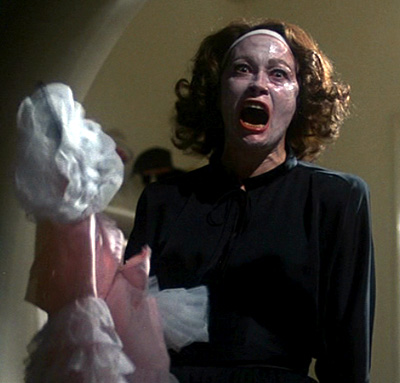
Faye Dunaway in one of the more crazed moments in her performance as Joan Crawford in MOMMIE DEAREST. Paramount Pictures, 1981

Because MOMMIE DEAREST draws from the classic Hollywood film and the made-for-TV movie, the movie feels more like an exaggerated melodrama than a traditional biopic. Characters are abstracted to fit into particular stereotypes (the repressive and tyrannical family head, the resolute and self-sacrificing heroine). Themes center on familial turmoil and emotional struggle. Emotions within the film are heightened to an almost surreal point. However, when you’re dealing with a persona as tightly wound and stylized as Joan Crawford, to abstract what is already something of an abstraction of a “real person”—while wildly amping up emotional levels to the John Waters setting—results in something close to (if not smack dab in the middle of) caricature. And while caricature is likely not what Frank Perry or Faye Dunaway was intending, the resulting cartoon is 10 times more captivating than a realistic depiction.

For instance, it requires a facile skill and considerable contemplation to film scenarios that turn a harrowing depiction of child abuse into something hilarious. It’s a fine line to tread between hysterical tastelessness and offensive tastelessness. But in the celebrated “no more wire hangers!” scene—a fractal-like smaller moment that perfectly captures and represents the larger whole—Frank Perry falls bass-ackwards into hilarity without even trying. He’s like the Fool in the Tarot deck: blissfully stepping off a precipice into the jaws of a grand journey while his attention is drawn elsewhere, unwittingly creating a sublime parody of the melodrama without even thinking about it.

Meanwhile, what can be said about Faye Dunaway? She’s one of the great actresses, whose performance in 1967’s BONNIE AND CLYDE helped define the “new Hollywood” of the late 1960s and ‘70s, portraying one of the defining actresses of the “old Hollywood.” And she physically transforms herself into…not Joan Crawford, but the idea of a Joan Crawford. A concept of what a Joan Crawford might be. She’s all eyebrows, lips, nostrils and shoulder pads, fueled by viciousness and liquor. A ranting, raging simulacrum of a human being. It’s a role that Divine was practically born to play, but somehow I doubt that even the divine Divine could pull off the required over-the-top theatrics of the part while maintaining the gravitas that comes with an actress like Dunaway in the role. It’s the only thing that keeps the performance from flying through the ceiling as it is.
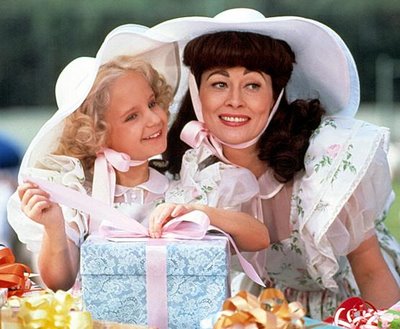
Christina Crawford (Diane Scarwid) and her MOMMIE DEAREST put on a cheery public face. Paramount Pictures, 1981

Shortly after the film was released, Paramount realized that nobody was seeing this film because of the story’s real-life compelling drama; they were seeing it for the unintentional comedy it had become. A month into its release, they changed promotional tactics, telling audiences to “meet the biggest MOTHER of them all!” Even that same year, rock band Blue Öyster Cult took advantage of the inherent comedy of MOMMIE DEAREST and released their single Joan Crawford from the album FIRE OF UNKNOWN ORIGIN. The song details the resurrection of Joan Crawford as a harbinger of the apocalypse and features the voice of a zombified Joan calling out “Christina, Mother’s home! Come to Mother!”

Blast-Off Burlesque brings the inadvertent work of genius that is MOMMIE DEAREST to the Plaza’s big screen in a celebratory bash as gloriously over the top as the film itself. DJ Westwood-A-GoGo will be spinning tunes in the lobby, where patrons can enjoy complimentary cocktails and mingle before the show begins. Once seated, the audience will be treated to a riotous performance by Blast-Off Burlesque, with guest performers Kristiva Diva, Poly Sorbate, Chico Nunez, and the Baphomettes. Audience members are encouraged to dress like their favorite character, and to enter contests to win prizes provided by Libertine and Cherry Blossom Salon.

So get dolled up in your old-school finery and get down to the Plaza on Saturday, April 6. You wouldn’t want to get on this Mommie’s bad side.

Aleck Bennett is a writer, blogger, pug warden, pop culture enthusiast, raconteur and bon vivant from the greater Atlanta area. Visit his blog atdoctorsardonicus.wordpress.com

Category: Retro Review | Tags: , , , , , , , , , , , , , , , , , , , , , , ,

‘80s Horror Bringin’ the ‘70s With It into the Now: THE DEMON’S ROOK Test Screening At Newly Renovated Plaza Theatre on Wed. April 3

Posted on: Apr 2nd, 2013 By:

THE DEMON’S ROOK (2013); Dir. James Sizemore; Prod. Tim Reis; Starring Ashleigh Jo Sizemore, James Sizemore, John Chatham; Test Screening; Wed. Apr. 3, 9:30 p.m., Plaza Theatre, Suggested donation $5; Trailer here.

By Josh Lowder
Contributing Writer

There are slap-happy, slimy, death-masked, gassed-out, creeper-features – as well as other such hyphenated, superlative-worthy schlock-mares that we’ve all known and loved since first sight, so long before my dog CeeGee and I killed crocs with sharks on SyFy. Then there are our most nurtured, formative dreams that reach out to us from our collective pasts to where we sit in the blissful ignorance of adulthood, slapping us into a working fervor. No? Well, fortunately the Black Riders are in this business of making awesome, chief among them is named Loup’Rah Garomore (a.k.a. James Sizemore, but what boring rubbish are Christian names when it is the darker palate from which we draw our pigments…we’ll stick with Loup’Rah Garomore).

When confronted about this sinister priory of Black Riders by Rondal at the Strange Kids Club website way back in 2011, nothing was held back and things got super-serious:

“I formed a secret art society with a couple close friends back in 2006 known as The Black Riders. We all had four things in common that we wanted to have fun celebrating in the society: our love for righteous art creation, cryptozoological creature study, veganism, and metal music. We dubbed ourselves the three elders, giving each other monikers. I was given the name Loup’Rah Garomore by my brother Lycanthropus Galleytrot. Ever since then, I’ve gone by that name when creating my art. Lycanthropus, Mudrot and I created a pretty strange set of induction rights, and since then we occasionally induct new members into the fold. As of now, we only have nine members. I guess you could say it’s a pretty exclusive society, but that’s the way we like it.”

The earnest eyes of a dedicated special effects meister, and his team of shiny-eyed believers, pierce the murky bog clogged with so many of our computer “enhanced” chiller reels and have brought to bear a sincere glimpse into the wilding world of inspired lore and lingo that their tireless fingers and worn sculpting tools, brushes and swabs, have brilliantly shape. Some of us do still enjoy a potable slice of context with our three-hour-application monster make-ups, but with the line between flesh and art so successfully blurred with each new creature revealed in the small sample leaked to us last Halloween in the trailer, the urge to press pause and gawk might best the quest for “what happens next.” Still, don’t think that this is any reason to dismiss the journey. It’s there for a sincerely dark and ominous reason. Behold…

On THE DEMON’S ROOK from Demon himself:

“The story follows a young boy named Roscoe who finds a portal to another world where he is taught magic by an exiled demon elder. Confined to their mystical cave, Roscoe is raised up by the demon elder in secret. Once he is discovered by three other demons, Roscoe must escape to avoid their wrath. Through desperation, he is forced to escape through the portal that leads back to our world. Unbeknownst to Roscoe, he leads the demons to discover the portal for themselves. Once the demons pass through, a nightmarish foray of summoned monsters are unleashed. One demon possesses the minds and will of all whom she crosses, another transforms a man into a murderous beast, and the other summons an army of the dead to do his bidding.“

Loup’Rah Garomore, the undisputed head on this corpus cinematique – FX master, commander, and cramps to prove it, producer, director, star, husband, you name it – has faced a lot of hot-light interrogation by a number of amazingly in-depth fan and genre websites that delve much deeper than I thought possible without a medical degree and an endoscope. And after a few gently invasive exchanges via emails with this bearded peach-stater, I realized that here was a man ready to let his work speak for itself despite his complete availability to me. Moreland, Georgia can be proud of this native son and his demonic generosity of spirit and wealth of energy for us all to see through his mind-expanding kaleidoscope of hopeful oblivion. This energy he shares knows very few bounds and is steeped with experience at work and at the front of the classes leading the way – his zest for new knowledge gets qualified and solidified by passing it so readily to those eager to learn. This qualifies him to make a monster movie with fewer regrets than most first-time film makers partly learning as they go.

Within this word-starved format satiating our inquisitive minds, it is one quote in particular from the past two years’ interviews of Loup’Rah (by those who have been brave enough to utter his summon-word), that I pry liberally to parse out the best possible passionate opinion to put us in those new seats, walking across that new carpet – seeing the refurbished Plaza and enjoying the best popcorn in town. This would normally make for a genuinely worthwhile experience on its own merit, and then BOOM, demons.

When Undead Backbrain at Roberthood[dot]net teed it up for him with a 100-word essay request, the everything-man drove it home in an A-Team-constructed iron horse:

“I could do that in two words: It delivers. But I’ll elaborate… ever see a trailer or poster art for a movie that gets you totally pumped to see it, but then when you finally do, you feel cheated because they showed all the best parts in the preview, or it was nothing like advertised? This ain’t that movie. THE DEMON’S ROOK is the real deal start to finish. See the poster art [at the top of the article]? That’s accurate. See the trailer? Only the tip of the iceberg. This is the ultimate low budget fantasy-horror movie.Buy Klonopin Online offers a lot of depression treatment varieties. You’ll be high-fiving strangers, guaranteed. 100.”

Now, when you remember the dark and sequestered nights staying up with one of your seminal UHF movies, that smoke-filled foam-carved cave teaming with beasts and maidens in just wisps of clarity in the snowy 14-inch technicolor or B&W tube you’d boosted from the kitchen or your neighbor – relax that reflexive memory muscle and let this feature return you to that moment with a far clearer vision, wisdom and the same solid wizardry of the old masters.

Category: Retro Review | Tags: , , , , , , , , , , , , , , , , , , , ,

Kool Kats of the Week: Shelby Hofer and Stephanie Pharr See Through to the Wacky – and Politically Incorrect – World of a Child’s Imagination

Posted on: Mar 29th, 2013 By:

A truly unique theatrical experience lets you See Through back to the Seventies into the secret life of 10-year-old Jenny Rose at the Erikson Clock in Castleberry Hill. Shows run Thursdays through Saturdays, and the good news is that it has just been extended  through April 6. Toss in the description of a “multilevel, fully immersive theme camp without so much of the mud or the dust” and more than two dozen visual artists, dancers, musicians and actors. The environment is fluid. Things change. No two nights are alike. We hear there’s also food, drink, live music and guest stars as visitors interact with Jenny Rose and her imaginary friends through the rooms that make up her life. And all for just 20 bucks (advance tickets at https://m.bpt.me/event/339179), but be there by 8 p.m.because latecomers won’t be admitted

Well, we’re not exactly sure what’s going on, but it sure sounds like fun. We already knew that Shelby Hofer, artistic director of PushPush Theatre, one of the architects of this adventure and mastermind of Jenny Rose’s character, was a Kool Kat. But to get a bigger picture of all the project’s creative sides, we decided to make it a dynamic duo this week and also catch up with visual designer Stephanie Pharr.

ATLRetro: Who’s Jenny Rose? Shelby, I understand you took part of the inspiration for her from your own childhood in the 1970s. 

Shelby Hofer: yeah, I guess it was the ‘70s. (laughs)  Well, sure, I’m in there. but a lot of other stories and imaginings and ideas – some very present – are in there, too. However, some things from my actual childhood are in the show. Jenny Rose is an extremely curious and precocious kid. She can’t sleep for thinking. We all experience this as a kid. There is no way she is going to sleep, and when everyone says “Not now, Jenny,” or “Go to bed, Jenny,” she builds a world where she can get her curiosities dealt with. In this case it’s a talk show during an adult party, and her guests are imaginary dolls, animals and real people from the party- also in her imagination – but real. Get it?  In her room i have some of my dolls, books, pillows and my brother’s vintage Hulk Hogan action figure, a book about how Mommy had a baby, and an easy bake (same idea, new version). If I can get my act together, I will cook something in there during the show as a party gift.

Stephanie, how did you get involved with See Through, and what excited you about it?

Stephanie Pharr: Sharon Dennehy put together an awesome group of artists to bring See Through to life.  When I was asked to be apart of this curious project, I was excited to explore the concept, to push boundaries but mostly to co-create with artists such as Orion, Kris Pilcher, Patty Lacrete and JD Koth.

Something as cool and different as See Through suggests an amazing anecdote of how it all came together. Shelby, how did it get started, what’s the Erikson clock, and how did you get involved?

SH: I wrote a script called the “Johnny Show” about two little girls – one imaginary, under her bed – having a secret talk show when told to go to bed. I got a small grant from Idea Capital to finalize it, then Tim {Haberger] wrote the “back story” to the party. After some readings of both, some research on immersive theater, hybrid shows with artists – and a longing to do a live version of [PushPush’s] GRFX digital series,which will also feature multi-disciplined artists as part of a much larger narrative – we decided to take the project from a standard stage play and open the door to its evolvement much wider.

We like things that can grow with time, and with more people involved than just us.  We like to get creative minds together to make things that are slightly out of our control. It’s more interesting and keeps us challenged [and] growing. Plus, [PushPush] got a grant from the NEA [National Endowment for the Arts] for our GRFX media project and didn’t want our space costs to eat it up.  So we got the chance last fall, and we moved out of our former tin building that we’d been in for 10 years. It was a beastly month, but we got free of being landlords and facility mangers, and got out into the world more. Literally. We took a show to the Goat Farm (THE BLACK GLASS), to LA and to Berlin.  Also to Castleberry – the Erikson Clock Building. which we absolutely loved. It’s really an amazing historic building, and the Mass Collective and Nelson Gallery folks have done a great job restoring it. I’m in love with the windows. They are SeeThrough. We’ve created a gigantic maze in there – my hub is a writer-director-builder and builds amazing sets – that is super cool.  But when it’s wide open and it’s just the nelson gallery – it’s stunning. We expect to build worlds there a lot now, but we’ll be producing shows at many other places, too, including the Plaza Theatre.

Stephanie, you designed Jenny Rose’s playground. Without revealing any big spoilers, can you give us a little sneak peek into your head as you conceived the installation?

SP: For See Through, I dreamt up an imaginary playroom for a fantastical character, Katherine.  Jenny’s imaginary friend Katherine resides in this trans-dimensional playroom, an experience of a young girl’s warped fears, desires and memory.

With See Through, Shelby, you’re trying to creating something more than theater, more than a gallery show, something new. How do you describe it to people?

It’s a pop-up theater and visual arts experience. It’s a sexy-angle-clothes-mad-at-Jesus-party. It’s a hybrid gallery performance. It’s a celebration of story and family. It’s a community therapy session and a feast for the eyes and soul. It’s about losing your keys and shoes, and the importance of traveling over arriving.

Stephanie, did you, like Jenny, have an imaginary friend growing up, and if yes, how did that influence you creatively?

SP: I played with worms as a child; those were my imaginary friends. They mostly told me lies. I believed them most of the time.

Is the playground interactive, Stephanie? Will audiences get to play in it and how?

SP: Katherine would love to have you over for a cup of tea in her playhouse, no appointment necessary.

What’s the funnest thing to you personally about See Through that either you contributed or someone else did, and why?

SP: The conversations I’ve overheard in the line to “7 minutes in Heaven” are the most entertaining thing about the show thus far.

SH: Well, there’s a hilarious door handle in [Jenny’s] brother’s room and my weird uncle in the adjacent. And there is something special for me in each room that captures the essence of the original themes. This happened organically with each of the artists who are all really great at what they do. I had a fear we’d end up bending the story to what the artists created, but it has not happened that way.  We are all starting to gel and connect our ideas, and each show will be different because of that.

But back to the funny, there’s a question that I sometimes ask in the show which always cracks me up: “If you were a Christian and also a little horny, how would you ask a boy to smoke a cigarette with you?”  This related to the story, but the question is fun, and so are the answers. I wish I could be a fly on the wall for all of it. As Jenny Rose, I’m out there some, but mostly i’m banned to my “bedroom” for the final part of the experience. Tim always cracks up during the section about my rape whistle and how you are supposed to use it. And the “pervert” section. That’s from my childhood, too, and that whole Wayne Williams era. This show will not be for the easily offending. I think we could go much further with the politically incorrect, but it’s not about that really. It will add to the humor for sure, and most fare well, but it’s about something deeper.

Shelby, what exciting can you share about your work with PushPush, or any other solo/group projects, in the near future?

This show is a live beta, if you will, for our GRFX Digital Series. It’s a story about a comic book/digital arts company trying to diversify and evolve into the 21st century. It’s about exploring story and celebrating culture and arts. We are behind here in Atlanta on many levels. This story basically mirrors [PushPush’s] efforts – locally and globally – in exploring story and trying to push boundaries, and the challenges of creating art with many minds. It’s hilarious and meaningful, and if it could be birthed in Atlanta and grow with a worldwide audience, it could be a game changer. Its for the “TV,” but what is that anymore? By next year, I’m hoping we can watch the first episodes on a curated digital network, like with a Roku or something. It’s a big story, and there are three seasons.

It’s very exciting. We did readings of it in Atlanta, LA, Berlin and New York over the winter, and everyone had a blast with it. It’s a rich story that is very important right now, plus it will be a distribution platform for a wide variety of artists, from animators and illustrators, to musicians and dancers. One scene involved a wanna-be writer getting coffee for the staff, talking up his new “story” idea, and winding up smack in the middle of a public dance performance – like walking through Piedmont Park right through a performance and talking way too loud – being danced with, dropping bagels, etc.  He makes a mildly racist comment while shoving a Starbucks muffin in his mouth, and the crowd and dancers come to animated life and interrogate him in a wonderful way.  Anyway, I digress.

Stephanie, what’s next for you?  

I’m moving to Iceland in the spring and hope to start a puppet theater with the money I’ve just been granted from the Merman Manor Folks Fund.  


Category: Kool Kat of the Week | Tags: , , , , , , ,

Retro Review: ON THE WATERFRONT Proved Marlon Brando Was Much More Than a Contender, at Plaza Theatre This Week

Posted on: Mar 29th, 2013 By:

ON THE WATERFRONT (1954); Dir: Elia Kazan; Starring Marlon Brando, Karl Malden, Lee J. Cobb; Starts Friday, March 29.; The Plaza Theatre

By Andrew Kemp
Contributing Writer

ON THE WATERFRONT (1954), a landmark film of the 1950s featuring one of the maybe two or three most memorable roles of Marlon Brando’s career, begins a revival run today at the Plaza Theatre. It’s a movie that many people have heard of but few have actually seen, and it’s one of those crazy films where the story behind the scenes casts a longer shadow than the one on the screen.

Brando stars as Terry Malloy, a simple guy who keeps to himself, tends a pigeon coop, and finds work by the day on the New Jersey docks. His brother, Charley (Rod Steiger), is connected to the dockworkers’ union run by Johnny Friendly (Lee J. Cobb), a crook who years ago put an end to Terry’s rising boxing career by forcing Terry to throw a fight. When Friendly comes under investigation by the authorities, he rallies the union around him and starts snipping the loose ends, but when Terry develops a distaste for Friendly’s murders, he has to make a decision between staying loyal to the union or doing what he knows to be right.

ON THE WATERFRONT is a conservative parable, an anti-union tale that works because of (or in spite of?) the seething anti-Commie anger of legendary director Elia Kazan. During the peak of the Red Scare, Kazan was dragged before Joseph McCarthy’s House Committee on Un-American Activities and, either from an inflated sense of patriotism or a desire to save his own neck, came clean about his past associations with communist groups and even named names of his co-conspirators (most of whom went to a few parties in their youth and then went to bed. It’s Hollywood, after all. The only ideology is the opening weekend). The film community turned on Kazan for cooperating with the witch hunt, but a defiant Kazan refused to apologize. He truly believed in the danger Communism posed to America, and hated the fact that some around him questioned his patriotism, the guy willing to ferret out the Red Threat. Kazan funneled his anger into the story of Terry Malloy and his crummy life, ruined when Terry bowed to pressure and refused to stick up for his principles, a man crushed by doing the bidding of others rather than himself. Terry is an Ayn Rand cautionary tale.

If ON THE WATERFRONT doesn’t jibe with your brand of politics, it’s tempting to dismiss it as propaganda, but that would mean ignoring a truly great movie and one of the all-time great film performances. Kazan was a master storyteller and he was motivated to bring his very best game. The film sweats anger from its pores as it depicts the trials of Terry, played by Brando as the ultimate sad sack resigned to having missed the only chances that would ever come his way. Brando was only a couple of years removed from his foundation-shattering performance as Stanley in A STREETCAR NAMED DESIRE (1951), also directed by Kazan, and the actor uses ON THE WATERFRONT as a lab to experiment with his role as an anti-star. The studio system was still strong in 1954, and the currency of the day was bankable movie stars. They didn’t want actors, they wanted known quantities who could repeat a winning performance in picture after picture. To his credit, Brando couldn’t have cared less what the studio wanted, or that he was meant to be a sex symbol. He disappeared into his roles, inhabiting them in a way that sparked a revolution in movie acting, and that’s not hyperbole. Brando changed everything, and he’s so electric and alive in the role of Terry that the weight of his cinematic legacy disappears. He’s perfect.

Equally incredible is the work of Karl Malden as the “dock priest” who fights the tyranny of the union bosses with impassioned speeches and principled beliefs. Malden was a tremendous actor, but he’s never better as he competes with the force of nature he’s acting against. Don’t miss Malden’s fiery speech to the dockworkers whose behavior has strayed so far from the moral high ground.

ON THE WATERFRONT’s most famous line—“I coulda been a contender!”—is a cry from Kazan that everybody has a right to stand up for what they believe in. If Terry had refused the dive, he could have been somebody. In Kazan’s mind, he avoided the easy fall. Naming names to McCarthy was the hard way out, at least as he saw it. ON THE WATERFRONT is Kazan’s angry appeal to see the nobility in sticking to your principles, even at the cost of a friend. The subject is a thorny one, even fifty years and a lifetime of politics away.

Andrew Kemp is a screenwriter and game writer who started talking about movies in 1984 and got stuck that way. He writes at www.thehollywoodprojects.com and hosts a bimonthly screening series of classic films at theaters around Atlanta.

Category: Retro Review | Tags: , , , , , , , , , , , ,

Retro Review: Fly Into the Past Aboard CHITTY CHITTY BANG BANG at the historic Plaza Theatre!

Posted on: Mar 29th, 2013 By:

CHITTY CHITTY BANG BANG (1968); Dir. Ken Hughes; Starring Dick Van Dyke, Sally Ann Howe, Gert Fröbe and Lionel Jeffries; Starts Friday, March 29 ; Plaza Atlanta; Trailer here.

By Aleck Bennett, Contributing Writer

The Plaza Theatre has a long, storied and—at times—notorious past. So leave it to them to revive one of the most frightening memories of my childhood by bringing CHITTY CHITTY BANG BANG  back to the big screen.

As a tiny tot, my family would drive across town every weekend to have lunch at my grandparents’ house. And being a movie fiend at even that young age, I’d plop down to watch whatever was playing on the Sunday Afternoon TV Movie that week while everyone talked in the kitchen and prepped the meal. There was a certain rotation to the movies they’d schedule, and it seemed like every couple of months or so they’d show either the Beatles’ YELLOW SUBMARINE or—more likely—CHITTY CHITTY BANG BANG. And I’d sit enraptured by the movie every time, even though I knew what was coming and that it would scare the pants off me.

Sure, most of the movie is harmless enough stuff. It’s set in the salad days of the 1910s, before the specter of World War I darkened the horizon. There’s Dick Van Dyke being his typical charming self as the perpetually failing inventor Caractacus Potts, but he could play charming in his sleep. There’s Sally Ann Howe in the Julie Andrewsas-Mary Poppins-eque role of Truly Scrumptious (Andrews herself was offered the role, but turned it down; it then went to Howe, who had replaced Andrews on Broadway in MY FAIR LADY). There are memorable songs from Disney’s celebrated in-house composers Richard and Robert Sherman. There are a couple of precious kids, a kindly grandfather and, best of all, a magical car named Chitty Chitty Bang Bang (after the sounds it makes while running). Despite the film’s meandering tone and frequent tangential detours, once we start seeing the car in action, it becomes something thrillingly charming.

The story has its roots in the children’s book by—strange as it may seem—Ian Fleming, creator of James Bond. He was sidelined from writing the Bond novels due to protracted lawsuits surrounding THUNDERBALL. Constantly stressed about the case, Fleming suffered two major heart attacks. During his recuperation, he set out to write a book based on a bedtime story he’d concocted for his son Caspar. Fleming, sadly, did not live to see the book published. A mere two months before its publication, on Caspar’s 12th birthday, Ian Fleming succumbed to a third and fatal heart attack.

Fleming is not the only Bond connection to the film, though. It was produced by Albert “Cubby” Broccoli, co-producer of the classic Bond films. It was directed by Ken Hughes, fresh off directing his segment of the Bond spoof CASINO ROYALE. The film co-stars Gert “Auric Goldfinger” Fröbe and Desmond “Q” Llewellyn. And, most importantly, it was adapted for the screen by the screenwriter of the previous year’s YOU ONLY LIVE TWICE: renowned children’s author and close friend of Fleming’s, Roald Dahl. And that’s where things get weird. And scary.

See, Dahl’s sensibilities were so black as to be nearly morbid. His CHARLIE AND THE CHOCOLATE FACTORY, for example, has so many kids meeting their (non-fatal) ends that it’s practically THE HUNGER GAMES set in the candy manufacturing industry. So Dahl (along with director Hughes) took great liberty with the source material and created something nearly as traumatic as the boat ride in 1971’s WILLY WONKA AND THE CHOCOLATE FACTORY or the flying monkeys in 1939’s THE WIZARD OF OZ.

During the course of the movie’s ambling narrative, we learn that Baron Bomburst, the tyrannical leader of Vulgaria, wants to steal Chitty Chitty Bang Bang. He sends two spies to kidnap Potts and force him to build a duplicate, but they kidnap Truly Scrumptious’ father and Grandpa Potts by mistake. Caractacus, Truly and the kids take off in Chitty to rescue the oldsters, and fly to the dreary country.

Why is the country so dreary, you might ask? Because there are no children on the streets of Vulgaria. And why not, you ask again? Because of…

The Child Catcher.

*shudder*

A character created entirely by Dahl for the film, Sir Robert Helpmann’s portrayal of the grotesque Child Catcher is one of the most frightening cinematic creations ever to be foisted upon unsuspecting movie-going children. The character is in the employ of the Baron and Baroness Bomburst, who hate children so much that the sight of them sends the couple into fits of fear and loathing. With his spindly legs, pasty face, black clothing, warped top hat and enormous nose (with which he can smell the very presence of the little rugrats: “This nose of mine has never failed me. And if there are children here, my friend, you will die.”), he tempts children out of hiding with promises of lollipops and treacle tarts and then takes them away in his carriage to be imprisoned.

And this is where I’d be sent into paroxysms of terror. Not even the presence of Benny Hill as a gentle toymaker could save me. No, this guy wormed his way into my consciousness and took root. He still freaks me out a little. And I’m not the only one. The character was voted in a 2005 BBC poll as “the scariest villain in books,” despite never appearing in the book. In 2009, a poll carried out by Penguin Books named him as the seventh scariest character of all time.

The Child Catcher even figures prominently as an avatar of childhood fright in the earlier, funnier work of Marilyn Manson. On the band’s debut album, PORTRAIT OF AN AMERICAN FAMILY, he is obliquely the subject of the song “Organ Grinder,” which features samples of the character calling out “Here we are children! Come and get your lollipops! Lollipops! Come along my little ones!” Manson’s second release, SMELLS LIKE CHILDREN, was even named in the character’s honor and featured Mr. Manson on the cover dressed in the Child Catcher’s garb.

So toss your cynicism aside and let the film take you back to a more innocent time. The journey may go all over the place, plot-wise, but it’s a scenic route. And the Plaza may not have a magical flying car, but taking a trip with CHITTY CHITTY BANG BANG costs you only the price of a ticket. Come along, kiddie-winkies!

Aleck Bennett is a writer, blogger, pug warden, pop culture enthusiast, raconteur and bon vivant from the greater Atlanta area. Visit his blog at doctorsardonicus.wordpress.com


Category: Retro Review | Tags: , , , , , , , , , , , , , , , , , , , , , , , , , , , , , , ,

Atlanta Film Festival Retro Spotlight #3: James Franco’s INTERIOR. LEATHER BAR. Explores Lost Footage, Is Just Lost

Posted on: Mar 24th, 2013 By:

Ed. Note: INTERIOR. LEATHER BAR.  played Thursday March 21 at the Plaza Theatre. Today’s the last day of the  Atlanta Film Festival (Sun. March 24), and you can still catch encore screenings of festival winners and attend a party at the Plaza starting at 9 p.m. Check out our top Retro picks here.

Retro Review by Andrew Kemp
Contributing Writer

Here’s the pitch: The release version of William Friedkin‘s 1980 oddity CRUISING is incomplete. The, um, problematic film stars Al Pacino as an undercover cop hunting a serial killer in New York’s gay underground, and it’s known today more or less as an ugly, backwards-thinking misfire that depicts gay men as craven lust monsters and deviants. In fact, some footage in the original cut was deemed to be too graphic and contained enough sexual material to land the film the deadly X rating. Cuts were made, 40 minutes of cuts, and since this happened in the era before home video and director’s cuts and special features, that footage is lost forever. Three decades later, directors James Franco and Travis Mathews imagine their own version of that footage and hire a batch of young unknown actors to recreate it. Franco and Mathews encourage the actors to find their own boundaries with the material, to go as far as they’re comfortable. For some of them, this means unsimulated sex on camera.

That’s a fascinating premise, but it begs so many questions. Franco and Mathews can reimagine this footage, but why? What point are they trying to make? What do you do with the footage when you separate it from the context of the film that inspired it? And what’s to be gained by shooting material almost certainly more explicit than the footage Friedkin shot? The actors Franco and Mathews hire ask those exact same questions throughout INTERIOR. LEATHER BAR., but they never get any real answers. Neither, I’m afraid, do we.

INTERIOR. LEATHER BAR. is several movies at the same time. One movie is the recreated footage. Another is a documentary about the making of that footage depicting Val Lauren, a friend of Franco’s and the actor portraying the Pacino role in the new footage, as a confused actor trying to make sense of the project. The last film is a meta-doc about the making of the doc, revealing that all or most of that material is scripted or staged. The result is a film that never seems to get its bearings about what exactly it’s trying to do, when the obvious answer is everything.

Val has the most screen time as the actor asks questions, stares wide-eyed at the sex happening in front of him on the set, and fields calls from a man who is likely his agent complaining that he’s doing “Franco’s faggot movie.” Franco appears in the film as himself, or at least a version of himself who appears gleefully willing to spoof his persona as a Hollywood big shot and all-around weird guy. Val convinces the nervous actors (and himself) that Franco must have a purpose for shooting this footage, but Franco himself can’t muster more than a few incoherent points, basically throwing up his hands and saying “why not?” whenever Val asks why.

INTERIOR. LEATHER BAR. takes a few well-aimed potshots at Hollywood hypocrisy, both in the content that it produces—sex, especially gay sex, can banish a film to obscurity, but bring on all the murders and gore you can carry!—and the people who claim to have artistic ambitions, but don’t really know what that means. But those points are the stuff that stuck after so many other things were thrown at the wall. Franco and Mathews want to declare that sex is beautiful and belongs in mainstream film, but their film is an outsider because of the explicit sex. For all of Val’s agent’s bigotry, he makes one valid point. People will see this film or hear about it, and immediately assume it’s a porno.

I must admit that there’s a certain thrill to seeing something so far on the fringes conceived by and starring a man who right now, today, is starring in a huge, Disney blockbuster at the local multiplex. But INTERIOR. LEATHER BAR. feels like cameras were turned on and footage shot without a plan. Franco (the character) doesn’t seem to have any idea what he’s trying to say. Franco (the actual) seems to want to say too much. Hollywood types, amIright?

Andrew Kemp is a screenwriter and game writer who started talking about movies in 1984 and got stuck that way. He writes at www.thehollywoodprojects.com and hosts a bimonthly screening series of classic films at theaters around Atlanta.

Category: Retro Review | Tags: , , , , , , , , , ,

Atlanta Film Festival Retro Spotlight: ICEBERG SLIM: PORTRAIT OF A PIMP Delivers as a Remarkable Documentary of a Complicated Man

Posted on: Mar 20th, 2013 By:

Ed. Note: ICEBERG SLIM: PORTRAIT OF A PIMP played Tuesday March 19 at the Plaza Theatre, but with the Atlanta Film Festival running through Sun. March 24, there are still plenty of movies to come. Check out our top Retro picks here.

Retro Review by Andrew Kemp
Contributing Writer

There’s a paradox at the heart of Iceberg Slim’s legend. Slim spent decades of his life speaking out against the world of the pimp, and each of his books, especially Pimp: The Story of my Life, are meant as cautionary tales. But if Slim had been writing about his former career in dishwasher repair, he never would have achieved so much success, or reached nearly as many people. Slim hoped to stop young black men from falling into the same trap he once did, but many read his books only because the pimp lifestyle is so alluring in the first place. So is Slim an author? Is Slim a pimp?

Director Jorge Hinojosa grapples with that paradox in his exceptional new documentary about the man, ICEBERG SLIM: PORTRAIT OF A PIMP. Hinojosa wisely leads with his ace card, placing “pimp” right there in the title, but he takes time in the film to carefully explore all sides of Slim’s tumultuous life, spending equal time with Slim the pimp and Slim the writer. Make no mistake, the film has plenty of lurid detail to share as it describes Slim’s life and criminal career, from his complicated relationship with his mother to his repeated incarcerations and open brutality against the women in his “stable.” But once Slim has his change of heart, Hinojosa follows him into the square life, chronicling his troubled first marriage, the birth of his children (three daughters; Slim considered it payback for his mistreatment of women), and the collaboration that led to Pimp‘s publication. Hinojosa knows that the true answer to Slim’s paradox is that he was both an author and a pimp, and the film reflects that, ensuring both stories are told.

Among the many attempts to film Slim’s life over the years, The Hughes Brothers (MENACE II SOCIETY (1993), THE BOOK OF ELI (2010)) were among those who came the closest, but their planned project eventually morphed into AMERICAN PIMP (1999), a Slim-free documentary often criticized for failing to live up to the larger-than-life style of their subjects and relying too much on talking heads. Hinojosa seems to have learned from this and pushed in the opposite direction, delivering a kinetic and highly-stylized experience using pulp art, animations and vintage video to visualize Slim’s tawdry stories. The film moves and never bores, perfectly suiting a man who never lived a boring moment.

Iceberg Slim, as pictured in documentary ICEBERG SLIM: PORTRAIT OF A PIMP

For his day job, Hinojosa manages rapper and actor Ice-T, and so the talking heads that do show up are heavyweights like Henry Rollins, Quincy Jones and Chris Rock, all willing to share the ways that Slim’s work has influenced their lives. But the real stars of the doc—apart from Slim himself who appears in archive footage—are Slim’s family, who hint at the struggle and tragedy that haunted him in his later years. Slim’s first wife, dying of emphysema and taking drags off a cigarette in between labored breaths, is absolutely riveting in her descriptions of their courtship and early marriage, and how she helped him to write the first manuscript of Pimp. She reveals a side of Slim that doesn’t appear in his books, a man so determined to go straight that he worked as a roach exterminator, and so worried about the acceptance and safety of his mixed-race children in white suburbia that he moved the family to the outskirts of the ghetto, where the children could grow up in relative peace. But there’s a heavy weight to the stories, and an impression that we’re not getting the full scope of the family strife. For the most part, Slim’s daughters appear separately, trading conflicting stories and memories about their dad’s behavior. One daughter speaks frankly about her drug arrests. I later learned that she passed away before the film was completed, and her name appears in a dedication at the end. It’s clear the demons that hounded Slim outlived him.

When the screening ended, I found myself wanting more. I wished that the film had dug deeper into the family issues, or had provided a more definitive answer about whether he returned to pimping when money got tight (the family is deeply divided on that detail). For its relatively short running time, however, ICEBERG SLIM delivers the goods and may hopefully send a new generation to discover Slim’s books. ICEBERG SLIM breezes past a lot of details, but it’s as close to definitive a work on Slim there has ever been. It’s a remarkable documentary on a troubled man who thrived in the darkness and then spent the rest of his life trying to keep the lights on.

Andrew Kemp is a screenwriter and game writer who started talking about movies in 1984 and got stuck that way. He writes at www.thehollywoodprojects.com and hosts a bimonthly screening series of classic films at theaters around Atlanta.

Category: Retro Review | TAGS: None

Kool Kat of the Week: Dancin’ to His Own Boylesque Beat: Russell Bruner Takes Off His Top Hat and More at Southern Fried

Posted on: Mar 20th, 2013 By:

Russell Bruner, Reigning King of Burlesque. Photo credit: Insomniac Studios

Stars both of the Burlesque Revival and of classic tease arrive in Atlanta this week for the third annual Southern Fried Burlesque Festival Thurs. March 21-24 at  the Wyndham Atlanta Galleria. Read our full festival preview here.

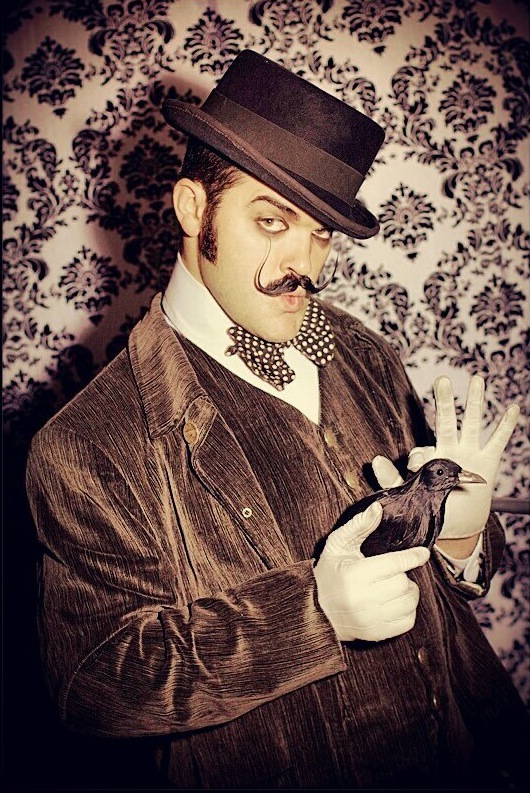
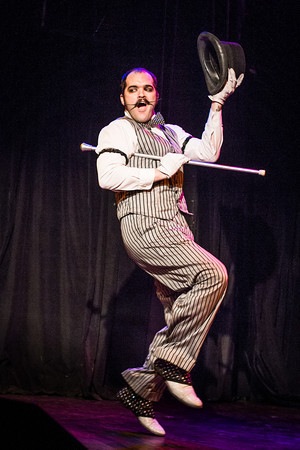
Just a quick glance at the line-up suggests this year will be just as good performance-wise as the first two, if not even better. But we have to admit that we’re especially excited to see Portland, Oregon’s Russell Bruner, reigning King of Burlesque, at the Free Range Burlesque show on Fri. March 22, after seeing him perform at our own Kool Kat Kitty Love‘s first Sultry Sunday of the year back in January. Male exotic dancers may be notoriously boring, but dressed in a pin-stripe seersucker suit, top hat and debonair curled moustache, let’s just say Russell wasn’t just sexy but sassy–really capturing the spirit of the tease in ways that most male dancers simply don’t. Of course, that underlines the essential difference between burlesque, or in this case “boylesque,” and striptease/exotic dance. Burlesque comes from vaudeville and variety and is all about having fun–which, well, they say gals love a guy with a sense of humor.

A little online research revealed that Bruner is a Vancouver, Washington native and Mormon-raised boy who eschewed football for the cheer squad and comes to burlesque via swing dance (He won a trophy at the Balboa Tempo Marathon in 2006) and a stint as the acrobatic Villain of Portland’s Wanderlust Circus. Needless to say, we had to make him Kool Kat of the Week just to find out more about what drew him from a tech career with a dancing hobby to a professional performer, how he developed his unique style, his influences and his act at SFBF!

So you were working for Intel, your job ended and you ran away to join the circus? Is that basically how your career in burlesque/variety got started? 

Well, the electrical engineering field wasn’t too bad. I enjoyed the work, but kept thinking about how if I was ever going to do performance art, I should do it before I get any older.

Russell Bruner, Master of the Hat and Cane Routine. Photo credit: Adam Scherer.

Just about every lady I know thinks there’s nothing duller than watching a Chippendale. You have a completely different look and approach to dancing off your clothes. To what extent do you think that playing against the expected is the key to your success? 

You’re right, I’m no Chippendale. I cater to the audience as I understand them with what I have to offer. I’m not playing against the idea of the Chippendale; I’m just more turned on by men like Gene Kelly, Tom Waits and Ray Bolger.

Your routines remind me of a cross between Fred Astaire – who also danced with a hat rack in a famous number and you’ve said is an inspiration -to ‘20s comedy cinema actors like Buster Keaton or Charlie Chaplin. Did you grow up on classic movies with dance and comedy numbers or when/how did you discover them? How influential are they on your routines? 

I didn’t see very many movies or see much television growing up, but there was this great movie place that I discovered when I first moved to Portland that’s called Movie Madness. They have nearly everything with Fred Astaire, WC Fields, Charlie Chaplin, Buster Keaton, etc. I’ve since taken advantage of the inspiration found there, and in other sources that have old vaudeville acts film.

Were you at all nervous when you first stripped down? Any advice to men who want to do burlesque but are a little shy about it? 

I was nervous about it. Any time I do something in front of an audience for the first time I’m always concerned about things going well. If someone is shy about performing, I think it’s normal and shows they too have concern for doing well.

Who are your inspirations, either male or female, classic or revival, in burlesque?

Aside from the mentioned persons of yesteryear, for males, I am inspired by Leapin’ Louie Lichtenstein, Armitage Shanks, the Stage Door Johnnies, Burlesquire, Tod Alan, Evil Hate Monkey, Mr. Gorgeous, Waxie Moon, Captain Kidd, Curtis Carlyle, Dahktur Sick, Jonathan Burns, Scott Maxwell, Luther Bangert, Nanda, Neil E Dee, Funny Eddie Dot Com, Bobbie Burlesque, Bellini Twins, Charlie Brown the Juggler, Donny Vomit, Scotty the Blue Bunny, Ben Delacreme, Jasper St. James, the cast of Meatfest in LA, the Boxers are Brief Boylesk, William Batty in Wanderlust Circus, and many others. All those are variety performers and not necessarily burlesque. The women that inspire me is a much longer list, so let me get back to you on that when I have more time to list everyone.

Russell Bruner. Photo credit: PEZ Photo.

Where/when was your favorite performance and what made it so special?

My last performance with the Carnivalesque Tour at State Theater in Falls Church, VA, was a recent favorite of mine. It was special because it was the last show of a great run. I had a lot of fun working with Gilded Lily Burlesque & Co., and I really enjoyed the spacious stage with a nice wood floor. I really enjoy performing on stages with nice wood floors.

Without ruining any surprises, what can you tease us about your performance at SFBF? 

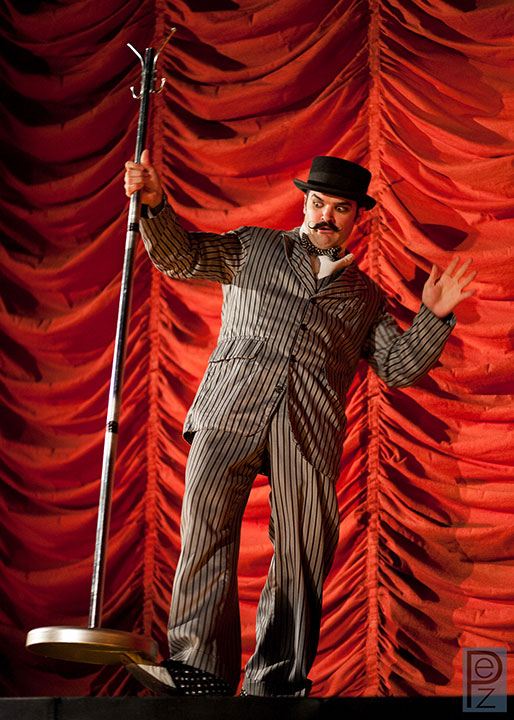
I think we’ve already given away that it involves working a hat rack like Fred Astaire. So other than hanging my hat up, you’ll also see some nice cane work.

What’s the secret of coiffing the perfect moustache? 

I use beeswax. I’m constantly running out of it or losing it as I’m on the road a lot, so I’m constantly using different products that have beeswax in it, and I use a woman’s personal trimmer that looks like a vibrator to trim it. And I just futz with it a lot. I stopped making circles at the ends because I can never get them to match so now I do more of a Salvador Dali type of styling.

Finally, what question do you wish someone would ask you to do but they never do? And of course, what’s the answer? 

I do wish I’d be asked to perform my partner acts more often. It’s harder to fit it in the budget for promoters and sometimes the stages are too small, but I enjoy doing partner acts the most. I would love to perform partner dance acts more often on the road.


Category: Kool Kat of the Week | Tags: , , , , , , , , , , , , , , , , , , , , , , , , , , ,

Atlanta Film Festival Retro Spotlight: THE SAPPHIRES

Posted on: Mar 19th, 2013 By:

Ed. Note: THE SAPPHIRES played Sunday at The Plaza, but with the Atlanta Film Festival running through Sun. March 24, there are still plenty of movies to come. Check out our top Retro picks here.

Retro Review by Andrew Kemp
Contributing Writer

Wayne Blair’s THE SAPPHIRES is a true-life story about race, war, music and love, a tale about four Aborigine women who rose above hatred and tragedy to represent Australia to the world just months after the country began acknowledging their people’s rights. It’s an incredibly compelling story that’s unfortunately resulted in a less than compelling film that distills the events down to their most obvious, predictable bullet points. The movie carries a tune, but there’s no feeling in the song.

Late-60s race relations in Australia weren’t much better than in the United States, and in some respects, the situation in Australia was worse. A government policy (dubiously presented as protecting black culture) endorsed the outright theft of fair-skinned Aborigine children, who were then raised in the cities as whites—the so-called Stolen Generations. Two 1967 amendments to the Australian constitution granted Aborigines a bank of basic human rights, as up to that point, the official position of Australia, dating back to colonization, was that the people were part of the country’s “flora and fauna.” Unfortunately, there as here, progress was slow to change minds. Deborah Mailman, Jessica Mauboy, Shari Sebbens, and Miranda Tapsell star as a quartet of rural Aborigine country and western singers struggling to find a white audience for their music in 1968. An Irish musician (BRIDESMAIDSChris O’Dowd, playing the Buttermaker role of the curmudgeonly drunk) discovers the girls at a talent show, and the group is soon off to Vietnam to entertain the American troops, but not before using a montage to learn the far sexier and, as the movie puts it, blacker sounds of soul music.

Audiences in love with soul will have the most fun with THE SAPPHIRES as the soundtrack of period tunes is by far the most engaging part of the film, and the production doesn’t skimp on period costumes and 60s flair. Unfortunately, as drama, the movie doesn’t offer very much. THE SAPPHIRES is built as a pleasant crowd-pleaser, coasting along on charm and good music, without a hint of dramatic urgency. Blair and Briggs thankfully ditch the band movie tropes, so there’s no big venue the girls are trying to reach, no agent to impress and no money needed to save the farm. But the filmmakers never find another story on which to hang the film’s characters and themes. Instead, once the gang arrives in Vietnam, the story splinters out into a series of romantic subplots that all play out more or less as you expect. Only once in the film do the girls brush up against the reality of war in Vietnam, and the rest of the time is spent romancing soldiers, singing songs and bickering about who’s in charge.

The Sapphires perform. Hopscotch Pictures, 2013.

Which is a shame, because the film does boast some fine performances from actors who deserved more to do. There’s no movie star, no Beyonce, hiding in the group of girls, and so they’re allowed to blend together as a true ensemble. If there is a standout, it’s Mailman, who plays the toughest of the women and the least willing to be bullied by a world that she sees as inherently unjust. She makes for an unlikely and refreshing romantic lead, and her pairing with O’Dowd is charming and believable. Also making an impression is Shari Sebbens as a person struggling with her racial identity after growing up in Melbourne as one of the stolen children, and her racially-charged tension with Mailman’s character provides an occasional dramatic spark.

In fact, THE SAPPHIRES is most affecting when it takes the time to explore the thorny racial issues of the 60s, including one touching scene that shows the reaction in Vietnam to Martin Luther King, Jr.’s assassination, a reminder that the path of racial justice here in the south had many observers around the world. Unfortunately, the film never quite finds its footing in the personal stories as it does in the grander themes. The performances and music are nice enough, but those looking for a deeper or more enriching experience may be disappointed. THE SAPPHIRES is all melody in search of a hook.

Andrew Kemp is a screenwriter and game writer who started talking about movies in 1984 and got stuck that way. He writes at www.thehollywoodprojects.com and hosts a bimonthly screening series of classic films at theaters around Atlanta.

Category: Retro Review | Tags: , , , , , , , , , , , , , , , ,

Third Time’s The Charm: Revival Stars, Legends and Rising Ingenues Add Spice to Southern Fried Burlesque Festival

Posted on: Mar 18th, 2013 By:

Stars both of the Burlesque Revival and of classic tease arrive in Atlanta this week for the third annual Southern Fried Burlesque Festival Thurs. March 21-24 at  the Wyndham Atlanta Galleria. Bras off to Syrens of the South Productions, and in particular Katherine “Lashe” Neslund, with assistance from Ursula Undress, who had a dazzling dream to start a festival in Atlanta.As a lover of classic burlesque but appreciative of the creativity that revival performers show, ATLRetro has to say that the big evening shows at the first two SFBFs were among the best in Atlanta. We loved the chance to see some of the nation’s and Southeast’s best, including legends that sizzled stages in the ’60s and ’70s, without traveling to New York, the West Coast or the Burlesque Hall of Fame. Aspiring performers can take classes taught by these talents on topics ranging from costuming to performance to the history of the art form, as well as shop from a host of vendors selling everything from pasties to vintage items.

Just a quick glance at the line-up suggests this year will be just as good performance-wise, if not even better. First, we have to admit that we’re pretty excited to see Portland, Oregon’s Russell Bruner, reigning King of Burlesque, after getting a peek at him during our own Kool Kat Kitty Love‘s first Sultry Sunday of the year back in January. Male exotic dancers may be notoriously boring, but dressed in a pin-stripe seersucker suit, top hat and debonair moustache, let’s just say Russell wasn’t just sexy but sassy–really capturing the spirit of the tease in ways that most male dancers simply don’t. Of course, that underlines the essential difference between burlesque, or in this case “boylesque,” and striptease/exotic dance. Burlesque comes from vaudeville and variety and is all about having fun–which, well, they say gals love a guy with a sense of humor.

Russell Bruner

OK, yeah, that was a lot of getting hot and bothered about Russell. SFBF 2013 also features a bevy of lovely ladies. Friday night’s all-star Free Range Burlesque will be headlined by Miss Exotic World 2010 Roxi D’lite, who also stars in BURLESQUE ASSASSINS, a Canadian comedy/action indie feature film which will have its Atlanta debut at SFBF. Set in a 1950s Burlesque theatre, it stars top burlesque performers from around the world and and follows a trio of sexy super-spies as they seduce their way within killing distance of a trio of villainy hell bent on global Cold War domination. How can one not want to see a movie whose description provocatively teases: “WITNESS the fatal fan dance of Koko La Douce! BEHOLD the brutal boa striptease of Bombshell Belle! SEE Bourbon Sue, a bad girl with a taste for booze, boys and Rock & Roll. Experience the carnage and the cleavage as the enemies of The Burlesque Assassins discover that when it comes to these women, LOOKS CAN KILL!” Catch the trailer here.

Known for having the “mouth of a sailor” and the “voice of an angel,” Cora Vette will be on hand as pageant mistress of ceremonies on Saturday night. She performed for more than one million guests over three years as Tanya in MAMMA MIA! at the Mandalay Bay Hotel and Casino in Las Vegas. She now runs a burlesque company called Black Box Burlesque and also has a troupe of male burlesque performers called Cora Vette’s Hot Rods. In fact, she may be one of burlesque’s most diverse talents, having also written two burlesque musicals, the critically acclaimed Victorian comic burlesque operetta, LEADVILLE OR BUST! and a pot opera called REEFER MANIA: DENVER’S GONE TO POT.

Cora Vette.

Notorious for her costumes, 2012 Southern Fried Burlesque Queen, Denver’s Orchid Mei, returns. She gracefully combines traditional Chinese dance with influences from classic burlesque femme fatales and has performed with the Dresden Dolls. Also back are last year’s best group, New Orleans’ Slow Burn Burlesque! Atlanta’s own lovely Talloolah Love and Knoxville’s Kisa Von Teasa will be featured performers at the Southern Scorcher showcase, hosted by Minette Magnifique‘s Baroness vonSchmalhausen which also includes Fonda Lingue, Ursula Undress and many more talented performers  from all over the Southeast!

late night Saturday. SFBF’s legends this year are Canada’s Judith Stein and Detroit’s Toni Elling, who will both be performing Friday. And that’s not even counting Atlanta’s New Orleans Jon, who emcees on Friday; all the way from Stockholm, Sweden, Adoria Amoria – if you had any doubt that the revival had reached Scandinavia; Knoxville’s Sweet Little Psycho Kisa Von Teasa, and many more.

Here’s a quick rundown of SFBF daily highlights:

Thursday March 21

SFBF kicks off with a happy hour mixer, which also will double as the monthly meet-up of the Atlanta Burlesque & Cabaret Club from 6 p.m. to 8 p.m., then get a sneak peek at burlesque’s future stars at the Just Hatched Newcomers Showcase and watch the Atlanta premiere of BURLESQUE ASSASSINS at 10 pm.

Friday March 22

The festival teases into full gear with classes and vendors during the daytime, the Free Range International Showcase headlined by Roxi D’lite and featuring performances by local and national stars at 9 p.m. and an after-party at 11:30 p.m with music by Till Someone Loses An Eye featuring Kool Kat Aileen Loy and Good Golly Svengali.

Judith Stein.

Saturday March 23

Take classes and shop the vendors’ market during the daytime, then see some of the south’s and nation’s finest compete in the Southern Fried Burlesque Pageant, at 8 p.m. It’s hosted by Cora Vette with farewell performances by last year’s winners Orchid Mei and New Orleans’ Slow Burn BurlesqueThen close out the night with the Southern Scorcher Showcase at 11:30 p.m. featuring Talloolah Love, Kisa Von Teasa, Fonda Lingue, Ursula Undress and many more talented performers  from all over the Southeast!

Sunday March 24

Get your final shopping done and catch up with the performers before they leave town.

To purchase advance tickets and peruse the full class and event schedule with performer bios, visit www.southernfriedburlesquefest.com/. And for the latest updates and extras, be sure to friend SFBF on Facebook and follow on Twitter

All photographs are courtesy of Southern Fried Burlesque Festival and the performers pictured.

Category: Features | Tags: , , , , , , , , , , , , , , , , , , , , , , , , , , , , , , , , , , , , ,

© 2025 ATLRetro. All Rights Reserved. This blog is powered by Wordpress