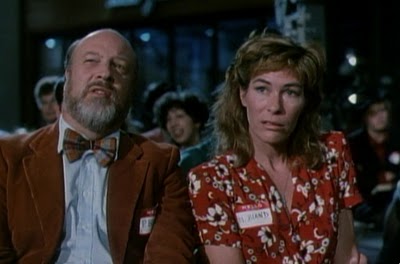
RETRO REVIEW: Splatter Cinema and the Plaza Theatre Unearth a Blood-Soaked Valentine With CEMETERY MAN!

Posted on: Feb 9th, 2014 By:

CEMETERY MAN (1994); Dir. Michele Soavi; Starring Rupert Everett, Anna Falchi and François Hadji-Lazaro; Tuesday, February 18 @ 9:30 p.m. (photos and merch table open @ 9:00 p.m.); Plaza Theatre; Trailer here.

By Aleck Bennett
Contributing Writer

Bringing classic gore flicks back to life is the mission of Splatter Cinema, and this Tuesday’s engagement at the Plaza Theatre is a special one indeed: Michele Soavi’s brilliant CEMETERY MAN!

Along with his compatriot, Lamberto Bava (son of the legendary filmmaker Mario Bava), director Michele Soavi breathed a bit of life into the twitching corpse of the Italian horror renaissance kicked off by Dario Argento and Lucio Fulci. Both worked under Argento as assistant/second unit directors, while Soavi took on acting roles in a number of Italian horror films as well (that’s him as the metal-faced mystery guy in DEMONS and as the boyfriend forced to watch his girlfriend puke up her intestines in CITY OF THE LIVING DEAD). And while Bava’s films typically went for the blunt, straight-ahead shocks of DEMONS and gialli like DELIRIUM, Soavi typically gravitated toward the surrealistic and fantastic elements of SUSPIRIA and THE BEYOND. 1989’s THE CHURCH and 1991’s THE SECT—both made under the auspices of Dario Argento’s production—both showed the kind of promise that he held as a filmmaker, but were hindered by scripts that drew too freely from highly influential works (THE CHURCH hews closely to Argento’s SUSPIRIA and INFERNO, while THE SECT is ROSEMARY’S BABY redux).

But once out from under his mentor’s wing, Soavi soared with perhaps the last great film of the Italian new wave of horror, CEMETERY MAN (released in Italy with the much better title, DELLAMORTE DELLAMORE, a pun on the main character’s name which translates as either “about death and about love” or “about the death of love”).

Francesco Dellamorte is the caretaker of the Buffalora cemetery, assisted by his mentally handicapped assistant Gnaghi, who can only speak the syllable “gna.” Dellamorte’s humdrum life consists of maintaining the grounds, crossing out the names of the dead from phone books and killing the reanimated corpses that rise after seven days of interment…all of which he undertakes with the same bored stoicism. It’s a job, after all, and shooting the zombies is easier than going through the paperwork needed to get any help. When he becomes infatuated with a young widow and Gnaghi falls for the mayor’s daughter, however, things take a turn for the worse.

Soavi’s film is full of delightfully dark comedy and the kind of atmosphere the Italian horror scene hadn’t witnessed in years, comparable to the best of Bava, Fulci and Argento. The tone and visuals not only echo the best of Italo-horror, but also the best of Terry Gilliam’s works—no surprise, as Gillaim devotee Soavi was second unit director on 1988’s THE ADVENTURES OF BARON MUNCHAUSEN and reportedly shot about a quarter of that film. Rupert Everett is especially effective as Dellamorte, bringing the right amount of pathos and longing to his dour role, while still delivering believable doses of sarcasm, wit and violence. And while the film isn’t quite as graphically violent as many of its Italian zombie counterparts, its effects (by maestro Sergio Stivaletti) are expertly pulled off.

It’s a rare film that can combine detailed character study, an exploration of the joys and pain of love and romance, rollicking comedy, explosive violence and the inevitable reanimation of the dead. But CEMETERY MAN is it. If just about anyone else tried to do it, it would likely come out as pretentious and scattershot, but Michele Soavi is the man who proved it could be done and done successfully.

Unfortunately for the Italian horror film scene and its fans, Soavi retired from feature film work after CEMETERY MAN to care for his ailing son, though he took on some television work in the years following. And while rumors of a return to horror have been suggested (with news of a potential sequel to CEMETERY MAN floated over the past two years), Soavi’s resurrection remains something the faithful still anticipate with bated breath.

Aleck Bennett is a writer, blogger, pug warden, pop culture enthusiast, raconteur and bon vivant from the greater Atlanta area. Visit his blog at doctorsardonicus.wordpress.com

Category: Retro Review | Tags: , , , , , , , , , , , , , , , , , , , , , , , , , , , , , ,

Retro Review: LAWRENCE OF ARABIA Was Made for the Big Screen: Why You Will Be at The Plaza Theatre, It Is Written

Posted on: Jan 1st, 2014 By:

LAWRENCE OF ARABIA (1962); Dir. David Lean; Starring Peter O’Toole, Omar Sharif, Alec Guinness, Anthony Quinn, Anthony Quayle, Claude Rains, Jack Hawkins; FIVE NIGHTS ONLY! Wed. Jan. 1 –  Sun. Jan. 5 at 7:15 pm; Plaza Theatre; Trailer here.

By Andrew Kemp
Contributing Writer

When Peter O’Toole passed away on December 14, blogs everywhere became choked with memorial blurbs and retrospectives, and not without reason. O’Toole was, no question, one of the greatest and most legendary personalities in the movies. Full stop.

However, one recurring theme I noticed on these sites was the offering of the little-known gem, some less-traveled, cultier role of O’Toole’s sent forth to remind fans that the actor was much, much more than just his most famous roles. And while, yes, films like MY FAVORITE YEAR, THE STUNT MAN and THE RULING CLASS certainly make the case for O’Toole as an actor of tremendous charisma and power—my apologies to fans of KING RALPH—there seemed a conscious effort by writers to ignore the big drunken, happy, English elephant in the room: O’Toole’s work in LAWRENCE OF ARABIA. Writers either assumed their readers were already familiar with LAWRENCE or that they would turn up their nose at what has, unfortunately, become something of a cinematic vegetable one has to power through at some point in life. Ignoring the suspicious notion that LAWRENCE is still much-watched and enjoyed by today’s younger generations, if only one movie can summarize O’Toole’s greatness, that movie has to be LAWRENCE OF ARABIA, doesn’t it? While each of those films I named above has its strengths and merits, they’re all, by definition, weaker examples of O’Toole’s brilliance because, quite simply, LAWRENCE OF ARABIA is one of the greatest films ever made, and O’Toole in it gives maybe the most electric star-making performance in the history of the art form. It’s LAWRENCE. It always had to be LAWRENCE.

LAWRENCE OF ARABIA (1962) is the kind of movie that sounds like dull dirt on paper (or, in this case, dry sand), ostensibly a biography film of the war hero T.E. Lawrence, an officer who united feuding groups of Arabs against the Ottoman Empire during the first World War. Lawrence was a larger-than-life figure whose exploits defied reality, and so the job of capturing this British hero’s story on film fell to that great British director David Lean. Lean had made his name with intimate family dramas and Charles Dickens adaptations, but three straight films [THE BRIDGE ON THE RIVER KWAI (1957); LAWRENCE OF ARABIA (1962); DOCTOR ZHIVAGO (1965)] would link him forever with the screen epic. Lean’s film jettisons the usual biographical bookending and fixates on the key years of Lawrence’s military campaign, his victories, his struggles and the eventual failure of his plan to save Arabia for the Arabs.

Peter O'Toole and Anthony Quayle in LAWRENCE OF ARABIA (1962)

But the movie is far more than the sum of its plotline. It’s not quite accurate to say that one could watch LAWRENCE OF ARABIA and ignore the war scenes, but it certainly feels like that’s the case. Lean is less interested in the deeds than he is in the land, and he shoots the desert not as a desolate or alien place, but with awe, majesty, and romance. Coupled with one of the all-time best musical scores from Maurice Jarre, LAWRENCE is an achievement in image, one of the landmark films of cinematography. The movie is never, at any point, anything but staggering to look at.

But then there’s Peter O’Toole, an actor so grandiose as to make the desert seem small. Although Lawrence was shot in a time of method acting and cinematic naturalism, that’s not O’Toole. He’s an actor of extreme mannerism and crisp efficiency, and his clear, sad blue eyes seem to be an incongruous fit for the brutality around him. And yet he’s grander than the desert and the war combined, striding across the landscape in great strokes and changing the fate of a continent with his whims. Ridley Scott’s PROMETHEUS (2012) supposed that the robots of the future might look to Peter O’Toole for inspiration on how to dress and behave, and there’s crystalline truth in that idea—O’Toole’s Lawrence is at once an ideal human, but also another kind of being. He’s mythic, synthetic. His gravity is so large that overshadows the other great actors who surround him. Anthony Quinn, Alec Guinness, Claude Rains—all are just notes surrounding O’Toole’s Lawrence. Without him, the desert is empty. Without O’Toole, the movie falls apart. Although he had a tremendous career, O’Toole would never again transcend a role in quite the same way.

Peter O'Toole in LAWRENCE OF ARABIA (1962)

I’ve watched LAWRENCE OF ARABIA many times on DVD, and I’ve had the great fortune to have seen the film three times on the big screen, once in its intended 70mm projection. If there was ever a single, undefeatable argument for the magic of cinema trumping the convenience of a living room couch, it is LAWRENCE OF ARABIA. Watching LAWRENCE properly projected, with a booming sound system, is like finally getting a glance at that “window to another world” nonsense the Oscars roll out every year in their self-serving montages. (That O’Toole was snubbed for his work in this film and, indeed, each and every subsequent film he made reminds us that movie awards are, fundamentally, bullshit.) At the time of its production, it was inconceivable that the film would ever be seen on home video or, god forbid, your tiny phone screen. Every choice of lens, frame and composition was made with the assumption that the audience would be confronted with a giant screen and have no choice but to lose themselves in the scale. More than almost any other film, LAWRENCE OF ARABIA suffers outside of its intended environment.

If you’ve seen the film, nothing I’ve just written is a surprise. I’m speaking to the people who haven’t seen it, who have somehow lumped LAWRENCE in with CITIZEN KANE (1941) (another great film unfairly burdened with the label of “great”) as a bit of cinema homework they’d rather put off until the mood is right. But LAWRENCE OF ARABIA is no vegetable, it’s a 12-course meal. And on the big screen, in our contemporary multiplex environment of cinematic sameness and digital paintbrushes, LAWRENCE OF ARABIA reminds us of cinema’s power to transform and ignite the passions of its audience. The film, anchored by this best performance from a much-missed legend, remains a fresh drink of water in what sometimes seems an endless sea of sand.

Andrew Kemp is a screenwriter and game designer who started talking about movies in 1984 and got stuck that way. He can be seen around town wherever there are movies, cheap beer and little else. 


Category: Retro Review | Tags: , , , , , , , , , , , , , , , , , , ,

A Very White Christmas in Atlanta: The Plaza Lets It Snow with Two Bing Crosby/Irving Berlin Christmas Classics

Posted on: Dec 20th, 2013 By:

HOLIDAY INN (1942); Dir. Mark Sandrich; Starring Bing Crosby, Fred Astaire and Marjorie Reynolds; Friday, Dec. 20 – Wednesday, Dec 25 (visit the Plaza Theatre website for times and ticket prices); Plaza Theatre; Trailer here.

WHITE CHRISTMAS (1954); Dir. Michael Curtiz; Starring Bing Crosby, Danny Kaye, Rosemary Clooney and Vera-Ellen; Wednesday, Dec 25 – Tuesday, Dec 31 , in repertory with MIRACLE ON 34TH STREET (1947) (visit the Plaza Theatre website for times and ticket prices); Plaza Theatre; Trailer here.

By Aleck Bennett
Contributing Writer

How much Bing is too much Bing? Trick question. There can’t be enough Bing this time of year. So when the Plaza Theatre offers up Der Bingle in HOLIDAY INN and WHITE CHRISTMAS—teamed with stars like Fred Astaire, Rosemary Clooney, Vera-Ellen, Danny Kaye and Marjorie Reynolds and built around numbers by the legendary Irving Berlin—well, it’s a Christmas present for every classic Hollywood musical lover.

In 1940, songwriter Irving Berlin came to Paramount Pictures with an idea he’d first toyed with after writing the song “Easter Parade” in 1932: a film set at an inn open only on holidays, featuring a series of different holiday-themed musical numbers. Fred Astaire and Bing Crosby—both riding high on waves of popularity—were quickly attached to the project, and filming began on November 1941. However, despite its reputation (and that the film begins and ends during the holidays), the film isn’t really a Christmas film at all. It’s the tale of a love triangle between Jim Hardy (Bing Crosby, as the retired stage performer who runs Holiday Inn), Ted Hanover (Fred Astaire, as Jim’s caddish former performing partner on a path set for stardom) and Linda Mason (Marjorie Reynolds, as the inn’s featured performer and Jim’s love interest, who is tempted by the future of fame and fortune promised by Ted).

Furthermore, while the song “White Christmas” is featured three times (once in the opening credits, twice in the film itself), its appearances are dictated more by the dramatic developments of the plot than to evoke memories of Christmases past or holidays longed for in the future. In fact, the song was unpopular at first (being released in the middle of summer might have had something to do with that) and was overshadowed by another song from HOLIDAY INN. “Be Careful, It’s My Heart.” Crosby himself was initially indifferent to the song, simply saying “I don’t think we have any problems with that one” when first hearing it. (Irving Berlin, on the other hand, was more enthusiastic, calling out to his secretary “Grab your pen and take down this song. I just wrote the best song I’ve ever written—heck, I just wrote the best song that anybody’s ever written!”)

By the end of October, things had changed. The song skyrocketed to the top of the “Your Hit Parade” chart where it sat until the new year dawned. It also nabbed the “Best Song” Oscar in the 1942 Academy Awards. To date, it is the best-selling single of all time. (There’s some dispute over that, however: because standard record charts weren’t in existence when Crosby’s single was released, there’s a lack of hard info on just how many copies were sold. As a result, some have claimed that Elton John’s “Candle in the Wind 1997” holds that title at 33 million copies sold. However, Guinness World Records—after extensive examination—concluded that the single had sold 50 million copies as of 2007, thus beating out Elton.)

As a result, the film has become somewhat pigeon-holed as a Christmas staple, even though little of the film takes place during that holiday (the Fourth of July seems to take a much more prominent role, due to the bombing of Pearl Harbor plunging the country into war during the filming). What the film lacks in explicit Christmas content, though, it more than makes up in the fantastic performances of Bing Crosby and Fred Astaire. Berlin’s music is tailor-made to be sung with the easy-going elegance of the film’s stars, and Astaire is at the top of his game during the film’s dance sequences. Marjorie Reynolds is a standout dancer and utterly convincing as the aspiring performer Linda (though her singing was dubbed by Martha Mears). The film is crisply directed with a sure hand by Mark Sandrich, a veteran of numerous Fred Astaire/Ginger Rogers musicals, and his camera showcases the musical performances beautifully.

Because the film was such a success, and because people just kept buying that Bing single, Paramount decided to return to the well again 12 years later with the film WHITE CHRISTMAS. It was intended to be the third Crosby/Astaire/Berlin feature (after 1946’s BLUE SKIES), but Astaire passed on the script. Crosby did, too, deciding to spend time at home after the death of his wife. When Bing returned to the project, finding a co-star proved problematic. Donald O’Connor was slated to take Astaire’s role, but suffered an injury prior to filming, so Danny Kaye stepped in at the last minute.

Determined to take full advantage of “White Christmas”’s perennial popularity, Paramount decided that the entire film should take place at the holidays. This time, the plot revolves around two ex-Army men who have made it big in show biz after WWII (Crosby and Kaye). They find themselves tangled up in a romance with two aspiring singer/dancers (Rosemary Clooney and Vera-Ellen) and a deal to perform a new show at a ski resort run by their former commander over Christmas. However, when the winter proves unusually warm and no snow is due on the forecast, the resort’s future is in jeopardy and the team step in to try to save the day.

Keeping in line with the song’s continued success, the film was the top moneymaker of 1954, bringing in almost twice as much as its closest competitor, THE CAINE MUTINY. And why not? It’s hard to go wrong with such an appealing cast and such a great set of Irving Berlin tunes. However, I feel it lacks the dramatic edge of HOLIDAY INN, and while it may be a more traditional Christmas movie, it errs on the side of schmaltz a little too often for my taste. Danny Kaye makes for a particularly saccharine replacement for Astaire, replacing Astaire’s lean elegance for a cloying sweetness.

But on the plus side, Crosby’s as on as he ever was (though he’s a bit long in the tooth by this point to be the love interest of Rosemary Clooney, some 25 years his junior), and Clooney and Vera-Ellen are both incredibly engaging. Director Michael Curtiz brings his trademark flair for inventive camera set-ups and capturing the emotion of a scene to the proceedings and makes the film—Paramount’s first shot in the widescreen VistaVision process—a visual delight. My small criticisms aside, the film is undoubtedly worthy of inclusion in the pantheon of great Hollywood musicals, and is a bona fide Christmas classic.

With the holidays as hectic as they are, it’s important to take the time to cool down. And here’s a perfect excuse to do just that. Simply sit back at the Plaza and let the glorious tunes of Irving Berlin and the incomparable pipes of Bing Crosby carry you away to a White Christmas of your own.

Aleck Bennett is a writer, blogger, pug warden, pop culture enthusiast, raconteur and bon vivant from the greater Atlanta area. Visit his blog at doctorsardonicus.wordpress.com

Category: Retro Review | Tags: , , , , , , , , , , , , , , , , , , , , , , , ,

Mall Insecurity: Just A Few More Chopping Days Left Until Splatter Cine-mas at the Plaza Theatre

Posted on: Dec 9th, 2013 By:

Splatter Cinema presents CHOPPING MALL (1986); Dir. Jim Wynorski; Starring Kelli Maroney, Tony O’Dell, Russell Todd, Barbara Crampton, Dick Miller, Paul Bartel and Mary Woronov; Tuesday, Dec. 10 @ 9:30 (photos and merch table open @ 9); Plaza Theater; Trailer here; Facebook Event Page here.

By Aleck Bennett
Contributing Writer

In the middle of the holiday season, when shopping centers are teeming with masses of bargain-hungry consumers, who doesn’t wish that a few bloodthirsty killbots could be unleashed to thin out the crowds? Look no further than the Plaza Theatre for some vicarious thrills as Splatter Cinema presents CHOPPING MALL!

You know, there was a time when a Jim Wynorski movie meant something. Granted, it didn’t mean much. But you knew what you were getting when you saw his name on the screen—an exploitation movie that didn’t take itself seriously in the least, and that sent itself and the genre up for affectionate ribbing. In short, a kind of low-rent Joe Dante flick (which makes sense, as both directors came from the benches of Roger Corman’s New World Pictures farm team). This is best exemplified in his two most fully-realized movies: his 1983 feature debut THE LOST EMPIRE (a comic variation on THE MOST DANGEROUS GAME but with a lot more nudity) and his more successful follow-up, CHOPPING MALL.

CHOPPING MALL answers the age-old question, “what would happen if mall security was handled by robots, and a freak lightning storm caused them all to go kill-crazy on a bunch of teens partying in a furniture store after-hours?” This question has plagued theologians, philosophers and scientists for centuries, and finally found all of its potential ramifications explored in full, rich, intellectual detail in the hands of Jim Wynorski. The answer, of course, is “well, the kids would start dying in hilariously bloody ways, and it would look a lot like DAWN OF THE DEAD if, instead of zombies, there were really cheap robots that looked kind of like Number 5 from SHORT CIRCUIT, yet acted like the ED-209 from ROBOCOP.”

Paul Bartel and Mary Woronov in CHOPPING MALL (1996).

Wynorski’s direction is perfectly adequate for this. It’s not pushing any envelopes or even trying to be groundbreaking in any way, but it’s tight and well-paced, creating a fun sense of tension while at the same time allowing you to chuckle at the complete outlandishness of it all. The movie hides its cheapness reasonably well, making the most of its Sherman Oaks Galleria setting, and features a host of familiar faces to distract you from the low budget. Among the teens getting slaughtered are Kelli Maroney from NIGHT OF THE COMET, Tony O’Dell from HEAD OF THE CLASS, FRIDAY THE 13TH PART 2’s Russell Todd and scream queen Barbara Crampton of RE-ANIMATOR and FROM BEYOND fame. Cameos are provided by the always-welcome Dick Miller (as Walter Paisley, his character name from A BUCKET OF BLOOD) and the delightful team of Paul Bartel and Mary Woronov, reprising their roles of EATING RAOUL’s Paul and Mary Bland.

In short, CHOPPING MALL is just a whole hell of a lot of fun, and one of the better (and bloodier) ways to blow off steam this time of year. If you want to turn your over-taxed, shopped-out brain off and have a riotously good time, you could hardly do better than watching a shopping mall turn against the idiots populating it. And don’t forget to show up early and get your photo taken in a gore-filled recreation of one of the movie’s scenes! It truly is the most wonderful time of the year.

Aleck Bennett is a writer, blogger, pug warden, pop culture enthusiast, raconteur and bon vivant from the greater Atlanta area. Visit his blog at doctorsardonicus.wordpress.com

Category: Retro Review | Tags: , , , , , , , , , , , , , , , , , , , , , , , , , , , , , ,

Bring Me the Fangs of Alfredo Garcia: Splatter Cinema’s November Movie JOHN CARPENTER’S VAMPIRES Features Some Badass Bloodsuckers But Is a Better Western Than a Horror Movie

Posted on: Nov 11th, 2013 By:

Splatter Cinema presents JOHN CARPENTER’S VAMPIRES (1998); Dir. John Carpenter; Starring James Woods, Daniel Baldwin and Sheryl Lee; Tuesday, Nov. 12 @ 9:30 p.m. (pictures and merch table open @ 9:00 p.m.); Plaza Theatre; Trailer here.

By Aleck Bennett
Contributing Writer

Still feeling unsatisfied after all of the horrors that Halloween and the Buried Alive! Film Festival had to offer? Not a problem! Splatter Cinema and the Plaza Theatre keep the gore flowing with their presentation of JOHN CARPENTER’S VAMPIRES! Turn up early to have your photo taken in a recreation of one of the film’s tableaux and check out the merch table!

Okay. Let’s be honest: the end of the 1980s was probably the worst thing that could have happened to John Carpenter. After a decade and a half of superior filmmaking—capped off by 1988’s savage and darkly comic take on Reagan’s America, THEY LIVE—the road suddenly became very bumpy for the director. Misfires like 1992’s MEMOIRS OF AN INVISIBLE MAN, 1993’s Showtime Networks project BODY BAGS and 1995’s VILLAGE OF THE DAMNED were interspersed with deliberate attempts to recapture past glories. 1995’s IN THE MOUTH OF MADNESS, surprisingly, worked; it succeeded in closing off his Lovecraftian “Apocalypse Trilogy” which began with THE THING and continued with PRINCE OF DARKNESS. But his re-teaming with Kurt Russell on 1996’s ESCAPE FROM L.A. was hardly a patch on ESCAPE FROM NEW YORK. It wasn’t even 1990: THE BRONX WARRIORS, for crying out loud. And when a quickly-made cash-in knock-off by Enzo G. Castellari is a more entertaining follow-up than the official one, then something is rotten in the state of Carpenter. Realizing that he just wasn’t having fun making movies anymore, John Carpenter decided to retire.

Why, then, did Carpenter change his mind after just two years and film an adaptation of John Steakley’s VAMPIRE$? He largely rejected the plot of the source novel, and pretty much tossed aside the two screenplay drafts that were offered to him, so it wasn’t the story that pulled him back into the game. A good guess is that he saw this as a chance to once again have fun. And how? By making the western that he’d always wanted to make.

He’d attempted to make a western once before with his second feature, ASSAULT ON PRECINCT 13. It was originally set in the Old West as a cross between RIO BRAVO and NIGHT OF THE LIVING DEAD. However, budgetary restrictions forced him to update the scenario to a present day urban setting. And while Carpenter had long integrated elements from his favorite western filmmakers into his work (Howard Hawks, John Ford and Sergio Leone among them), he had never explicitly returned to the genre. VAMPIRES’ Southwestern setting and revamping (no pun intended) of a “hired guns” trope allowed him to explicitly return to his own favorite genre.

The storyline is relatively simple. A crack team of Vatican-backed vampire hunters takes out a cell of vamps holed up in a New Mexico house. Afterward, an ambush back at their motel leaves only the team’s leader, Jack Crow (James Woods), his partner Tony Montoya (Daniel Baldwin) and a prostitute (Sheryl Lee). Crow pulls together a new team in order to take out the vampire’s leader and his army. There’s some supernatural gussying-up going on (the vamps are after an ancient relic, there’s a climactic exorcism ritual as a plot turn), but as you can see, this is largely a “cowboys vs. Indians” story disguised as a horror movie.

Is it successful? Well, not entirely. It actually makes a fairly good run at turning THE WILD BUNCH into a horror flick, its action sequences are well-staged and deftly shot, it sports a typically good score from Carpenter and it’s more lively than almost anything Carpenter had done in the decade following THEY LIVE. But the leads are woefully miscast. James Woods is sufficiently vicious as a hired killer, but—let’s face it—there’s nobody among us that wouldn’t have rather seen Kurt Russell as the lead of this John Carpenter horror/western hybrid. Daniel Baldwin is…well…Daniel Baldwin, as unfortunate as that might be, and Sheryl Lee is merely okay in her role as Katrina, the prostitute-turned-vampire. But they’re all serviceable in their roles; it’s not like any of them are really bad actors. They’re just not quite right for the project. So while all of this may make this sound like it’s just one of Carpenter’s weaker films, why is it so poorly regarded?

Ultimately, JOHN CARPENTER’S VAMPIRES falls victim to its placement in his filmography. It came at the end of a “lost decade” of sorts, when his career needed a severe revitalization, and when he desperately needed to make an Important John Carpenter Film. And this movie is blissfully unimportant. Carpenter just wanted to have some fun once again, and if it had landed somewhere around BIG TROUBLE IN LITTLE CHINA in his oeuvre, it would be seen as a nice little detour. Not a damaging entry into his work history, just a fast-paced bit of vampire killing with western flair. But in the context of his career, it was the wrong movie at the wrong time.

So, my advice is this: take the movie out of context. Forget what Carpenter needed, and focus on what it is: a beer-drinking, hell-raising, rip-snorting, ass-kicking, heart-staking, head-cutting, over-the-top, balls-out bit of fun. Don’t even look at it as a horror movie. Because it’s really not, once you get past the surface. Look at it as a blood-soaked action/western with vampires as the villains and James Woods chewing up the scenery like it was made out of cheeseburgers. And have a ball, because everyone making it appears to have been having one.

And thank your lucky stars that it’s not GHOSTS OF MARS.

Aleck Bennett is a writer, blogger, pug warden, pop culture enthusiast, raconteur and bon vivant from the greater Atlanta area. Visit his blog at doctorsardonicus.wordpress.com

Category: Retro Review | Tags: , , , , , , , , , , , , , , , , , , , , , , , , , , , , , , , , , , , ,

Step Right Up to CARNIVAL OF SOULS, Just One of a Macabre Menagerie of Movies at the Plaza Theatre’s October FrightFest

Posted on: Oct 16th, 2013 By:

CARNIVAL OF SOULS (1962); Dir. Herk Harvey; Starring Candace Hilligoss and Sidney Berger; Friday, Oct. 18 @ 9:30 p.m.; Saturday, Oct. 19 @ 5:30 p.m. & 7:20 p.m.; Plaza Theatre; Trailer here.

By Aleck Bennett
Contributing Writer

During the Plaza Theatre’s week-long celebration of classic horror, a number of legendary films are being shown, including NOSFERATU, WHITE ZOMBIE, FRANKENSTEIN and THE INVISIBLE MAN. But sandwiched in there is a film that dwelled in relative obscurity for years before home video led to its rediscovery and reappraisal: Herk Harvey’s incredible CARNIVAL OF SOULS.

The film’s plot is deceptively slim. Church organist Mary Henry (Candace Hilligoss) and her two girlfriends are challenged to a drag race over a rickety bridge, and plunge into the river below. While the police drag the river for the remains, Mary emerges with no knowledge of how she survived. Upon leaving the town of Lawrence, Kansas, for Utah, she starts experiencing supernatural events that grow in intensity. She sees haunting visions of a ghoulish, pasty-faced man everywhere she goes. A nearby abandoned carnival pavilion seems to be pulling her toward it. And, eventually, she begins experiencing states where she becomes literally detached from her surroundings—nobody can see or hear her. These all seem to be leading her to an inevitable fate, as she is continually beckoned to take her rightful place among the dead in the Carnival of Souls.

The bones of the story may seem familiar if you’re a fan of old-time radio or THE TWILIGHT ZONE. A similar tale was first told on THE ORSON WELLES SHOW in 1941. “The Hitch-Hiker” took place on a cross-country drive, after the narrator (Ronald, played by Welles) has a car accident following a blow-out. After getting his tire fixed, he sees the same haunting hitchhiker motioning to him at various points on his journey. Nobody he encounters sees the strange man, yet the hitcher continues to appear along his route. At a stop, he calls home only to receive the news that he never survived that accident, and realizes that the hitcher is Death himself, waiting for him to accept his fate and move on. The story was a radio staple for years, and was later adapted by Rod Serling for TWILIGHT ZONE, with Inger Stevens in the lead role of “Nan.”

The story of a person who should have died—who may, in fact, be dead as the story proceeds—is not an original one, and has been seen many times before and since CARNIVAL OF SOULS. From Ambrose Bierce’s 1890 short story “An Encounter at Owl Creek Bridge” to 1990’s JACOB’S LADDER and 2001’s MULHOLLAND DRIVE, and from 1983’s SOLE SURVIVOR to 1999’s THE SIXTH SENSE, the basic story proves to be still-fertile ground.

But few have done it as well as CARNIVAL OF SOULS.

Herk Harvey, an industrial filmmaker based in Lawrence, came up with the film’s premise as he passed the then-closed Saltair Pavilion on his way to Salt Lake City. To set his film apart, he claims to have wanted to achieve “the look of a Bergman, the feel of a Cocteau.” His atmospheric lighting and high-contrast cinematography come about as close to that as one can achieve on a $33,000 budget. The film is one of those rare “dreamlike” movies that earns its name. The looming camera angles and the oppressive feeling of dread that accompanies her strange visions translate Mary’s sense of feeling trapped in some otherworldly web to the screen with incredible effectiveness. CARNIVAL’s organ score also adds to the disorienting effect of the film. The textual reason for its presence is an explicit reference to Mary’s profession, but its unconscious association is with silent film. And the intrusion of something from another time or place (the specter of death, the abandoned pavilion) into our present is one of the main conflicts that defines the atmosphere of the movie.

Lee Strasberg-trained star Candace Hilligoss also deserves strong praise, as she carries the entire weight of this film. She has the task of making the character of Mary Henry—who is extremely distancing and unsympathetic—into a character that we fear for. Hers is not a character that we immediately identify with. Everyone that reaches out to her gets pushed away (some deservedly so), and yet we eventually identify with her growing need to connect. As her supernatural experiences become more and more frequent, she suddenly finds that she needs these people. They’re at least less unnerving than that strange man she keeps seeing.

The movie was relegated to the bottom half of double bills upon release, and while late-night broadcasts inspired a small cult of film buffs to take cues from it, CARNIVAL’s quiet approach to horror kept the film from spreading far outside those numbers. It wasn’t until 1989, with the debut of the film on VHS, that people really began to take notice. New prints were struck and screened at art-houses and film festivals across the country, and Herk Harvey—who had continued to be a successful industrial movie maker and film instructor—was finally able to see his only feature film gain the kind of respect and acclaim that it had long deserved.

Herk Harvey joined the Carnival in 1996.

This is not a movie to be slept on. It’s a small, haunting masterpiece of horror cinema that was almost forgotten. It’s the kind of re-discovery that you wish would happen more often. Feel that pull? It’s the call of the Plaza, drawing you into this CARNIVAL OF SOULS. Care to dance?

Aleck Bennett is a writer, blogger, pug warden, pop culture enthusiast, raconteur and bon vivant from the greater Atlanta area. Visit his blog at doctorsardonicus.wordpress.com

Category: Retro Review | Tags: , , , , , , , , , , , , , , , , , , , , , ,

Splatter Cinema and the Plaza Theatre Deliver a Night of Horror with DAWN OF THE DEAD!

Posted on: Oct 8th, 2013 By:

Splatter Cinema presents DAWN OF THE DEAD (1978); Dir. George A. Romero; Starring Ken Foree, Gaylen Ross, David Emge, Scott Reninger and Tom Savini; Tuesday, Oct. 8 @ 9:30 p.m. (photo and merch table open @ 9 p.m.); Plaza Theatre; Trailer here.

By Aleck Bennett
Contributing Writer

It’s here! The season of Samhain is upon us, when the veil between the living and the dead is at its thinnest. And in acknowledgement of that, Splatter Cinema rips the veil asunder and brings the living dead directly into the Plaza Theatre with a screening of George Romero’s epic masterpiece of massacre, DAWN OF THE DEAD!

“When there’s no more room in Hell, the dead will walk the earth.”

There are zombie movies, and there are Zombie Movies. And George Romero is the architect—directly or indirectly—of almost every one of them made after 1968.

1968 saw the director change the very definition of the word zombie (though it’s not uttered a single time) with his classic NIGHT OF THE LIVING DEAD. Before his ghouls stalked the screen, the cinematic zombie was tied closely to the mythology of Haitian voodoo: reanimated corpses brought back through ritual and acting as tools under the control of a powerful magician. But Romero’s stark vision cast off those supernatural chains. His zombies were still reanimated corpses, true, but his were under no man’s thrall or control. They shuffled across the landscape with a single goal: to feast on the flesh of the living. And unlike traditional zombies, they multiplied in number; every person wounded (but not consumed) by the walking dead became one of them. And any corpse whose body was not destroyed was resurrected and became part of their number.

And whether intentional or not, NIGHT introduced an aspect of social criticism to the subgenre. Star Duane Jones became the first African-American horror hero, and his mere presence added a layer of subtext to the film. And with its graphic violence coming on the heels of the “Summer of Love,” NIGHT seemed to speak to both the horrors witnessed regularly on the nightly news as the Vietnam War continued unabated, and to the spread of mindless violence present in American society.

In the interim, countless number of filmmakers followed in Romero’s footsteps with varying degrees of success. And while some did attempt to tie the supernatural back into the equation (Lucio Fulci’s ZOMBI 2 and Bob Clark’s CHILDREN SHOULDN’T PLAY WITH DEAD THINGS being notably among them), even those tended to stick with Romero’s zero-sum “the living vs. the dead” equation.

A decade later, DAWN OF THE DEAD upped the ante on NIGHT considerably.

DAWN takes place shortly after the events of NIGHT (though time-adjusted to the late 1970s), and picks up as the living dead seem to be gaining the upper hand. SWAT teams are being utilized to clean up dead-infested urban areas, but after a mere three weeks, society is beginning to spiral into chaos. A handful of survivors (two TV staffers and two SWAT team members) try to make an escape from Philadelphia into safer territory using the TV station’s helicopter. Spotting a shopping mall, and deciding that it would be easy to secure such a location, the team decide to take their chances and land.

DAWN not only goes NIGHT one better on the social front by giving us strong African American and female lead characters in Ken Foree’s Peter Washington and Gaylen Ross’ Francine Parker (NIGHT’s Barbara, in comparison, spends the entire movie in a state of shock and vacillating between hysterics and detachment), but it also contains multiple levels of satire. While the film explicitly depicts our heroes attempting to placate or avoid their concerns by indulging in rampant materialism, it also shows that this is no real escape; that the threats ignored by mindless diversion still gather steam and can—and will—intrude when you least expect it. Romero also stacks the film with multiple scenes of zombies aimlessly walking the mall, the implicit message being that this mindless consumerism is truly mindless—a rote activity that has become almost reflexive in human nature. And with the introduction of Tom Savini’s invading gang of bikers into the equation, he shows that the living can be just as mindless and dangerous as the dead.

But lest you think that this is a film purely made up of rhetoric, let me stress that this is all subtext. The text of the movie is all pure apocalyptic zombie horror. Romero, a master of composition and editing, ratchets up the feeling of dread from the beginning, plunging us into a world where order is fracturing and the constant threat of horrific death is right around every corner. Tom Savini’s groundbreaking effects top anything seen in gore film history to that date, and critics such as CINEFANTASTIQUE’s Steven Biodrowski agree, claiming that the film turned gore and horror into “a form of art.”

The film even launched the entire Italian zombie film craze. Unable to find any investors willing to back the film in the US, Romero secured the film’s funding with the help of Dario Argento, who invited Romero to Rome to work on the screenplay. The two collaborated on the film’s script (though the extent of Argento’s involvement is debated), Argento brought the band Goblin aboard to score the film, and Argento retained international non-English rights to the film’s distribution. He released it in a tightened-up version (cut from 126 to 119 minutes and featuring more of Goblin’s score) overseas as ZOMBI. The impact was immediate, with Lucio Fulci’s ZOMBI 2 being a quickly-devised unofficial follow-up and a host of other productions following in its wake.

Domestically, the film has deservedly received almost unanimous praise, named by many as one of the greatest horror films ever made. Some, like EMPIRE magazine and the NEW YORK TIMES, go a step farther, proclaiming it one of the best films of all time, full stop.

…And here it is in Atlanta for a one-night screening. Do you need any more reason to go? Well, let’s add in the chance to have your picture made in a recreation of one of the film’s ghoulish tableaux. If that’s not enough for you, then, well…you might just be dead yourself.

Aleck Bennett is a writer, blogger, pug warden, pop culture enthusiast, raconteur and bon vivant from the greater Atlanta area. Visit his blog at doctorsardonicus.wordpress.com

Category: Retro Review | TAGS: None

Take a Savage Journey with Blast-Off Burlesque and the Plaza Theatre as TABOO LA-LA presents FEAR AND LOATHING IN LAS VEGAS!

Posted on: Sep 17th, 2013 By:

Blast-Off Burlesque’s TABOO LA-LApresents FEAR AND LOATHING IN LAS VEGAS (1998); Dir. Terry Gilliam; Starring Johnny Depp and Benicio del Toro; Saturday, September 28 @ 10 p.m. (pre-show cocktails at 9 p.m.); Ages 18+ only; Plaza Theatre; Trailer here.

By Aleck Bennett
Contributing Writer

It’s time for Blast-Off Burlesque to tempt us with TABOO LA-LA at the Plaza Theatre! This time we venture into Bat Country with Hunter S. Thompson and Terry Gilliam for FEAR AND LOATHING IN LAS VEGAS!

It’s easy to celebrate Dr. Hunter S. Thompson for all the wrong reasons. FAR too many people see him only as a caricature: senses blazingly altered by some high-octane combination of hard drugs and bourbon, firing his guns at anything that dares blink in and out of his peripheral vision and ranting unintelligibly at imaginary phantasms. For these people, he’s become a counterculture hero not because of his accomplishments or the words he’s written, but because of a persona.

Sure, it’s a persona that he called into existence and encouraged to a large extent. Why? Because, goddammit, you need a larger-than-life personality to stand up next to those works of his. You can’t be some milquetoast beat reporter and deliver epic pieces of immersive journalism like “The Kentucky Derby Is Decadent and Depraved,” “Freak Power in the Rockies” or “The Banshee Screams for Buffalo Meat.” Nor can you be a typical Washington Beltway insider and compose the incredible series of articles that would eventually make up FEAR AND LOATHING: ON THE CAMPAIGN TRAIL ’72, perhaps the greatest piece of political journalism ever written. No, you’ve got to be a daredevil. You’ve got to be a shaman, using sacramental substances to achieve the frenzied mental state needed to venture into the heart of darkness and divine the inner essence of a situation. You’ve got to be the kind of drug-crazed madman who is unafraid to sacrifice accuracy on the altar of journalism to summon forth the Elder Gods of Truth.

And if you’re not that person, then you need to invent that person and become that person.

Which brings us to Raoul Duke and his journey with his personal attorney, Doctor Gonzo, into the godforsaken land of Las Vegas in 1971—the story of which would become Hunter S. Thompson’s landmark novel FEAR AND LOATHING IN LAS VEGAS: A SAVAGE JOURNEY TO THE HEART OF THE AMERICAN DREAM.
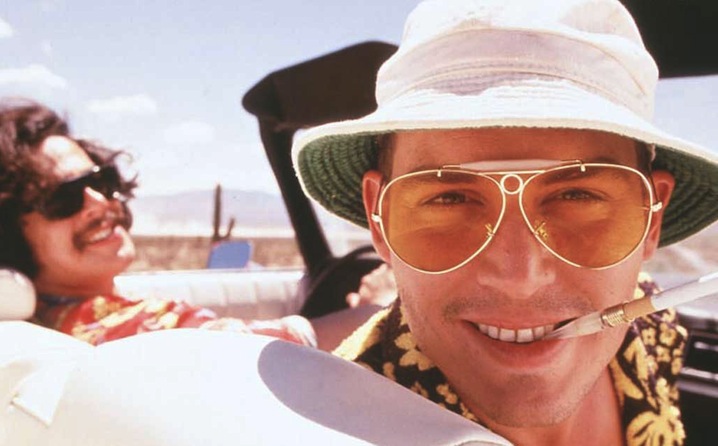
Benicio del Toro and Johnny Depp find FEAR AND LOATHING IN LAS VEGAS (1998).

Thompson’s tale is actually a portmanteau of two trips into the desert city with his friend Oscar Zeta Acosta, lawyer and Chicano activist. The first was intended to be a retreat for the two of them to discuss an article Thompson was writing about the death of Mexican-American journalist Rubén Salazar. Thompson used an invitation from SPORTS ILLUSTRATED to write a series of photo captions about the Mint 500 motorcycle race as an excuse, and the two of them descended onto the city.

250 words. That’s all they wanted.

Instead, he spent 36 hours straight, “feverishly writing in my notebook,” describing the pair’s wild adventures in Las Vegas and creating the expansive first part of the novel. And then, after the insane experience they undertook, they went back. Thompson took an assignment from ROLLING STONE to report on the National District Attorneys Association’s Conference on Narcotics and Dangerous Drugs held a few weeks later in Vegas, and further explored an idea that manifested during the first trip: that the rebellion of the 1960s had failed, and that the American Dream was now manifest in the crass, loud and materialistic oasis of Las Vegas.

Thompson combined the two trips into one story, which ROLLING STONE published as a two-part serial illustrated by Ralph Steadman, and which was later compiled into a novel. In creating what he admitted was “an essentially fictional framework,” Thompson assigned himself and Acosta pseudonyms: Raoul Duke (a nom de plume frequently used by Thompson and originally used as his byline for the ROLLING STONE serialization) and Doctor Gonzo. As for the book itself, it’s hard to say how much of what is written about is strictly accurate. It’s easy to say that the whole thing is true. What may have appeared at first as a wacky drug-fueled adventure turned into a work mournful of the failure of the ‘60s revolution, furious at the insane excess of artifice and celebration of the futile pursuit of money that is Las Vegas, and aghast that Vegas survived the revolution to stand in representation of the American Dream.

For years, the thing was regarded as being as unfilmable as NAKED LUNCH. Surreal, hallucinatory and depicting any number of illegal and violent acts by its protagonists, it just seemed to be too much to exist on a movie screen. Sure, they tried. Martin Scorsese and Oliver Stone both gave it a shot, but only one movie wound up being made in the wake of those early efforts. WHERE THE BUFFALO ROAM (which attempted to shoehorn “Fear and Loathing at the Super Bowl,” “The Banshee Screams for Buffalo Meat” and LAS VEGAS into one movie) starred Bill Murray, and was widely panned, particularly by Thompson himself. He praised Murray’s performance, but said the movie was saddled with “a bad, dumb, low-level, low-rent script.”

A direct adaptation eluded filmmakers for years, but that ended in 1998. After Rhino Films went through protracted tangling with director Alex Cox (whose screenplay Thompson viscerally hated), Terry Gilliam was brought on board to helm the film adaptation of the novel, and his surreal vision was a perfect match for the material. Though Gilliam had never used drugs, he researched the effects of all the chemicals used by the characters to create a series of visual effects that would mirror how the drugs would have affected their perception. The end result, while not exactly matching the horrifically ugly darkness of Ralph Steadman’s illustrations, stands on its own as a fully-formed take on Thompson’s subject matter.

Johnny Depp and Benicio del Toro were cast as Duke and Gonzo, respectively, and both underwent extensive preparation for their roles. Del Toro gained 45 pounds and immersed himself in studying the life of Oscar Zeta Acosta, and Johnny Depp spent four months living with Thompson at his Woody Creek ranch. Depp assembled his wardrobe from Thompson’s clothes of the time, wore a pendant of Thompson’s that was a gift from Acosta, and shaved his head in imitation of Thompson’s own male pattern baldness. The research and work paid off in spades. Depp and del Toro inhabit their roles perfectly. While they may come across as slightly cartoonish exaggerations of both Thompson and Acosta, it must be remembered that the Duke and Gonzo of the novel are slightly cartoonish exaggerations of Thompson and Acosta.
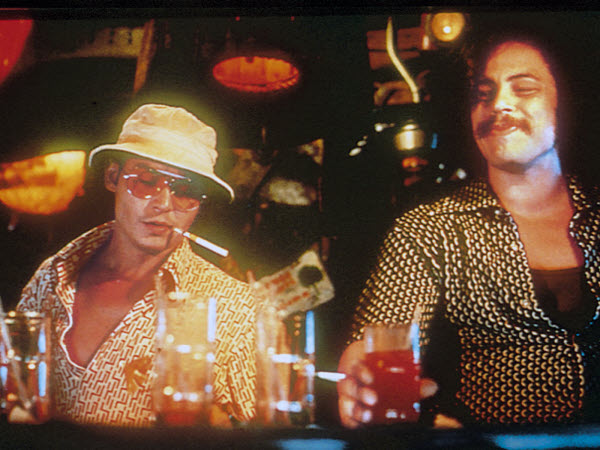
More gonzo antics by Depp and Del Toro in FEAR AND LOATHING IN LAS VEGAS (1998).

Terry Gilliam stated that he wanted the film to be polarizing—that he wanted it to be known as both the greatest and worst film of all time. And, thusly, it sharply divided critics: it currently holds a 50% average on the review aggregator ROTTENTOMATOES.com. Meanwhile, the film was a huge commercial failure. Filmgoers wanting to see the handsome Depp and del Toro got presented with a pair that were deliberately ugly. Filmgoers wanting to see a modern drug comedy wound up with something less a comedy and more a tragedy. And filmgoers wanting to see the Thompson perpetuated by DOONESBURY’s Uncle Duke character (and practically every other mass media depiction of the author) wound up with the only-slightly-fictionalized Thompson of the book, which is far closer to Thompson the man than Thompson the caricature.

Thankfully, due to home video releases, the film has built up a large, faithful audience, and it’s that crowd which is invited to the Plaza Theatre as Blast-Off Burlesque’s TABOO LA-LA brings us a screening of Gilliam’s adaptation. The pre-show kicks off at 9 p.m. with complimentary cocktails served up in the lobby, and then things kick into high gear with a live stage show from Blast-Off Burlesque featuring special guests Tom Jones, Elvis (somehow I’m guessing that these might not be the actual Tom Jones and Elvis) and Batastic. There will also be a Gonzo Costume contest and an Ether Walk contest with prizes from Libertine and the Cherry Blossom Salon, as well an art display of Lucy’s Barbara Streisand portraits! So come down and enjoy one of the greatest films of the 1990s while celebrating Hunter S. Thompson for all the right reasons.

Aleck Bennett is a writer, blogger, pug warden, pop culture enthusiast, raconteur and bon vivant from the greater Atlanta area. Visit his blog at doctorsardonicus.wordpress.com

Category: Retro Review | Tags: , , , , , , , , , , , , , , , , , , , , , , , , , , , , , , , , , , , , , , , , , , , , , ,

Retro Review: Don’t Go Into the Light—Go Into the Plaza Theatre! Splatter Cinema Scares Up Some POLTERGEIST Activity!

Posted on: Sep 8th, 2013 By:

Splatter Cinema Presents POLTERGEIST (1982); Dir. Tobe Hooper; Starring JoBeth Williams, Craig T. Nelson and Zelda Rubenstein; Tuesday, September 10 @ 9:30 p.m. (photos and merch table open @ 9 p.m.); Plaza Theatre; Trailer here.

By Aleck Bennett
Contributing Writer

It’s Splatter Cinema time once again! And with September upon us, and the first hints of autumn in the air, it’s also time for ghosts to take flight. With that in mind, Splatter Cinema and the legendarily haunted Plaza Theatre join forces to bring you POLTERGEIST! Come by at 9 to have your picture made in a recreation of a scene from the movie, and stop by the merch table!

POLTERGEIST, man. It’s a movie that comes with a lot of baggage if you’re a horror film fan. It’s impossible to dig into the movie at all without getting tangled up in contradictory recollections of who’s responsible for the final product. And it’s incredibly easy to wind up in vicious arguments with fellow horror geeks just by venturing into that subject. The question that inevitably gets asked and debated over is this: who actually directed the movie?

It’s a tough question to answer. Superficially speaking, it’s a Tobe Hooper film. His name is on it as director, the Director’s Guild of America states that he’s the director, and there are plenty of people who worked on the movie who steadfastly insist that Hooper directed it. But on the other hand, there are also plenty of people who worked on the film that say that producer Steven Spielberg was the man really calling the shots (Spielberg himself even implied as much in pre-release interviews, only to have to backtrack and issue public apologies afterward). Many claim that Spielberg took over for an unreliable Hooper, but due to DGA rules and his exclusive contract with Universal Studios to make E.T., he could not remove Hooper’s name from the project and claim ownership for himself. Others claim that it was a much more collaborative effort than simply one-or-the-other, and that all of Hooper’s directorial decisions were made in conjunction with Spielberg. (In any case, most people agree that Spielberg had final say.)

Then you have those who believe that this whole “Spielberg was really the director” rumor came from the studio itself. That when faced with having to market a “family friendly” film helmed by the director of 1974’s THE TEXAS CHAIN SAW MASSACRE—a man whose name wasn’t a sure-fire selling point—the studio leaked that Spielberg was the “real” director of the movie. A behind-the-scenes featurette was made that only showed Hooper once: standing alone, silent, drinking a can of Coke and identified only by a subtitle. In the set of film stills released to the press to promote the film, there were several shots of Spielberg on set, but only one of Hooper—and in that shot, he’s sitting next to Spielberg, who is telling Hooper what to do. In the trailer, Spielberg’s name is mentioned and appears onscreen twice before Tobe Hooper’s, whose name is never spoken and in much smaller type than the credit “A STEVEN SPIELBERG Production.” The whole thing does smack of the studio wanting to distance itself from Hooper.

Add in that Hooper hasn’t had the most spotless track record beyond TEXAS CHAIN SAW MASSACRE, SALEM’S LOT (1979) and POLTERGEIST (though I love 1977’s EATEN ALIVE and 1981’s THE FUNHOUSE more than I have any reasonable right to; I’m in the distinct minority on that issue) and the picture gets muddier and muddier, and it’s just a messy situation any way you look at it.

The real question, though, is this: is POLTERGEIST a good movie? And the answer is—no matter who’s responsible for it—yes. It’s a good movie. But it’s not great. It feels like a compromise in many regards, and that’s what has given the authorship argument legs over the years. You get the feeling that it wants to be a lot scarier than it is, but that it too frequently errs on the side of playing it safe. It seems really conscious of the fact that it must receive a PG rating. There are certainly some terrifying moments (please note: a scene that begins with a steak crawling across a countertop can’t end well, and clowns are always harbingers of doom), but any suspense tends to get overshadowed by Spielbergian spectacle.

However, it’s a tremendously fun movie. The story is simple: the Freelings are living in quiet suburban comfort when their house is suddenly plagued by poltergeist activity, and their daughter Carol-Anne is taken by the spirits into their ghostly realm. The family calls upon a team of psychic researchers and a medium to exorcise their home and save their daughter. Within this basic framework, any number of frightening set pieces have been constructed, and to see them executed on the big screen is a rare treat. POLTERGEIST is the kind of movie that just doesn’t translate to home video viewing effectively; it must be seen LARGER THAN LIFE for the visuals to really deliver. The performances are engaging and authentic, drawing the audience in and rooting them in the movie’s emotional core. JoBeth Williams and Craig T. Nelson have a chemistry together that both makes us believe them as the married couple they’re portraying and allows us to share their fright and torment as the supernatural elements ramp up. And though her performance has been parodied and lampooned endlessly, Zelda Rubenstein as the diminutive medium Tangina Barrons is incredibly memorable and effective, her kindly demeanor and small stature belying the force of will and strength she brings to the surface.

So forget the controversy over who did what. Nobody knows to this day whether Howard Hawks or the credited Christian Nyby directed 1951’s THE THING, but what is remembered is the film itself. Likewise, enjoy POLTERGEIST for the movie it is, rather than whose movie it is.

Now, who wants to speculate over the film’s relationship and debts to Richard Matheson’s “Little Girl Lost,” and why Spielberg was so quick to get TWILIGHT ZONE: THE MOVIE into production?

Aleck Bennett is a writer, blogger, pug warden, pop culture enthusiast, raconteur and bon vivant from the greater Atlanta area. Visit his blog at doctorsardonicus.wordpress.com

Category: Retro Review | Tags: , , , , , , , , , , , , , , , , , , , , , , , ,

Going Back to the Bizarre Birthing of Burton: Splatter Cinema Raises Blythe Spirits with BEETLEJUICE at the Plaza Theatre!

Posted on: Aug 12th, 2013 By:

Splatter Cinema Presents BEETLEJUICE (1988); Dir. Tim Burton; Starring Michael Keaton, Winona Ryder, Alec Baldwin, Geena Davis, Jeffrey Jones and Catherine O’Hara; Tuesday, August 19 @ 9:30 p.m.; Plaza Theatre; Trailer here.

By Aleck Bennett
Contributing Writer

This month, Splatter Cinema goes a little off the beaten path at the Plaza Theatre. This month’s showing is not the typical gore-soaked exploitation fare you’re likely to see them serve up. But the way that BEETLEJUICE enthusiastically revels in horror and delights in depicting twisted flesh makes it a good choice for those of the Splatter Cinema mindset.

It’s hard to believe that there was a time when Tim Burton wasn’t a “thing.” That there wasn’t an identifiable “Tim Burton” style. And that there was a time when BEETLEJUICE was a sudden and surprising leap into the dark comic realm that would eventually come to define that style.

Burton had exploded onto the film world with his previous film, 1985’s PEE WEE’S BIG ADVENTURE. While that movie contains themes that he would revisit many times in the future (particularly “childlike protagonist exists in a fanciful universe seemingly of his/her own creation until a shock tosses them into the outside world”), it also contains the off-kilter and baroque visual sensibility that is a hallmark of his films to this day. But aside from the “Large Marge” and “clown hospital” scenes, there’s little of the horror-steeped atmosphere that saturates so much of his work.

BEETLEJUICE is where (aside from his earlier short films, which were largely unseen by the public at that point) Burton first seamlessly blended equal parts horror and quirky comedy into the recognizable whole that would come to identify the director.

The film focuses on a young couple, Adam and Barbara Maitland (Alec Baldwin and Geena Davis), who find themselves unexpectedly deceased and forced to haunt their New England home. When the Deetzes (Catherine O’Hara, Jeffrey Jones and Winona Rider) move in, the Maitlands are forced to circumvent the bureaucracy of the afterlife and engage “bio-exorcist” Betelgeuse (Michael Keaton, pronounced and also known as “Beetlejuice”) to force the new residents out. As to be expected, wacky antics ensue.

In collaboration with production designer Bo Welch, Burton used the foundation of the screenplay to paint his comic sensibilities in a luridly-colored, high-contrast gothic horror sheen. His scenes in the afterlife and during Beetlejuice’s reign of terror in the Maitlands’/Deetzes’ home look like Charles Addams’ cartoons filmed in the style of SUSPIRIA. Grotestqueries bathed in candy-colored lighting schemes. Welch and Burton would develop this aesthetic even further in collaboration on 1990’s EDWARD SCISSORHANDS and 1992’s BATMAN RETURNS, firmly establishing this as the “Tim Burton” trademark style.

It would have been all too easy for the screenplay to serve simply as a hook from which Burton could hang a number of ghoulish setpieces. It’s to the credit of writers Michael McDowell, Larry Wilson and Warren Skaaren that the film is as engaging as it is. By keeping the “ghosts” of the movie benign and well-meaning—and the new residents not malevolent but incredibly selfish and irritating—Beetlejuice’s diabolical motives put both families in a sympathetic light.

And the cast’s performances can’t be overlooked in helping create the rounded characters of the movie. Alec Baldwin and Geena Davis are both amiable and sweetly romantic as the ghostly Maitlands, while Catherine O’Hara and Jeffrey Jones are their polar opposites: antagonistic and back-bitingly snarky. Where Baldwin and Davis are convincingly laid-back and plain, the performances of O’Hara and Jones are deftly high-strung and pretentious. Winona Ryder as young Goth daughter Lydia Deetz bridges both worlds—not only figuratively in the temperament of the clashing couples, but literally within the story as she is the only person able to see and converse with the Maitlands—and delivers a performance in turns dryly sardonic, cooly detatched and warmly engaging.

Winona Ryder in BEETLEJUICE.

But the movie truly belongs to Michael Keaton. As Betelgeuse/Beetlejuice, his performance clashes perfectly with everyone else’s. No matter how engaging or off-putting the Maitlands and Deetzes may be, the performances of Baldwin, Davis, Jones, O’Hara and Ryder are tightly restrained and controlled. Keaton, on the other hand, is entirely explosive and cartoonishly over-the-top; issuing forth a rapid-fire patter of one-liners, non-sequiturs, mumbled asides and mad proclamations delivered at the top of his voice. He’s physically manic as well, leaping about and flailing around wildly, as if Burton was randomly jolting Keaton with a live electric wire just off-screen. He turns Beetlejuice from a simple, evil prankster into something larger than life. If, you know, he were alive rather than a moldering corpse.

And if the movie belongs to anyone else, it’s Burton. This is where the Tim Burton we now know was born: the bright colors washing over stark black-and-white-patterned spookiness of THE NIGHTMARE BEFORE CHRISTMAS, the stylized locations and set design of EDWARD SCISSORHANDS, the dark humor of FRANKENWEENIE. They all spring from here. But few mesh these elements together with as much effortless skill as BEETLEJUICE.

Aleck Bennett is a writer, blogger, pug warden, pop culture enthusiast, raconteur and bon vivant from the greater Atlanta area. Visit his blog at doctorsardonicus.wordpress.com

Category: Retro Review | Tags: , , , , , , , , , , , , , , , , , , , , , , , , ,

© 2025 ATLRetro. All Rights Reserved. This blog is powered by Wordpress