Retro Review: BARBARELLA, Take Two, or Today, I Watched Jane Fonda Narrowly Escape Death-by-Orgasm in the Excessive Machine; How Was Your Day?

Posted on: Jan 25th, 2013 By:

BARBARELLA (1968); Dir: Roger Vadim; Screenplay by Terry Southern; Based on a bande dessinee by Jean-Claude Forest; Starring Jane Fonda, John Phillip Law, Anita Pallenberg, David Hemmings, Milo O’Shea, Marcel Marceau; Plaza Theatre, Saturday, January 26 at 10:00pm; presented by BLAST-OFF BURLESQUE’S TABOO-LA-LA with live stage show before the screening including raffle of 10 8×10 signed photos of Fonda as Barbarella from Jane Fonda’s personal collection; Trailer here

By Andrew Kemp
Contributing Writer

Today, I watched Jane Fonda narrowly escape death-by-orgasm in the Excessive Machine. How was your day?

Although I’d never seen BARBARELLA (1968), the infamous sci-fi sex romp produced by Dino de Laurentiis and directed by Roger Vadim, before today, I definitely knew about it. Almost everyone knows about it. BARBARELLA is a movie with more reputation than respect, a movie that, depending on who you ask, is either awful or awfully amazing. Just its name invokes a few key images—that amazing poster by Robert McGinnis; Jane Fonda’s buxom, uh, hair. I grew up in a post-STAR WARS world, when just the sight of a science-fiction ray blaster promised a particular brand of space fantasy and action, but combine aliens and thrills with the promise of a naked, beautiful woman? There’s not enough concrete on Earth to build a wall an adolescent boy can’t climb.

But I never made it over that wall. Yes, it’s true that young boys can sniff out nudie films like pigs root up truffles, but you guys have never met my mother. I once got a few short minutes of FLASH GORDON (1980) and its adventurous female costumes on the TV before she stomped into the room, feeling a psychic disturbance, I suppose, in her son’s mind. She played goalie effectively until around the time I entered high school, and by then I had found other ways to see boobs. And so, somehow, Barbarella and I had never met.
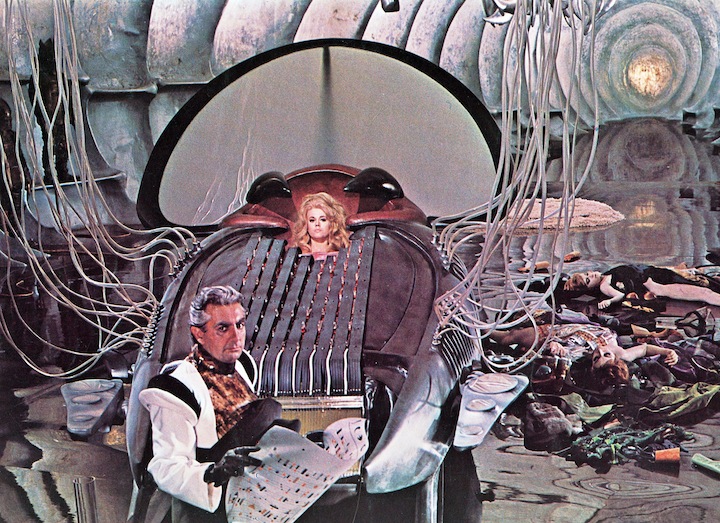
Durand Durand (Milo O'Shea_ tries to defeat Barbarella (Fonda) with death by orgasm. Paramount Pictures, 1968.

BARBARELLA was a famous flop at the box office, but its racy content, goofy cheerfulness about sex and outrageous set design—the spaceship is lined with shag carpet!—fit snugly with the mood of the late 1960s, at least with certain segments of the youth. The film quickly gained a cult infamy, especially as its star, Jane Fonda, transitioned into A-pictures and won an Oscar for the popular detective film, KLUTE (1971). There’s always been kind of a funny dividing line between mainstream film and exploitation, and it’s thrilling when some star gets a weekend pass to play on the other side, whether it’s Bruce Campbell showing up in SPIDER-MAN (2002) or Jane Fonda taking her clothes off. It was impossibly tantalizing to know that a major actress had once bared it all in a sex adventure, especially before home video, when the only way to see something like BARBARELLA was to catch a revival screening, and there weren’t nearly enough of those. Lack of availability helped grow the film’s legend, and it soon became trendy and cool to latch onto its camp appeal. Even by the early 1970s, a club named Barbarella’s existed in the UK, and it became a key location in the developing punk scene, hosting bands like The Sex Pistols and The Clash. One rising band that played frequently at the club even sampled clips and songs from the film into their music, tweaking the name of the film’s villain, Durand-Durand, into their own name, Duran Duran.

But it was the 1960s; everyone was taking their clothes off, right? There were plenty of sex movies in the world. What is it about BARBARELLA that keeps it going? “I just remember seeing that strip tease during the opening and being in love with the world,” says Max Shell, director of the undead-chicken cult movie THE DEVIL’S COCK. “Dino’s [de Laurentiis] Euro Sci-Fi is about ‘getting it on!’”

Melanie Magnifique of Blast-Off Burlesque takes a more esoteric approach. “I was traversing the spirit lands, when this film was released in conventional space-time. When I first experienced it, many years later, it was still the powerful tale of a girl doing what a girl’s sometimes got to do!”
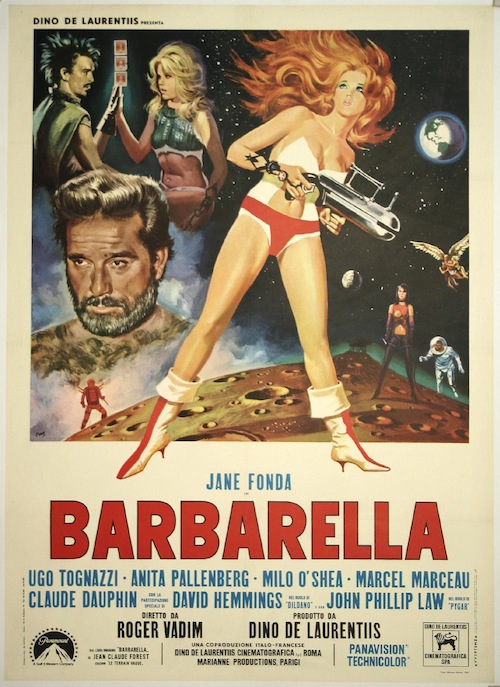
The famous poster by Robert McGinnis.

Aha! If there’s another narrative to the BARBARELLA appeal beyond sex, it’s girl power. The film came at this neat little intersection of the free love ‘60s and the peak of the misogynist spy fantasies like James Bond. There had simply never been a female action hero who freely used and enjoyed sex while saving the day. (Hell, it’s still hard to find a character like that today!) Perhaps this explains why Barbarella became a feminist icon, and a popular cosplay target for over 40 years. It’s common to see Barbarellas walking the floors at comic book shows and sci-fi conventions, and the heroine’s legend is so large today that the film lives under constant threat of remake, with the most recent major attempt fronted by director Robert Rodriguez as a vehicle for Rose McGowan, who he’d already cast once as an ass-kicker in his GRINDHOUSE entry, PLANET TERROR (2007).

Does BARBARELLA deserve its infamy? I finally sat down to watch the film today, and I was kind of amazed with what I found. Despite its legacy in the sexual revolution, BARBARELLA can sometimes be cruel, and other times naïve. After the famous opening strip scene (described in wonderful detail here on this very site), we learn that Fonda’s secret agent is a wide-eyed wonder. A child of a civilization that has evolved beyond violence and pain, she greets the world with simple joy and, when confronted with the bizarre horrors in an “unevolved” part of the galaxy, she simply pushes through and perseveres, using far more optimism than skill. Melanie Magnifique rightly describes Barbarella as “a female protagonist who wants to do the right thing, but is sometimes a little confused about what that thing is.” Fonda’s earnest devotion to her mission is entertaining, even if that mission sometimes devolves into bizarre, disconnected segments. She’s nearly devoured by carnivorous songbirds, for crying out loud.

As for the sex, my adolescent self would have enjoyed Fonda’s matter-of-fact approach to her body and to the sexual beings she encounters. She’s more or less willing to have sex just for the asking, which works both for and against her feminist reputation. On the one hand, the film is full of scenes of sexual aggression or sexual bartering. Sex is a currency that gets Barbarella from place to place, and there’s an unsettling trend towards sexual torture. It’s easy to read the film as misogynist, using Barbarella as a doll to act out aggressive male fantasies. But, on the other hand, there’s something charming and empowering about how Barbarella, after having been introduced to real sex (in the future, evolved beings do it with a pill) by an impossibly masculine hunter, Barbarella blossoms as a sexual being, pursuing sex with the chiseled angel Pygar and showing frustration when a bumbling freedom fighter (the awesome David Hemmings in the film’s best supporting role) wants to do it with the pill.

Although the film sought mainstream success, BARBARELLA is a movie destined for cult status. Like every good cult flick, there are moments that you simply can’t believe you’re seeing, scenes that should be impossible in a well-budgeted studio film, and yet here they are. This is a film for an audience, if simply so you can turn to the person next to you to share a laugh and one of those “holy shit” looks. This movie should be *ahem* a shared experience, not a solo trip. Even with all the sex, there’s something incredibly innocent about the film, and it serves as a window into a more optimistic, good-natured time. It’s fitting, then, that it’s being hosted at the Plaza this weekend by Blast-Off Burlesque. Burlesque itself is an art form that walks that beautiful line between sweetness and spice, and BARBARELLA is their kind of movie. When asked about the links between burlesque and BARBARELLA, Melanie Magnifique agreed: “It contains many simple theatrical tricks which are used to achieve special effects (we do that a lot).”

“Oh, also, we love to smoke Essence of Man.”

The show starts at 10 pm on Saturday with music, a dance party and complementary signature cocktails, but says Magnifique, “Come early to get your groove on!”

And be sure to read our other Retro Review: Jane Fonda Has No Clothes On: Stripping Down Our Love Affair with Psychedelic ’60s SF Camp Cult Classic BARBARELLA in Time for a Blast-Off Burlesque Taboo-La-La at the Plaza Theatre by Robert Emmett Murphy Jr.

Category: Retro Review | Tags: , , , , , , , , , , , , , , , , , , , , , , , , , , , , , , , ,

Retro Review: Jane Fonda Has No Clothes On: Stripping Down Our Love Affair with Psychedelic ’60s SF Camp Cult Classic BARBARELLA in Time for a Blast-Off Burlesque Taboo-La-La at the Plaza Theatre

Posted on: Jan 21st, 2013 By:

BARBARELLA (1968); Dir: Roger Vadim; Screenplay by Terry Southern; Based on a bande dessinee by Jean-Claude Forest; Starring Jane Fonda, John Phillip Law, Anita Pallenberg, David Hemmings, Milo O’Shea, Marcel Marceau; Plaza Theatre, Saturday, January 26 at 10:00pm; presented by BLAST-OFF BURLESQUE’S TABOO-LA-LA with live stage show before the screening including raffle of 10 8×10 signed photos of Fonda as Barbarella from Jane Fonda’s personal collection; Trailer here.

By Robert Emmett Murphy Jr.
Special to ATLRetro.com

BARBARELLA is a special kind of cinematic disaster. A lavish space-opera comedy released in 1968, the most important year in SF cinema since 1951, it had a $9 million budget, making it only modestly less expensive than the same year’s 2001: A SPACE ODYSSEY ($10.5 M) and more expensive than that year’s PLANET OF THE APES ($5.8 M). Meant to celebrate the era’s new found sexual freedom and the changing role of women in society, BARBARELLA is one of those films in which the first five minutes tell you everything you are going to get, as well as promising you all the things it should’ve given us and simply failed to deliver.

The opening image is a lovely array of stars, and hanging within it an improbable and more than slightly feminine-looking space ship. We move in closer until we can see through a portal into the fur-lined cockpit…

Full stop. Christ, I can’t believe I just wrote that: “fur-lined cockpit.” You know that whoever came up with that idea was thinking ahead to an exhausted film reviewer of a more innocent age, sometime after midnight hammering out copy and tearing his hair out screaming, “HOW CAN I GET THIS PAST THE EDITORS!”

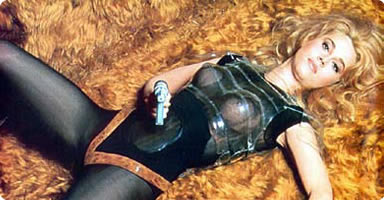
Jane Fonda as BARBARELLA. Paramount Pictures, 1968.

OK, so we can see through a portal into the fur-lined cockpit where a space-suited figure floats in a really excellent simulation of zero-gravity (also a simple illusion, the astronaut is filmed from above while lying on a plexiglass platform). The identify is hidden behind a featureless metal helmet. But the material transforms from metal to clear plexiglass (another fine piece of simple FX, the reflective metal is actually a liquid in a space within the helmet’s bowel-like structure. It’s merely drained through the bottom.) revealing the “spaceman” is actually a not-quite-yet-30 Jane Fonda, never looking more beautiful. Her expression not only evokes a potent come-hither sexual promise, but more importantly, pure delight.

The music comes up. The song is deliberately silly (unafraid to rhyme “Barbarella” and “psychedella”) but quite catchy, celebrating the film’s title character’s sex appeal in a way that is far more joyful than crass. Though the film is based on a French comic book, it’s geared to an American audience, so before we hear her name (already legendary across the ocean), the singer compares her to our more familiar Wonder Woman.

Fonda/Barbarella strips off her space suit. It’s a sectional outfit revealing her progressively, teasingly. She is completely naked beneath. The animated titles escape the seams of the garment like venting gasses, swirling around her, protecting her immodestly. Except when they don’t. They keep trying to obscure, but she is happy to reveal. And the wantonness is now more than just promise; she expresses ongoing sexual pleasure (perhaps the caress of the letters?). Finally, wholly naked, she presses a button, tumbles down the luxurious furs, and she clearly is sated.

It’s one of the greatest stripteases in film history.

The next four minutes aren’t half bad either. The dialogue is witty and provides a lot of narrative context without excessive exposition. Barbarella immediately gets a call on her video screen from Claude Dauphin as the President of Earth. Their greet each other by saying “Love,” in what is clearly a political party’s salute.

Barbarella: “Just a minute. I’ll slip something on.”

President: “Don’t trouble yourself, this is an affair of state.”

In short order we learn that Barbarella is a secret agent in a future so perfectly utopian and groovy that she is rendered childlike in her naivete. She is assigned the mission to find an evil scientist named Durand Durand (yeah, that’s where the ’80s band got their name from) and stop him from supplying weapons to primitive peoples and threatening to disrupt the proper social order.

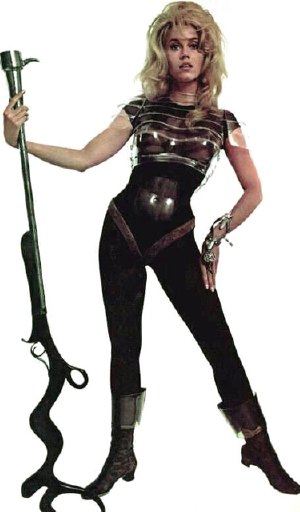
Barbarella (Jane Fonda) strikes a dangerous pose. Paramount Pictures, 1968.

Barbarella: “Weapon? Why would anyone want to invent a weapon?…I mean the universe was pacified centuries ago.”

President: “What we know of it…We know nothing of Tau Ceti.”

Barbarella: “You mean they can still be living in a primitive state of neurotic irresponsibility?”

Sweet Barbarella seems only vaguely familiar with the concept of secrets (yeah, I know, she’s supposed to be a “secret agent,” but whatever) and can’t even say the word “war,” but instead babbles absurd multisyllabic euphemisms like “archaic insecurity” and “selfish competition.”

We’re now nine minutes into the film. After this point, there’s not a single Goddamn scene in the film that follows that compares, either in its sexiness, warmth of performances, generosity of humor, playful satire or technical achievement.

So why watch the remaining one and half hours?

I can think of three reasons:

1) The wonderfully creative and over-the-top costumes. Especially Fonda’s, who goes through a wide variety because since she’s constantly undressing, she is therefore constantly redressing.

2) The sets and props, which are even more impressively inventive than the costumes. I especially liked the aforementioned fur lined cock pit, the ice craft, the bird-shaped bird-cage that is the size of a small bus- well, the list goes on. Though the film showed little interest in evoking the title-character as she was presented in Jean-Claude Forest‘s comic strip, they did hire Forest as a consultant on the visuals. As wrote Graeme Clark: “[T]he film-makers’ maxim seems to have been, if it looks cool, if it looks weird, then put it onscreen.” And Gary Morris wrote, “[G]audy, colorful sets, looks like it was shot in the bowels of the Playboy mansion — especially our heroine’s spaceship, with its fur-lined walls that reek of ’60s softcore chic.”

3.) Maybe, deep down in your heart, you hate Jane Fonda, and want to just sit back, watch her flounder, and feel superior.

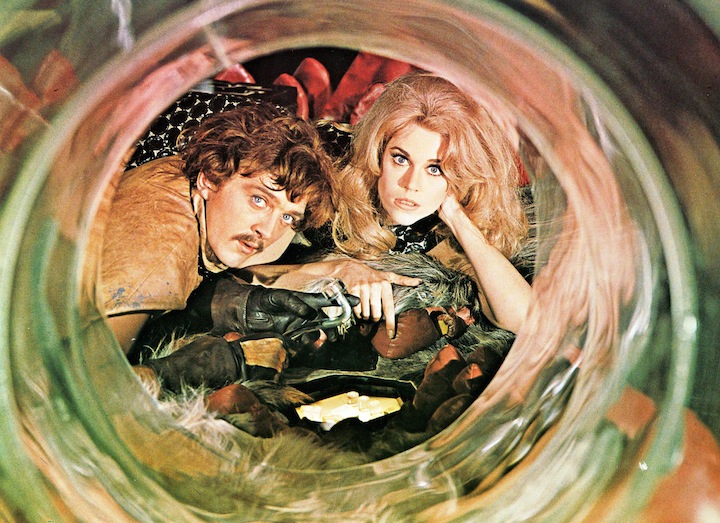
David Hemmings and Jane Fonda in BARBARELLA. Paramount Pictures, 1968.

Yes, Fonda has never been more beautiful, but there’s no doubt this is her career worst performance. Despite being charming in the first scene, her performance quickly degrades, as she becomes increasing wide-eyed, vacuous and cold. I have to wonder why she gets worse the farther she gets into the film. I do know it was made in France at the most important transition point in her acting and political career (her follow-up film, the same year, THEY SHOOT HORSES, DON’T THEY? earned her first Oscar nomination, and by the time BARBARELLA was released, she’d embraced feminism and thrown her support behind the Native American occupation of Alcatraz Island). What I think happened is that in between takes she started listening to the babble of French intellectuals who analyzed the film’s actual content (and I should say, this is a film that shouldn’t be analyzed for content), and they revealed to her some uncomfortable things:

First, the bad guys are led by an arrogant intellectual who insidiously infiltrates and corrupts a primitive culture with the goal of undermining the larger community of peace-loving, wealthy, advanced societies. Meanwhile the good guys, also foreigners, are forced to intervene and also engage in infiltrating and saving the backward indigenous peoples through a nobler, but still newly introduced, ideology, military training and supplying advanced weapons. The good guys turn the indigenous people into a “third force” that will create a society more cooperative to the ideals of more civilized foreign powers. The overarching message is that if you want to preserve universal peace, start a proxy war. It’s almost Robert Heinlein-esque in the way the heroes are “forced” into engaging in foreign interventions. In other words, the movie is pro- the kind of Third Phase Imperialism that led both the USA and the USSR into the Vietnam conflict.

Ugo Tognazzi plays Mark Hand, the heroic Catchman, the guy who introduces Barbarella to the wonders of really good primitive sex. But he also spends most of his day using corporal punishment to discipline nasty, unsupervised, disrespectful children. He then rounds them up so they can be properly indoctrinated into their responsibilities to society. In other words, BARBARELLA the movie hates the youth culture.

And it didn’t like homosexuals much either.

Women are completely objectified, and the heroine is an utter bimbo (which the comic-book heroine was not). Though she does heroic things, she doesn’t have an idea in her head or a goal worth pursuing that wasn’t planted there by an older, dominant male. Also, after arriving on the planet, almost all the “sexy” scenes concern her being captured and tortured. In other words, the movie is amazingly misogynistic right at the dawn of American feminism.

Also, I think even French intellectuals probably thought that director (Fonda’s then-husband) Roger Vadim, was a sleazy creep who was ruining her career with films like this. Vadim’s life reflected the films bizzaro sexual anti-liberation. He was a serial husband with a penchant for woman barely more than half his age and made a habit of trading eachwoman in as soon as responsibility reared its ugly head. Prior to Fonda was Brigitte Bardot (probably the inspiration for the comic book Barabarella in the first place), who was 15 to his 22 and whom he drove to several suicide attempts before their divorce. He left Bardot for the more age- appropriate Annette Stroyberg, but then abandoned her with a two-year-old child for Catherine Deneuve who was 17 to his 33. He was already involved with Fonda during that third marriage – when Fonda and Vadim first met she was 18 to his 27 -and when Vadim abandoned Deneuve, with their two-month-old child, to move in with Fonda she was 26 to his 35. The two would separate not long after BARBARELLA, leaving yet another child too young to walk. During that separation he would get involved with Catherine Schneider who was 26 to his now-44. There would be another two marriages after that.

Fonda would eventually disown the film. At the San Francisco Film Festival in 1994, she was asked “Where was her head?”

“I don’t know – up my armpit, I guess,” she replied. “We all make mistakes. In my case, I keep getting my nose rubbed them.”

Worse still, Fonda turned down the role of Bonnie in BONNIE AND CLYDE (1967) to do this stinker. Faye Dunaway eventually got that role, and an Oscar nomination. Fonda should’ve listened to Virna Lisi. When Lisi was told to play the part of Barbarella, she terminated her contract with United Artists and returned to Italy.

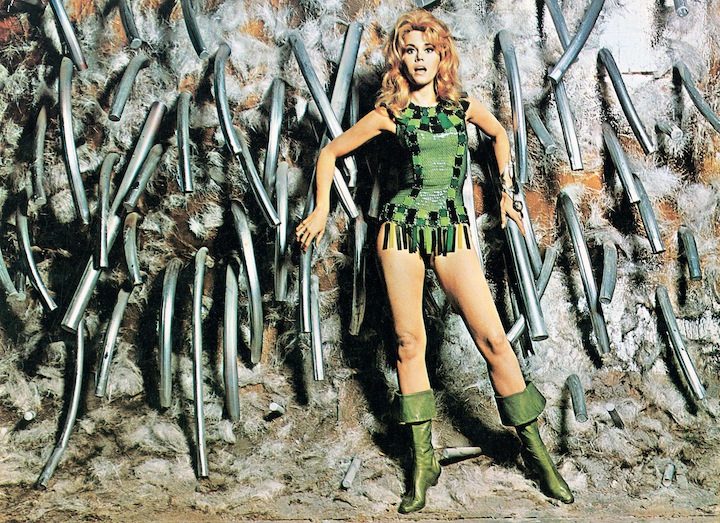
Jane Fonda changes costumes again as BARBARELLA. Paramount Pictures, 1968.

Episodic in the same way J.R.R. Tolkien’s work was, BARBARELLA lacked the master’s flair for the actual episodes, as well as being completely lacking in forward momentum. It displayed none of Tolkien’s warmth or affection for his characters, and notably Tolkien’s much-maligned female characterization was far better than what we see in this film with a higher percentage of prominent female roles. It wasn’t even close to Tolkien’s capacity to pull the divergent threads of plot into a meaningful climax.

BARBARELLA was panned in its day but has grown into a cult classic. Today, many critics are generous towards it because of its camp value, of which there is a great deal (It’s listed with the “Top 100 Most Amusingly Bad Movies Ever Made” in THE OFFICIAL RAZZIE MOVIE GUIDE), but I can’t help but be put off when watching a film that contains much to snicker about, but when it tries to tell an intentional joke, it generally falls terribly flat. Forest’s original comic book was fun, and the movie’s original script was by the great Terry Southern, but later critics seem unanimous that Vadim was more interested in his sexual obsessions than Forest’s swashbuckling adventurism or Southern’s omni-directional satire. As a result, no one in the cast seemed to be having any fun, and lines that really should’ve been been amusing come off stale:

Barbarella: “Make love [in a manner that involves actual physical contact]? But no one’s done that for hundreds of centuries!”

“This is much too poetic a way to die!”

“A good many dramatic situations begin with screaming!”

Mark Hand: “Are you typical of Earth women?”

Barbarella in a revealing costume made all the more so because it was shredded: “I’m about average.”

Pygar the angel (John Phillip Law, who if anything, a worse actor than Fonda in this movie):

“An angel does not make love, an angel is love.”

“But you’re soft and warm! We’re told that Earth beings are cold.”

And explaining why he saved the evil queen who tortured him: “An angel has no memory.”

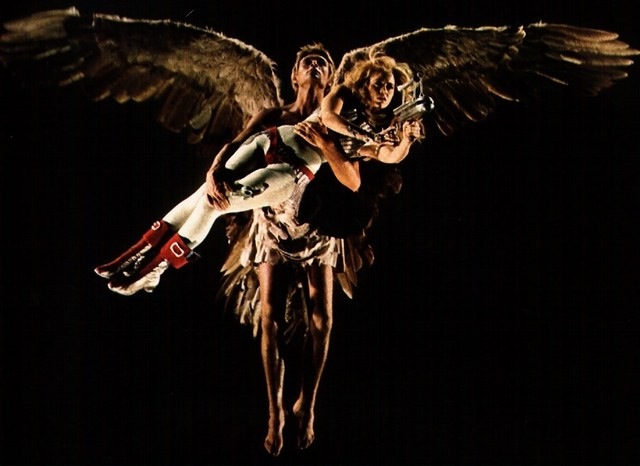
Pygar the angel (John Phillip Law) gives Barbarella (Jane Fonda) a ride. Paramount Pictures, 1968.

I will credit one cast member with carrying on like a true soldier. David Hemmings, in an underwritten part as the inept freedom fighter Dildano, was quite good. He offered some hints of what this film could’ve been.

Also very fine was a captivating soundtrack by Bob Crewe and Charles Fox performed by The Glitterhouse which featured Pink Floyd guitarist David Gilmour.

Vadim wanted to do a sequel to BARBARELLA, but that dream died with his marriage to Fonda. He then talked about a remake right up to his death, toying with leading ladies like Drew Barrymore. Other directors have expressed interest in the remake project, notably Robert Rodriguez.

In closing, I would like to recommend an exceptionally sophisticated homage to this really dumb film. CQ (2001) written and directed by Roman Coppola (son of Francis Ford) takes us back to Paris of the ‘60s where a young American filmmaker, Paul (Jeremy Davies), is trying to made personal art film/love letter to his girlfriend Marlene (Elodie Bouchez) but all that the honest camera can do is document her depression and resentments. So he gets a job assisting the director of an a cheesy sci-fi that is clearly a better version of BARBARELLA. That film’s director, played by Gerard Depardieu, is turning the project into a complete train wreck because he can’t come up with an ending, but really, can’t cope with the fact that the fantasy of revolution and liberty he creates on film will never translate to the real world. Paul gets drawn into the director’s lunacy through his growing infatuation with the film’s sexy star, played by Angela Lindvall, who remains the same impossible ideal of sexuality and liberty even when Depardieu’s camera is not rolling.

Robert Murphy is 47 years old and lives in New York City. Formerly employed, he now has plenty of time to write about movies and play with his cats.

Category: Retro Review | Tags: , , , , , , , , , , , , , , , , , , , , , , , , , , , , , , , , , , , , , , , , , , , , , , , , , , , , , , , , ,

Retro Review: WHITE ZOMBIE Walks Again in the World Premiere of an All-New Restoration at Atlanta’s Historic Plaza Theatre!

Posted on: Jan 16th, 2013 By:

WHITE ZOMBIE (1932); Dir. Victor Halperin; Starring Bela Lugosi, Madge Bellamy, John Harron and Robert Frazer; World premiere Friday, Jan. 18 @ 8:00 p.m. hosted by Prof. Morte (scary details at end of story), and Jan. 25-31; Plaza Theatre; Trailer here.

By Aleck Bennett
Contributing Writer

Long before George A. Romero’s NIGHT OF THE LIVING DEAD forever redefined “zombie” in the public mind as “undead, flesh-eating ghoul,” the Halperin Brothers first brought the Haitian legend of the zombie to the screen with 1932’s WHITE ZOMBIE.

The movie finds young couple Madeline Short (Madge Bellamy) and Neil Parker (John Harron) reuniting in Haiti to be wed at the plantation of their friend Charles Beaumont (Robert Frazer). Beaumont’s secret love for Madeline drives him to visit local voodoo master Murder Legendre (Bela Lugosi) in order to enlist his help in winning Madeline’s hand. Legendre provides Beaumont with a potion that will transform her into a zombie, robbed of her will and love for Parker. He complies with Legendre’s instructions, but soon finds that the villainous voodoo master has plans of his own for the young beauty.

In 1932, America was in the midst of a newfound fascination with voodoo due to New Orleans’ emergence as a tourist destination. Interest was further fueled by authors such as William Buehler Seabrook. Seabrook was a well-traveled journalist, explorer, occultist and Georgia resident who had gained renown by documenting occult practices across the globe, including some of the only objective contemporaneous reporting on Aleister Crowley. Seabrook’s interest in the occult led him to spend considerable time in Haiti researching voodoo and the Culte des Morts. This adventure resulted in his 1929 book THE MAGIC ISLAND, which introduced the concept of the “zombie” to American audiences.

Producer Edward Halperin and his brother, director Victor Halperin (along with screenwriter Garnett Weston) capitalized on the nation’s interest in voodoo by borrowing liberally from both Seabrook’s work and Kenneth Webb’s 1932 Broadway play, ZOMBIE, and crafted an atmospheric masterpiece. The Halperins enlisted Bela Lugosi, fresh off his success in Universal’s 1931 smash DRACULA. It’s unclear as to Lugosi’s reasons for choosing to immediately follow a major studio hit with a micro-budgeted independent film, but he may have seen it as a way to stretch his creative muscles in a low-risk venture. Although he was paid little for his role (reports vary from $500 to $5000), his co-star Clarence Muse reported that Lugosi rewrote portions of the script, restaged some of the scenes and even directed portions of the film. His personal investment in the end results may be why Lugosi considered WHITE ZOMBIE a favorites among his own movies.

It could also be because it’s just a damned fine film.

The film deftly balances the legendary with the actual. While Legendre’s zombies are the reanimated corpses of Haitian lore (their look provided by Universal’s maestro of makeup, Jack Pierce), the film also depicts his use of a poison that emulates death and results in the victim’s deathlike trance and subsequent subservience to a bokor or sorcerer. Though this method had long been suspected, a pharmacological explanation for the zombie phenomenon wouldn’t be confirmed until ethnobiologist Wade Davis’ explorations into Haiti in the 1980s.

Beyond the film’s knowing mixture of fact and fiction, it benefits from the collaboration of Victor Halperin, cinematographer Arthur Martinelli and music superviser Abe Meyer. Together, they take what may have read on the page as stagebound and stodgy and create a dreamlike vision that mirrors Carl Dreyer’s VAMPYR (also 1932), echoes elements of contemporaneous Universal horrors and anticipates Val Lewton’s exercises in atmosphere and sound design. Constantly inventive staging and camera work—taking place on sets borrowed from DRACULA, FRANKENSTEIN and THE HUNCHBACK OF NOTRE DAME—operate in sync with native drumming, chants, ambient noise, eerie rearrangements of classical works and original music by Xavier Cugat to deliver a palpable sense of creeping death under the oppressive hand of Murder Legendre.

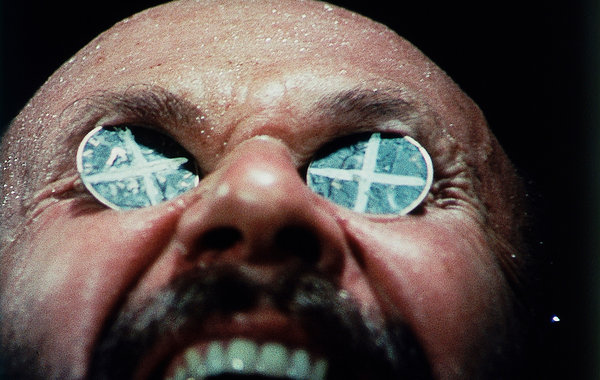
And in the role of Legendre, Lugosi becomes the embodiment of evil itself. No other role—not even Dracula—fully utilizes his mesmeric power and hypnotic presence. From the opening scene, when his eyes are superimposed on the landscape of Haiti, his presence is felt in every frame of film; this is the power of his performance as Murder Legendre. The Halperins attempted to recapture the magic of this film with a sequel, REVOLT OF THE ZOMBIES, but made the mistake of attempting to replace Bela with Dean Jagger. It’s no small wonder that the subsequent film failed.

For years, WHITE ZOMBIE only circulated on washed-out transfers of faded 16mm prints, mastered for public domain VHS and TV broadcast. In 1999, two rare 35mm prints were used to create the restored version released on DVD by the Roan Group. However, those prints were hardly in pristine condition, displaying evident damage and dropped frames.

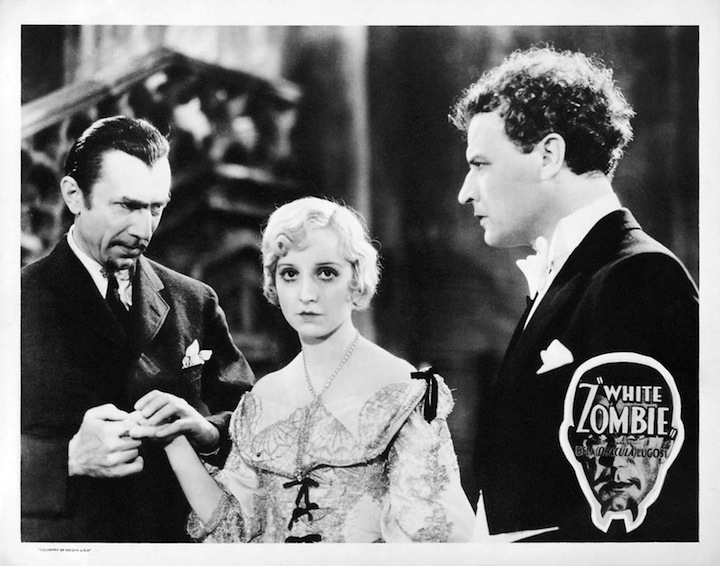
Left to right: Bela Lugosi as voodoo master Legendre, a mesmerized Madge Bellamy and a concerned John Harron in WHITE ZOMBIE (1932).

In recent years, Los Angeles-based Holland Releasing had heard that a previously unknown complete 35mm print was rumored to be in the possession of an aged film collector. Thomas W. Holland (a previous resident of Roswell and Marietta) spoke about the efforts to track down this elusive print and its owner. “I heard a rumor about an old fellow who claimed to have a superb, original 35mm print and that began a worldwide search to find this aging, eccentric film lover and convince him to let us acquire the film for a full restoration.  People think I’m joking when I say I had to go through a friend of a friend of a friend to contact this man.” When the print was found, Holland was stunned at its overall condition. “It must have been removed from theatrical service early on, or been set aside as a special studio print.” The Holland Releasing group then set about restoring the film.

AlgoSoft-Tech USA, based in Bishop, Georgia, was hired to return WHITE ZOMBIE’s image quality to its original standards. AlgoSoft’s president, Dr. Inna Kozlov, a famed mathematician in her native Russia, took on the project with great excitement. “We arranged to have the vintage 35mm print scanned, frame-by-frame, at a very high resolution so as not to lose any information.” From that point, Dr. Koslov and her technology developer, Dr. Alexander Petukhov wrote customized software to correct any imperfections in each frame. “Our goal was to return the film’s visuals to how they looked in 1932, the way a vintage carbon arc light source would have glistened through a silver nitrate print of the era.”

Another Atlanta firm, Crawford Media Services, was chosen to do the final re-assembly of the motion picture which included intensely detailed color-correction. “Being a black-and-white film, WHITE ZOMBIE required far more expertise and patience than a typical color feature to get the light levels correct,” says producer Holland. “This film is a gothic masterpiece, and we wanted it to look exactly the way it did when audiences first saw it.”

Once the Georgia image work was completed, the master was sent to Chace Audio by Deluxe in Burbank, California. Using a variety of sources, Chace remastered the film’s faded audio tracks to restore the sound to match the quality of the restored image. “Early sound films had a tremendous amount of inherent hiss, clicks and pops,” Holland says, “but Chace was able to give us a new audio track that greatly reduced this. We weren’t looking to make a hi-fi version of the WHITE ZOMBIE track, just a cleaner, clearer representation of how the movie originally sounded in theaters of the ’30s.”

Of course, any restoration invites an amount of controversy, and WHITE ZOMBIE is no exception to this rule. The Holland restoration, which has been licensed for use on an upcoming DVD and Blu-Ray release by Kino/Fox Lorber, is already attracting its share of debate from advance reviews. (The release offers two viewing options for comparison: the Holland restoration and a “raw” transfer of the print used prior to AlgoSoft’s restorative work.) However, without actually being able to see an arc light-projected silver nitrate print of WHITE ZOMBIE, it’s impossible to say that the Holland restoration is an inaccurate representation of how the film looked in 1932.

What is most exciting, though, is the chance to see WHITE ZOMBIE on the big screen once again as the restoration makes its world premiere at the Plaza Theatre. The Plaza is making this night a grand event. Hosted by Professor Morte of the Silver Scream Spookshow (aka Shane Morton) and Blake Myers (Atlanta effects artist, filmmaker, Buried Alive Film Festival programmer and ATLRetro Kool Kat, whose credits include THE WALKING DEAD and V/H/S), the film will be preceded by the vintage Betty Boop cartoon “Is My Palm Read?” and followed by the 1932 short subject “An Intimate Interview with Bela Lugosi.” Following the filmed entertainment, the team behind WHITE ZOMBIE’s restoration will take part in a question-and-answer session. And attendees will have a chance to win a lifetime all-inclusive ticket to the Plaza, original Plaza seats and T-shirts and monster masks from event sponsor Atlanta Zombie Apocalypse.

Following its premiere on January 18, the film will be showing at the Plaza for a full week, running from January 25-31, and will be shown on a one-time-only basis in theaters across the Unites States and Canada. But you can be there first and see WHITE ZOMBIE brought back to life at its world premiere in Atlanta.

Aleck Bennett is a writer, blogger, pug warden, pop culture enthusiast, raconteur and bon vivant from the greater Atlanta area. Visit his blog at doctorsardonicus.wordpress.com

Category: Retro Review | Tags: , , , , , , , , , , , , , , , , , , , , , , , , , , , , , , , , , , , , , , , , , , , , , , , , , , , , , , , , , , , , , , , , , , ,

Retro Review: It’s Simply CHILD’S PLAY: Splatter Cinema and the Plaza Theatre Throw a 25th Birthday Bash for Chucky!

Posted on: Jan 7th, 2013 By:

Splatter Cinema present CHILD’S PLAY (1987); Dir: Tom Holland; Starring: Brad Dourif, Chris Sarandon and Catherine Hicks; Tue. Jan. 8 @ 9:30 p.m. and Fri. Jan. 10 at 11:30 p.m.; Plaza Theatre; Trailer here.

By Aleck Bennett
Contributing Writer

Who could have predicted that a child’s doll would boast a career of evil spanning 25 years?

By 1988, the slasher film had seen its peak. The A NIGHTMARE ON ELM STREET franchise delivered a fourth movie that fell far short of 1987’s well-received third entry. The FRIDAY THE 13TH series offered up a lackluster seventh film that attempted to pit Jason Voorhees against a distaff CARRIE knockoff. Producer Moustapha Akkad attempted to revive Michael Myers in an ineffective fourth HALLOWEEN film without the participation of John Carpenter. Meanwhile, the horror film world was looking across the pond for its new icons of terror: the Cenobites of Clive Barker’s groundbreaking HELLRAISER.

It might have seemed laughable on its face to combat this by saying, “well, what about a serial killing doll?” It’s not like the premise of a killer doll had never been done before. From the ventriloquist dummy with a mind of its own of 1948’s DEAD OF NIGHT to THE TWILIGHT ZONE’s Talky Tina, and from the possessed clown of 1982’s POLTERGEIST to the Zuni fetish doll of 1975’s TRILOGY OF TERROR, the killing machine posing as an innocuous inanimate figure was a familiar face on the horror landscape. But resting a relatively big-budgeted slasher film on the stuffed shoulders of a Good Guy doll must have seemed a risky proposition.

And in the wrong hands, it could have been. Thankfully, the screenplay was tightly executed, displaying a surprising intelligence and wit. The film finds serial killer Charles “Chucky” Lee Ray (Brad Dourif of ONE FLEW OVER THE CUCKOO’S NEST, WISE BLOOD and the LORD OF THE RINGS trilogy) mortally wounded and pursued by Chicago homicide detective Mike Norris (Chris Sarandon of FRIGHT NIGHT and THE NIGHTMARE BEFORE CHRISTMAS). On the verge of death, Chucky takes refuge in a toy store and uses a voodoo ritual to pass his soul into a handy Good Guy doll. The doll finds its way into the Barclay family home, where the now-sentient doll seeks to continue the mortal Chucky’s killing spree…and find a way to get out of his molded plastic and rubber holding cell.

The film was helmed by veteran horror writer-director Tom Holland (CLASS OF 1984, PSYCHO II, FRIGHT NIGHT) with a seriousness that served as a perfect counterweight to the cartoonish possibilities that an ersatz Cabbage Patch Kid slaughtering Chicagoans might pose. And his cast of familiar faces (and voices) helped sell that premise. In particular, the sardonic performance of Brad Dourif as Chucky walked the tightrope between threatening and humorous deftly, simultaneously communicating Chucky’s thirst for violence and his recognition that being stuck in a doll’s body is almost some kind of cosmic joke at his expense.

The novel concept, combined with the effects of the incredible Kevin Yagher and Dourif’s indelible voice work, quickly established Chucky as a most unlikely horror icon, and the film spawned several sequels in a franchise that continues to this day. Filming on the most recent installment, CURSE OF CHUCKY, was completed in Fall 2012.

Wanna play? Come out to the Plaza Theatre and celebrate Chucky’s quarter-century of slaughter with a special presentation of CHILD’S PLAY from Splatter Cinema. It’s not every day a doll turns 25.

Aleck Bennett is a writer, blogger, pug warden, pop culture enthusiast, raconteur and bon vivant from the greater Atlanta area. Visit his blog at doctorsardonicus.wordpress.com

Category: Retro Review | Tags: , , , , , , , , , , , , , , , , , , , , , , , , , , , , , , , , , , , ,

Retro Review: Viva Morte! Viva la Plaza! Celebrate the Plaza Theatre as the Silver Scream Spookshow presents ABBOTT & COSTELLO MEET FRANKENSTEIN!

Posted on: Dec 20th, 2012 By:

Silver Scream Spookshow presents ABBOTT & COSTELLO MEET FRANKENSTEIN (1948); Dir: Charles Barton; Starring: Bud Abbott, Lou Costello, Bela Lugosi, Lon Chaney, Jr. and Glenn Strange; Sat. Dec. 22;  kids’ matinee at 1 PM (kids under 12 free & adults $7) and adult show at 10 PM(all tickets $12); Plaza Theatre; Trailer here.

By Aleck Bennett
Contributing Writer

Let me get personal for a minute here.

This month’s Silver Scream Spookshow at the Plaza Theatre is a special one for me. Not just because every Spookshow is its own special thing. And not just because the Plaza is Atlanta’s oldest running independent cinema, which is just incredible in its own right. But because the film being presented—ABBOTT & COSTELLO MEET FRANKENSTEIN—is my very first memory. The earliest thing I can recall from childhood is trying to fall asleep while watching Glenn Strange’s monster lurching about a pier in a film on the “late-late show” my mom was watching. It’s stuck with me. That’s why one of my most treasured possessions as a kid was a glow-in-the-dark poster of James Bama’s portrait of Glenn Strange as the Frankenstein monster. (Thanks, Super Sugar Crisps!) That’s why I’ve got Glenn-as-Frankie tattooed on my forearm. In the years since that fateful day, I’ve watched this movie over and over again and I’ve never grown tired of it.

For those not in the know, here’s the lowdown on this flick: Chick (Bud Abbott) and Wilbur (Lou Costello) are bumbling baggage-claim clerks in Florida. Thanks to a late-night delivery of mysterious crates to a wax museum, they unwittingly wind up caught in Dracula’s (Bela Lugosi) evil plot to replace the Frankenstein monster’s brain with a more receptive one: that of the dim-witted Wilbur. Lawrence “Wolf Man” Talbot (Lon Chaney, Jr.) enlists their assistance in stopping Dracula’s fiendish plot, and once the full moon rises, the whole thing turns into a large-scale monster bash along the lines of 1944’s HOUSE OF FRANKENSTEIN or 1945’s HOUSE OF DRACULA. Just a whole lot funnier.

Besides the film’s early imprinting on my developing mind, though, the film is notable for many other reasons. It’s Bela’s second and final feature-length performance as Dracula (he had a cameo as Dracula in 1933’s HOLLYWOOD ON PARADE theatrical short). It’s one of the few horror comedies in which the monsters are not treated as the butts of the film’s jokes; the horror elements are respected and presented practically as seriously as they were in any other Universal film, while the comedy largely rises from Bud and Lou’s interplay and reactions to the horror. (This, however, didn’t stop Boris Karloff from refusing to see the film, believing it to be disrespectful toward the horror genre.) All three of the “monster” actors had played the role of Frankenstein’s monster (with Chaney even briefly playing him during the course of this film when Glenn Strange broke his foot on a falling lighting rig), and both Chaney and Lugosi had played Dracula. Vincent Price even makes a surprise cameo (though don’t keep your eyes peeled for him).

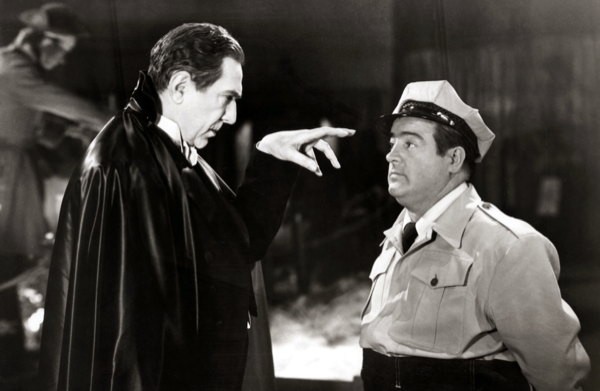
Dracula (Bela Lugosi) hypnotizing Bud AbbotT in ABBOTT AND COSTELLO MEET FRANKENSTEIN. Universal Pictures, 1948.

But beyond even those items of interest, there’s a larger and more personal reason why this Spookshow is a special event this month: it’s the final Silver Scream Spookshow being held at the Plaza under the watchful eye of Jonathan and Gayle Rej, the Plaza’s owners and operators since 2006.

Let me make another personal detour here. The Plaza Theatre is, to me, a sacred space. It’s almost a religious temple, dedicated to conjuring and making manifest the spirit of cinema. And over its history—from movie palace to grindhouse to a showcase for independent film and performing arts—it has presented Atlanta with the full spectrum of the cinematic experience. And more than that, it has become a central, vital spot in my life. When I first moved back to the Atlanta area in 2006 after more than a decade away, I was working from home and initially didn’t get out much. It took me a while to get settled in and motivated to check out what was going on. That was when I saw a flyer for the Silver Scream Spookshow in the window of Junkman’s Daughter. It promised a revival of the classic Spook Show tradition of live stage shows augmenting showings of classic horror flicks—a phenomenon that I was old enough to remember coming to my home town, but young enough to have never personally experienced—presented by Professor Morte, an old-school-styled horror host from the cracked mold of Ghoulardi and Zacherley. So I went. And went. And went again.

The Frankenstein Monster meets Bud Abbott and Lou Costello. Universal Pictures, 1948.

Being a movie fanatic, the Plaza quickly became the center of much of my recreational time because more than simply being a theater, it has spawned a community. Most of the people I know and the friends I have, I have met either directly or indirectly through the Plaza. In fact, I wouldn’t be writing this piece for this fine website if it weren’t for the Plaza. And if it weren’t for the hard work and dedication of Johnny and Gayle Rej in the face of economic struggles that would have beaten down lesser mortals, none of the above would have existed.

As you may or may not know, Johnny and Gayle have sold the Plaza to Michael Furlinger, who recently revived the classic Terrace Theatre in Charleston, SC. I spoke with Shane Morton, the mastermind behind Morte, for his thoughts on the end of the reign of the Rejs and the beginning of a new era for the Plaza.

“I think out of all the phases that the Plaza has gone through, that Johnny and Gayle have really turned it into something much more than just a movie theatre. Something beyond just building the stage and clearing out the space in the back for us to work. It’s like they gave this place a soul. You can feel it when you walk in there. And if I can be selfish, they’ve given me a place to do what I think is the most important work of my life with the Spookshow. We recently did a showing of THE PHANTOM OF THE OPERA (1925), and I spent 15 minutes turning a kid into Lon Chaney’s Phantom. All that time, I was talking to the audience, and I felt the passion that one of those true-believer preachers must feel—not one of those charlatans that’s just out for money or to bang chicks or whatever. I got to preach about the magic of the movies. I not only get to be this hero (or anti-hero, if you want); I get to educate kids and give them something that they don’t have enough of right now. Kids’ programming today sucks, and they don’t have the kind of stuff available to them that even you and I had growing up; they don’t see things like the original KING KONG, stuff that filled me with a sense of wonder and amazement at the age of four.”

Shane went on to discuss the creative development that the Plaza has encouraged: “It’s become a hub for a lot of creative people: Splatter Cinema, Blast-Off Burlesque’s Taboo-La-La series and all the great art shows that they’ve hosted at the Plaza. Johnny and Gayle really turned a simple movie theater into almost an art movement. I know that it has literally changed my life. It’s given me the chance to fulfill every dream I ever had growing up. I could get to be Houdini or Alice Cooper or the horror host I had always wanted to see. And no matter what happens in the future, if I wind up making the greatest movie ever made, I don’t need any more than this: I saw a kid dressed as Professor Morte for Halloween. My mother passed away recently, and I’m so glad that she got a chance to see me spread my bat wings and fly with the Spookshow. And I really have Johnny and Gayle to thank for this.”

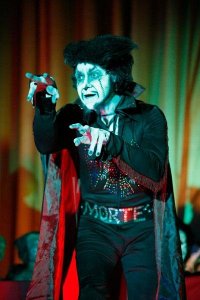
Professor Morte (Shane Morton). Photo courtesy of Shane Morton.

And what of the future? “We’d always hoped that someone with the financial backing could come in and turn the Plaza Theatre around. It seemed like an impossible dream. And then suddenly, it all seemed to fall together at the right time. Johnny and Gayle had just had a baby, and that’s without a doubt their most important job right there! Suddenly, Mike Furlinger came in and was in the position to deliver everything anyone involved with the Plaza could hope for. New digital projectors, new seats, new carpeting…now, I like the old seats and the old carpeting. I like stuff that’s old and weird. But you have to keep moving with the times, and what he’s going to bring to the Plaza is going to help the theater thrive. The future looks really exciting. The Plaza will be able to show first-run films along with the art-house movies they’re known for and keep delivering the funky stuff that all of us bring to the table.”

After the Rejs turn the keys over to Furlinger at the end of this month and renovations begin, it may be a while before we can see Morte’s handiwork on the Plaza stage. So come out and celebrate. Celebrate that the world didn’t end on Friday. Celebrate that the solstice has passed and a new dawn is rising. That Santa’s on his way. That a new year is on the horizon. That one of the best films in the Universal Horror cycle is screening in a lovely digital restoration. That Professor Morte and his merry band of misfits are taking the stage. And celebrate the legacy of the hard work and spirit of Jonathan and Gayle Rej. Raise your tubs of popcorn in salute, boils and ghouls.

Aleck Bennett is a writer, blogger, pug warden, pop culture enthusiast, raconteur and bon vivant from the greater Atlanta area. Visit his blog at doctorsardonicus.wordpress.com

Category: Retro Review | Tags: , , , , , , , , , , , , , , , , , , , , , , , , , , , , , , , , , , , , , , , , , ,

Retro Review: Deck the Halls With Splatter Cinema: GREMLINS Invade the Plaza Theatre!!!

Posted on: Dec 10th, 2012 By:

Splatter Cinema Presents GREMLINS (1984); Dir: Joe Dante; Starring: Zach Galligan, Phoebe Cates and Hoyt Axton; Tue. Dec. 11 @ 9:30 p.m.; Sun. Dec. 16 @ 3:00 p.m.; Plaza Theatre; Trailer here.

By Aleck Bennett
Contributing Writer

One of the most notable aspects of the classic Warner Brothers Looney Tunes series of cartoon shorts is that while they were created for the enjoyment of children, they were written to also entertain those parents accompanying their kids to the theater. They’d frequently wink at the audience, breaking the fourth wall and commenting on the ridiculousness of what was transpiring. Few directors have the right touch to pull this off in live-action filmmaking the way that Joe Dante does, and fewer films succeed at this to the extent of GREMLINS.

From his more cartoonish collaborations with Allan Arkush (HOLLYWOOD BOULEVARD, ROCK ‘N’ ROLL HIGH SCHOOL) to his somewhat more restrained horror features (PIRHANA, THE HOWLING), Dante’s modus operandi is to pepper his films with sly humor that acknowledges the fact that we’re all watching a movie. In the hands of some, it could come off as condescending—a kind of “look at us: we’re intentionally making a bad movie, hyuk hyuk!” attitude. But Dante loves this stuff too much to be condescending. In his hands, it all comes across as gleeful subversion; he seems to say that it’s okay to have fun with this medium and the things we love about it. That it’s okay to throw in a special appearance by Robby the Robot for a laugh because who doesn’t love Robby the Robot? That casting Dick Miller in every movie you make and frequently crediting him as “Walter Paisley” (his character from A BUCKET OF BLOOD) is fine, because Dick Miller is a legend and A BUCKET OF BLOOD is fantastic! More than even Tarantino, Joe Dante is the movie nerd’s movie nerd. His films take the attitude that they can have fun with established movie tropes because you should be having fun, and nothing is more fun than the movies.

Which brings us to GREMLINS. Like the classic Warner Brothers cartoons (hey, there’s Chuck Jones in the bar scene!) and Dante’s previous work, it blissfully screws with expectations about what you’re watching. And what it’s playing around with is Steven Spielberg’s E.T. the Extra-Terrestrial. Like E.T., the film is about a small-town kid who winds up taking care of an adorable, otherworldly creature, gets in over his head and madcap antics ensue. The first twist to the formula is that Billy (Zach Galligan), unlike E.T.’s Elliot, is college-aged, pursuing his old high school crush (Phoebe Cates) and still living with his folks. But still, that’s not such a departure that it necessarily alters the story dynamic, right? I mean, after his dad (Hoyt Axton) presents him with a precious little Mogwai named Gizmo, even if he breaks the final two of the creature’s three rules (1. Keep him out of bright lights. 2. Don’t get him wet. 3. Never feed him after midnight.), how bad can it get? It’s a Christmas movie, for crying out loud!

GREMLINS' Gizmo is darned cute when he's not wet. Warner Brothers, 1984.

Things can get really bad.

Rather than the film conforming to the E.T. template by having a force from outside threaten the poor little guy and his human pal, and eventually giving us a warm and affectionate send-off, Dante and screenwriter Chris Columbus have Billy make a couple of boneheaded mistakes and potentially doom the entire town. Thanks to Billy, an army of scaly, green and ugly little beasties are running about the place and gleefully killing and eating townspeople just for kicks. Gremlins are gruesomely killed in food processors and microwaves. Phoebe Cates recounts a horrific story about her father’s death. Nobody is safe. It’s almost as if Dante knew that the movie-going public would see Gizmo looking like a little bipedal pug and making high-pitched Howie Mandel noises and generally being so adorable you can barely stand it, and bring their kids to unwittingly witness THE MOST VIOLENT PG-RATED FILM OF ALL TIME. Okay, maybe INDIANA JONES AND THE TEMPLE OF DOOM has it beat, but not by much, bucko. Instead of the heartwarming and heartbreaking farewell of E.T., Billy’s family gets chewed out at the end as a proxy for the entirety of Western Civilization being a bunch of jerks. And all the while, you can practically hear Joe Dante, standing just off-screen, laughing himself half to death.

Predictably, parents were horrified. One of the teachers at my high school refused to let her kids see the film because the Gremlins “were obviously demons from the pit of Hell.” Outrage from Responsible Parents over the violence in this (and yes, in TEMPLE OF DOOM) is what led to the establishment of the PG-13 rating. But kids? Kids ate this up. They ate it up like pancakes covered in ice cream. Because even if the Responsible Parents didn’t get it, the kids did. And the Irresponsible Parents (like mine, bless ‘em) got that this was all a huge, happy joke.

Don't be fooled. The caroling GREMLINS aren't here for good cheer. Warners Brothers, 1984.

Unfortunately, GREMLINS wasn’t originally released at Christmastime. Fearing that they had nothing to offer for competition during the summer of GHOSTBUSTERS and (again) TEMPLE OF DOOM, Warner Brothers rushed the release of the film and pushed it up by six months. It’s a shame, too, because despite the absolutely epic violence of the film, it’s practically the perfect Christmas movie. Let’s face it: the best Christmas entertainments are fueled by a perverse viewing of Things Going Wrong. Would IT’S A WONDERFUL LIFE be what it is without spending the vast majority of the film watching everything that could possibly go wrong in George Bailey’s life go even worse? Would HOW THE GRINCH STOLE CHRISTMAS be as enjoyable without watching the Grinch attempt to ruin everybody’s life? Santa Claus in MIRACLE ON 34TH STREET may just actually be insane. RUDOLPH, THE RED-NOSED REINDEER runs away from home and hangs out with a bunch of losers and reprobates. There was that YEAR WITHOUT A SANTA CLAUS. It’s not A CHARLIE BROWN CHRISTMAS without watching Chuck’s life spiral into a void of existential dread. Christmas is a time for joy and merriment…and bloodshed and death.

…All of which makes GREMLINS the perfect choice for Splatter Cinema to screen at the Plaza Theatre this month. Even if it doesn’t seem to make sense at first (Spielberg produced it! Its hero is a little fuzzy critter!), sit back and enjoy one of the few Christmas movies to fully embrace the notion that over-the-top violence can be joyful.

Aleck Bennett is a writer, blogger, pug warden, pop culture enthusiast, raconteur and bon vivant from the greater Atlanta area. Visit his blog at doctorsardonicus.wordpress.com

Category: Retro Review | Tags: , , , , , , , , , , , , , , , , , , , , , , , , , ,

Retro Review: WAKE IN FRIGHT: Witness the Birth of the Australian New Wave Digitally Restored at Landmark Midtown Art Cinema

Posted on: Dec 8th, 2012 By:

WAKE IN FRIGHT (1971); Dir: Ted Kotcheff; Starring Gary Bond, Donald Pleasence and Chips Rafferty; Through Dec. 13 at Landmark Midtown Art Cinema; Dec. 14-20 at The Plaza Theatre. Trailer here; Tickets here (visit website for prices and showtimes).

By Aleck Bennett
Contributing Writer

“Have a drink, mate? Have a fight, mate? Have some dust and sweat, mate? There’s nothing else out here.”
WAKE IN FRIGHT poster tagline

The 1970s and 1980s were ground zero for a renaissance in Australian filmmaking. Beginning December 7, Landmark Midtown Art Cinema offers a rare chance for you to witness one of the groundbreaking films that sparked that boom: Ted Kotcheff’s 1971 film WAKE IN FRIGHT.

In the late 1960s, the film industry in Australia was basically nonexistent. To remedy this, John Gorton (Australia’s Prime Minster from 1968-1971) set into motion several policies and governmental agencies to promote local filmmaking. Sensing a need for native Australian film, local production companies began collaborating with outside studios in the first few years of Gorton’s administration, the most notable results being Michael Powell’s AGE OF CONSENT (1969), Tony Richardson’s NED KELLY (1970), Nicolas Roeg’s WALKABOUT (1971) and Ted Kotcheff’s WAKE IN FRIGHT.

Both Powell’s and Richardson’s films were critical and commercial failures, and as a result, didn’t contribute much to the notion of Australia as a hotbed of cinematic activity. Roeg’s WALKABOUT, on the other hand, was a critical and commercial triumph, yet its authenticity as a truly representative Australian film was in dispute immediately upon release. It was based on a novel by British author James Vance Marshall, featured a screenplay written by British playwright Edward Bond, was directed by British director Nic Roeg, starred his son alongside British actress Jenny Agutter, was produced by American businessmen Max Raab and Si Litvinoff (whose production company was incorporated in Australia), financed with funds raised in America and distributed by US-based company 20th Century Fox.

WAKE IN FRIGHT, however, sported a much more authentic Aussie pedigree. Whereas WALKABOUT used the Australian outback as primarily a vehicle for Roeg’s surreal vision, WAKE IN FRIGHT engaged the oppressive landscape as almost a character in itself. Based on the 1961 novel by Australian journalist Kenneth Cook and based on his own experiences, the screenplay by British writer Evan Jones—who consulted with Cook on its creation—hewed as closely to the original text as possible. The story finds a young schoolteacher from the city, John Grant (Gary Bond), posted to a tiny school in the outback town of Tiboonda. As the Christmas holiday begins, he plans to take a flight to Sydney to visit his girlfriend, but finds himself waylaid at a train station in the nearby mining town of Bundanyabba (aka “the Yabba”) as he waits to make the flight. After getting sucked into the hard-drinking ways of the townspeople, he loses his money gambling, loses his chance to make his plane…and slowly begins to lose his mind.

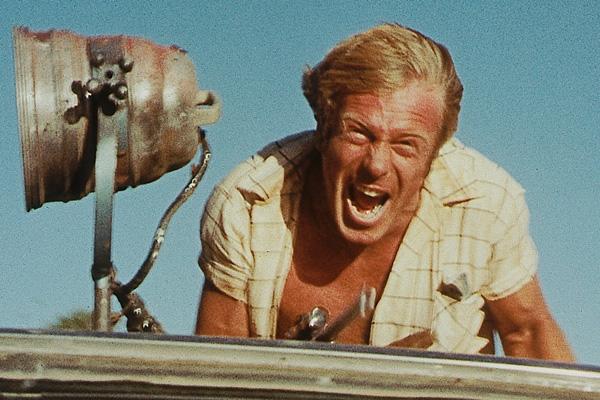
Jack Thompson in WAKE IN FRIGHT (1971), Drafthouse Films.

The screenplay was initially to be filmed in 1963 by Joseph Losey, with whom Jones had collaborated on the ’63 Hammer film THE DAMNED. A lack of financial backing doomed the project, and the screenplay was kicked around for nearly a decade. In 1968, Jones collaborated with Canadian director Ted Kotcheff (FIRST BLOOD, UNCOMMON VALOR, NORTH DALLAS FORTY) and felt that the director would be a good match for the screenplay. Kotcheff fell in love with the script, and immediately set about the business of raising funds and casting the film.

Kotcheff arrived with his family in Australia in 1969, determined to soak up Aussie culture in order to more realistically depict the people and locations described in the novel and screenplay. With his assistant director Howard Rubie, Kotcheff explored the worlds of illegal casinos, kangaroo hunters, Returned Services League veterans’ clubs, and the blue-collar pubs of dock workers and the like. As Kotcheff related to Australia’s National Film & Sound Archive, the pair sought out the kind of places “whose clientele clock off work at 6 a.m. and are heavily into the drinking by 9 a.m.—we did a lot of drinking.”

In many cases, it takes an outsider’s eye to catch details or present a perspective that might be glossed over by one more familiar with a place or subject. In this instance, Ted Kotcheff perfectly captures the bleakness of life in the outback before the internet, decent roads and efficient train and plane travel increased connectivity. In this much larger world, everything and everyone bakes in the 100-degree weather, and dust coats every surface. Likewise, an attitude of aggressive friendliness also coats the culture of drinking, gambling and game hunting that pervades the community. And in the Yabba, the mateship and seemingly out-of-place Christmas decorations also mask the sinister and menacing eye cast upon the outsider in its midst.

Donald Pleasance in WAKE IN FRIGHT (1971) Drafthouse Films.

The film opened in Sydney to worldwide acclaim. Ted Kotcheff was nominated for the Palm D’Or award at the Cannes Film Festival, and the film was tremendously commercially successful in France and Great Britain. However, it failed to find an audience in Australia. Said co-star Jack Thompson in the 2008 documentary NOT QUITE HOLLYWOOD: THE WILD, UNTOLD STORY OF OZPLOITATION!, “Australians at the time didn’t want to see it (the film) as Australia. People would walk away saying ‘That’s not us. We don’t behave like that.’” Kotcheff counters, “As a foreigner, you see things that Australians take for granted or accept as part of the dailiness of their life. They don’t see what’s eccentric or idiosyncratic about their life.”

However, the critical and (at least overseas) commercial success of WAKE IN FRIGHT and WALKABOUT lent credence to the notion that Australia was indeed a place to be taken seriously as a cinematic force. Jack Thompson confirms this, saying “What they provided was the knowledge for would-be Australian filmmakers that we had the ability to tell tales about ourselves in a way that was dynamic and interesting.”

In the wake of these early films came what would be known as the Australian New Wave of cinema, producing such soon-to-be-internationally-known talents as directors Peter Weir, Bruce Beresford, John Duigan and Fred Schepisi. The exploitative elements of WAKE IN FRIGHT (released stateside as OUTBACK) also proved to be influential in the development of what would later be known as “Ozsploitation.” Filmmakers such as George Miller, Russell Mulcahy and Richard Franklin seized upon the needs of the action and horror marketplace that was opened up by WAKE IN FRIGHT with films like MAD MAX, MAD MAX 2: THE ROAD WARRIOR, RAZORBACK and ROAD GAMES. Echoes of WAKE IN FRIGHT’s depiction of building dread can be found in films as recent as Aussie Greg Mclean’s 2005 film WOLF CREEK.

For years, the film WAKE IN FRIGHT was thought to be essentially lost. While it was released on VHS in the US, prints of the film were nearly impossible to find. 16mm prints of the movie were found, but were in poor condition for screening. The only full 35mm print of the movie, which was found in Dublin, was deemed to be of insufficient quality for commercial release. The film’s editor, Anthony Buckley, began searching for the film’s original elements in 1996. After years and years of false leads, prolonged negotiations with foreign rights holders and digging through cut and mangled prints of the movie, Buckley found the original film negatives in a shipping container marked “For Destruction.” Were it not for his efforts, the film would be nearly impossible to see today. Australia’s National Film & Sound Archive completed a full digital restoration in 2009, and premiered the new print at the Sydney Film Festival that year. It was later selected by Martin Scorsese as a Cannes Classic and was screened at that year’s Cannes Film Festival—with Michelangelo Antonioni’s L’AVVENTURA, it is one of only two films to ever be screened twice at Cannes.

Brutal in its honesty, bleak in its vision and startlingly original in its approach, WAKE IN FRIGHT is a long-hidden masterpiece of cinema, ranking with the best of the Australian New Wave and transcending even that pigeonholing. It’s where the Australian filmmaking renaissance started, and set a nearly impossible standard for all that followed.

Aleck Bennett is a writer, blogger, pug warden, pop culture enthusiast, raconteur and bon vivant from the greater Atlanta area. Visit his blog at doctorsardonicus.wordpress.com

Category: Retro Review | Tags: , , , , , , , , , , , , , , , , , , , , , , , , , , , , , , , , , , , , , , , , , , , , , , , , , , , , , , ,

Retro Review: MIAMI CONNECTION: Congratulations, The Plaza Got You Motorcycle Ninjas for Christmas

Posted on: Dec 8th, 2012 By:

MIAMI CONNECTION (1987); Dirs: Y.K. Kim & Woo-sang Park; Starring Y.K. Kim, Vincent Hirsch; Plaza Theatre, HELD OVER for second week through Dec. 13; Trailer here.

By Andrew Kemp
Contributing Writer

The first thing you need to know is that MIAMI CONNECTION takes place not in Miami, but on or around the beaches of landlocked Orlando.

Still listening? Then the other thing to know is that MIAMI CONNECTION is a movie out of time, a gift from the past that you didn’t even know you wanted. Congratulations, The Plaza got you motorcycle ninjas for Christmas, but you have to go this week to pick them up.

The history of MIAMI CONNECTION is so unbelievable that it’s already a movie legend. In 1987, Korean immigrant and self-described “modern philosopher” Y.K. Kim collected a modest budget and a gang of amateur actors and taekwondo students to craft a martial arts epic about a black-belt rock band’s struggle against drug-dealing ninjas, starring Kim, of course, as the improbable college student hero, Mark. After failing to find distribution, the movie disappeared into obscurity, never officially released.

Twenty-five years later, an employee of the Alamo Drafthouse in Austin, Texas, stumbled upon the last remaining film print on an online auction site. The Drafthouse is a kind of national church for movie fans, and they’ve been aggressively searching out and stockpiling 35mm film prints for years, defying the conventional wisdom that film is dead. After negotiating a $50 price for the MIAMI CONNECTION print—sight unseen—the Drafthouse decided to show the film as a random oddity for their midnight crowd. The audience erupted and, somehow, MIAMI CONNECTION became a hit. Now, the Drafthouse has made the movie an official release for their distribution arm, remastering it and shipping it to theaters nationwide. They’ve even mounted a tongue-in-cheek Oscar campaign and produced a new trailer, cut by Jason Eisener, director of CONNECTION’s spiritual soulmate, HOBO WITH A SHOTGUN (2011).

For decades, THE ROCKY HORROR PICTURE SHOW (1975) was the king of ironic entertainment, beloved for being bad long enough to become an institution, but today’s audiences have been seeking new guilty pleasures. First, we had SHOWGIRLS (1995) and its silly drinking game, and then TROLL 2 (1990) became popular enough to spawn its own documentary. Most recently, crowds pack the Plaza for regular showings of THE ROOM (2003), bringing forks and costumes to make themselves part of the experience.

And now, for these folks, MIAMI CONNECTION feels almost like a culmination. It’s an honest-to-godawful classic, something that’s normally found and championed by the few, now delivered by a major theater entity in a pristine presentation. It’s a movie literally plucked off the scrap heap, polished and mass-produced. Ready-made cult movies tend to flop because audiences are savvy and they know when they’re being pandered to (REPO: THE GENETIC OPERA, anyone?), but the vibe around MIAMI CONNECTION is completely different. This is one group of movie-fanatics speaking to others and saying “you have GOT to see this,” just as they’ve done for years, but never before on this scale.

Part of the film’s charm is that it’s so damn sincere. Y.K. Kim’s college student is just one member of the band Dragon Sound, all of whom are badass taekwondo students/total dorks. For some reason, Dragon Sound’s very existence seems to be standing in the way of a growing drug cartel based out of Miami, but doing business through the band’s club in Orlando. This thin premise kicks off an escalating series of martial arts battles between the band and the cartel’s thugs and, yes, eventually leads to a confrontation with motorcycle-riding, cocaine-dealing ninjas.

In between attacks, the band hangs out at their favorite eateries, spars on campus and fails to score with chicks at the beach. Oh, and one member of the band has about three scenes dealing with the search for his long-lost father, handled entirely via mailbox. Did I mention that the band also writes and performs a song about friendship? That song shares stage time with a ditty about fighting ninjas, which they sing before any member of the band has encountered even a single one.

But no plot synopsis can completely capture MIAMI CONNECTION’s charms. Sure, there are laughs to be found in the schlocky gore effects, bizarre plot twists and bad dialogue (“…because of that stupid cocaine…”), but people don’t go to these movies again and again to simply sit and make fun of them. That’s a mean-spirited reaction, and the crowd with whom I watched MIAMI CONNECTION showered it with love. No, what makes the movie resonate with people is that it’s an endearing reflection of the types of movies it wants to be. When you watch MIAMI CONNECTION, you can recognize the notes the film is trying to play, even if it comes off more than a bit tone deaf. Film is a language, and this is an American urban action movie made by someone who doesn’t quite speak that language, but who was passionate enough to try anyway. This is true, too, of the Italian ambition behind TROLL 2 or, um, wherever the hell Tommy Wiseau came from to produce THE ROOM. If any of these filmmakers had managed to make the movie they attempted, the result would have been a magnitude less interesting. Are these movies bad in the strictest sense? Sure, but they’re also minor miracles. In a sea of low-budget mediocrity, it takes a special spark of passion to fail this spectacularly and entertainingly.

MIAMI CONNECTION doesn’t make much sense as a story, but the action is fun and for real, and it’s a blast to watch the random plot threads bang together and make noise. Most of all, it’s a reminder that films inspire and speak to all of us, even those who don’t quite know the words. Come for the irony and the motorcycle-ninjas, but don’t be surprised if you get caught up in the fun of going to the movies.

Andrew Kemp is a screenwriter and game writer who started talking about movies in 1984 and got stuck that way. He writes at www.thehollywoodprojects.com and hosts a bimonthly screening series of classic films at theaters around Atlanta.

Category: Retro Review | Tags: , , , , , , , , , , , , , , , ,

Retro Review: The Sweet Scent of POLYESTER: Blast-Off Burlesque Taboo-La-La Presents John Waters’ Most Odor-ific Cult Classic

Posted on: Dec 1st, 2012 By:

POLYESTER (1981); Dir: John Water; Starring Divine, Tab Hunter; Plaza Theatre, Saturday, December 1 at 10:00pm; presented by BLAST-OFF BURLESQUE’S TABOO-LA-LA in ODORAMA. Trailer here.

By Andrew Kemp
Contributing Writer

Let’s start with a question. What if I told you that, on Saturday night at the Plaza, you had a chance to experience a film in ODORAMA, a process that lets you scratch-and-sniff a card to experience with the, um, aromas of the movie you’re watching, aromas that include such delights as model airplane glue, skunk and flatulence? Does that sound like your idea of a fun weekend night?

Those of you who said “yes, please!” already know John Waters and his film, POLYESTER, playing as part of the regular TABOO-LA-LA series presented by Blast-Off Burlesque. You guys are going to be there anyway. For those of you who *ahem* politely declined, the burden now falls to me to change your mind.

John Waters is kind of a maniac, but movie nuts and those with a taste for the trashy have long considered him their maniac. Waters is a true indie, a guy whose tastes and warped sense of humor never stood a chance of playing in Hollywood, and so he made his own Hollywood in Baltimore, churning out a handful of homemade movies starring his friends, a company of actors who took to calling themselves the Dreamlanders. Perhaps the most famous Dreamlander was Divine, an actor who performed in drag and rose to fame as Waters’s muse, due equally to Divine’s incredible charisma and willingness to waltz into the darkest corners of Waters’s imagination. Divine starred in all of Waters’s early Baltimore films, never more famously (or infamously) as in PINK FLAMINGOES, which uses as its money shot a scene where Divine consumes dog shit. Did I mention that John Waters movies aren’t for the weak-stomached?

Baldly nasty content is what earned all of Waters’s early films an X-rating, when he bothered to have them rated at all. Waters sold himself as a master purveyor of camp, trash and kitsch, and his films can be endurance tests for the timid. So, Waters had to seek his audience, growing them like a culture through word of mouth. Many people watched Waters’s films with jaws dropped and raced from the theatre to tell friends who, of course, could never believe such filth existed at the cinema… and so they bought a ticket to find out for themselves. A passionate few liked what they saw and became fans for life. Waters’s movies owned midnight crowds back when late-night movies were for the deranged and the dangerous, but then a funny thing happened somewhere along the way: once the shock value numbed, fans noticed the actual craft and talent present both behind the camera and in front of it. Despite his image as the gleeful outsider with the pencil-thin moustache looking to tear down the system, Waters was the real deal, and as experience improved his work, his films became less pointedly offensive and more simply on-point. It was time for John Waters to go mainstream.

Enter POLYESTER, the film universally recognized as the transition from Waters’s early days with the Dreamlanders to an artist whose work could eventually be mined by Broadway (his hit 1988 film HAIRSPRAY eventually became a Broadway show, and then a movie musical, with John Travolta in the part originated by Divine. Times, they do change.) POLYESTER is John Waters’s take on the suburban aesthetic and weepy melodrama of Douglas Sirk, with Sirk’s painterly Technicolor tossed aside for garage-sale chic. Divine stars as a housewife named Francine Fishpaw whose marriage falls apart while her kids spin off in a variety of unsavory directions. To fully describe the plot would risk giving away many of its lightly-shocked laughs, but the movie isn’t afraid to explore. The more over-the-top the tragedy—and believe me, this clears the top by a half-a-foot–the more laughter Waters drags from the audience.

POLYESTER was the first John Waters film that could sit comfortably at the multiplex, and his first to receive an R-rating, bringing his work and his fans reluctantly blinking out into the sun. No matter which version of Waters you enjoy the most, generally everyone can agree that POLYESTER is one of his best and most accessible. In fact, The AV Club named POLYESTER as the ideal gateway into the director and his work.

And then there’s ODORAMA, the gimmick Waters cooked up to let his fans know that mainstream success wasn’t going to change him. In a nod to the showmanship of the great huckster William Castle, viewers of POLYESTER were handed scratch-and-sniff cards to keep up with the overactive olfactory system that helps Francine through the film’s plot. Now you can smell what Francine smells, and although the odors are rarely pleasant, the whole idea is just on the right side of wacky to lend the proceedings a heaping helping of charm. It’s Waters saying that it’s OK not to take his movie so seriously; he certainly doesn’t.

Blast-Off Burlesque is handing out ODORAMA cards for Saturday night’s viewing of POLYESTER, and they’re sweetening the deal with their usual variety show of burlesque performance and contests. The Dreamlanders would be proud.

Andrew Kemp is a screenwriter and game writer who started talking about movies in 1984 and got stuck that way. He writes at www.thehollywoodprojects.com and hosts a bimonthly screening series of classic films at theaters around Atlanta.

Category: Retro Review | Tags: , , , , , , , , , , , , ,

Retro Review: Feminine Sexual Threat Meets Avian Apocalypse: THE BIRDS Attack the Plaza Theatre in the Last Weekend of Alfred Hitchcock Month

Posted on: Nov 28th, 2012 By:

By Robert Emmett Murphy Jr.
Special to ATLRetro.com

THE BIRDS (1963); Dir: Alfred Hitchcock; Screenplay by Evan Hunter (aka Ed McCain); Starring Tippi Hedren, Rod Taylor, Suzanne Pleshette, Jessica Tandy; Fri. Nov. 30 – Sun. Dec. 2; Plaza Theatre (visit Plaza Theatre Website for showtimes and ticket prices); Trailer here.

Alfred Hitchcock, like a lot of thriller and horror filmmakers, always displayed an influence by Freudian theory. In THE BIRDS, he’s pared it down to one essential: all actions are motivated, most motives unconscious. Having first established that with the characters, he shows the same proves to be the apocalyptic secret behind the workings of the whole world.

Loosely based on Daphne du Maurier’s short story of the same title, THE BIRDS is Alfred Hitchcock’s only explicit foray into science fiction and fantasy. The screenplay by Evan Hunter (better known as crime writer Ed McCain) is awkward, but also ambitious. It’s Hitchcock’s immediate follow-up to PSYCHO (1960) and borrows from its device of a lengthy preamble, telling a story that proceeds along one narrative line until events outside the so-far-established frame of reference break that line, radically changing what the film’s about. When the main story arrives, it is disorienting and meant to be. Tippi Hedren plays a spoiled heiress who develops a crush on Rod Taylor which seems petulant – she wants to win his affection only to trump his mocking her – and a little creepy in its aggressiveness. She doesn’t know him at all, but stalker-like, she travels a long distance to arrive uninvited at his home.

Taylor lives in an island fishing community, and the first hint of the actual threat/main story comes is when Hedren is approaching the island by motorboat and a seagull flies into her, giving her a minor injury. That minor injury may have influenced Taylor in not immediately demanding she turn around and go home. So Hedren has a small opening and is not without wiles. Taylor starts to respond, but obstacles appear quickly. His clinging mother, Jessica Tandy, doesn’t like Hedren. Then there’s Taylor’s ex-girlfriend, Suzanne Pleshette, who surprisingly befriends Hedren, but also provides some insights into Taylor that suggests he’s as out-of-touch with his motivations as Hedren is.

The dialogue is a little strained, but covering interesting ground. It’s a love story examining people who don’t know why they do the things they do. It’s justifiably talky because every dialogue is a negotiation to establish one’s position in three-or-more-player power relationships.

This is also not at all what the film is about. As the threat escalates at an almost leisurely pace, the amount of dialogue decreases.

THE BIRDS attack Tippi Hedren and a group of children in one of the Hitchcock masterpiece's most iconic scenes. Universal Pictures, 1963.

What this film is about is the revenge of nature and the end of the world. The film won’t tell us why this inexplicable disaster erupts any more than Hedren can honestly explain her pursuit of Taylor. I don’t know if it was Hitchcock or Hunter who made the bold move to violate one of the fundamental rules of monster movies in their refusal to provide even a partial explanation for the events. It was ballsy though. I can’t think of another film driven by seemingly motiveless events that was anything but annoying, because in almost any other example, motivelessness is the same as incoherence. The original short story is ambiguous regarding explanation, but suggestive. The film, though, is completely opaque.

Maybe part of the success is that explanations are dangled in front of us, and they seem to make emotional sense, but clearly don’t make narrative sense. This is another of a string of Hitchcock films where ice-queen blondes appear to be the well from which all evil flows, but always Hitcock is always putting a modest twist on that easily misogynist interpretation of that “evil.” In VERTIGO (1958), Madeleine (Kim Novak) is bad, and drives a innocent man to obsession, but she’s not the main architect of the fiendish plot [Ed. note: Read our Retro Review of VERTIGO, which played last weekend at The Plaza, here]. In NORTH BY NORTHWEST (1959) Eve (Eva Marie Saint) is deceitful and part of the circumstances that put our hero at risk, but she is in on her deceit, she is serving a greater good and proves to be almost as much a victim of circumstances as our hero is. In PSYCHO (1960) Marion (Janet Leigh) is a criminal and a betrayer for sure, but none of her sins have any bearing on her fate.

Here, the apocalypse seems to arrive with Hedren, but as weird as she is, she does nothing that could reasonably provoke anything larger than Tandy’s jealous resentment. Moreover, as the story unfolds, it becomes obvious that the disaster is much larger than any of these lives or the geography we see in the film itself. When Hedren is accused of being evil’s harbinger by a hysterical woman, that seems only to reinforce the irrationality of the suggestion. But no other explanation is provided.

Semi-feminist writer Camille Paglia mined the irrational vein in search of meaning. She interpreted THE BIRDS as a celebration of the complex faces and threats female sexuality presents to a man, to the point that nature becomes an extension of that tension. She notes that more women play more pivotal roles in THE BIRDS than in any other Hitchcock film. The hero is defined by his relationships with his mother, younger sister (more like a daughter) and ex-lover, and that careful balance is thrown off by the appearance of Hedren. The disruption of the domestic balance is blown up to become the disruption of the balance of nature.

Once the bird attacks start escalating, each is paced and staged very differently from the one before, and this is where Hitchcock shows his true mastery. Every attack is remembered as a classic moment. Like Hedren sitting on a bench outside a school house waiting for Pleschette, a teacher, to take a break. Hedren lights a cigarette. We hear the children inside singing in unison. Hedren doesn’t notice what we can see over her shoulder, the playground jungle-gym gradually fill with hordes of silent crows.

Or like the largest attack, which, surprisingly, isn’t the last one. It features Hedren, who arrived at the island with caged birds, trapped in a cage-like phone booth while killer birds swirl around her (Hitchcock quite effectively put the camera inside the booth with her, so we shared the claustrophobia and shock of the assault).

And the climax, after the whole community finds itself under siege, and Hedren and Taylor’s family barricade themselves in his house. In the only scene taken directly from Du Maurier’s story, the attack becomes more frenzied, suicidal, and no defense can be adequate because there are so many of them, they are so small and there’s always another way in.

Tippi Hedren and Rod Taylor in Hitchcock's THE BIRDS. Universal Pictures, 1963.

Two things come up in every review of THE BIRDS – Hitchcock’s choice to do without a conventional score and the landmark FX. Though there is no music per se, Hitchcock did use his favorite composer, Bernard Herrmann, to create scary, synthesized bird calls to counterpoint the calculated silences. For this reason, THE BIRDS is the eeriest sounding of all his films.

Then there are the special effects. Simply put, what Hitchcock achieved should’ve been impossible with the technology of the day. It contains more than 370 separate trick shots. Every technique then imaginable was employed here including a slew of matte paintings, trained birds lured by feasts of fish and food scraps, mechanical birds, stuffed birds, and a scene during which Hitchcock literally threw live birds at Hedren (under those circumstances, the animals’ aggressiveness was probably sincere and Hedren’s fear wasn’t acting). The scene where the children are attacked on the road (this is part of the same sequence where the birds gather on the jungle-gym) involved most of the above, plus meticulous animations integrated into shots of live actors, through a complex “yellowscreen” process executed by Disney’s Ub Iwerks, who was one of the technique’s inventors. And then there were the two unnamed female artists who spent three months hand-painting seagulls onto tiny film frames for a scene that lasted less than 10 seconds.

David Thomson refers to THE BIRDS as Hitchcock’s “last unflawed film.” These two clips cover the jungle-gym attack of children sequence. I still marvel that this was done in the days before CGI:

watch?v=ydLJtKlVVZw&feature=relmfu

watch?v=hplpQt424Ls

Robert Emmett Murphy, Jr., is based in New York. This article is number 58 in a series of 100 essays he is penning, inspired by the British documentary THE 100 GREATEST SCARY MOMENTS (2003). It is reprinted with permission. The moment selected for the list can be found at the 1 hour, 38 minute marker. 

Category: Retro Review | Tags: , , , , , , , , , , , , , , , , , , , , , , , , , , , , , , , , , ,

© 2025 ATLRetro. All Rights Reserved. This blog is powered by Wordpress