Really Retro: Your Ultimate Guide to AnachroCon 2013, Atlanta’s Steampunk/Alt-History Con

Posted on: Feb 22nd, 2013 By:

Science fiction used to be all about the future, but in steampunk, it’s gone back to the past to create a steam-powered alternate Victorian era full of airships, goggles and rayguns where Tesla trumps Edison. If you think that steampunk is just about creative costumes, there will be plenty walking the halls of AnachroCon, this weekend (Feb. 22-24) at the Marriott Northwest, but there will also be so much more from literary to art to performances. Read more about the many facets of this fast-growing subculture in our interview with STEAMPUNK BIBLE co-author S.J. Chambers, then head on down to AnachroCon to experience the city’s biggest annual steampunk gathering live.

As Anachrocon’s Website says, it’s the “place in the South for Steampunk, History, Alternate History, Science, Music, Classic Sci-Fi Literature and the most amazing costuming you’ve ever seen!” This year’s theme “The Roaring ’20s” takes steampunk into the 20th century so be prepared to do the Charleston with goggles on and a rocket pack on your back.

Here’s our top nine coolest things to do at Anachrocon. For times and locations, check the full con schedule here.

1. Costumes Extraordinaire

Men in top hats, boots and goggles. Ladies in their finest Victorian dresses with rayguns tucked into their beaded evening bags. Gizmos galore. In the case of steampunk, accessories make the outfit and it’s not just a look but a way of life for some followers who meticulously craft their eccentric wardrobes in home workshops. Expect to see an amazing array of hall costumes, but the best of the best compete in the Costume Contest at 7:30 p.m. on Saturday. Or learn to make your own from award-winning costumers in the Fashion and Fabrication programming tracks.

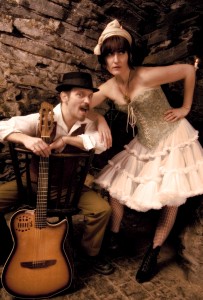
Frenchy & the Punk.

2. A Marvelous Menagerie of Musical Acts

If steampunk has a look, thanks to a motley menagerie of talented musicians, it also has a sound – a diverse blend of jazz, ragtime, gypsy, classical, goth and even a touch of rock n roll. At Anachrocon, you can hear some of the best in the region and nation including The Extraordinary ContraptionsFrenchy and the Punk, The Gin Rebellion, Vauxhall Garden Variety Players, Denim Arcade, New York Disco Villains, Valentine WolfeEliza Dane, Mark Gunn, Victorian funk rapper (yes you read that right!) Montague Jacques Fromage and more. Dance the night away to several DJs including “self-described eccentric audio arranger and morally ambiguous scientist” Dr. Q, the mad mastermind behind The Artifice Club which stages quarterly steampunk shindigs and is the official sponsor of the Friday night ’20s themed Repeal Revival. Keeping with the ’20s con theme, the repeal is, of course, of the Prohibition Act and the event is also the official afterparty of their Secret Speakeasy bash in December as well as their 3rd annual Opening Night Dance for AnachroCon. Read an interview with Dr. Q here about The Artifice Club here.

Talloolah Love. Photo credit: Mark Turnley.

3. Trick or Tease: Burly-Q Steampunk-style

Burlesque arose out of vaudeville and sideshow hoochie-coo, all of which go back to the bawdy dancers, singers and comedians of the Victorian music hall. Award-winning Atlanta burlesque beauties Talloolah Love, Ursula Undress and more will be entertaining at The Repeal Revival and offering costuming workshops throughout the weekend.

4. History, Science and Fashion, Oh My!

Yes, the whole idea of steampunk is based on an alternate history and a different direction in science and energy. Costumes are not mandatory to attend these bonafide actual history and science with fascinating panels on such topics as and much more including a variety of historical periods, musings on literary figures such as Sherlock Holmes, pulp fiction, culinary discussions, Vikings, pirates, great comets, the paranormal and more.

5. A Little Etiquette & Indulgence Can Do You Good

The Victorian Age was known for being prim and proper, unlike our uncouth contemporary era, so it seems only fitting that AnachroCon has a programming track centered on Etiquette & Indulgence. Founded last year by Peter Beer Slayer and Richard Carnival, “their mission [is] to make the world a better place by providing instruction on the Social Graces and how to truly enjoy life by using their combined powers to become the Traveling Revelers!” Take a ConChemistry class on whiskey and cigar pairing at 5 p.m. on Friday, or ConSociology on “how to meet people at cons” at 10 p.m., learn to mix civilized cocktails, or engage in properTea Dueling at  5 p.m. Sat.

Bill Pacer as Benjamin Franklin.

6. Viva the Revolution – Meet the Founding Fathers

Tea Partiers and Ultra-Liberals, take note! OK, AnachroCon isn’t breaking out the Ouija Board (well, not right now anyway; we kind of think there has to be some Ouija-ing going on somewhere), but professional Thomas Jefferson and Benjamin Franklin impersonators (J.D. Sutton and Bill Pacer) will be on hand to share their wisdom on government, electricity and even provide a Q&A. Find out what the founding fathers really thought about freedom of religion, gay rights and sleeping with French prostitutes – we dare you to ask them!

7. Astounding  Alt-History Literature & Pop Culture Panels

At the end of the day, it’s sometimes forgotten that steampunk started not as an aesthetic movement but in the pages of books and now is a lively literary genre. Panels discuss classic influences from Edgar Allan Poe to Jules Verne and H.G. Wells might get a few mentions, as well as how to write in the steampunk universe. Author guests include Cherie Priest, Lee Martindale, Eugie Foster , Jana Oliver, Philippa “Pip” Ballentine, Delilah S. Dawson, James R. Tuck, Tee Morris,  Kathryn Hinds, Emilie P. BushKimberly Richardson and Alan Gilbreath.

8. Sensational Steampunk Marketplace

Need a pair of goggles, a trusty ray gun, a corset, jewelry, custom leather items? All of these and more are available in the Vendor Room, a veritable bazaar of steampunk-related merchandise, with a little Medieval-Renaissance-Celtic thrown in for fun. Well, steampunk does share some roots in modern fantasy which is often inspired by those eras. Be sure to also visit the Artisans Room where you can buy unique, one-of-a-kind creations.

9. The Horror! The Horror!

OK, maybe we’re a little prejudiced because ATLRetro’s Anya Martin is on several of the panels on the all-new classic horror programming track, including Frankenstein: Horror or Science Fiction? (Fri. 3 p.m.), Cinema of Mystery and Imagination: Edgar Allan Poe at the Movies (Fri. 7 p.m.), Two-Fisted Tales of Robert E. Howard (Sat 1 p.m.), Dracula’s Bloodline (Sat 7 p.m.) and Jack the Ripper at the Movies (Sun.). Other panels cover Hammer horror movies and much more, and it’s all conceived by Derek Tatum, the grand master of the horror and dark fantasy track at DragonCon.

Category: Really Retro | TAGS: None

Kool Kat of the Week: The Beating Heart of Art: Garrett DeHart and His Poe-Inspired Short Film IF I AM YOUR MIRROR

Posted on: Feb 22nd, 2013 By:

By Aleck Bennett
Contributing Writer

Atlanta native filmmaker and photographer Garrett DeHart is the mastermind behind one of the most inventive short films ATLRetro has seen in recent years: IF I AM YOUR MIRROR. An adaptation of Edgar Allan Poe’s short story, “The Tell-Tale Heart,” the film takes Poe’s lean exercise in mounting paranoia and expands it into a fractured document of Post-Traumatic Stress Disorder in the years following the Civil War. Beyond the narrative twists taken with Poe’s themes, the film dramatically stylizes the world its characters inhabit – presenting it as a living Victorian-era oil painting imbued with the blood, spit, dirt and murk both of the time and of its main character’s mind. The portrayal of that lead character by the late actor Larry Holden in one of his last roles, is a triumph: in turns fierce and fragile, proud and pitiable. Currently available for viewing online, this immersive 18-minute epic is well worth your time.

In honor of this horrific accomplishment, ATLRetro goes Really Retro with this week’s Kool Kat.  We spoke with Mr. DeHart about his experiences making the film, the techniques behind creating the images, his influences, his local ties and much more.

ATLRetro: IF I AM YOUR MIRROR has a remarkable visual style, resembling an oil painting come to life. Were there any particular artists that inspired the look of your film? Filmmaking-wise, who influenced you on this particular project?

Garrett DeHart: I’ve always loved Poe, and  I had been playing around with a process to make live action film look like an animated oil painting. I thought the color and composition of Romantic painting, the predominant painting style of Poe’s time, was very well-equipped to tell a story inspired by Poe’s voice. I added a bit more dirt, grim and blood, and I think, with that, it’s a style that lends itself well to my voice as well. I did research on Romantic painting as a whole, but was really drawn to the paintings of Eugène Delacroix, J. M. W. Turner and Thomas Wilmer Dewing.

As far as filmmakers, the process was, of course, inspired by Richard Linklater‘s WAKING LIFE.  I loved what he did, turning live action into animation, to create a world of dreams, and really loved the look of his Rotoshop films. But I really wanted something that had a bit more texture and grim to it, and also wanted something that I could do myself.  After I saw WAKING LIFE, I started working on the process and used it in my film THE PROBLEM WITH HAPPINESS (2004) a 70-minute film that was projected on three discrete screens and had an accompanying seven-piece live band playing the score. We had 300 people at Eyedrum for the premiere and then later played The Earl before the band broke up. It was a sci-fi film in which the protagonist’s world slowly turns into a moving oil painting. I was never really happy with the effect that I was able to produce for that film and so I kept playing around with the process. The narrative was inspired by the films of Terrence Malick and Lars von Trier.

Could you describe how you came to create MIRROR’s striking look? How long did it take to bring such a heavily-stylized project to fruition?

The actors were shot on green screen at a small studio at Georgia State University. Aside from a few chairs, luggage and miscellaneous props, everything else was added in post. I developed a process through Photoshop to stylize the actors’ frames and ran each frame of each element in a scene through Photoshop to add the effect. Many of the shots have multiple layers on each actor, and the layers were then rotoscoped in to create lighting effects, shadows and a greater depth of field with the paint effects. The backgrounds were developed from stills, paintings and created graphics. Those backgrounds were then layered and animated in After Effects. Some of the shots have hundreds of layers in them. The final shot of the film took over 30 hours to render. I pushed the capabilities of After Effects in working in a 2D for 3D world. I did all of the post for the film on my MacBook Pro. The computer was running full speed around the clock for over two years. I’m typing this now on the same machine. The whole process took a bit over two years.

You also directed DOGME #55: A PICNIC AND A STROLL. You’re obviously not frightened by taking on a wide variety of styles, as MIRROR is about as far away from the Dogme 95 philosophy as possible! Which turns out to be more difficult (or, alternately, more fulfilling) for you as a filmmaker: following the self-imposed restrictions of the Dogme 95 movement, or the technical demands of an effects-heavy film like MIRROR?

I was really inspired by the Dogme 95 manifesto. I really like the idea of using real people, instead of actors, when possible, and breaking down the spectacle of lighting and score, and using a handheld, cinéma vérité camera style to get to some truth. I think my tendency would be to lean more towards a Dogme esthetic, at least in the way in which I direct actors. Now that I think about it, It might be compelling to try and develop one of Poe’s stories as a Dogme style film.  But I don’t think even Von Trier or Vinterberg ever made a truly pure Dogme 95 film, and while I think there are some very important ideas in the Dogme 95 movement, I’m really most inspired by very stylized expression in films. I also love the graphics and effects and the spectacle of fantasy and horror films.

I did MIRROR for my graduate thesis and I really wanted to experiment with this effect that I had developed. They have a great studio at DAEL (Digital Arts Entertainment Laboratory), and I wanted to utilize the GSU facilities while I had the chance to access all of their equipment for free. We shot almost everything in the DAEL blue-screen studio at GSU and got to utilize all of the studio equipment.

I’m not sure which style is harder as a means of telling a story well. I know which takes longer.

How did you come to work with the late Larry Holden, and how was your experience working with him on MIRROR?

I met Larry on the set of another film a few years prior to my film. My friend had written him a letter, told him he was trying to make his first feature and asked if he’d be willing to be in the film. Larry drove across the country for that film, so when it came time to make my film, I thought he would be perfect for the role [and] I wrote him and asked if he would star in the film.

Larry was an amazing cast member to have on set. The experience and vitality he brought to the set really energized everyone working on the project. For most of us on set he was the biggest name we had worked with, but he was incredibly humble and was really dedicated to working with and teaching everyone on set. He had been in Christopher Nolan’s films and a lot of TV, but he was making his own films whenever he could, and when he had time he would travel across the country, for little more than expenses, to help and teach those who were trying to learn the craft. He stayed with some friends of mine up the street from my house during the shoot.

He was not only incredibly influential to all of the crew that he worked with for less than a week, but many folks in the neighborhood became very close with him in that time as well. My neighbors traveled across the country to go to his funeral. I was not able to make the trip at that time. It’s an incredible loss. He was an amazing artist and an amazing person, and we all feel very fortunate to have had the opportunity to spend some time with him.

Poe’s stories are known for how streamlined they are, which makes adapting them almost impossible without necessarily expanding on the source material, or deviating from it in some way. MIRROR provides a particularly novel take on Poe’s “The Tell-Tale Heart.” How did you decide on your approach to the source material?

Initially I had planned to shoot a straight version of “The Tell-Tale Heart” told through the lens of Romantic painting, with voiceover. I had all the pre-production done and was ready to shoot and make that film. As I got Larry Holden interested in and then brought him onto the project, he convinced me that “The Tell-Tale Heart” films had been done enough and that it might be more interesting to take Poe’s story and its themes and let those inspire a new story. After some research, I realized that while a modern “Tell-Tale” done well could be really compelling, he was right and that I needed to develop something new: something that would express my voice. So I dug in, and with the help of a couple of friends, developed a script that I thought respected Poe’s legacy but might expand on who his characters were and the world they may have inhabited.

Garrett DeHart on set of IF I AM YOUR MIRROR.

I had the blueprint of all that pre-production I had done for the Tell-Tale script, but I was convinced we were making something new now—something certainly more challenging for me. So it wasn’t really a difficult process in deciding what to add or subtract. Poe’s story works really well in its minimalism and focus. He excludes all details that don’t lend directly to the development of the protagonist’s obsession and insanity. I was working on a new project; a film inspired by Poe. I think that “inspired by” gave me the freedom to expand on Poe’s ideas and imagine circumstances that may have brought his characters to the situations they experience in his story, and in that imagining I was creating my own story, a story that explored some slightly different, maybe more contemporary themes.

My first edit of the film we shot was almost 50 minutes. It was really more about pacing than it was about cutting scenes. But many of those quick shots, that last only a few frames, were 5, 10 or even 30 seconds long in the first cut. I was really working from the inspiration of Malick and Von Trier in the pre-production process. I imagined the film as a very slow, melodic PTSD nightmare. But as I worked with the film more and more, I found something of a thriller in it, and it seemed a bit pretentious to let the scenes linger like they were. I loved the 30-second wide, static shot of the train driving across the horizon, or 30 seconds of his wife walking through a burning wheat field, or a 5-minute flashback of the Civil War, but as I lived with the film day and night for two years, I realized this was a short, not a feature. I felt the audience might find it a bit tiring, and I wasn’t sure the long shots and extra scenes were really helping to propel the narrative. I’m happy with the decisions I made in cutting the film down.

Being an Atlanta-centric website, I’m required by city ordinance to ask: what local talent should we be keeping our eyes peeled for in the film? Any notable locals toiling behind the scenes that we should be aware of?

We had an amazing turn-out for crew from GSU grad students and for extras from all over the Atlanta area.

Shane Morton (aka Professor Morte of the Silver Scream Spookshow) was incredibly helpful on set. He did a lot of makeup work on the actors in production to help the paint effect along when we got to post.  He’s always working on cool projects. He did some effects and stars in the TALES FROM MORNINGVIEW CEMETERY horror anthology. He’s always planning and working on Atlanta Zombie Apocalypse, and they are in development on FRANKENSTEIN CREATED BIKERS (The sequel to DEAR GOD NO!).

If you’ve seen any Atlanta independent film you probably know Barefoot Bill (aka Bill Pacer), the Old Man/Evil Eye. Bill is always auditioning in Atlanta when he is not working on his one-man Ben Franklin show. He”ll be doing the Ben Franklin show at AnachroCon this weekend and March 2 at Duluth Historical Museum.

Mari Elle, the wife in the film, is now in LA but comes back to Atlanta to audition for films. She’s in town this week auditioning so catch her while you can. She is fantastic.

Steven Swigart and Chris Escobar were a huge help during production as the anchors of the production team. Chris is now the director of the Atlanta Film Festival and recently made a documentary short, shot partially in Colombia, about the ripple effects of family choices. Steven is making mini-documentaries for a university.

Jeff Ballentine, who let us borrow his large Civil War re-enactor wardrobe, is working on post for his own Civil War film.

What led to your decision to release the film online, rather than pursue the typical festival route? What has the reaction been thus far?

There’s a misconception, I think, that filmmakers are giving their work away for free when they put it online. The truth is that most filmmakers don’t make any money from their films; in fact, most spend hundred or thousands of dollars just trying to get the film seen in festivals. I made IF I AM YOUR MIRROR as my graduate school thesis project, so I wasn’t expecting to make money on the film. I wanted to create a film that exemplified my capabilities at the time, and I feel this film does that. MIRROR, at 18 minutes, is long for a short film and does not easily fit into an established genre. Therefore, it would be difficult to place it in festivals.

The festival circuit, while important, seems to me, just another way to suck money out of the truly indie filmmaking market. At $20 to $50 per entry, it’s just so much time and money that could be spent on the next project. And while seeing a film on the big screen is, of course, a far better experience (I screened my film at the Plaza Theatre and the trailer at the High Museum as part of WonderRoots Best of Generally Local, Mostly Independent Film Series), reaching an audience is really the most important thing, and the potential audience on the web is immense. Tapping that audience is, of course, the key, and that has been somewhat difficult, but I’m doing everything I can to self-promote the film through online media like ATLRetro. The critical response has been great and the film has gotten a lot of attention but, sadly, that has not really translated into as many viewers as I had hoped.

If you like the film, please support independent cinema, and pass it along to your friends and social networks.

This past October, I saw the 7 Stages production of DRACULA: THE ROCK OPERA, and when I saw your film later at the Plaza, there were a few effects shots in the video projection that looked familiar—primarily some shots of the train and the train station itself. Given the overlap in talent between these projects, I have to ask: were these your handiwork?

Yes. Rob Thompson was in MIRROR and asked, when they started to develop DRACULA, if they could use some of the footage for the backgrounds of the rock opera. I adjusted a few of the shots and gave them longer takes, and I’m very happy that MIRROR helped to fill in some of the space of the Dracula rock opera.  We’ve talked about the possibility of doing a music video/short with one of the songs on the soundtrack that will be released this month, but we haven’t had the time to work it out yet.

Are there any future projects on the horizon we should be looking out for?

I’m hoping that getting IF I AM YOUR MIRROR out into the world will facilitate connections with other writers and filmmakers and lead to new projects in the near future.  I’m in development on a Steampunk character study, short film with a style inspired by Wong Kar-wai and Gaspar Noé, that I hope, when complete, I can crowd-source into a TV series or web series. I’m looking for some writers to help in the expansion of that project. Again, if you like the film, please support independent cinema, and pass it along to your friends and social networks.

You can like IF I AM YOUR MIRROR on Facebook and check out the webpage; www.ifiamyourmirror.com.

Aleck Bennett is a writer, blogger, pug warden, pop culture enthusiast, raconteur and bon vivant from the greater Atlanta area. Visit his blog at doctorsardonicus.wordpress.com

All artwork is courtesy of Garrett DeHart.

Category: Kool Kat of the Week | Tags: , , , , , , , , , , , , , , , , , , , , , , , , , , , , , , , , , , , , , , , , , , , , , , , , , , , , , , , , , , ,

More Than Still Standing: Melba Moore Talks About Growing Up in Jazz, the Summer of Love, and Living the Dream Again in GOOD GOD A’MIGHTY

Posted on: Feb 16th, 2013 By:

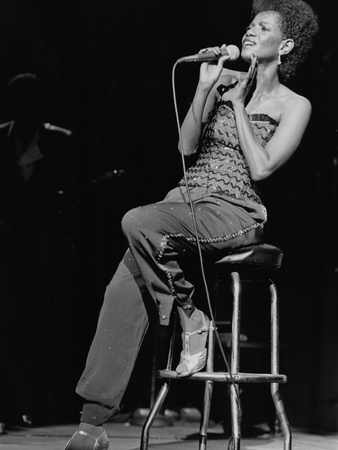
Melba Moore, 1985. Photo credit: James Mitchell.

Legendary R&B vocalist Melba Moore stars as the bombastic director of a Southern church choir in Lolita Snipes‘ gospel musical GOOD GOD A’MIGHTY, playing Feb. 14-24 at 14th Street Playhouse. A hilarious behind-the-scenes look inside a southern African-American church faced with a vibrant new pastor from New York, the play marks a bit of irony in that Melba is a born-and-bred New Yorker herself.

Because Melba is best known for a string of ’70s and ’80s Billboard hits starting with “I Got Love,” it’s easy to forget that her first big break came on Broadway when she replaced Diane Keaton in HAIR. She went on to win a Tony Award for playing Lultiebelle in PURLIE and appeared with Eartha Kitt in TIMBUKTU. Then her recording career took off, she started touring, and would not return to the theater until after a painful break-up with her husband. She used her remarkable life story as the backdrop for a one-woman play, I’M STILL STANDING, and soon was back on Broadway as Fantine in LES MISERABLES. Since then she has continued her comeback, including appearing with Beyonce and Cuba Gooding Jr. in the movie THE FIGHTING TEMPTATIONS (2003) and recording a new CD entitled FOREVER MOORE on her own label, A’Moore Music.

ATLRetro recently had the pleasure of interviewing Melba, and we couldn’t resist not just asking about her role but also her own Retro experiences growing up in a musical family in New York in one of the most exciting jazz music eras, the summer of love, working with Eartha Kitt, and much more. The conversation turned into a who’s who history lesson of some of the top names in recording which we couldn’t be happier to share.

How did you first get involved with GOOD GOD A’MIGHTY?

Lolita Snipes, the producer and writer of GOOD GOD A’MIGHTY, and her partner and husband, Jerome [Snipes],  got in touch with my manager and myself. We met in New York, and she said she had been watching me for quite a long time and knew I would be prefect for the role. I was a little surprised because though I do have a Tony Award for a comedy performance, I haven’t done a lot of comedy. She said the main reason she wanted me for the role was the music. She wanted the Melba Moore sound. She also wanted to make sure born-again Christians were involved in the play, and she wanted me because I had a reputation of being amenable, in harmony with the person in charge. She wanted to make sure that it was a real Christian play with the real Christian spirit, which is love.

You aren’t from the south but you certainly have a lot of experience with New York City having grown up there. Is there anything particular which resonates to you about this story personally?

It’s great in terms of a family culture because pretty much all of us originated from the south because we came here as slaves. We were farmers and eventually moved to the north, and we still have cultural clashes between north and south. Northerners are often considered educated and uppity by Southerners. These cultural clashes are nice food for comedy.

My mother was a professional singer and away all the time so I was raised in New York by a nanny who never learned to read or write, but came from a family of tobacco growers and sharecroppers. She was trying to get off the farm and get a job that was not so hard even if it was as a domestic or nanny. The thing that set many African-American families free was our music and the music industry, so my family was typical of that combination.

Tell us about your part and did you do anything in particular to prepare for it.

THE FIGHTING TEMPTATIONS. Look at the role that LaTanya Richardson – she’s the wife of Samuel L Jackson – played in that. She was feisty, bossy; she runs everybody. She doesn’t care who you are, she’s the boss. She will bring you down to size all the time. She’s a very selfish, mean-spirited ogre. That’s my part.

But it’s not dark or brutal. This is a Christian musical, so we don’t want to tell the bad news. She is not mean or evil. That’s one of the things that sets apart gospel plays or musicals. You’re not telling a negative story nor sympathizing with the bad guy.

This musical just sounds like a lot of fun. Is there a favorite part that you’d like to share?

It’s going to be so much fun. First of all, gospel comedies are the funniest type of comedy, and maybe one of the reasons they are is they don’t pander to the lowest elements of people. They don’t resort to cursing or really poking fun at people. They don’t have to be deep, but really have to be funny. They have to be joyful, really lift your spirits. That’s the point of it.

You grew up in a musical family. Your mother was a singer, your father a saxophonist and your stepfather a jazz pianist. Can you talk a little bit about growing up with jazz in the golden age of the 1940s and 1950s, maybe share a favorite memory?

My stepfather [Clement Moorman] is 97 years old. He still plays the piano and keeps his art. He plays better than ever before. My mother, though, has passed away. I grew up in an environment with a passionate love for music, and in an age when African-American artists had to be 10 times better because of racism. I grew up meeting Sarah Vaughan and Ella Fitzgerald. I thought I was going to be a piano player. I thought I’d be the next Horace Silver. I knew I was not going to be the next Oscar Peterson. My brother and I learned how to play these piano solos because we were so passionately enmeshed in this music. We were equally impassioned by classical music so also Leontyne Price or Marian Anderson. As I look back, it’s not just nostalgia, it just was truly a golden age. I majored in music in high school. I didn’t know if I had enough talent but I knew it was going to be my life’s work. I didn’t know if I would be a musician or singer, but I grew up listening also to Miles Davis and Nancy Wilson. I was totally enmeshed and absorbed in their recording.

Who was your favorite jazz performer in those early days and why? Outside of your family, of course.

They kept changing. Bill Evans and Horace Silver were two of our favorites. We’d sing all the solos. The Adderley Brothers, Nat Adderley, and the sax player Art Farmer. I can’t remember them all. There was just a plethora. I also loved Melba Liston because she had my name. And Ella Fitzgerald. I can sing her solos now, but I couldn’t then.

What was it like spending the summer of love in New York City and ending up cast in HAIR?

It was very unexpected. I was teaching music from kindergarten thru age 12 of high school in northern New Jersey, and I quit because I felt like if I stayed in teaching, I never was going to find out if I had enough talent to be a singing artist. My father took me to New York, where I met Valerie Simpson, who got me involved in overdub singing, At one of the recording sessions, Galt MacDermott, who wrote the music for HAIR, asked us all if we could come and sing for the director, choreographer and producer because they were still looking for strong voices. I was the only one who said yes. It was like I can’t even describe it – moving to another planet.

What was it like working with Eartha Kitt in TIMBUKTU?

She definitely was an icon and an artiste and her own self-person. She was intimidating in a sense. She was so strong and so confident and so good, and my personality was totally opposite. I was just starting to get some confidence now, but I have a gentle body language. We’re both petite women but total opposites. She was a cat and I was a kitty.

You started acting in musical theater in your twenties in HAIR and then winning the Tony for PURLIE, but then concentrated on your music career. How did you end up coming back to Broadway in 1995 to play Fantine in LES MISERABLES?

After TIMBUKTU, I went on tour and had my first hit record. I did 10 to 15 years of recording and touring. Then my marriage to my husband, who had been responsible for my success, disintegrated. During that time, I was trying to stay alive, much less stay in the industry. I did a one-woman play [SWEET SONGS OF THE SOUL, later renamed I’M STILL STANDING], and I began to climb back up the mountain. Richard Jay-Alexander, the casting director for LES MISERABLES on Broadway, saw me in Florida in my own play. He said he came in to see the play., but what he saw different sides of Melba Moore that he had never known. He had only seen me in PURLIE. He didn’t know I had a classical voice, or the other aspects of personality. It was thanks to I’M STILL STANDING that Lolita and Jerome found me, too. It was a wonderful audition piece for me.

You were the first African-American to play Fantine, the role that Anne Hathaway is favored for an Oscar this year. Can you talk a little about that experience?

I was just trying to survive, and then someone takes me and puts me into that role. When I got into it and realized what it was about, I thought, God put me here. How do you go from nothing to a lead role in LES MIZ? It showed me this is my destiny, where my good luck will happen. It was so much more than just playing a role and was a natural one to me.

It seems like certain songs play special roles at different times in one’s life. You have a long repertoire. Is there one song from it that means more now than it ever before, and if yes, why?

There are two songs. One is “I Got Love” from PURLIE, and the other is “Lean on Me,” written by Van McCoy. The longer I sing it, the more that I see that the song is my life. It’s always relevant, and the longer I sing it, because it is about your life going the right way, the more powerful it is again. It doesn’t depend on any age, any gender gap. It’s about people coming together, and the place that unites us is that magic of music which unites us. Some things pass away. With GOOD GOD A’MIGHTY, this play, I am beginning again at a fresh point. All those things that are retro and nostalgic have a fresh life again. That’s what music can be. In pop culture, we try to make things old and passing away, but that’s not what art is. Art lives.

Purchase tickets for GOOD GOD A’MIGHTY here or at the Woodruff Arts Center Box Office.


Category: Features | Tags: , , , , , , , , , , , , , , , , , , , , , , , , , , , , , , , , , , , , , , , , , , , , , , ,

Kool Kat of the Week: Darcy Lemmonier and Minette Magnifique Invite You and Your Lover to Cupid’s Pajama Party

Posted on: Feb 15th, 2013 By:

Atlanta burlesque beauties Minette Magnifique shimmy into something more comfortable during Cupid’s Pajama Party, their Valentine’s Day show Fri. Feb. 15 and Sat. Feb. 16. This time we have to say we are extra tempted by the location, which is the beautiful Le Maison Rouge at Paris on Ponce. In addition to performances by this tempestuous troupe known for their creative playful interpretations of the Retro art form, special guest stars include magic by our favorite zoot-suited man of ATLRetro fashion Chad Sanborn and an act by Ninja Puppet Theatre.

For an advance peek behind the curtain, we tracked down the delicious Darcy Lemonnier, who kindly agreed to be our Kool Kat of the Week.

ATLRetro: How did you discover burlesque? 

Darcy Lemmonier: I never knew much about burlesque till I started doing a little research. The whole idea of it made me a little scared.

When did you start performing and what was your first act/show?

It was about 2.5 years ago at a restaurant and lounge called Ziba’s in Grant Park. My very first piece I did was very European-inspired about the art of smoking and I was lounging around waiting for my lover.

Why the name Darcy Lemmonier?

I’ve always loved the name,  “Darcy.” The name was actually one of my favorite characters in a show I grew up watching. She played the part of a sweet young girl, but she had a dark side and she portrayed a big tease in the show.

Is there any story about how you become part of Minette Magnifique? 

Well the story itself is pretty short. I was a model for Pin Up Girl Cosmetics first and eventually became a performer. the owner of the company who happens to be a dear friend of mine said I had a great face burlesque and she roped me in to becoming part of the troupe.

In your opinion, what makes Minette Magnifique stand out/different from other local burlesque troupes/groups?

Minette is a group of fun, easy-going girls. I think our style along with our comedic edge helps to set us apart. We love to have fun and show our crowds a good time.

Who are a few of your burlesque role models, both classic and revival era? And of course, why?

Josephine Baker hands down. Shes was amazingly talented and dazzling to watch. I also love Dita Von Teese. Her take of classic burlesque I love and admire and shes beautiful with some of the most fabulous costumes.

Do you consider yourself to have a certain look/style? If yes, what is that and how did you develop it?

At first, I found myself trying to pinpoint my style, but after some time, I found that Darcy’s style tends to be more vintage with a lot of mod colors. Lots of black, silvers, and whites with a bit of Josephine’s richness thrown in.

How do you prepare a new act? Does the idea for the act come first or are you given a theme for a show and then come up with an act?

Our troupe usually goes with a theme for each show and we work around that,. It helps to give the pieces we create a story.

Without giving away any major spoilers, can you tease a little about your routine for the Valentine Showcase?

Let’s just say I find love, but I find it leaving me alone at the altar, hahaha. That’s all I’m going to say.

Why is watching burlesque together the perfect date night for a couple?

Burlesque is sexy, and it gets the blood pumping. It’ll give her some new ideas of teasing, and men love to be teased,  ha! But truly it’s a great time and should will be enjoyed by both.

Why is Crown your favorite cocktail?

I’m a girl who loves her whiskey, and Crown is the smoothest going down.

What do you do when you are not Darcy?

Hide in my bedroom till she is ready to come out and play.

What else would you like folks to know about you?

Darcy has big plans for Atlanta and she hopes everyone is ready for the ride.

Category: Kool Kat of the Week | Tags: , , , , ,

This Week in Retro Atlanta, Feb. 11-17, 2013

Posted on: Feb 13th, 2013 By:

Monday, Feb. 11

Northside Tavern hosts its weekly Blues Jam featuring blues and southern soul singer, Lola Gulley. Enjoy BBQ and Dry White Toast at Fat Matt’s Rib Shack.

Tuesday, Feb. 12

Don’t have a Valentine? Splatter Cinema shows you how to make one with a special screening at 9:30 p.m. of FRANKENHOOKER (1990) directed by BASKET CASE’s notorious Frank Henenlotter, at the Plaza TheatreIn addition to the usual pre-movie photo shoot, catch a special interview with star Patty Mullen. Read our Retro Review here. Hilarious Mel Brooks comedy western BLAZING SADDLES (1974) plays a second week as the retro cinema classic  at Northlake Festival Movie TavernKool Kat Calu Cordeira mixes tiki libations at Mai Tai Tahitian Tuesday starting at 9 p.m. at the Dark Horse Tavern. Grab your horn and head over to Twain’s in Decatur for a Joe Gransden jazz jam session starting at 9 p.m., or you can blues it down with Nathan Nelson & Entertainment Crackers at Northside Tavern. Head over to Fat Matt’s Rib Shack for some old school R & B, rock ‘n roll and blues with Crosstown Allstars.

Wednesday, Feb. 13

“I’m wearing black. You’re wearing black. Let’s head to Mary’s in East Atlanta for a Goth Nite: St. Valentine’s Massacre. Get ready to rumba, cha-cha and jitterbug at the weekly Swing Night at Graveyard TavernDanny “Mudcat” Dudeck brings the gospel blues to Northside TavernFrankie’s Blues Mission blues it down at Fat Matt’s Rib Shack.

Melba Moore. Photo credit: James Mitchell.

Valentine’s Day, Thursday, Feb. 14

Make a date with FRIDA AND DIEGO: PASSION, POLITICS AND PAINTING, a blockbuster special exhibition showcasing the works of one of art’s most famous couples, which opens today at The High Museum of Art. Starring Tony Award winning actress and legendary singer Melba Moore, electrifying comedy GOOD GOD A’MIGHTY takes audiences behind-the-scenes look inside an African-American church in the midst of change at the 14th Street Playhousestarting tonight and running through Feb. 24. Watch out for ATLRetro’s exclusive interview with Melba soon! Ruby Velle Trio brings some soul to The Family DogBig Mike is back with Tongo Hiti all month at vintage tiki bar, Trader Vic’s, where you can relax with a cocktail while listening to Retro-Polynesian luxurious live lounge sounds, as well as trippy takes on iconic pop songs, every Thursday night. Disco in the Village at Mary’s is your midweek neighborhood dance party, now on Thursdays.  Go to Northside Tavern to hear the classic 50s Chicago-style blues of The Breeze Kings. Get on over to Fat Matt’s Rib Shack to hear Chickenshack.

Friday, Feb. 15

Burlesque beauties Minette Magnifique shimmy into something more comfortable during the first of two nights of Cupid’s Pajama Party, their Valentine’s Day show at the beautiful Le Maison Rouge at Paris on Ponce. featuring special guest stars Chad Sanborn and Ninja Puppet Theatre. Watch for a sneak preview with Kool Kat of the Week Darcy Lemonnier soon. The Plaza Theatre launches week-long runs of two cult classics, RE-ANIMATOR (1985) and REEFER MADNESS (1936). Make love the Latin way – on the dance floor – when Salsambo Dance Studio throws a Salsa Night under the dinosaurs at Fernbank Museum of Natural History’s Martinis and IMAX. Atlanta Lyric Theatre takes you back to the heyday of girl groups such as The Chiffons, The Supremes, Tina Turner and Aretha Franklin in high-energy musical revue BEEHIVE at the vintage Earl Smith Strand Theatre in Marietta, starting tonight and running through March 3.Head to Northside Tavern to hear Danny “Mudcat” Dudeck bring you the gospel blues.

Saturday, Feb. 16

The Atlanta Rollergirls launch their 2013 season with bouts between the Denim Demons vs Toxic Shocks and Rumble Bs vs Fort Myers, FL, at the Yaarab Shrine Center. Burlesque beauties Minette Magnifique shimmy into something more comfortable during the second of two nights of Cupid’s Pajama Party, their Valentine’s Day show at the beautiful Le Maison Rouge at Paris on Ponce. featuring special guest stars Chad Sanborn and Ninja Puppet Theatre. Rocket to Ruin reunite for a dirty hard-edged  throwdown with Dreaded Marco, Bigfoot, featuring Kool Kat Jett Bryant, and Casket Creatures at Smith’s Olde Bar. One of Atlanta’s best postpunk garage bands, Subsonics, open for The Woggles at Star BarThe Jagged Stones, featuring Kool Kat Keef Richards, head all the way OTP to rock The Cove Bar & Grill in Dallas, GA. Tommy Dean honktonks it up at Big Tex. Some of the South’s finest female vocalists, Michelle Malone, Dede Vogt, Caroline Aiken and Danielle Howle perform at Red Clay Theatre in Duluth. As usual, DJ Romeo Cologne transforms the sensationally seedy Clermont Lounge into a ’70s disco/funk inferno late into the wee hours of the night. Tony Byrd plays Sweet Georgia’s Juke Joint.

Sunday, Feb. 17

The Dark Star Orchestra brings the Force of The Grateful Dead to Variety Playhouse. Cleveland’s The Two Gentleman Band brings country swing to The Five Spot with Rolling Nowhere. Yacht Rock Revue rocks some classics into Sweetwater Brewing Company at 2 p.m. Kris Youmans Band makes it a honkytonk brunch at noon at Big TexThe Skylarks play dunch starting at 1 p.m. at The Earl. Francine Reed and The Trio jazz up The Family Dog. Join Uncle Sugar at Northside Tavern to wrap up your weekend or check out the blues at Fatt Matt’s Rib Shack with Tony Bryant.

Frida Kahlo. Photo credit: Nickolas Muray

Ongoing

Starring Tony Award winning actress and legendary singer Melba Moore, electrifying comedy GOOD GOD A’MIGHTY takes audiences behind-the-scenes look inside an African-American church in the midst of change at the 14th Street Playhouse from February 14-24. Watch out for ATLRetro’s exclusive interview with Melba soon!

Experience a darkly romantic version of DRACULA as presented by the Atlanta Ballet, through Feb. 16, at Cobb Energy Centre. Read ATLRetro’s exclusive preview here.

The Plaza Theatre launches week-long runs of two cult classics, RE-ANIMATOR (1985) and REEFER MADNESS (1936) on Friday Feb. 15.

Make a date with FRIDA AND DIEGO: PASSION, POLITICS AND PAINTING, a blockbuster special exhibition showcasing the works of one of art’s most famous couples, at The High Museum of Art from Feb. 14-May 12.

Atlanta Lyric Theatre takes you back to the heyday of girl groups such as The Chiffons, The Supremes, Tina Turner and Aretha Franklin in high-energy musical revue BEEHIVE at the vintage Earl Smith Strand Theatre in Marietta. Feb. 15-March 3.

Learn about  a different side to the third American president and Constitution author in the Really Retro special exhibition Slavery at Jefferson’s Monticello: How the Word is Passed Down at the Atlanta History Center through July 7.

Every Tuesday and Thursday night is Retro Cinema at Movie Tavern. Check out classic movies on the big screen weekly at 7:30 p.m.

 If you have a Retro event you’d like to see listed in this weekly calendar, don’t forget to drop the details to atlretro@gmail.com. 

Category: This Week in ATLRetro | TAGS: None

ABRAHAM LINCOLN: VAMPIRE HUNTER by Seth Grahame-Smith: The Novel Is Better Than You’d Think, and Maybe That’s the Problem

Posted on: Feb 12th, 2013 By:

By Robert Emmett Murphy, Jr.
Special to ATLRetro.com

ABRAHAM LINCOLN: VAMPIRE HUNTER By Seth Grahame-Smith; Grand Central Publishing. 384 pages.

If the forecasts of the end of publishing as we know it, and the end of the novel as an important art form, prove correct, what will we be left with?

Well, one thing I note when I go into a bookstore is that though there’s not as much of what I personally want any more, there’s an ever growing abundance of at least one type of product. The product is remarkably adaptable to our all-too-instantaneous culture, and so deeply committed to vacillating fashions, that though the books are individually ephemeral, they are collectively eternal. I refer to novelty books.

Each is quickly produced, and just as quickly forgotten, yet the space they occupy is never empty. And if you return to that space over and over again, you will see that our impulsive and unconsidered consumption of facile distraction represents a continuum, demonstrating evidence of the hive mind and proof of a certain form of reincarnation. Moreover, within these novelties, maybe sometimes there is the possibility of a slightly substantive literature.

Both of Seth Grahame-Smith’s two most famous novels, PRIDE AND PREJUDICE WITH ZOMBIES and this one, ABRAHAM LINCOLN: VAMPIRE HUNTER, were commissioned for gimmicky series dreamed up by his editor at Grand Central Books. In both cases, he was the only novelist engaged who was able to play with the gimmicks (rewriting classics with monsters, reimagining historical figures with monsters) in a way that received significant positive critical attention. Grahame-Smith has a rare gift (or compulsion) to infuse some artistry to a throwaway idea. His literary career is distinguished by focusing on some ersatz absurdity, applying a sharper intelligence than many would think the subject deserves, and then keeping his one-note-joke buoyed by imaginative wit and exceptional attention to telling detail. He knows how the mechanisms of the B- and exploitation-movies make a narrative move, and he knows how to toss in just enough brain candy so that we don’t feel as guilty while reading his work as we did that time when Mom caught us flipping though the pages of a dirty magazine. (I should throw in, his first book was THE BIG BOOK OF PORN, a modestly seriously-minded history of the porn industry.) Here we have (as Gina McIntyre put it) “a great SATURDAY NIGHT LIVE sketch” transformed into a full-blooded, even epic novel.

In classic “high-concept” style (who the hell coined “high-concept”? It’s deliberating misleading as it inevitably targets the lowest common denominator!), the title says it all. I expected it to be fun, and it was, but I didn’t expect it to be as good as it was. And there in lies the rub – it was good enough to disappoint. When I saw what Graham-Smith was capable of doing, he raised my expectations, and then I found myself disappointed he didn’t do even more.

No one reading ABRAHAM LINCOLN: VAMPIRE HUNTER is expecting either a real biography, or something comparable to the truly timeless historical novels like WAR AND PEACE. This is a populist fiction about a President we like a lot more in myth that reality. Rather than comparing this book to Doris Kearns Goodwin‘s TEAM OF RIVALS (the basis of the Steven Spielberg movie LINCOLN) or Leo Tolstoy, we are more in the territory of the movie YOUNG MR. LINCOLN, that sentimental piece of heliography that made Henry Fonda a star back in 1939 (directed by John Ford, written by Lamar Trotti).

Well, like YOUNG MR. LINCOLN, only with more a lot more blood and a much higher body count.

But then Grahame-Smith surprises us with a Lincoln who is many times more believable than Fonda’s. This Lincoln is strongly sympathetic, and though frequenting engaging in super-heroic antics, he’s neither a paragon of some ideal (Superman) nor an invitingly unoccupied vessel for the reader to fill with over-textural identification (most private eye heros). Clearly, Graham-Smith learned a few things from comic-book pioneer Stan Lee’s formula. In the past, Graham-Smith has collaborated with Lee, and here we see that the student far has excelled the master.

The novel begins in 2008, with a fictional version of Seth Grahame-Smith deep in a writer’s funk as he watches President Obama’s first inauguration. At this historically appropriate moment, he is offered a confusing, disturbing, perhaps dangerous, but also irresistible commission: to edit and flesh-out a long rumored of, but never made public diary which represents nothing short of a secret history of the Civil War, and by extension, America’s development and the whole of Western Civilization. You see, vampires are real, and the diary was Abraham Lincoln’s own record of his war against them.

The novel that follows switches back and forth between Lincoln’s secret dairies, which are, of course, fiction, woven seamlessly in with Lincoln’s letters, which are real, and Grahame-Smith’s omniscient third-person narrative, which is based on the testimony of surviving (undead) witnesses and a great deal of material pulled directly from more respectable historical sources.

The novel starts in Lincoln’s childhood and shows his development in a rich and thoughtful in a way that too little genre fiction has much patience for. Deftly sketched is Lincoln’s complicated family tree, the challenges of his humble beginnings, his strained relationship with his father, his enormous personal drive, his insatiable intellectual curiosity, and how his life’s trajectories were guided by a series of early tragic losses and economic reversals. Lincoln’s famous battle with depression is woven throughout the book, but treated with an appropriately light touch, because Grahame-Smith instinctively knows that had the depression truly been crippling, Lincoln would’ve never become Lincoln. It is somewhat removed from the “cult of Lincoln” of popular myth and somewhat closer to a figure historians would recognize.

At least up to a point.

The “up to a point” part is the crux of the novel, because in 1820 Lincoln realizes his life is being shaped by the capricious whim and insatiable hunger of supernatural entities that are stronger, faster, more experienced and more skillful than he. In 1820, he launches a one-man covert-war against their evil.

The novel is at its strongest when addressing Lincoln’s early days. Rich in the biographical detail of years that many, even Civil War buffs, are not fully familiar with, this part of Lincoln’s life is the era in which this kind of keyhole narrative can most easily be integrated into historical realities. The young Lincoln rambled widely, living and working in several states and trying out several professions, giving any adept writer abundant opportunity to paint the landscape vividly and imaginatively and still remain in the context of the verifiable. When Grahame-Smith puts words in his fictional Lincoln’s mouth, he displays a fluid style that is often lacking in like-pastiches, for example, when the diary recounts what Lincoln witnessed at a slave auction:

“I saw a Negro girl of three or four clinging to her mother, confused as to why she was dressed in such clothes; why she had been scrubbed the night before; made to stand on this platform while men shouted numbers and waved pieces of paper in the air. Again I wondered why a Creator who had dreamt such beauty would have slandered it with such evil.”

By this point in the narrative, Lincoln has already allied himself with a group of not-so-evil vampires who call themselves the “Union” –  get it? – against the other more powerful group who dominated Southern politics and society. His political career which would start not long after and be shaped by that association. The contrasts in which the story revels rest on this foundation, largely historical content vs. horror-movie scares and comic-book action scenes.

The horror/action content is fast- paced, hugely entraining and often quite funny. In one episode, Lincoln, now a lawyer, is bruised in court with the loss of a civil suit; that evening he goes out on a vampire hunt. To his surprise, it turns out that evening’s monster is none other than his client from earlier in the day. Just as they are about engage in their death duel, the demoness hisses contemptuously that Lincoln better hope that he’s a better fighter than an attorney.

Grahame-Smith’s historical fidelity grants his hero a more interesting character arc than most pulp heroes. When this fictional Lincoln, mimicking the real one, falls in love, marries, has children and enters politics, he does something few action heroes ever do, but most men of accomplishment accept as an inevitability. He puts aside childish things (in this case, his axe) and creates a more stable and sustainable life, integrating himself into new venues, and pondering how he can apply the lessons of his youth to the realities of maturity.

This radical turn in the narrative allows the pulp novel to be shaped by more-complex-than-average relationships. Lincoln profoundly loves his wife, who is treated with a lot more respect here than in most dramatizations of Lincoln’s life, but  still he turns his back on her in her hour of greatest need. After losing a second child, she spirals into mental instability, but by then he is President and in the midst of the ultimate national crisis. I also liked the handling of his long-rivalry, and occasional allegiance, with Stephen Douglas, who in most Lincoln dramas is regulated to a single footnote incident.

The novel leans heavily on mano-a-mano combat up to this point, and as the more complex history unfolds, Grahame-Smith repeatedly interrupts it with more breathless action-episodes. During the build-up to the Civil War, the retired vampire hunter reluctantly accepts one last vital mission from his Union allies.

So the hero’s reluctantly dragged out of retirement for one last vital mission. Yeah, we all know how well those generally work out, don’t we?

This situation leads to a wild scene where Lincoln and his two assistant vampire hunters, Joshua Speed and Jack Armstrong (both historical characters), are hopelessly trapped in a burning plantation-manor-house, surrounded by an army of vampires, while Jefferson Davis, in classic melodramatic villain style, gives a smug speech about the superiority of his cravenness over Abe’s naive virtues. It would not have been out of place in the recent film DJANGO UNCHAINED.

As entertaining as all this interplay is, it also is evidence of the difficulties of taking a story that was one thing and trying to mutate into another into another. This problem is demonstrated even in the number of pages the book devotes to this subject or that. A full 187 pages are required to get us to the year 1843, when Lincoln hangs up his axe. After that, a mere 146 pages is left to get him into Congress, then the White House, guide the nation through the Civil War, and fall to an assassin’s bullet (by the way, John Wilkes Booth was a vampire).
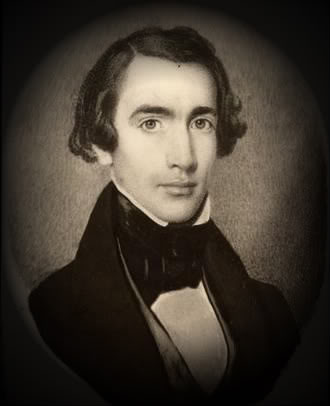
Joshua Speed.

However, Graham-Smith, making vampires the primary drivers of the slave economy and the secret force behind the South’s mad, headlong rush into war, has stumbled across a near perfect metaphor. Vampires, since Dracula, have represented hold-over superstitions trying to keep the shadows deep and dark in the face of the light of reason and modernity, and they are simultaneously the aristocracy and the parasite. They have been exploited to make political points not only in fiction but presidential campaign rhetoric (anyone remember the “Romney is a Vampire” TV ad?). The metaphor has rarely been utilized as forcefully as here, but unfortunately it isn’t used to dig as deep as it could. Having set the stage so deftly, Graham-Smith fails to utilize his fantasy to illuminate real themes in history as historical fictions are generally expected to do.

One thing almost every Lincoln drama gets wrong is how slowly his positions on slavery evolved. From his earliest years, he found slavery morally repugnant, and his abolitionist rhetoric was fiery in even his earliest political speeches. But even well into the Civil War, his policies regarding the institution were, in fact, quite moderate (and from a 21st century perspective, reprehensible). Preservation of the Union was his number one priority, freeing the slaves was way down the list. It would not be much of a stretch to say he’d have been satisfied to institute a handful of reforms that maybe could have been utilized by others later, and that he was okay with the possibility that the end of slavery was something he didn’t personally live to see.

The first step in seeing someone as human is fully recognizing them as real. There’s little reason to think that black slaves, who did move Lincoln’s heart when he saw them suffer from a distance, were ever close enough to him that he was forced to see them as real as his friends and associates, or even as real as his bitter enemies. There’s little or no record of Lincoln having substantive encounters with blacks during his formative years in rural Kentucky. Working on a flat boat on the Mississippi, he wasn’t likely to be invited into the homes of slave owners, nor to encounter the minority of black freemen in his day-to-day labors. Though Lincoln married the daughter of a prominent slave-holder, he was not close to his in-laws, and he and his wife settled in a free state. I’d wager that it’s not likely he had a conversation with a black person longer than 10 words before went to Washington in 1846, maybe not until he entered the White House in 1861, and maybe not even until his memorable meeting with Frederick Douglass in 1863 (which isn’t included in this particular book).
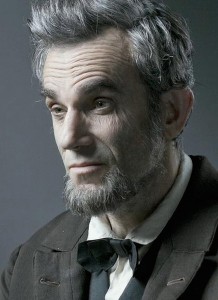
Daniel Day Lewis as Abraham Lincoln in Stephen Spielberg's LINCOLN. Dreamworks/20th Century Fox, 2012.

Moreover, not only was Lincoln not a liberal by today’s standards, he was a man of a time when it would’ve been almost overwhelming intellectually challenging to conceive of blacks as fully of the same species as whites. He was quite articulate in expressing his belief that blacks were inferior to whites. Lincoln’s moral evolution was a long road that most dramatists don’t want to admit he had to travel. Nor do they want to acknowledge that his eventual abandonment of comfortable, if reprehensible, moderation and his heroic embrace of a righteous stand was something that he was burdened with, in part, by the Confederate madness.

ABRAHAM LINCOLN: VAMPIRE HUNTER doesn’t misrepresent Lincoln’s relationship with slavery, but having built so a fine bridge of fantasy to this true subject, it side-steps it rather than crossing it.

The novel is better in evoking the madness and hopeless of the Southern cause, but even here I find fault. We see the relentless spiral towards war through Lincoln’s eyes in the first-person entries. But Graham-Smith also availed himself of the third person omniscient, yet didn’t utilize it when it was most needed. It should’ve been said that the South had a smaller population, a limited industrial base, and significantly no cannon factories. The Confederate strategy was to strike first in the months between the election and inauguration and then dig in so that the Federal Government couldn’t respond. When Lincoln chose the course of military engagement, the South inevitably was doomed. Yet almost four years and more than 600,000 lives were forfeited to this pointless exercise. Even to that last moment, the firing on Fort Sumter – hell, even after that last moment – the South had so many other options, but they acted with the kind of irrational absolutism that we now associate with only the maddest of despots or the presumptuousness of the divine (read: supernatural) right of kings.

According to a 1973 study by Harvard economist Claudia Goldin, had the South ended the institution of slavery by buying and freeing all the slaves instead of going to war, it would’ve cost them about $2.7 billion 1861 dollars. True, it is hard to imagine the political will to execute such a plan could’ve ever been mustered, but what were the costs of turning their collective backs on any compromise or accommodation? On the Southern side alone, the most often-cited figures are $1 billion in property destruction, $1.5 billion in loss of human capital, $767 million for war expenditures, and an appalling 258,000 dead young men. To this, Goldin added a net economic difference of $10 billion between an imaginary South without rebellion and the one we got, in which wide regions wallowed in near continuous recession for the next 80 years. This is the kind of clarifying extra that the fictional narrator Graham-Smith could have provided us with, but that the fictional diarist Lincoln couldn’t have been reasonably expected to.
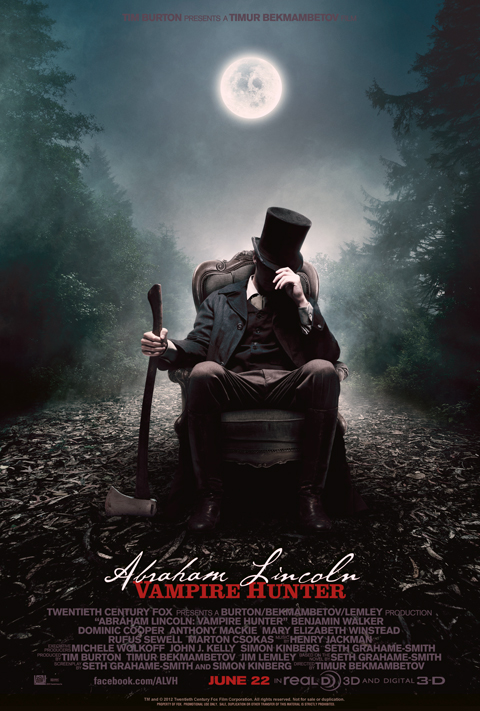
Poster art for the movie of ABRAHAM LINCOLN: VAMPIRE HUNTER (2012).

And not for nothing, the real Lincoln, who couldn’t have done Goldin’s math, wasn’t insensitive to the idea. In an 1862 letter Lincoln wrote, “Less than one half-day’s cost of this war would pay for all the slaves in Delaware at $400 per head … [and] less than 87 days’ cost of the war would, at the same price, pay for all in Delaware, Maryland, District of Columbia, Kentucky and Missouri.” (This letter is not cited in this particular book.) In fact the Federal government did buy back the slaves within the confines of the District of Columbia. (This fact is also not cited in this particular book.)

Once the war starts, the novel engages the reader mostly because of its effective and exciting compression of what actually happened, while the vampire metaphor, suddenly under-exploited and under-explored, loses much of it bite (pardon the pun). Lev Grossman puts it well in TIME Magazine, “Once the connection is made, it feels obvious, and neither slavery nor vampirism reveals anything in particular about the other. One could imagine a richer, subtler treatment of the subject, in which the two horrors multiply each other rather than cancel each other out.”

Yet as Lincoln fictions go, ABRAHAM LINCOLN: VAMPIRE HUNTER has more to say than most. Maybe it communicates something about our culture that a deliberately ridiculous, axe-wielding, vigilante super-hero towers over most more easily respected works. Allegedly realistic fictions have been full of myth, while the myth-shaped novel presents a sharper picture. One measure in how the novel succeeds is revealed in a words of a withering critique of the Timur Bekmambetov’s film based on this novel. Historian Vernon Burton enjoyed the book but hated the movie, and spoke volumes of the pitfalls of fictions that prove incapable of grasping the real historical issues they grapple with (from an article by Tierney Sneed in US News and World Report):

“‘Slavery was our national sin,’ said Burton, who said the connection works in that ‘the nation sucked the blood out of Africans for its wealth.’ However, in posing vampires as the villains behind the crime of slavery, the film risks ‘letting the South and the United States off,’ freeing it from blame for the practice.

‘The book did some clever things,’ said Burton. ‘I was excited to see the movie. The book had potential.’ He said the film version was oversimplified, and he worried viewers would make too much of what he and other historians often call the ‘Oliver Stone school of history.’”

That, at least, is one trap the novel didn’t fall into.

Robert Murphy is 47 years old and lives in New York City. Formerly employed, he now has plenty of time to write about movies and books and play with his cats.

Category: Really Retro | Tags: , , , , , , , , , , , , , , , , , , , , , , , , , , , , , , , , , , , , , , , , , , , , , , , ,

Tis The Season for a Love Bite: 10 Tantalizing and Terrifying Reasons to Take Your Valentine to the Atlanta Ballet’s DRACULA

Posted on: Feb 11th, 2013 By:

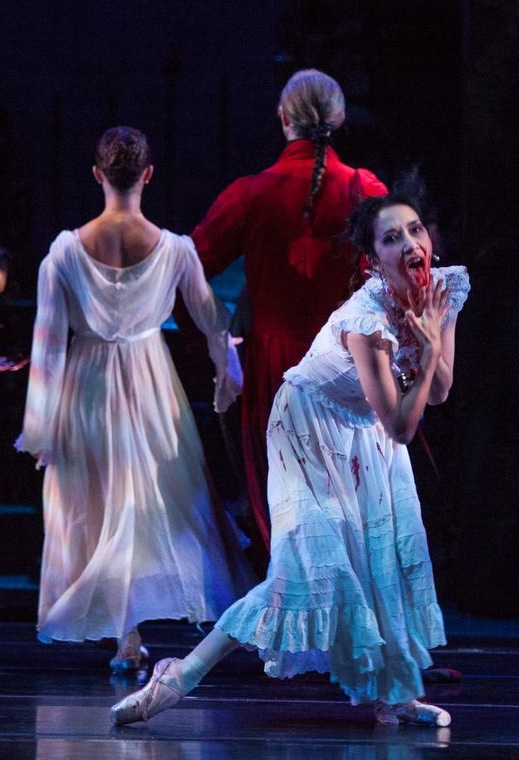
L-R: Mina (Nadia Mara), Dracula (John Welker) and Lucy (Rachel Van Buskirk) in the Atlanta Ballet's production of Michael Pink's DRACULA. Photo credit: Charlie McCullers.

Last Friday night, ATLRetro had the phantasmagoric pleasure of experiencing the Atlanta Ballet‘s production of Michael Pink’s DRACULA, which plays through Feb. 16 at Cobb Energy Centre. The ballet has now become almost as much of a Valentine’s Day tradition for the company as it’s performances of THE NUTCRACKER are quintessential to an Atlanta Christmas.

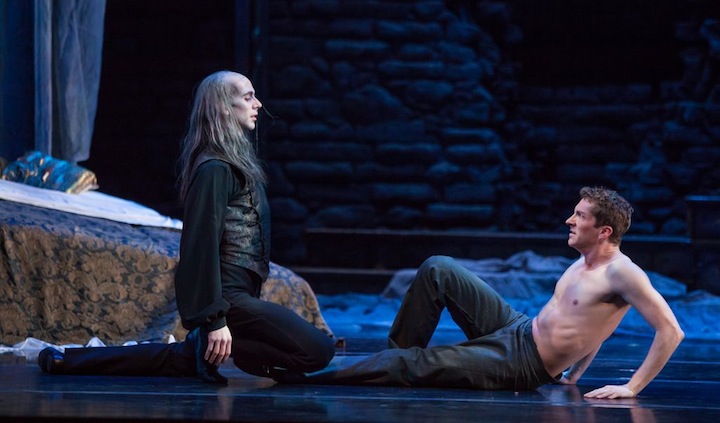
Like Seven Stages’ DRACULA: THE ROCK OPERA, (which we reviewed here) this version hues surpisingly close to Stoker’s novel, especially in the first act (Harker’s seduction by Dracula’s three brides on a bed will be familiar to rock opera attendees) and even reinstating the American cowboy character of Quincey, though it keeps the characters in London for the climax. In the Atlanta Ballet’s version, however, Dracula runs a fine line of both sexual predator and charmingly seductive, appropriate for a Valentine’s production of a vampire story. Yes, we admit getting being much more hot and bothered when the Count seduces Mina in an electrifying erotic dance than we ever have been seeing a glittered-up Robert Pattinson sinking his teeth into a perpetually bored Kristen Stewart.

So in celebration of this now-Atlanta tradition, we asked the Atlanta Ballet if it could unbury a few behind-the-scenes secrets…

1. Michael Pink’s DRACULA had its world premiere in September 16, 1996, in Bradford Alhambra, England by the Northern Ballet Theatre in conjunction with the 100th anniversary of Bram Stoker’s novel.

2. Production has been seen by over a half a million people worldwide since the world premiere.

3. Atlanta Ballet presented the North American premiere of DRACULA in 1998, and the production broke Atlanta Ballet box office records. The record was then broken again the following season when the company restaged the work for an encore presentation.

4. Dancers who portray Dracula receive additional pay for performing stunts of extraordinary risk.

Dracula (John Welker) and Jonathan Harker (Brian Wallenberg) in the Atlanta Ballet production of Michael Pink's DRACULA. Photo credit: Charlie McCullers.

5. Dancers in the production wear hand-tied wigs costing over $2,000.

6. It takes at least an hour and a half for the dancer performing Dracula to get in costume and makeup, and at least 15 minutes of work after each performance to remove the makeup and wig.

7. Artistic Director John McFall performed the role of Renfield in the Company’s original production in 1998.

8. David Grill, lighting designer of Michael Pink’s DRACULA, has designed the lighting for numerous Super Bowl halftime shows, including Beyonce‘s performance at this year’s showdown between the San Francisco 49ers and Baltimore Ravens.

9. Nick Dudman [blood] is the “drink” of choice for Atlanta Ballet’s Dracula. Dudman Blood was created by costume and special effects director Nick Dudman whose film credits include the HARRY POTTER series, STAR WARS V: THE EMPIRE STRIKES BACK, INDIANA JONES AND THE LAST CRUSADE, BATMAN, ALIEN 3 and INTERVIEW WITH A VAMPIRE.  It’s apparently the most realistic blood on the market.

10. There are about 40 dancers cast in Atlanta Ballet’s production of Dracula.

BONUS 11: “My favorite scene is the Dracula and Harker part at the end of Act 1,” says Brian Wallenberg, who plays Jonathan Harker in Cast A. “Whether I’m dancing it or not, it’s just one of the best parts of the Ballet. It’s the most fun experience that a character goes through.”

To find out more and purchase tickets to the Atlanta Ballet’s DRACULA, click here.

Category: Tis the Season To Be... | Tags: , , , , , , , , , , , , , , , , , , , , , , ,

Retro Review: Feeling Lifeless? Head to the Plaza Theatre for an appointment with Herbert West: RE-ANIMATOR!

Posted on: Feb 11th, 2013 By:

RE-ANIMATOR (1985); Dir. Stuart Gordon; Starring Jeffrey Combs, Bruce Abbot and Barbara Crampton; Starts Friday, Feb. 15; Plaza Theatre (visit website for show times and ticket prices); Trailer here.

By Aleck Bennett
Contributing Writer

Atlanta’s historic Plaza Theatre has become well-known for bringing new life to classic films. It makes sense, then, this week that the Plaza ins mot only making the dead return in FRANKENHOOKER, but also exhibiting the nefarious dead-raising actions of Herbert West: RE-ANIMATOR.

Prior to 1985, Stuart Gordon had been best known as a leading theatrical director in Chicago, having founded the Organic Theater Company with his wife, Carolyn Purdy-Gordon. Gordon had overseen such important productions as the world premiere of David Mamet’s SEXUAL PERVERSITY IN CHICAGO, E/R EMERGENCY ROOM, Gordon’s own three-part sci-fi epic WARP! and his adaptation of Kurt Vonnegut’s THE SIRENS OF TITAN. After 1985, however, Gordon became as inexorably linked with H.P. Lovecraft as Roger Corman once was with Edgar Allan Poe.

It all started with a desire to see a Frankenstein movie. Gordon had been discussing horror movies with a friend of his, who had asked if he’d read Lovecraft’s short story “Herbert West: Reanimator,” itself a parody of Mary Shelley’s FRANKENSTEIN. Though Gordon was familiar with Lovecraft’s fiction, this story had eluded him. He tracked down a copy at the Chicago Public Library, and was inspired to adapt the story for the stage. After struggling with the material, Gordon (along with his writing partners Dennis Paoli and William Norris) decided to update the setting and adapt it as a television series. After writing 13 episodes, the team was discouraged from pursuing a TV deal due to horror’s lack of success on the small screen. Instead, Gordon was introduced to producer Brian Yuzna, who was enthusiastic about turning the project into a feature film. Yuzna brought Gordon out to Hollywood to shoot the film and landed a distribution deal with Charles Band’s Empire Pictures.

The story, in short, is this: at Miskatonic University, Herbert West has arrived having already been driven out of Zurich for experimenting with a reagent that will reanimate dead bodies. He teams with fellow medical student Dan Cain to further test his reagent. First, Dan’s girlfriend’s cat is reanimated. Then it’s the school’s dean. And then the blood really starts to flow.

Lovecraft has long been a problematic author to adapt. His best-known tales are built on what has come to be known as the Cthulhu Mythos, which postulates that this world was once ruled by alien Elder Gods that have since either fallen into a deathlike slumber or have lost their access to this plane of existence. Because a glimpse into these other planes or even merely a quick glance at one of the Great Old Ones is often enough to cause insanity in Lovecraft’s characters, it’s got to be pretty hard to translate the mind-bending incomprehensibility of Lovecraft’s cosmic horrors to a visual medium with any chance of success.

Jeffrey Combs as Herbert West, RE-ANIMATOR (1985).

It stands to reason, then, that perhaps the most successful direct adaptations of Lovecraft are those not related to the Mythos. Which is where we find RE-ANIMATOR. Even though its sardonic humor and oceans of gore would seem to be far removed from the reserved and serious-minded attitude of Lovecraft’s fiction, the film hues remarkably close to its source material. The short story was written as a parody to begin with, so the film’s humorous tone is not a huge departure from Lovecraft’s intent. And as grisly as the film is, the events it depicts are largely taken directly from the first two chapters of the story and portions of the final chapter. None of this is to suggest that Lovecraft would have approved of the film, as he didn’t even approve of his own short story the movie is based upon, having unhappily written it purely for the publishing money. And even though the story is universally considered his least work, as an inspiration for a horror flick, it’s pure gold.

A lot is made of RE-ANIMATOR being a horror-comedy, but I think that what makes it work is that it’s more than just simply funny; it’s fun. It’s not a movie chock full of belly laughs, but it tells its story with such a perverse sense of glee that it’s hard not to get caught up in the movie’s charm. In addition, the screenplay never downplays the horror in favor of the humor, instead drawing the latter out of natural reactions to the former, and out of the well-developed chemistry between the film’s characters. And Gordon’s direction is surprisingly tasteful for such a bloody film. Every shot is composed thoughtfully, and his deft hand at pace and timing keeps things tightly-wound throughout. This may sound blasphemous to the devout film buff, but RE-ANIMATOR is precisely the kind of movie that James Whale would have made if he had made BRIDE OF FRANKENSTEIN in 1985.

Barbara Crampton and a disembodied head in RE-ANIMATOR (1985).

However, all of this would likely be for naught if it weren’t for the remarkable performance of Jeffrey Combs as Herbert West. Combs plays West as remarkably arrogant and self-important while simultaneously nervous, brittle and on the edge of psychotically unraveling. Combs’ performance was instantly memorable, crafting a variation on the “mad scientist” archetype that is strong enough to stand with any of the legends. And while Bruce Abbott as Dan Cain is a bland (yet likeably bland) co-star, Barbara Crampton stands out in what could have been a throwaway part as Dan’s girlfriend Megan. Thanks both to the screenplay and Crampton’s solid acting, Megan transcends the mere “damsel in distress” role and becomes a believable, human character. Moreover, Crampton’s smart acting choices in every scene make her come across as being game for whatever “WTF?” moment the film throws her way (and thanks to the inventive effects work, there are plenty). As a result, the viewer doesn’t get pulled out of the film, their suspension of disbelief shattered, by suddenly becoming concerned about what the actress (rather than her character) is going through.

RE-ANIMATOR, in short, captures what is fun about horror movies without looking down its nose at them. It’s smart, energetic, delightedly (and delightfully) wicked and full of inspired set pieces and visuals. It’s not just one of the top horror films of the 1980s. It’s one of the top horror films full stop.

I was prescribed Ativan 1 mg 4 times a day. I use 2 pills before I go to sleep as it relaxes my muscles and I can sleep all night long.

Aleck Bennett is a writer, blogger, pug warden, pop culture enthusiast, raconteur and bon vivant from the greater Atlanta area. Visit his blog at doctorsardonicus.wordpress.com

Category: Retro Review | Tags: , , , , , , , , , , , , , , , , , , , , , , , , , , , , , , , , , , , , ,

Retro Review: Succumbing to REEFER MADNESS; Be Sure to Inhale the 1936 Cult Propaganda Classic at The Plaza

Posted on: Feb 11th, 2013 By:

REEFER MADNESS (1936); Dir: Louis Gasnier; Starring Dorothy Short, Kenneth Craig; Starts Friday, February 15.; The Plaza Theatre; Trailer here.

By Andrew Kemp
Contributing Writer

REEFER MADNESS is invading your town. Your children could be next….or yours…. or YOURS.

REEFER MADNESS is one of those films that cast a huge shadow for reasons that have nothing to do with quality: the plot of the movie is pretty standard for a 1930s hand-wringer, the cast is clumsy, and the production values are Ed Wood-cheap. Still, the film’s campy charm and incredibly sincere doofiness has helped elevate it to true cult status. REEFER MADNESS was cult before cult was cool.

The plot is suitably scandalous. Bill (Kenneth Craig) and Mary (Dorothy Short) are teenagers in love. They play tennis together, take walks together, and even discuss Shakespeare while sipping hot chocolate on Mary’s idyllic patio. But when a sinister drug dealer lures Bill into the corrupt wonderland of an apartment run by Mae (Thelma White), just one puff of “marihuana” is enough to send Bill down into a spiral of sex and murder that dooms the sweet, chaste Mary as well. The film’s cautionary tale is spun by a stern high school principal demanding parents warn their children about the dangers of smoking reefer—a drug more dangerous than opium, heroin or any other narcotic known to mankind!

This is all fairly standard propaganda, but REEFER MADNESS stands apart by virtue of its total, dedicated dunderheadedness. What the hell are these kids smoking? To hear the film tell it, smoking marijuana causes fits of maniacal laughter followed by hallucinations, temporary insanity, rabid sexual urges and even permanent psychosis. But, despite apparently being laced with Joker gas, marijuana was then and remains today a cornerstone of the counterculture. People know the plant, we know what it does, and it definitely looks like a different weed in REEFER MADNESS. Few things cheer up the underground as when the mainstream gets it so terrifically wrong.

The origins of REEFER MADNESS are hazy. A church group supposedly funded the film to promote marijuana awareness, but there seems to be no real record of which church paid the money or how they acquired a budget hefty enough to hire a bunch of Hollywood B-movie players. A rumor claims the film was really bankrolled by the federal government as part of Harry Anslinger and William Randolph Hearst’s anti-marijuana campaign, but there’s more speculation than evidence to support this. The film seems to have appeared in a puff of truly excellent smoke, cashed in by filling a few programming slots under titles like TELL YOUR CHILDREN and THE BURNING QUESTION, and then faded into obscurity.

Enter Bob Shaye, a young entrepreneur in late-1960s New York City. After getting a good laugh at a screening of REEFER MADNESS, he realized that one could get mighty rich screening a hilarious anti-weed polemic on college campuses. And get rich he did. Shaye’s newly-founded production company, New Line Cinema, made millions screening the public domain film, and the cult of REEFER MADNESS has been growing ever since. Today, a fan can find REEFER MADNESS posters, merchandise and colorized versions of the film. In 1998, Dan Studney and Kevin Murphy (of MYSTERY SCIENCE THEATRE 3000 fame) created the musical version, REEFER MADNESS!, which later received its own film adaptation.

Since the original REEFER MADNESS is in the public domain, there are oodles of ways to see it. You could see it alone right now on your couch if you chose to, but why would you do that? REEFER MADNESS is a group project. Like THE ROCKY HORROR PICTURE SHOW (1975), THE ROOM (2003) or the up-and-comer MIAMI CONNECTION (1987, and also back at the Plaza this week), most of the joy of REEFER MADNESS comes from hearing a crowd full of people in the know laugh their heads off at whatever unbelievable scene they just saw. You should definitely see REEFER MADNESS with a crowd at the Plaza, but if you do, please remember that marijuana is a scandalous, dangerous drug and unfit for public consumption. What you do in Mae’s apartment, or your own, is completely up to you.

Andrew Kemp is a screenwriter and game writer who started talking about movies in 1984 and got stuck that way. He writes at www.thehollywoodprojects.com and hosts a bimonthly screening series of classic films at theaters around Atlanta.

Category: Retro Review | Tags: , , , , , , , , , , , , , , , , , ,

Wanna Date? Let Splatter Cinema and the Plaza Theatre Set You Up With FRANKENHOOKER!

Posted on: Feb 8th, 2013 By:

Splatter Cinema presents FRANKENHOOKER (1990); Dir. Frank Henenlotter; Starring Patty Mullen and James Lorinz; Tuesday, Feb. 12 @ 9:30 p.m.; Plaza Theatre; Trailer here.

By Aleck Bennett
Contributing Writer

“If you only see one movie this year, it should be FRANKENHOOKER.” – Bill Murray

And just who do you think you are to argue with Bill Murray? Thankfully, Splatter Cinema and Atlanta’s historic Plaza Theatre have joined forces to make this easy for you. Heck, the Splatter folks even filmed an exclusive interview with star Patty Mullen at last weekend’s Days of the Dead convention to sweeten the deal.

Jeffrey Franken (James Lorinz), lowly employee at New Jersey Electric and erstwhile mad scientist, has a problem. His beloved fiancée Elizabeth (Patty Mullen) has just been dismembered in a freak lawnmower accident, and he was only able to retrieve the head. He’s got the means to bring her back, but since her body is missing, why not spring for some upgrades? Armed with an explosive batch of crack, he starts to collect choice parts from NYC’s hookers, but what happens when Elizabeth wakes up and starts looking for tricks on 42nd Avenue? Can Jeffrey win back his blushing bride-to-be?

Few people on this planet are as devoted to the form and function of the grindhouse era as director Frank Henenlotter. Beyond capturing and preserving the pre-Disneyfication of Times Square in the classic BASKET CASE, he has long been associated with Something Weird Video, rescuing classic exploitation films from destruction and presenting many of them in the “Frank Henenlotter’s Sexy Shockers” series. In FRANKENHOOKER, he returns to the seedy side of New York City, but this time sees it being decimated by the crack epidemic.

Not that FRANKENHOOKER is some preachy vehicle, mind you. Like in Henenlotter’s previous film BRAIN DAMAGE, the subtext of drug abuse is present and slyly addressed, but this time—as opposed to the more serious-minded BRAIN DAMAGE— the emphasis is fully on sleaze and gore so over-the-top as to be hilarious. And as always, that’s why we love Frank.

Patty Mullen walks Times Square as FRANKENHOOKER (1990).

Now, a lot can be said for Henenlotter’s visual style, which he has always managed to pull off without the benefit of any kind of real budget. For instance, his use of lighting and color is consistently well-thought-out and effective, and his ability to shoot effects that both maximize their impact and mask their cheapness is almost unmatched. The fact that FRANKENHOOKER was a larger-budgeted film didn’t lead to him getting lazy on this shoot; it only makes the film look that much more expensive than it was. But his real talent has always been his ability to pull unexpectedly great performances out of unlikely suspects. In BASKET CASE, it’s Kevin Van Hentenryck as Duane Bradley. In FRANKENHOOKER, it’s former Penthouse Pet of the Year Patty Mullen. Previously only seen in the abysmal DOOM ASYLUM and a couple of bit parts on TV, Mullen turns in a brilliant comedic performance as the undead patchwork prostitute. She’s completely believable as the sweet Elizabeth (pre-lawnmower death) and her shift into the gratingly aggressive “Frankenhooker” persona, accompanied by completely insane facial mugging, is something of a triumph for someone who is essentially a non-actor. It’s a shame that this is her final film to date, as she’s just an incredibly likeable presence throughout. Co-star James Lorinz has always been a weak link for me in this movie, coming across as a poor man’s Andrew McCarthy, but in recent years I’ve warmed up to his overacting, twitchy presence and incessant ad-libbing. It’s not that he’s bad; he’s just completely overshadowed by Mullen.

Henenlotter has peppered the film with familiar faces as well. Louise Lasser (MARY HARTMAN, MARY HARTMAN) appears as Jeffrey’s mom, pioneering TV horror host Zacherley shows up as a weatherman, and cameos also go to Henenlotter regular Beverly Bonner and the legendary Shirley Stoler (THE HONEYMOON KILLERS, THE DEER HUNTER, SEVEN BEAUTIES, PEE-WEE’S PLAYHOUSE).

The screenplay by Frank and FANGORIA founding editor Bob Martin (who wrote the novelization of BRAIN DAMAGE) is constantly amusing, mixing references to FRANKENSTEIN and THE BRAIN THAT WOULDN’T DIE with clever spoofs of local news and late-night talk shows. It’s quite probably the best screenplay that Henenlotter has ever had to work with. BRAIN DAMAGE is a more cerebral work (pun intended), but FRANKENHOOKER is more flat-out entertaining.

So join Splatter Cinema in sharing Frank Henenlotter’s love for grindhouse cinema in the only surviving theater in Atlanta that once served as a grindhouse: the Plaza.

Bill Murray demands it.

Aleck Bennett is a writer, blogger, pug warden, pop culture enthusiast, raconteur and bon vivant from the greater Atlanta area. Visit his blog at doctorsardonicus.wordpress.com

Category: Retro Review | Tags: , , , , , , , , , , , , , , , , , , , , , , , , , , ,

© 2025 ATLRetro. All Rights Reserved. This blog is powered by Wordpress