Kool Kat of the Week: It Ain’t Rockabilly If You Don’t Have the Right Pair of Shoes; Talking Smart, Sassy and Southern with Miss Mason of Mon Cherie’s Rockabilly Lounge

Posted on: Feb 6th, 2013 By:

Every other month for more than five years – that’s half a decade – Atlanta’s Retro hostess with the mostest Mon Cherie gathers her friends and throws a Rockabilly Lounge at The Masquerade. And we’re tickled pink that her Valentine’s Lounge this Saturday Feb. 9 features a bunch of Kool Kat alums. First off, Mon Cherie is one. Then shake rattlin and rollin’ will be one of our favorite Atlanta bands The Stumblers, featuring Kool Kat Keith Martin. The Sweetheart Burlesque Show includes performances by Stormy Knight and the magic of Chad Sanborn, not to mention Scarlett PageHada Pixie, and debuting for the first time anywhere: Sunshine Divine. Wear your jitterbug’ shoes because The Right Reverend Andy will be spinning swing, rockabilly and psychobilly favorites. And that’s not to mention the Ragin’ Raffle and vendors aplenty to help you find that perfect gift for your Retro-lovin’ Valentine. Doors are at 9 p.m. but it’s no exaggeration to say the fun always runs well past midnight, making it just about the best way to get a bang out of 10 bucks.

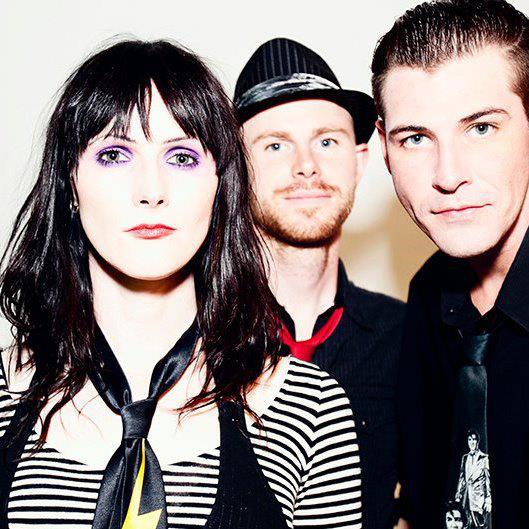
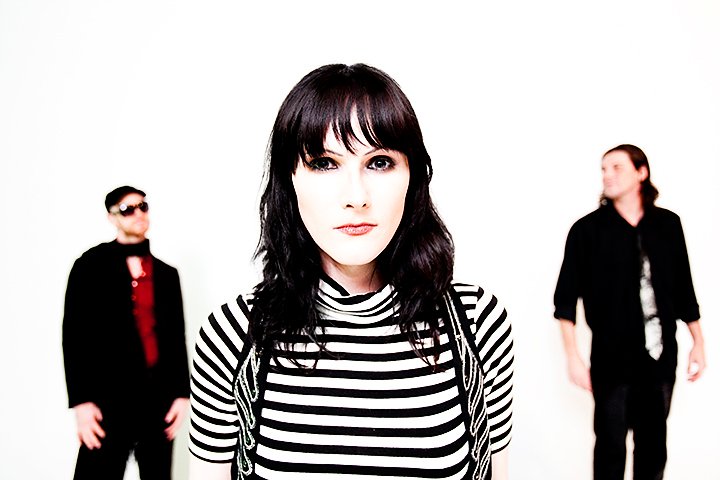
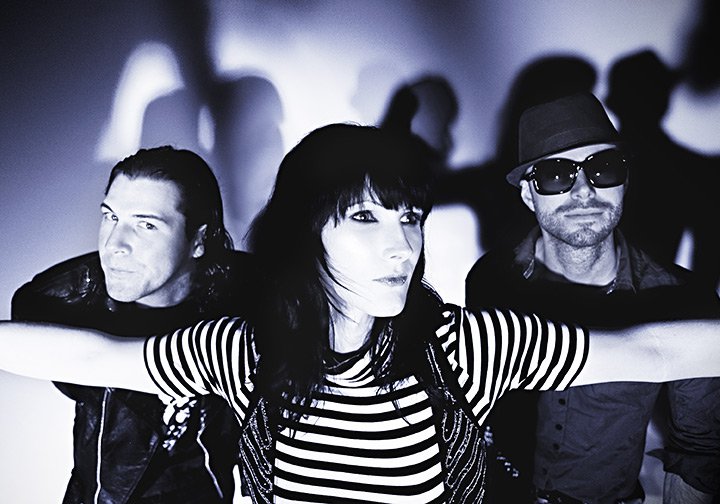
In the midst of all this Koolness, we realized there’s one kool kitty we hadn’t gotten to profile yet, the Rockabilly Lounge’s gorgeous, charming and dangerously clever emcee, Miss Mason. Not wanting to get stung by Cupid’s arrow in our rear, we decided we’d better remedy that situation right quick.

ATLRetro: Why Miss Mason? 

Miss Mason: It’s my maiden name. Incidentally it’s also the name I was often referred to when I was at trouble at school. Went like this: THEM: “Do you think you’re being funny, Miss Mason?” ME: “I KNOW I’m bein’ funny.”

Miss Mason and the Right Reverend Andy Hawley. Photo credit: Shawn Doughtie.

How did you get the nickname “The Mouth of the South”?

Ha, that one is courtesy of my parents, as I had – have! – the proclivity for talking when I shouldn’t, talking back, talking loud. Seemed a perfect fit for a tag line for a big-mouthed shit-talker!

To us, emceeing seems like an absolute art. How much of what you do is pre-scripted and how much is improvised?

I don’t fancy myself much of an artist. I’m just not afraid of crowds, not afraid to talk in front of one. As for scripting, information about the artists is something I collect so they can get a proper introduction. The artists work very hard at building their brand, and the last thing I want to do is mess that up. Sometimes they have developed intros to use for each performance, but there are plenty of artists who trust me to come up with something silly and fun. As time goes by and we all get to know each other better, the introductions get more and more clever. I rather enjoy it, and I hope it endears the artists to me.  So a little is scripted, but for the most part I just get up there and roll with the punches.

What do you love most about emceeing?

That’s easy: I love to make people laugh.

How did you get your start performing?

A little over five years ago I attended a birthday party for my friend’s son and Mon Cherie was there. She was just about to give birth to Rockabilly Lounge and asked if I’d like to be one of her Burlesque Beauties and give out Jell-O shots. Not long after our first Rockabilly Lounge, Mon Cherie asked if I’d introduce the band. I mentioned that I was surprised she wasn’t doing it on account of her history of being on stage and performing at The Chamber, and she said, “Believe it or not, I’m kinda shy!” – which cracks me up that THE Kitten With A Whip of Atlanta was too shy to say a few words on the mic! She tickles me like that. Anyhow, I did get up and intro the band, and she liked it, so the next time there were band intros, burlesque intros and much more. It was a happy accident. The rest is history.

How did you meet Mon Cherie and how long have you been collaborating with her?

I was introduced to Mon Cherie by Phil Solomon (AntiHeroes, Impotent Sea Snakes) for the first time at The Chamber in the early 90s. She had just come off stage. She was thrilling to watch. And I mean RAWR! We met again maybe a year or so later when she and Philip were touring with Impotent Sea Snakes in Miami. But it wasn’t until six years ago that we became reacquainted at a kid’s birthday party. There we were, grown up. HAHAHAHAHA! I’m kidding. We’re never growing up.

What’s so special about Mon Cherie’s Rockabilly Lounge and especially about this month’s Valentine-themed event?

Well, first off, there is something special about a promoter who puts her heart and soul in her work, and that is bound to translate into a great show. And this month’s edition features The Stumblers! Aaaaaand we have fresh meat debuting in the burlesque set! Aaaaaand I’m wearing my favorite red heels! I’m excited. Can we go there now?

What’s the best pair of shoes you’ve bought lately, where did you buy them, and why did you just have to have them?

Oh,man, I’ve been a good girl lately with the shoe shopping, but the last pair I bought are a fierce pair of black leather ankle booties with an architectural heel and a zipper up the back. Once I found them, it was love, and when it’s love I don’t care about the price. They’re absolutely more fetish/rock than they are anything, but I am that girl, too. Sigh, I love shoes. I have a closet full.

Miss Mason shows off her favorite pair of rocket red Betsey Johnson Mary Janes. Photo credit: Shawn Doughtie.

What’s your favorite cocktail and who in Atlanta makes it the best?

Oooooh, my favorite cocktail? That’s like asking which pair of shoes is my favorite pair!!!!  I love so many. Damn. Honestly my favorite cocktail, The Pink Lady, is made by meeeeeeee. It’s Smooth Ambler Spirits Gin and Cherry Limeade. But then I have vodka moods, SoCo moods, and I’m always in the mood for a frosty PBR.

What do you do when you aren’t being the fabulous hostess of Mon Cherie’s Rockabilly Lounge? 

When I’m not on stage, I’m a wife to The Mister and a mom to The Boy – who’s got a big old case of The Show Biz bug! – and puppet to Lily and Ginger, better known as Puggy Goodness, LLC . We love entertaining at Chateau Mason! I love to make a wicked cocktail, bake anything under the sun, make weird ice creams, and especially enjoy creating things with bacon, cayenne, Nutella, and/or bourbon. Ask around.  My skills are that of local legend! I’m a fledgling cyclist. I’ve committed to riding two centuries (that’s 100 miles! eek!) this year. Oh! And sometimes I hoop! I love to hoop!

Category: Kool Kat of the Week | Tags: , , , , , , , , , , , , , , , , , , , , , , , , , , , , ,

This Week in Retro Atlanta, Feb. 4-10, 2013

Posted on: Feb 5th, 2013 By:

Monday, Feb. 4

Monday is Big Band Night at Café 290 with featuring Joe GransdenNorthside Tavern hosts its weekly Blues Jam featuring blues and southern soul singer, Lola Gulley. Enjoy BBQ and Dry White Toast at Fat Matt’s Rib Shack.

Tuesday, Feb. 5

There’s only one The Residents and they’re playing Variety Playhouse. Catch Leon Redbone at Eddie’s Attic. Inspired by the 1980s movie, FLASHDANCE: THE MUSICAL starts a weeklong run at the Fox Theatre. Hilarious Mel Brooks comedy western BLAZING SADDLES (1974) is this week’s retro cinema classic film at Northlake Festival Movie Tavern. Kool Kat Calu Cordeira mixes tiki libations at Mai Tai Tahitian Tuesday starting at 9 p.m. at the Dark Horse Tavern. Grab your horn and head over to Twain’s in Decatur for a Joe Gransden jazz jam session starting at 9 p.m., or you can blues it down with Nathan Nelson & Entertainment Crackers at Northside Tavern. Head over to Fat Matt’s Rib Shack for some old school R & B, rock ‘n roll and blues with Crosstown Allstars.

Wednesday, Feb. 6

Honky punk it down with Grim Rooster, featuring last week’s Kool Kat Phil Stair, open for Canada’s Corb Lund at Smith’s Olde Bar. Be enamored by the eclectic sounds of Jeffrey Butzer, Lily and the Tigers, and Book of Colors at 529. If you missed our Kool Kat on Jeffrey, catch up on it here. Get ready to rumba, cha-cha and jitterbug at the weekly Swing Night at Graveyard TavernDanny “Mudcat” Dudeck brings the gospel blues to Northside Tavern. Frankie’s Blues Mission blues it down at Fat Matt’s Rib Shack.

Tongo Hiti.

Thursday, Feb. 7

Big Mike is back with Tongo Hiti all month at vintage tiki bar, Trader Vic’s, where you can relax with a cocktail while listening to Retro-Polynesian luxurious live lounge sounds, as well as trippy takes on iconic pop songs, every Thursday night. The Atlanta Burlesque and Cabaret Society hosts its monthly meeting at Eliot Street Pubin the Old Fourth Ward. North Alabama garage rockers Nightmare BOyzzz play a free show at Star Bar, along with Bad Brains tribute band Fearless Vampire KillersG/H/B (Get High Boyz) and Adam ÄnzioJoe Gransden joins guitarist Sal Gentile for an evening of jazz standards at PricciDisco in the Village at Mary’s is your midweek neighborhood dance party, now on Thursdays. Catch another screening of this week’s retro cinema classic, BLAZING SADDLES (1974), at Northlake Festival Movie Tavern. It’s 80s vs 90s Thursdays at The Shelter. Go to Northside Tavern to hear the classic 50s Chicago-style blues of The Breeze Kings. Get on over to Fat Matt’s Rib Shack to hear Chickenshack.

The Whiskey Gentry.

Friday, Feb. 8

Experience a darkly romantic version of DRACULA as presented by the Atlanta Ballet, starting tonight and running through Feb. 16, at Cobb Energy Centre. The Whiskey Gentry, featuring Kool Kat Lauren Staley Morrow, kick off a two-night stand at The Earl, tonight playing with two of Nashville’s finest – Jacob Jones and JP Harris and the Tough Choices. Fat Back Deluxe rock the blues at Fat Matt’s Rib Shack. The Breeze Kings play both their originals and blues standards under the dinosaurs at Fernbank Museum of Natural History’s Martinis and IMAX. Head to Northside Tavern to hear Danny “Mudcat” Dudeck bring you the gospel blues.

Saturday, Feb. 9

Get romantic the rockabilly way at a special Valentine’s-themed Mon Cherie’s Rockabilly Lounge, emceed by this week’s Kool Kat, Miss Mason. Indeed the night is chock full of Kool Kats from DJ Rev. Andy spinning Psychobilly Freakout to headline band The Stumblers, featuring Kool Kat Keith Martin, plus burlesque, a raffle and more. Just go straight to Hell at The Masquerade. The Syrens of the South present their annual V-Day Vixen’s Valentease Burlesque Show at The Five Spot, featuring The Magic of Chad Sanborn, Katherine Lashe, Lola le Soleil, Tru Bliss, and a special treat of man meat, The Gentleman Callers from Athens, just to name a few! Doors are at 8 and proceeds benefit Good Mews Cat Rescue. Spend the afternoon learning to hula hoop in a class with another Kool Kat Rebecca Deshon-Gilbert, of Hoop Essence, at Core Studios Decatur. The Whiskey Gentry, featuring Kool Kat Lauren Staley Morrow, continue thir two-night stand at The Earl, this time with Folk Soul Revival and Josh Roberts & The Hinges. Jazz great Wynton Marsalis accompanies the Atlanta Symphony Orchestra. As usual, DJ Romeo Cologne transforms the sensationally seedy Clermont Lounge into a ’70s disco/funk inferno late into the wee hours of the night. Tony Byrd plays Sweet Georgia’s Juke Joint.

Sunday, Feb. 10

Recent Kool Kat Kitty Love throws a “Carnival of Love” in her monthly Sultry Sunday burlesque show series at Red Light Cafe, this time featuring her Cheeky Belles along with local guest stars. Whoa Nelly makes it a honkytonk brunch at noon at Big Tex. The Wheel Knockers play dunch starting at 1 p.m. at The Earl. The Trio and Gwen Hughes jazz up The Family Dog. Join Uncle Sugar at Northside Tavern to wrap up your weekend or check out the blues at Fatt Matt’s Rib Shack with Fatback Deluxe.


Ongoing

Learn about  a different side to the third American president and Constitution author in the Really Retro special exhibition Slavery at Jefferson’s Monticello: How the Word is Passed Down at the Atlanta History Center through July 7.

Every Tuesday and Thursday night is Retro Cinema at Movie Tavern. Check out classic movies on the big screen weekly at 7:30 p.m.

 If you have a Retro event you’d like to see listed in this weekly calendar, don’t forget to drop the details to atlretro@gmail.com. 

Category: This Week in ATLRetro | TAGS: None

Let’s All Go to the Horror Con! Our 10 Best Retro Reasons To Attend DAYS OF THE DEAD ATLANTA

Posted on: Feb 1st, 2013 By:

What are we doing this weekend?! We’re heading down to the Sheraton Hotel Atlanta, one of the most Retro of downtown hotels, to hang out with thousands of horror fans at the second annual Days of the Dead. Last year, we drove all the way to the golf-cart-riding Stepford Wife wonderland of Peachtree City, but was it worth the hour-long commute. Hell, yeah, if only to hang with super-friendly and nice Kate Rambo of ROCK N ROLL HIGH SCHOOL, aka Dey Young, and have her sign a photo to us “I have never done detention in my entire life”! Alas Dey won’t be there this year, but if anything, there is a larger rogues’ gallery of monster, scream queens and heroes! OK, money’s tight, but where are you going to spend it? The Mall? And besides you have to worry about real zombies there.

1) BUTCH PATRICK! Yes, the original Eddie Wolfgang Munster from THE MUNSTERS, one of our two favorite Retro horror-sitcom TV shows. Sure, he’s more than all grown up now, but we can’t wait to hear any memories he might be willing to share about growing up at 1313 Mockingbird Lane.

2) RETURN OF THE LIVING DEAD REUNION! OK, who didn’t want to party with a spikey red-headed Linnea Quigley getting drunk and dancing in a graveyard in this quintessential ’80s zombie black comedy. Days of the Dead has gathered Linnea and seven other starts of the cult classic which spawned four sequels. See everyone on stage at a noon panel. Don’t eat people, we say! Brains!

3) RIFF RANDELL! We’re still fantasizing of hanging with the Ramones and blowing up our high school, even after all these years, so we can’t think of anything more awesome than to meet and get the autographs of P.J. Soles who played Joey’s biggest fan in cult classic ROCK ‘N’ ROLL HIGH SCHOOL (1979). In case you’re too young to know this cult classic, get yourself educated by readingMark Arson’s Retro Review here. Oh, yeah, P.J. was in a few other obscure horror movies like CARRIE and HALLOWEEN.

4) HOUSE OF 1000 CORPSES/DEVIL’S REJECTS Reunions! Rob Zombie’s two best movies aren’t actually Retro but they sure look that way, being tributes to the over-the-top exploitation flicks of the 1960s and 1970s. DAYS OF THE DEAD has rangled 13, by our count, of the cast, but we have to admit we’re most excited about Mr. Machete himself Danny Trejo, Michael Berryman, who also gave us the willies in Wes Craven‘s THE HILLS HAVE EYES (1966)and Sid Haig, one of those rare B-movie icons and character actors whose career spans the decades from Jack Hill’s blaxploitation films of the 1970s to the chaotic, creepy Captain Spaulding. Quite frankly you scared the sh-t out of us and since we’re not easily scared, for that we salute you, Sid, as a true master of horror. A reunion panel is Saturday at 1 p.m.

5) PATTY MULLEN! Get ready for Splatter Cinema’s Tues. Feb. 12 screening of Frank Henenlotter‘s FRANKENHOOKER (1990) at The Plaza Theatre by meeting the actual Frankenhooker!

6) DICK MILLER! Poor Murray Futterman can’t escape our favorite feel-good holiday movie monsters GREMLINS (1984) even on vacation. We promise we’ll be polite to the consummate character actor and won’t bring our Stripe along to ruin his con. We also haven’t forgotten that he was in the original Roger Corman-directed LITTLE SHOP OF HORRORS (1960) and played the police chief in ROCK N ROLL HIGH SCHOOL.

7) GUNNAR HANSEN! Leatherface in the original TEXAS CHAINSAW MASSACRE (1974). He’ll even be on a panel with Marilyn Burns, the only survivor of the original rampage, on Sun. at 1 p.m.  Nuff said.

8. COMICS ARTISTS! Hopefully by now you’ve read our exclusive interview with James O’Barr, creator of THE CROW, who will be bringing along  pages from his new THE CROW: THE ENGINES OF DESPAIR series. If not, check it out here. Also at Days, look for two of our favorite Atlanta-based artists, Chris Hamer, a master of the quirky creature and bonafide Kool Kat, and Jason Flowers, who recently completed work on THE NIGHT OF THE LIVING DEAD trading card series for U.K. sketch card company, Unstoppable Cards. All three will be bringing con-exclusive prints and new works, so be sure and seek out their tables.

9) SPOOKTACULAR SHOPPING! Horror cons are the perfect place to stock up on both macabre memorabilia and creepy clothing, costumes and accessories. One booth we’ll definitely be stopping by is that of Athens, GA-based artist Jeanne the Maskmaker, who crafts one of a kind visages worthy of the Red Death’s Masquerade Ball.

10) PHANTAMAGORIC PARTIES! On Friday night, wear your craziest, creepiest costume to the Monsters Ball at 11 p.m. followed by karaoke at half past the witching hour. Then on Saturday at 10 p.m., Atlanta’s own most extreme Halloween attraction Chambers of Horror presents a concert by Fiend Without A Face  featuring Brent Hinds of Mastodon, followed by the MurderBall and Side Show Party, featuring Captain Stabb-Tuggo and Maybelle’s Sideshow, a Chamber-of-Horror-themed burlesque show, a costume contest, prizes and the Wheel of Torture.

Days of the Dead main con hours are Fri. Feb. 1 from 5 to 11 p.m.; Sat. Feb. 2 from 11 a.m. to 7 p.m.; and Sun. Feb. 3 11 a.m. to 5 p.m. Door prices are $55 for  a weekend pass and $25 for a day pass. Park at the hotel for only $5 with validation from front desk (valet parking exempted). For more info, visit https://www.daysofthedead.net/atlanta/.


Category: Shop Around, Tis the Season To Be... | Tags: , , , , , , , , , , , , , , , , , , , , , , , , , , , , , , , , , , , , , , , , , , , , , , , , , , , , , ,

A History of Violence: Dwayne Epstein Aims POINT BLANK to Uncover the Real Lee Marvin in First Definitive Biography and The Plaza Screens CAT BALLOU

Posted on: Jan 31st, 2013 By:

CAT BALLOU (1965); Dir: Elliot Silverstein; Starring Jane Fonda, Lee Marvin; featuring Q&A by Dwayne Epstein, author of the new biography LEE MARVIN: POINT BLANK, including a book signing; Sat. Feb. 2 3:00 p.m.; $5; The Plaza Theatre; sponsored by Atlanta Film Festival and A Capella Books. Trailer here.

By Andrew Kemp
Contributing Writer

Lee Marvin is an icon of 1960s cinema, a legendary screen tough-guy who punched hard and lived harder, or at least that’s how the story goes. Before he became famous on the screen, Marvin worked for years in thankless villain roles and bit parts, often outshining his co-stars, and it took over a decade of hard work and a few unhappy years in series television before he finally saw a reward for his effort. During his Hollywood peak, Marvin starred in a string of classics that rewrote the rules on screen violence and forever changed the landscape of American cinema: THE PROFESSIONALS (1966); THE DIRTY DOZEN (1967); POINT BLANK (1967).

Dwayne Epstein has spent almost two decades researching the life and legacy of Lee Marvin. Epstein had unprecedented access to the Marvin family and a mountain of records and personal letters, and the result is the first major biography of Marvin to dig into the roots behind the actor’s history of violence, his unusual family legacy, and the demons that drove him to alcoholism and hell-raising. Epstein will be signing his book—LEE MARVIN: POINT BLANK—at the Plaza Theatre on Saturday, Feb. 2 at 3 p.m. and provide a Q&A for the only film to gain Marvin any Oscar recognition, the western comedy CAT BALLOU. ATLRetro recently spoke with Epstein to ask him about the book and about Marvin’s storied career.

ATLRetro: You’ve written a large number of Hollywood biographies for the youth market. LEE MARVIN: POINT BLANK is the first adult biography that you’ve written.

Dwayne Epstein: That would be accurate. The other biographies I’ve written were for a company called Lucent, and they were for a series called People in the News. A lot of them were what you would call Hollywood biographies, but also about political figures. I wrote about Hillary Clinton and Nancy Pelosi, as well as Adam Sandler, Will Ferrell, Denzel Washington. I wrote another book for Lucent called LAWMEN OF THE OLD WEST for a series called History Makers. That was just helpful and a way to pay bills while I worked on the Lee Marvin book.

Why Lee Marvin as the subject of your first major biography, then?

Lee Marvin has always fascinated me. I’m a baby boomer and I grew up watching THE DIRTY DOZEN on TV, way back when they were showing it in two parts. I can watch it now and distinctly remember when the first part would end and the second part would begin. Even when they show it on Turner now, uncut and all the way through. In all of his films, he was always very distinct to me, even when he was not the leading actor. Even more so after I decided to write a book on him, and the more I found out about him. He was much more than he was on screen, obviously, just like most people are. He was a fascinating man. When I researched the book, I discovered he really was the first of his kind, I mean of the post-war actors; he pretty much created the modern America cinema of violence as we know it. It came from him, not from Clint Eastwood. Lee Marvin predated Clint Eastwood by a couple of years.

You say you’ve been researching the book for a long time, and the research is obvious when you read it. How long did you research and work on the book?

I began in 1994, so that went on about 18 years. Many of the people I interviewed for the book are no longer with us, and it was a real saving grace in some ways that I was able to do it when I did. Such as his brother, who had never been interviewed before.

How did that come about?

That became kind of a cool story. Like I said, he had never been interviewed, and I found that his brother had worked for the New York City school district and that he was a teacher. I have a cousin in New York who works in the teacher union, and I contacted her and asked her if she knew of a way to get into contact with Robert Marvin, and she said if he had any connection with the teacher’s union at all, [she’ll] find him. And she did. At the time, he still lived in the Marvin family home up by Woodstock, NY. I took a shot and gave him a call, and lo and behold I wasn’t on the phone with him two seconds when I knew I had Lee Marvin’s brother. He sounded just like him.

Yeah, he had a distinct voice.

Yes, he did. That voice was one of his many, many great attributes as an actor.
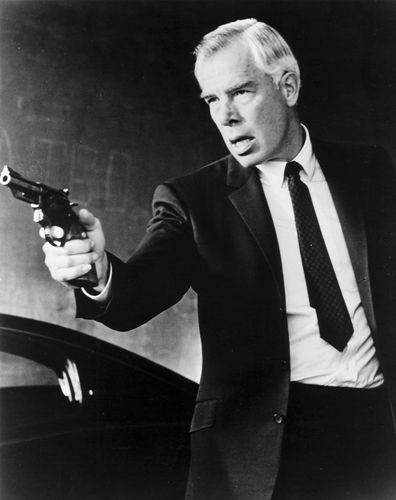
Lee Marvin in POINT BLANK. MGM, 1967.

You mention in the book that there had been studio biographies written on Lee Marvin, but that they had inaccuracies. Why did it take this long for someone to get to the definitive Lee Marvin story?

When I say studio biographies, I mean something produced by the studio to promote the film. Not an actual print biography. Press books and press releases, what have you. Some of the misinformation that’s been put out there is a result of Lee Marvin himself. He loved mythology and he created his own mythology. One or two other books had been printed previously, and if there’s been misinformation there, it’s because Lee Marvin loved to tell stories. He was a heck of a storyteller. He knew a good story when he made one up, and he would promote it.

Your book is getting beyond all of that and collecting the facts from everyone else, though.

Right. As often as I could, I would verify a particular story from one source with another source. I would compare one version of a story to another, such as how he got started as an actor – him often saying he was fixing the toilet at the Maverick Theater in Woodstock when his destiny called. But there are several quotes from people in that same time period who say that would be pretty hard to do since the Maverick Theater didn’t have a toilet.

When reading the book, Lee Marvin’s family is just as important to the book as his career. He had the great uncle who died in Robert Peary’s North Pole expedition.

That’s one of the most fascinating things I discovered while doing the research. I was blown away to find out the true story behind Ross Marvin.

It’s kind of mind-blowing. Like, this guy had such a family history.

That was one of the early connections I made to create the theme of the book. If you believe in this thing about fate or destiny or what have you, it was there in Marvin’s life before he was even born. His trail was preset, as it was. It dates back even before Ross Marvin.

In what way?

I love this story, and Lee Marvin loved to tell this story, too. The earliest Marvins in America helped settle the colony of Connecticut, and there was a puritan named Matthew Marvin who would go on fiery pub raids to get the farmers out of the pubs and into the churches. There was fire and brimstone in Lee Marvin’s ancestry. He also had a varied history in terms of the colorful characters in it. He was related to George Washington and Robert E. Lee, which is why he has the name that he has. His older brother’s name is Robert, and he’s Lee. His mother was a very conscientious Virginia southern woman, and that kind of thing was important to her.
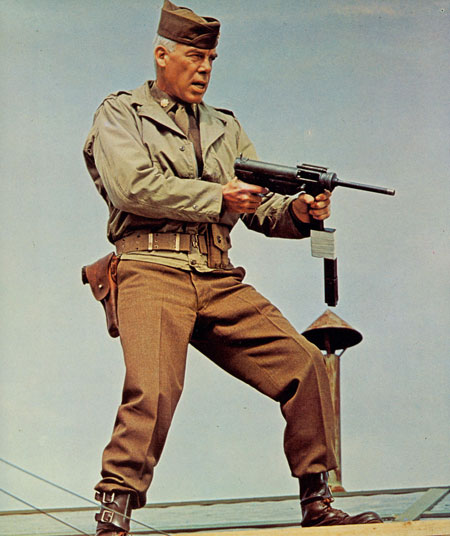
Lee Marvin in THE DIRTY DOZEN, MGM, 1967.

You talk about the theme of his family, and I noticed that there’s another theme running through his story about absent fathers. His father was always traveling, and his father was raised by his uncle who passed, and Lee Marvin was always traveling.

You’re right about that aspect, but to give it even more perspective, I would say that dysfunctional family was really a looming shadow in Lee Marvin’s life. The violence that was perpetrated during World War II did propel his career as an actor, but it wasn’t the end-all, be-all. Before that, he had travails in his family. There was alcoholism, there was abuse, all kinds of stuff. And like many families like that, there was still love. Everybody in the family loved each other, they just didn’t quite know how to handle their emotions.

I want to talk for a second about this interesting chapter that you wrote. Marvin is in the Pacific Theatre in World War II, and you construct his military career almost entirely through the letters that he was sending home. You have some commentary, but almost the whole chapter is just his letters. What was it about his letters that you found so compelling that you wanted to just let him take the stage?

I’m glad you mentioned that. That was a conscious choice based on a crisis I was facing. I knew how critical that chapter was. It was the very foundation to a lot of Lee Marvin’s life, and I didn’t want to screw it up. I’ve never seen battle, and badly written battles or wartime remembrances are untrue and they can really turn the reader off to the rest of the book. If it’s done well, listen, I’m not Ernest Hemingway. I can’t write that kind of thing. And it was quite a dilemma for me how to approach it, and then I realized while doing the research that if I put the letters that I had that had been previously given from Lee’s family in chronological order, I realized that he could write this chapter himself and he should. And that was the hardest part of doing that, deciphering what he wrote. He was dyslexic, and he had terrible handwriting. It was a lot like being an archaeologist, deciphering what he wrote. Putting them together, I realized this is Lee Marvin’s voice. Let him tell the story himself.

In one of those letters he writes, towards the end of his time in the war, he’s had his fill of war. But he spent a huge portion of his career recreating war and violence on film. Was he working through his experience, or was it just another job for him?

No, it was not another job for him, I can tell you that. There was something I discovered while researching the book, and I’ll take the heat for this if anyone gets mad at me. It was my diagnosis, for lack of a better word, that Lee Marvin had post-traumatic stress disorder. I had never read that anywhere, I came to that conclusion myself researching and reading about PTSD and reading about the symptoms. He pretty much matched all of them, and it really went unknown and undiagnosed until about 1980. Marvin died in 1987, so most of his life was spent without any knowledge of that. Consequently, in having these symptoms, he had to channel a lot of the anger and emotions and the symptoms of PTSD, nightmares, alcoholism, survivor’s guilt, a need for violence. All of these things kind of came together and he had to filter it somehow. Probably the most acceptable way to do so, aside from getting arrested on a daily basis, was becoming an actor. He prided himself on being able to do things on stage and on film that people weren’t allowed to do in everyday life.

Throughout his whole life, he had struggles with marriages and struggles with alcohol. There was that infamous Robin Hood party in Vegas. What is he, dangling women out of a window with bedsheets? Do you think his alcoholism was related to his PTSD?

I think there was a vicious circle kind of thing. He drank to forget, and when he drank, he became—there’s not any one thing, of course, but there was antisocial behavior, and being in Hollywood and being a big movie star in the 1960s, that kind of behavior became the talk of the town. People loved it. It’s not like working as a plumber in small time America, where it’s “did you see what Lee did at the party?” In Hollywood, it’s like “Wow! Wasn’t Lee great drunk at the party last night?” That kind of social strata encouraged it. It also ruined his marriages. A marriage, anyway.
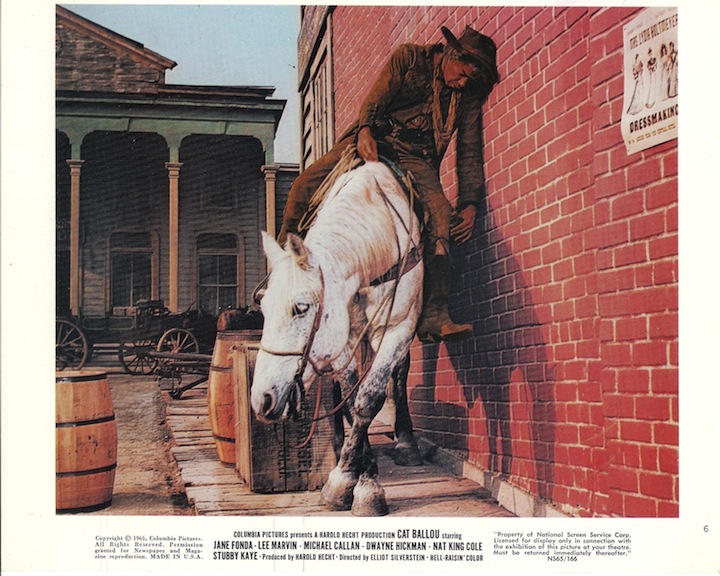
A lobby card of the famous drunk on a horse scene from CAT BALLOU. Columbia Pictures, 1965.

I want to talk about CAT BALLOU for a minute. You’re signing books at a screening at the Plaza on Saturday. They’re screening the film that gave Lee Marvin his only Oscar.

One for one. One nomination, one Oscar.

The funny thing about that movie and it being his only Oscar is that it’s not really the kind of movie you’d associate when you think of Lee Marvin. Why CAT BALLOU? Why did it resonate?

It’s interesting. A few years before he passed away, a reporter said to Marvin “I don’t really think you deserve the Oscar for CAT BALLOU, it’s not really your best work.” He surprised the reporter by saying “You’re right. It wasn’t my best performance, and I don’t know if I did deserve the Oscar for that. But there is such a thing as being on the Oscar track, and I was on the Oscar track with that film.” He was as surprised as anybody to see how successful it turned out. But one of the reasons why it was as successful as it is, I interviewed the film’s director Elliot Silverstein, who told me some fascinating stories about the making of that movie. Lee didn’t play that movie for comedy. The main character, I mean, because it was a dual role. He played the main character of the drunken, burned-out gunslinger as a tragic figure. He played the character as someone who is past his prime, and what do you do with a gunslinger when nobody wants him anymore? He compared it to many things, an old soldier, a broken-down prize fighter, a retired athlete who had his day in the sun and is now making change, that kind of thing. There’s a wonderful moment when Jane Fonda tells her father, “How would I know he was going to be a drunk?” And when she says that, Marvin looks over his shoulder at her, with a look of pain in his eyes. It’s some of the best acting he’s ever done. But it’s not something that normally wins Oscars.
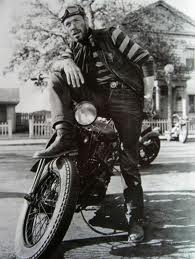
Lee Marvin in THE WILD ONE. Columbia Pictures, 1953.

Well, if the movie came out today, I feel like it would be the kind of role to get you an Oscar. It’s a dual role, which is difficult, and he’s playing outside of his type.

He is, but what’s interesting, too, is that he was cast because in a weird way he was making fun of the stuff he had done before. There’s a lot of Liberty Valance in Tim Strawn, Kid Shelleen’s brother. There’s a little bit of that in Kid Shelleen. Silverstein said that the reason he was casting Marvin in the first place is that a couple of nights before, he had seen Marvin in THE WILD ONE (1953), and he remembered the way he fell off his motorcycle. He did that in a very funny way; he knows how to move. There’s a little bit of a lot of other things Marvin had done on film that come across.

I noticed that myself, that dual role is kind of spoofing on his Liberty Valance role. If it was just the old coot, if it was just Kid Shelleen, does Marvin get the part, or does Jack Palance get it like he wanted?

The funny thing is, Palance let everyone know that he wanted the role. Apparently he wasn’t even considered for the part. [both laugh] And if Palance had done it, he would have been parodying the character that he played in SHANE, which is what put him on the map. But for Marvin, there were several major actors at the time that were considered and for some reason or another—well, we know specifically that Kirk Douglas passed on it. Jose Ferrar was considered, Burt Lancaster. Several others. As years go by, there’s a debate about how much of this is actual and factual and how much was urban legend. But I do know that once Lee Marvin got the part—and he had to be convinced, too, by his wife and his agent—and once he got the script, he started quoting the dialogue in the party circuit, because he thought it was the best dialogue he’d read in a long time. He had problems with the character because it was a physical character to play. You have to sell it broad, but with it being broad, you’ve got to be believable, or the audience is going to say a few seconds into it that this is just a cartoon. And yet, he was able to pull it off.

To me, he definitely deserved the Oscar.

That’s another thing, too. Comedies don’t generally win Oscars, and he pulled it off.

It was fairly late in his career when he won that Oscar, but it was also fairly late in his career when he became a household name. Why do you think it took so long for audiences to warm up to him?

There’s another question outside of film in general, and that’s do the times make the man or does the man make the times? With Lee, I think it was a combination of wonderful things converging at the right time. He wouldn’t have made it as a star in the 30s, 40s, and 50s because it was a different thing required by both the studios and audiences. The 60s were a very interesting time cinematically, culturally, in this country in that the rules were changing, both on film and in the culture at large. There was the civil rights movement, the women’s movement, the generation gap, war, assassinations, rioting in the streets. This cultural basis helped Lee Marvin become a star. He wasn’t the only one, there were other stars at that time. You look at somebody like Steve McQueen. They’re different actors, but Steve McQueen wouldn’t have made it in the 40s and 50s. There’s always exceptions of course, Humphrey Bogart was the anti-hero of his time and didn’t look like a matinee leading idol, but Lee Marvin got something across to the audience that the audience wanted to see and hear, which is that man is a violent animal and I’m going to show you how violent he can be! And that was a component of the 1960s, a violent time. And movies like THE DIRTY DOZEN and POINT BLANK, which really wasn’t as accepted in its day as it became later on, a cult film, they were saying that guys in the middle class, with white hair and ties—they can do some pretty despicable things if they have to. And that’s what Lee Marvin was about. He was perfect for the 60s at that level.
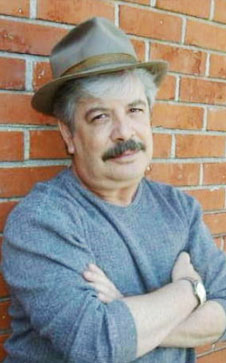
Dwayne Epstein, author of LEE MARVIN: POINT BLANK.

One of the stories that jumped out at me from the book is that we talk about Lee Marvin redefining screen violence through his films, but another film that’s often credited with redefining screen violence was THE WILD BUNCH (1969). Now he didn’t star in that film, but there’s a bit in the book about him helping to write the screenplay!

He did. He was the one who introduced the story to Sam Peckinpah. A friend of Lee Marvin’s had been working on the script, and Lee would periodically go over and help him a bit and mold it. And that part—if ever a part had Lee Marvin written all over it, it was the role of Pike Bishop in the THE WILD BUNCH. But unfortunately, as things turn out, he made PAINT YOUR WAGON (1969) instead. And I think it’s one of the greatest ironies of all time, that a man who defined modern American screen violence missed out on making the most important violent film of all time. It changed everything. He missed out on that. You look at the American Film Institute [which] does that greatest 100 American films of all time, and Marvin has always just kind of missed the mark for being on those lists, for having his name-above-the-title type film in that list. It would have been THE WILD BUNCH, and he missed that, which is very sad.

So here’s a question, just for your opinion on his work. As he got older, a lot of aging actors go through that sad part of the career where they do a bunch of stinkers, and he did a few towards the end of his career. But he didn’t seem to sink as low as some have. He wasn’t Joan Crawford doing brain-dead horror movies.

Yeah, TROG (1970).

Yeah, yeah. So he had a knack for elevating material. Is there one film or performance in that forgotten section of his career you wish could be found again? Can you rescue something from the scrap heap?

The films themselves are of various quality—[but there are] ones that I think are worthy of being discovered. The film itself isn’t that good, but I thought he was wonderful in DEATH HUNT (1981). He did some wonderful things in that movie. Also, GORKY PARK (1983). It wasn’t a very good film; it wasn’t well-received. It was based on a popular novel, but he’d never played a guy like that before. He played an American businessman who was very rich and imports sable into the Soviet Union. He’s just this wonderfully deadly guy who can wear a three-piece suit and do something heinous at the same time. Just a great performance on his part. Like I said, something he had never done before. And probably the best of them all was THE BIG RED ONE (1980), which he did about five or six years before he died, Sam Fuller’s epic retelling of his own experiences in World War II. Lee Marvin is a nameless sergeant who—he does things in this movie that I’ve never seen him do, in that film acting. There are a lot of elements to film acting, and one of them is being able to convey without dialogue because it’s a visual medium. There’s a sequence at the end of the film where he’s helping a concentration camp refugee. He’s just liberated a concentration camp, and he helps a little boy. There’s almost no dialogue in that sequence for like 9 or 10 minutes, and it’s all played on Lee’s face. He’s very poignant, and he’s not over the top. It’s some of the best film acting I’ve ever seen. And it’s kind of being rediscovered. It’s important and it should be, because it’s a great performance and a great film.
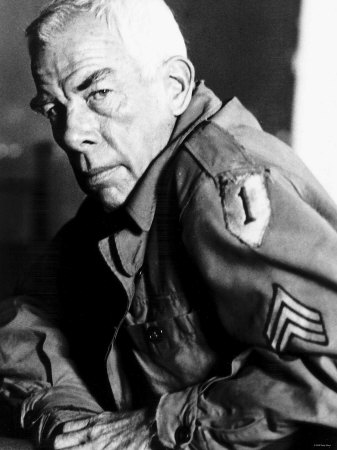
Lee Marvin in THE BIG RED ONE. United Artists, 1980.

Actually, when I was young, probably about 9 or 10 years old, I would grab everything at the video store and try to watch it, and I saw THE BIG RED ONE then. I’m pretty sure it was my first Lee Marvin movie, and even as a kid watching it, I absolutely loved that movie. I still have a soft spot for it all the way to today.

I think in 2006, there was a restoration done.

I haven’t seen the restoration yet. I loved it in the original version, so I’d imagine I’d really love it now.

My personal opinion [is] I don’t think it was improved on all that much. I know it was meant to be a three-hour film and it got taken away from Sam Fuller, who by the way I got to know, he’s one of the many people I interviewed for the book. He loved Lee. That’s one of the tragedies, that they didn’t work together more. They worked together on television a couple of times. That was Sam Fuller’s opus, and he’s another film director being rediscovered. They discovered him in Europe first. He’s an American director, but in America he was considered a hack, and in Europe, he’s God. Now American film fans are starting to rediscover his work. He was quite an individual filmmaker. Nobody else could make a movie like THE NAKED KISS (1964) or SHOCK CORRIDOR (1963) or THE BIG RED ONE. There are things that are done in that movie that had never been done before in film, no matter how long we’d been making World War II films. The four lead characters with Lee Marvin looked like young soldiers. They don’t look like actors playing soldiers, they all looked to be the age 17 to 19, and they’re swimming in their uniforms, you know, the way it would be in real life. Things like that.

OK, so, it’s a topic that never seems to go away. Throughout his career, Lee Marvin had to field questions about cinema and violence in society. And unfortunately, your book is arriving at a moment when that conversation is back in the news.

Indeed it is. Unfortunately. The timing is badly fortuitous in terms of the book, but that conversation is out there.

Well, you quote Lee Marvin a couple of times in the book; basically his quote boils down to he wants the violence in his movies to be incredibly brutal and realistic because he thinks it acts as a deterrent. The rougher the violence, the less likely someone is to try it.

Right, that was his belief. I don’t necessarily hold to that belief, but Lee Marvin professed that. He believed that the more brutal you made it, the more you would turn people off. I don’t know if that’s necessarily the case. He made those statements before there were warfare videogames and things we see on the news on a regular basis that were much more graphic. The kind of violence Lee Marvin was talking about is not the kind of violence that, say, a Jason Statham action film has, where it’s quirky and cartoony, but it’s in your face every two seconds. It’s not like that MTV editing style that’s quick cutting, that’s not about the impact you would have on another human being. It’s like a videogame or cartoon. Let’s blow up as many cars as we can. Let’s shoot as many things as we can. Marvin’s point was, let’s show the threat of violence. I’m paraphrasing here, but he said, if I’m going to shoot somebody, I’m going to knock them down, walk over, shoot them two times, and then roll them over and shoot them again. And sell it! Not just have it happen quick and go on to the next thing. That’s not really what he thought violence was about. Violence is ugly, so show it to be ugly.

It’s funny. You have this image—well, before I read your book, Lee Marvin seems to appeal to a certain stereotype of a conservative tough-guy, pro-war cinema. Was Lee Marvin pro-war?

Let me tell you something, that’s one of my favorite things about this book. I’ve been reading blogs or comments about Lee Marvin. He’s often been called “America’s favorite badass,” “he’s not a wussy,” and “he would go out there and kick Obama’s ass!” Things like that. And people who say stuff like that don’t realize that Lee Marvin was not John Wayne. Most of his life, politically, Lee Marvin was a liberal Democrat. He worked for John F. Kennedy’s campaign in 1960. After Kennedy’s assassination, he kept his politics to himself, but the only thing he was really a hawk on was indeed gun control. He believed very strongly in the 2nd amendment and he would tell friends that, but politically, he was a liberal. I hate to disappoint John Wayne fans out there. By the way, John Wayne and Lee Marvin were friends. They worked together, but Lee Marvin would definitely not be put in the category of a Tea Partier. Another point, too, is that you can be a liberal and be a badass. [laughs]

In the book, there are two other actors that you explore the similarities and kind of dismiss those similarities with Lee Marvin, and that’s Humphrey Bogart and Clint Eastwood. If those two aren’t good comparisons, who is the best comparison to Lee Marvin, in your opinion, before and after his time?

There are elements in terms of being antiheroes—and by the way, what I wrote in the book about Bogart was really comparisons to Bogart before he was famous. Comparisons can be made, because Bogart’s career was very similar to Lee Marvin’s. He played a lot of bad guys and secondary roles before he made it with HIGH SIERRA (1941) and MALTESE FALCON (1941) and CASABLANCA (1942) and those films, but when Lee Marvin was doing supporting and secondary roles, he really tried to sell it and do the best job he could. If you look at Bogart in those early Warner Brothers films before he was famous, he looked so uncomfortable. He didn’t look like he was enjoying himself or having a good time. He looked like he was working, whereas Lee Marvin always tried to give a little more to the character, like saying to the audience, “I’m going to do something despicable here, and we’re going to have fun.” And that was a weird thing, too, that nobody had ever done before. There’s a lot of elements of Lee Marvin in other actors, you know? There’s a great quote by Errol Flynn in THE ADVENTURES OF DON JUAN (1948). He’s about to chase a girl, and he’d said he would never do that again. His friend says “I thought you weren’t ever going to do this again,” and Errol Flynn as Don Juan says “You know, there’s a little Don Juan in every man, and if I am Don Juan, there must be more of him in me!” The same goes for Lee Marvin. There’s a little Lee Marvin in a lot of actors, but there’s only one Lee Marvin, and there’s more of Lee Marvin in him than anyone.

One last question. Besides the obvious connection to one of his most well-known films, why choose the title POINT BLANK for your book?

I had a devil of a time coming up with a title. I had several things I was thinking of, but once I wrote the introduction, I realized that what Lee Marvin did that nobody else had done before him was that he presented violence on film like nobody had done before and consistently. That’s the other thing. There were moments of violence in American cinema that were pretty bad, like when Richard Widmark pushed a lady in a wheelchair down a staircase [in KISS OF DEATH (1947)], but after Richard Widmark did that, he never played that kind of character again which is, you know, a tragedy. But Lee Marvin, once he established himself, never walked away from how violent mankind can be. He was in your face with the way it was presented. I thought if I could come up with a name for that style, and that was point blank. Just that’s how he was. He was point blank, in your face, no excuses.

Andrew Kemp is a screenwriter and game writer who started talking about movies in 1984 and got stuck that way. He writes at www.thehollywoodprojects.com and hosts a bimonthly screening series of classic films at theaters around Atlanta.

Category: Features | Tags: , , , , , , , , , , , , , , , , , , , , , , , , , , , , , , , , , , , , , , , , , , , , , , , , , , , , , , , , , , , , , , , , , , , , , , , , , , ,

The Engines of James O’Barr’s Art: On Returning to The Crow, Heading to Atlanta for Days of the Dead, BLADE RUNNER, Robert Mitchum and His Latest Pin-Up Passion

Posted on: Jan 31st, 2013 By:

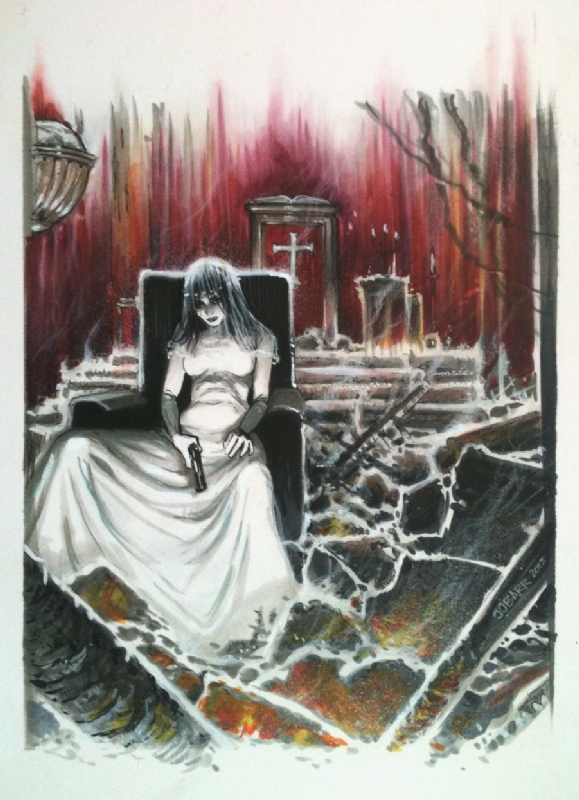
The cover to issue #1 of THE CROW: THE ENGINES OF DESPAIR, a six-part comics series which marks James O'Barr's return to his most famous creation. Used with permission.

At the Days of the Dead convention this weekend at the Sheraton Atlanta Hotel downtown, horror fans can meet and collect autographs from a rogues’ gallery of actors from a DEVIL’S REJECTS/HOUSE OF 1000 CORPSES cast reunions to Butch Patrick, the former child star who played Eddie Munster. Or they can visit the table of artist James O’Barr and pick up an exclusive signed print, preview original artwork from James’ first return to THE CROW in 20 years, and muse about art, favorite movies and the Retro glory days when Sophia Loren and Marilyn Monroe, full of curves and class, ruled the silver screen.

While quite a few comics creators delve into the darkness, James is one of a handful who cross mediums and regularly attends horror cons as often as comics gatherings. But that’s not the most surprising thing about him. First published by Caliber in the early 90s, then reprinted and completed by Tundra Publishing and recently picked up by IDW, The Crow’s revenge saga was inspired by James’ own tragic loss of a lover. It gained an even more mythic status among fans when Brandon Lee, son of Bruce Lee, died due to an accident on the set of the movie based on the comic. So as the creator of a vigilante antihero with an androgynous mimelike visage and Gothic black hair, James might be expected to be as tough as nails as his own hero Robert Mitchum or as dark and brooding as Trent Reznor.  But anyone who’s met the artist knows that while he’s weathered his share of adversity amplified by years living in crime-ridden Detroit and dwells creatively in the realm of the dark phantastique, James has also come through the other side. He has emerged surprisingly soft-spoken and even with a signature joie de vivre. His most common public demeanor is a smile and a wisecrack, probably more than a little politically incorrect.

ATLRetro spent a couple of hours on the phone with James this week to find out more about what he’ll be doing and displaying at Days of the Dead, as well as what it’s like to be back drawing The Crow after all these years. And yeah, we couldn’t help but ask about his own influences from Will Eisner to Bernie Wrightson, mural painting with Mark Bode, his take on the BLADE RUNNER prequel, what makes Robert Mitchum still so unmatched among men, and find out his current Retro pin-up crush.

ATLRetro: You’re one of the few comics artists who regularly does horror media cons as well. What sets the comic and horror con experience apart for you?

James O’Barr: I am one of the fortunate ones that has a crossover audience since I had a film made of my comics. I don’t consider it a horror film, but it does get grouped in. There’s a lot of surface differences between the different crowds, but in reality they are kind of the same thing – groups of fans all broken up into little subgenres. At a comics show, some guys are just there for the super-heroes and others hate super-heroes. At a horror show, some people are into slasher movies. Other people hate them and love the classic Hammer Films. It’s the same animal but just from a different continent.

Will you be have any new work or prints for sale at Days?

Yeah, every time I do a show, I do a handful of prints, maybe 20 of each that you can only get from me and only at that show. That way the fans have something special that no one else has anywhere else in the US. I have so much material that it’s not difficult for me to pick a new image for each con.

Are you doing any panels or demonstrations at Days, or more body-painting like you did at the dooGallery during DragonCon?

I don’t think I have anything officially scheduled. But the body-painting will be at the show, and I volunteered to paint some more half-naked girls because I had a lot of fun doing that last time. I’ve only done it three times, and it’s a learning process. I’m getting better each time. Body-painting is difficult because it’s like painting with makeup, and it has entirely different textures than paint or ink, plus you’re not dealing with a flat surface. It does make a difference because I when I painted Frankenstein or Dracula on a girl’s back the last time I was there, I had to take into account the arch of her back so it didn’t look like he didn’t have a chin. It’s like Michelangelo at the Sistine Chapel where he had to elongate the figures so they would look correct from the floor.

What’s the craziest thing a fan ever did to get your attention at a con?

Just the typical like a woman showing me their tits and people just trying to shock me. I’m not easily shocked. Mostly my fans are very kind and gracious and very polite. I have the greatest fans in world who have stuck with me for 25 years, and because of them, I get to do what I love for a living. So I’m very appreciative.

You’ve said that you wanted to work with Jim Terry (the artist on THE CROW:SKINNING THE WOLVES, the recently released three-issue IDW miniseries set in a Nazi concentration camp) because you liked his “Eisneresque style.” How much of an influence was Will Eisner on your own work and wanting to get into comics?

Will Eisner was a huge influence on me. It was by studying old SPIRIT stories that I learned actual storytelling. Then it suddenly dawned on me that he was taking film techniques and applying them to comics, and no one had ever done that before. So I pretty much took that basic premise, using film techniques in comics for lighting set-ups and camera angles, and I push that as far as I can into comics. As much as movies and comics have in common with each other, they also have so much uncommon or ‘discommon’ between them as well. In comics, you can’t control the timing like you can in a film, but you can slow down the pace of a page by making someone spend more time by putting more images on it. Another huge drawback is lack of sound. You don’t have a soundtrack to accentuate the emotions portrayed in the image. You don’t have the voices of the actors, and you don’t have sound effects, so you have to rely on the reader to supply those in their head. But like I said, it can also be a plus. What’s there is only what you put there, but an actor could spoil a scene or music could spoil a scene or a bad sound effect could spoil a scene. I am one of the few artists who does employ sound effects. If someone fires a gun in my comic, there’s a big boom sound effect. To me, supplying sound effects is an essential part of comics. It’s one of the charms of comics, I think.

If you had to pick five classic comics artist greats to recommend to a new reader, who would they be?

Will Eisner. Harvey Kurtzman. Jordi Bernet is not well-known in the US. He’s from old Milton Caniff (TERRY AND THE PIRATES, STEVE CANYON) school – lot of brushwork and shadows. IDW is reprinting his TORPEDO series about gangsters in the 1930s. There are so many. Bernie Wrightson was a huge influence on me. The way I look at it, Will Eisner showed me how to tell the story, but Berni Wrightson showed me how to light the scene for the most dramatic effect. And probably Dave Sim for teaching me how to include dialogue and sound effects into the artwork to where they are essential, which is why I like Dave Sim.

I still hand-letter all of my comics on the actual artwork. Since we’re talking Retro, I might as well point out I don’t use computers for anything. Everything is ink on papr or paint on paper. Nothing is photoshopped. Even my titles are hand-drawn on artwork – which is a pain because lettering is not my forte. I can do balloons, but with a three-inch font, I inevitably fuck it up. But that’s part of charm of hand-lettering. It’s not a perfect font pulled off a computer. It’s not that I have disregard for PhotoShop and those tools. I see people like Jon Foster who do great artwork with them Looking at his work, I couldn’t tell it wasn’t oil-painted or acrylics, but to me, using a mouse or a keyboard or a tablet would just drain all the fun out of comics. I love draging a brush across a blank page. For me, that’s the joy of creating comics. I sit down with a blank sheet of paper, and everything is my choice. And it has to be the right choice because there is no undo. This may make me a more confident artist than those who use computers. I don’t redo. I know what I want before I sit down.

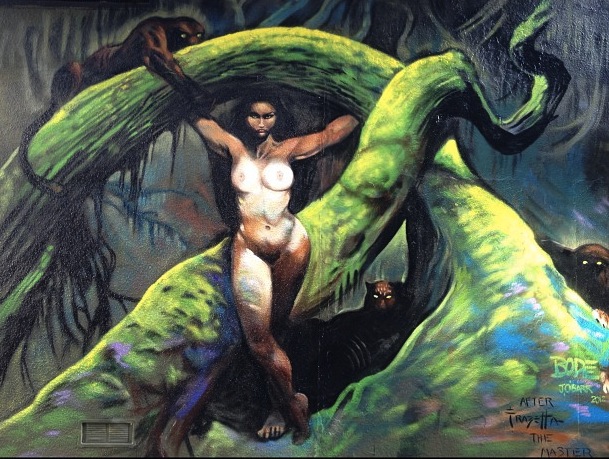
Mark Bode's and James O'Barr's mural tribute to Frank Frazetta at Clarion Alley in San Francisco.

Do you have any more mural work planned with Mark Bode, and how does working with a spray can on a wall compare to a paintbrush on a canvas?

Every time I see Mark, usually once or twice a year, we plan on doing something. The only difficult thing is San Francisco is finding a place to do it and deciding what we’re going to do. But the four we have done have gotten progressively better. I posted some pictures of the Frank Frazetta one on the Internet, and people thought it was the original, so we’ve gotten really good at it. They all have been tributes to our artistic heroes who have passed away –  Moebius, Jeff Jones and Frazetta. I’m going to be up there later this year, and we’re hoping to do a Jack Kirby one which will be a lot of fun — to do that hyper-stylized Kirby line. The main difficulty is not necessarily working with a spray can but it’s working that large. The shortest was like 20 feet tall, so it involves being up on a ladder and drawing, and it’s hard to tell if something is in proportion without stepping back off ladder and walkg back 20 feet. Mark and I are really good about trading off with one of us painting and the other watching. He taught me everything I know about graffiti art, even though I still do more artistic things rather than scribbles or tags. I have no idea what they say. I would rather do Monet’s waterlilies 20 feet tall than put a line of poetry up there that is so stylized that the lettering is illegible. I like mural work. It’s free, outside and for the public. It’s transient because it will only be there for a certain amount of time. And it’s been great to introduce certain artists, like Jeff Jones, to people who may not have ever heard of them before.

What has the reaction been to the return of THE CROW published by IDW?

Honestly it’s been mixed. The one I’m doing by myself (THE CROW: THE ENGINES OF DESPAIR) hasn’t come out yet, but I think some people were expecting right off the bat that the first book would be mine. The first series looks very rushed, though it had a nice script by John Shirley. THE CROW: SKINNING THE WOLVES book has done phenomenally well. The first two issues sold out, and it’s in its second printing, and I think that’s because I was involved. It sticks rather closely to the kind of thing I do even though Jim Terry was responsible for the artwork.

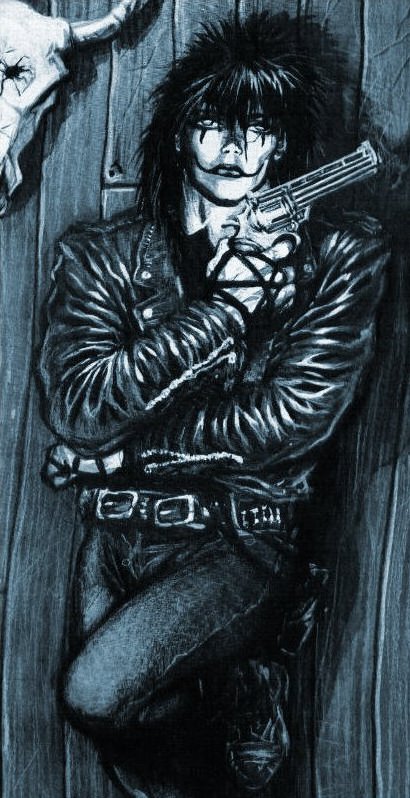
From the original THE CROW series by James O'Barr.

THE CROW: THE ENGINES OF DESPAIR will be six issues. I’m finishing up the third issue, but I didn’t want them to solicit until the third was done because didn’t want there to be any lags between issues. I wanted them out on a regular basis because it’s continuing story. I have to say I am more than happy with the work I’ve done on it so far. It’s far and above the best thing I’ve ever done. I have definitely learned my craft over the last two decades. With the first CROW book, I honestly had no idea what I was doing. I just sat down and let things flow out of me. There are lots of flaws in that book, but I think the love and passion which I put into that work is what made the public love it and kept it in print for 25 years. But there were things in that book that I avoided because I didn’t have the skills to do them. With his book now, if I can think of it, I can draw it. It’s not a struggle at all. With every page, I set a challenge for me. How can I make it more difficult and learn something from this page. Without exception, 60-something pages into it, I’m delighted with every page.

Will it be in black and white like the original CROW or in color this time? And can you reveal anything about the story? 

At the beginning, IDW kind of strong-armed me a little bit, saying they wanted it in color. I said it’s my project and it’s a CROW book, and I think it should be in black and white – or at least the ones I do should be. For me, it adds a certain otherworldly aspect to it with hard shadows. Honestly I don’t see it in the coloring I see in comics nowadays. If it was going to be in color, it would have to be handpainted by me, but I am hesitant to do that. However, that being said, I just did 20 black and white pages of this shootout and then in the middle, added an intermission in color – that kind of 1930s technicolor where everything is in brighter, warmer and hotter colors that don’t exist in real life. So that gives it a very dreamlike feel to it. Since I learned all the rules in the last 25 yrs, now I can break them.

Plus after 20 pages of people getting killed, it’s a nice little break for the reader as well. Still even though they are pretty and bright, happy colors, just them having been done by me has sort of a haunting creepy quality about it as well. Also I think it’s kind of funny that it’s a CROW book, but I am 60 pages into it and birds haven’t appeared in it once. I’m using rabbits this time. Not talking rabbits, but they are the animal in it. I think it’s so close in feel and atmosphere to the original book, all on a much higher level of competence, that people don’t even notice there’s not a bird in it. The bird will make a few cameo appearances.

It all looks really amazing, and in this one, the best character is the Skull Cowboy, that never actually appeared in the movie. The death character is with the woman the whole time. It kind of takes the place of the bird. The bunny man. He even scares me when I’m drawing him, probably because he reminds me a lot of myself. He’s very – I don’t want to say evil – but there are no ambidexterous morals in this. He’s frightening, but he’s a smart-ass and he’s lovable as well. It gives the bride a nice alter-ego to play off of.

I don’t want to give too much away, though. I’d rather that you come by the table [at Days of the Dead] and see what I’m doing and decide for yourselves. But I guarantee no one will be disappointed.

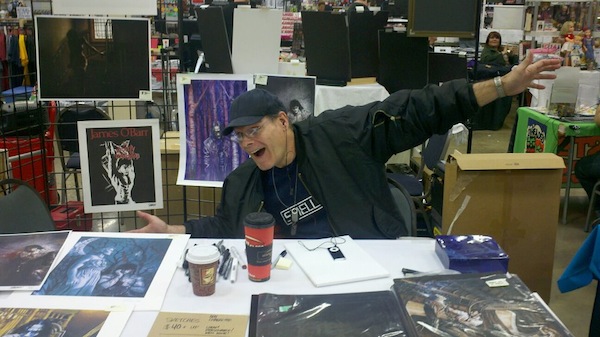
James O'Barr gets happy at his convention artist table. Photo courtesy of James O'Barr.

Shifting gears back to some of the pop culture you’re known for being passionate about, as a big BLADE RUNNER fan, how do you feel about Ridley Scott’s announcement that he’s going to go back to and do a prequel after all these years?

BLADE RUNNER was Ridley Scott’s vision so if he wants to go back and play in that universe, I am more than happy to sit in the audience. I will pay my $15. I really liked PROMETHEUS. I think I am one of the few people on the planet who did. I thought it did no disservice to the ALIEN film. I read somewhere he’s going to connect the ALIEN universe and the BLADE RUNNER universe or make references to both taking place at the same time. Somebody told me he read the script to PROMETHEUS 2 and that there were references to replicants in there. I’m a little skeptical about him pulling that off but I would love to see it. I have no idea what he is going to do, but I would love to see how the replicants got to Earth. He throws it all into one sentence — they escaped from an off-world colony. It would be great to see how Roy and Pris escaped from the planet where they were slave labor. I don’t know who could play those parts now, but it’s a really rich universe he created there and a lot was skimmed over the surface. I have a lot of faith in Ridley Scott. He’s made about 20 films and less than a handful have been bad. He needs to stay the fuck away from romantic comedies, though. The one he made with Russell Crowe and [Marion Cotillard] – A GOOD YEAR – that was just horrific, painful. He’s at his best when he’s exploring fantasy and science fiction and – some people probably will hate me but – nobody does epic like Ridley Scott. Even something like KINGDOM OF HEAVEN that’s factually based has more stunning imagery than all three LORD OF THE RINGS movies together.

What’s so great about Robert Mitchum?

He was the last real man, I think. He was a brute and a gentleman and a real life badass. Jason Statham would last about 30 seconds with Robert Mitchum. He just has such a presence. He’s very subtle, and he never, ever plays to the camera. Laurence Olivier could not say a line without turning to the camera and making a face. Robert Mitchum wouldn’t care if his back was to the camera. He was so charismatic, and he was willingness to take on any role. That was endearing to me. He’d play the hero or the bad guy, he didn’t care. He was truly frightening in CAPE FEAR (1962). THE NIGHT OF THE HUNTER (1955) and OUT OF THE PAST (1947) are two films I could just watch any time. I do watch both of them once or twice a year. In fact, I just bought the British release poster for OUT OF THE PAST. It was called BUILD MY GALLOWS HIGH in London when it was released. That was the original name of the story.

You’ve often said that you admire the style and shape of the classic actresses and models of days gone by such as Sophia Loren, Marilyn Monroe and Bettie Page. Who’s your favorite right now and why?

Right now going through a mild Bettie Page fascination. I purposely avoided the whole Bettie Page parade 10 years ago because I was a little angered and disgusted that all these people were making money off this girl, my artists friends included. So I avoided anything Bettie Page. Just recently I subscribe to those vintage pinup Facebook pages, and I have gotten into appreciation. I see what it’s all about now – all the curves, and there was a really gentle innocence to her, too, where she always looks like she is having fun. I have definitely seen some pictures where I don’t think she had any idea what she was doing, such as the bondage stuff. That’s my least favorite. I love the images of her on the beach. There’s something about her eyes and her smile that is really endearing, and that silly haircut that people are still imitating today. I kind of group her in with Marilyn Monroe. I look at the pictures, and yes, I see all the right curves, but I don’t get aroused looking at them. It’s more endearing and charming to me than anything else. There’s something about both Bettie Page and Marilyn Monroe that makes me want to protect them. It makes me want to take on a fatherly role. I have never seen one so I assume it was impossible to take a bad picture of them. There’s some kind of inner beauty there which really transcends the film.

James O'Barr strikes a Mitchum pose. Photo courtesy of James O'Barr.

Given the success of THE CROW franchise, are a lot of fans surprised that you lead a pretty simple life of drawing/painting, writing, watching old movies and hanging out with cats? 

The reality is that I grew up way below the poverty level, and so I have never been comfortable with luxury. It’s not that I don’t think I deserve it, but I don’t need it. Having expensive things does not make me happy. I’ve had a five-bedroom semi-mansion, and invariably I spent all my time in the basement in the dark drawing. There were rooms I never even went in. I like that I lead a very insular disciplined life, and I only bring things in that bring me joy and happiness—books and movies and music and artwork. I don’t need anything else. My cat’s my best friend. He never lies to me. He doesn’t cheat on me. He tries to lie to me. “You didn’t feed me. You didn’t feed me.” “Yes, I did. I did.” Just like dogs, they have unconditional love. My cat is lying on my feet right now. He wants to be close to me. I love dogs, too, but I prefer cats because they’re less needy. I can go away for a weekend, leave cat food, and he will be fine. I definitely like companionship. Being artist or a writer is very solitary. Just to have a little silent partner next to me is very comforting.

Category: Features | Tags: , , , , , , , , , , , , , , , , , , , , , , , , , , , , , , , , , , , , , , , , , , , , , , , , , , , , , , , , , , , , , , , , ,

Kool Kat of the Week: Hooting, Hollyfesterin’ and Cockle-Doodle-Doom with Phil Stair of Grim Rooster

Posted on: Jan 31st, 2013 By:

Phil Stair, lead vocalist/guitarist of Grim Rooster. Photo courtesy of Phil Stair.

Every year around the anniversary of The Day the Music Died, the Right Reverend Andy Hawley gathers some of Atlanta’s best rockabilly and neo-honkytonk talent at the Star Bar for a righteous revival called Hollyfest! This year the fifth annual tribute to Buddy Holly, Ritchie Valens and The Big Bopper is on Sat. Feb. 2, so mark your calendars for  a Groundhog Day you’ll want to relive with a 14-band line-up conjuring up rock n roll deja vu that includes many groups whose members have been previous Kool Kats from Cletis Reid to Andrew & The DisapyramidsThe Stumblers to Rod Hamdallah.

Also on the playlist is Grim Rooster. While the group has only been around for a couple of years, its members include Phil Stair (lead vocals, guitar), Dylan Ross (bass) and Nate Elliscu (mandolin) and Tigerbeat Tony (drums) who have been active in the scene here for many a corn season. Boasting a diverse barnyard of influences that range from Johnny Cash to Rancid, they’ve already got more than 30 original songs under their belt and the fireball audacity to promise this about their musical menu on Facebook: “just try not to drip any tobacco juice on the floor the first time you feast your ears on this blue-plate dee-light of mother-cluckin’ foot-stompin’ fun and your jaw drops wide open!”

ATLRetro caught up with Phil to find out how Grim Rooster got hatched, what Hollyfest is all about and just what the hell is honky punk anyway?

So how and when did Grim Rooster get hatched?

Grim Rooster came about in the spring of 2011. My band Rocket 350 was on its last legs, and I was fairly bummed about it. My bass player had moved to Nashville so I wasn’t getting a lot of playing time. Also our crowd had finally faded, and it  just wasn’t worth the effort of getting everyone together. At that point, my buddy Dylan asked if I had any interest in starting some sort of side project. I knew that I wanted to start either a straight punk band or do something very stripped down and roosty. Dylan wanted to play stand-up bass so it was settled. We asked one of neighbors to come play drums, and then I wrote about 20 songs for the project. I really got wrapped up in the music and was very excited to be doing something new. It had been about 15 years since I started a new band.

What’s in the name?

Grim Rooster came from a goofy brainstorming session. We wanted to use something with the word “rooster” in it, and that’s when we started coming up with ridiculous names. Obviously it’s a play on Grim Reaper, and it was meant to be funny at first, but it had a pretty good ring to it. We started coming up with crazy logos and realized we had a winner.

What the hell is honky punk?

We play honky tonk and bluegrass. We have an acoustic guitar, mandolin, upright bass and drums. The ferocity that we play our honk tonk is where the punk comes in. Although we have a real roosty sound, the punk rock still seems to slip in there. This is great when we play places like the Star Bar, but when we play to the bluegrass crowd, a lot of times they get a bit lost. We used to do a cover of Operation Ivy‘s song “Knowledge,” but it never seemed to go over too well even though we really honky-tonked it up.

What’s so great about three dead Retro rockers and was it really the day the music died? In other words, what do Buddy Holly, Ritchie Valens and the Big Bopper mean to you personally?

The day the music died will always remind me of the terrible Ritchie Valens movie that they did in the 80s. “Not my Ritchie!!” But seriously I think out of the three, Buddy Holly was the biggest loss. He was a great songwriter, and he did a lot to help shape rock ‘n’ roll at its very beginning. I will have to say though, that I’m very happy Waylon Jennings did not get on that plane. I can only imagine how terrible this event was when it happened and what a blow to rock ‘n’ roll it was. It seems like we always lose the great ones, yet guys like Justin Bieber seem to stick around forever. As far as what they mean to me personally, I’m more of an Elvis man myself, but that’s a conversation for another day.

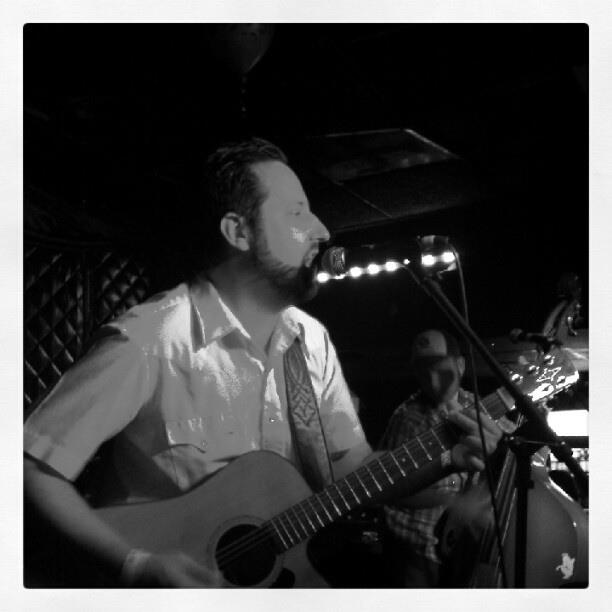
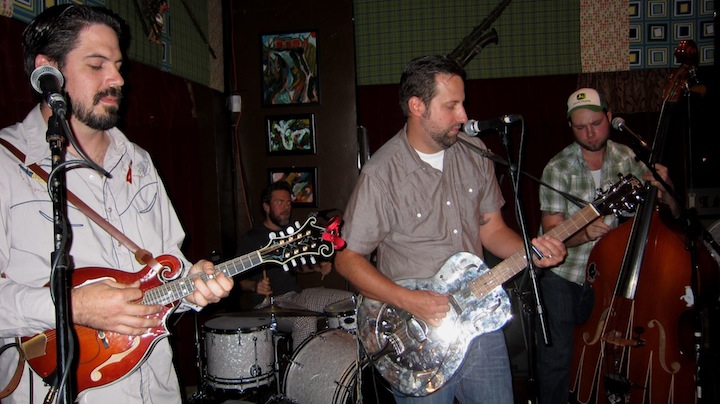
The Grim Roosters at Twain's. Photo courtesy of the Grim Roosters.

Have you played past Hollyfests? For the uninitiated, what happens at Hollyfest and makes it special? With all the Star Bar regular bands and Andy organizing, it sounds like it’s a big rockabilly/honkytonk homecoming. 

I have played many Hollyfests. One with Grim Rooster and a couple with Rocket 350. It is like a big homecoming, or more like the Atlanta rockabilly scene’s annual meeting. It’s always a great time, and its always great to see friends that I’ve hung out with for the past 20 years. It’s funny. I was sneaking into that place when I was 18, and here I am seeing the exact same folks. Something like that is rare, and I’m glad Andy and the Star bar are keeping it alive.

What will Grim Rooster be playing at Hollyfest – Holly classics or your own songs or both? Any special plans?

We are stripping down for Hollyfest because our drummer won’t be able to make it. We will be going string-band style. We are going to bluegrass up “Midnight Shift” and “True Love Ways.” Next we are going to do a slow-dance version of “Rave On.” Then, last but not least, we are going to do a Roosterized version of Weezer’s tune “Buddy Holly.”

How did you start playing guitar, and were your first rock influences the classics or were you more of a punk rock boy or a metal-head?

I started playing guitar in 7th grade but quit when I got a Nintendo for my birthday. I stupidly put it down, but hell, I was 12. I picked it back up when I was 19 because I wanted to be in a band and I realized that no one wanted just a singer. I started by trying to play along to punk rock records. It took a few years to start getting the rockabilly licks down.  When I finally did, I started Rocket 350.

I would say punk rock boy and metal head, or maybe just a lot of classic rock. I love Guns n Roses and the Ramones, what can I say?! I knew about the classics, but I didn’t start seeking out different genres till high school. I originally got into roots music through ska. That scene used to be huge in Atlanta, and there were a ton of shows. That pushed me to seek out rockabilly, and then I was hooked on that for many years. Through all of it though, I would have to say punk rock is by far my favorite music. That is probably my biggest influence. Then there’s a lot of old school country and just plain rock ‘n’ roll thrown in there.

What other bands have you played with?

Rocket 350 has been my main band; that lasted from 1997 to 2011. We went on four US tours and played hundreds of regional shows. We recorded five albums. I have yet to release our last record. Also I did fill in for my buddy’s metal band Grayson Manor once. That was fun as hell, but not exactly a good fit.

Other than Hollyfest, what’s your most memorable, fun, crazy or satisfying Grim Rooster gig? 

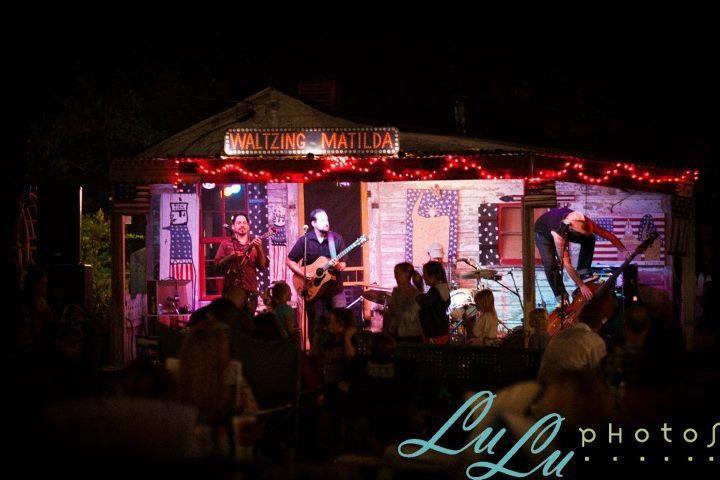
We enjoy playing an outdoor venue in Alpharetta called Matilda’s. Everyone calls it the poor man’s Chastain. They have roots music outside every Saturday during the summer. You play on the porch of an old house, and everyone brings their own food and beer. It’s all ages, so all of our families can make it out to the show. Those so far have been my favorite gigs, and they always draw a huge crowd. Just a really great vibe when we play there and a lot of interaction from the crowd. At the end of the day, we do this for fun so when you can get people out and involved, it makes it worth it.

The Grim Roosters shake up Matilda's. Photo Courtesy of the Grim Roosters.

Do you have a day-job?

I do, but I don’t want to ruin the illusion. Ha, yes in real life, I have a wife and two kids and live in the burbs. I work as a financial advisor, so me playing music has become a way for me to release a ton of stress. If it wasn’t for the release of playing music, I would probably be in the looney bin. I was very lucky to have been able to play music for a living and go nuts. In my late 20s, the writing was on the wall. I realized I wanted other things.

What’s next for Grim Rooster?

Just trying to find more gigs. If you know of any, let me know. We do have a big one on Feb. 6 at Smith’s Olde Bar. We are opening up for Corb Lund, and we are super excited about it. We will be playing our usual set of originals with a couple covers thrown in. Should be a great night of honky tonk.

Also, Grim Rooster is on Facebook if anyone wants to check us out. We have a three-song demo up there for everyone to listen to and download.


Category: Kool Kat of the Week | Tags: , , , , , , , , , , , , , , , , , , , , , , , , , , , , , , , , , , , , , , ,

Of Cupcakes and Pillow Fights: Pink Pastry Parlor is Like a Scrumptious Slumber Party for Girls, Both Big and Small

Posted on: Jan 31st, 2013 By:

By Rachel Marshall
Contributing Writer

Brave the traffic of Buckhead and you will be rewarded with a tasty treat at Pink Pastry Parlor‘s new Phipps Plaza location where owner Tiffany Young-Cooper is offering a sweet twist on girl power. Her confectionary parlor marries those first shopping trips with Mom and baking with Grandma to produce a palatable paradise to any little princess looking to cut loose with fellow royalty for an unforgettable party. Not only does Pink Pastry promise delectable and adorable cupcakes, but there is a runway room, tea room and, yes, even a pillow fight room where girls can feel beautiful, playful and classy. The Pink Pastry also offers daycare, as well as pastry lessons if Mom wants a ladies night out to enjoy cupcakes and wine.

ATLRetro had a chance to hang out with Tiffany for some glamour shots and stayed for the cupcakes!

What inspired the pillow fight? Because that is basically awesome.

The pillow fight idea came about while I was brainstorming about what every little girl wants for her party – A SLUMBER PARTY! This way she gets a little bit of everything!

Favorite cupcake? Or if it’s impossible to name just one, name your top three.

My favorite cupcake is the Italian Dream, and our top sellers are Strawberry Fairy and It’s My Birthday Cake!

Any new cupcakes you’re just dying to make? 

Salted caramel!!!!

You mention that first shopping trip with your mom and helping grandma bake. Can you go further into detail on how these women shaped your life and work?

I dreaded spending summers in the country learning to bake with my grandma. I loved kids and just knew I would be a pediatrician. But my granny saw something that I didn’t, and all those long summers paid off! Wish she was still here.

If you had any advice for anyone looking down the entrepreneurial path, what would it be? In retrospect, what was your best first step, and what was your worst?

Advice: Save up until you can’t save anymore! So put those hair/nail/massage appointments to the side for four months and see how much of an impact that makes! My best move: Staying economical. Every business owner in my plaza had luxury cars, and I’m still driving my 2007 Dodge. Delayed gratification is key! My worst move: Location is key. I chose affordability over profitability. Continue to save until you are able to afford a good location.

Which doll did you spend the most tea-time with while you were growing up? 

I’m a BARBIE girl. I had all five in one chair!

Do you like to listen to music when you’re baking? Any favorite playlists right now? 

I jam while I’m baking! My favorites are ol’ school: Queen and Donna Summers!

You emphasize self-esteem and empowerment. When you’re down, what is the best confidence booster? 
Best confidence booster is getting all dressed up in pink, hop on the Pink Pastry runway, lights out/disco ball on/alone/after hours and blast “Anything Can Happen” by Ellie Goulding. Talk about CONFIDENCE BUILDER!

If you could say anything to the little, rambunctious girl out there with flour on her hands and chocolate on her cheek, what would that be?  
It’s time for you to be your OWN cake boss at Pink Pastry! Maybe teach me some tricks!

Pink Pastry Parlor is located on the second floor of Phipps Plaza, next to Belk. Call (404) 841-9997. Or  visit the original Pink Pastry Parlor at 8465 Holcomb Road, Suite 1000, in Alpharetta. Call (770) 650-PINK (7465). https://pinkpastryparlor.com/

All photographs are courtesy of Pink Pastry Parlor and used with permission.

Category: Wednesday Happy Hour & Supper Club | Tags: , , , , , , , , , , , , , , , , , , , ,

Get Set for a Swinging Time with Vincent Price at THE PIT AND THE PENDULUM! A New Digital Restoration at Atlanta’s Historic Plaza Theatre!

Posted on: Jan 30th, 2013 By:

THE PIT AND THE PENDULUM (1961); Dir. Roger Corman; Starring Vincent Price, Barbara Steele and John Kerr; Premiere Friday, Feb. 1 @ 8:00 p.m. with giveaways; then nightly at 8 p.m. Feb. 2- 7; Plaza Theatre (visit website for times and ticket prices); Trailer here.

By Aleck Bennett
Contributing Writer

Finally, after years of waiting, it is now possible to see PIT AND THE PENDULUM on the big screen once again in a newly-restored, high-definition digital presentation. For far too long, the movie has been hard to see in optimal condition (even the most recent MGM Midnite Movies DVD of the title isn’t anamorphically enhanced for widescreen presentation). This is something that’s always struck me as odd since it’s one of the best-remembered films of American International PicturesEdgar Allan Poe cycle, was a huge box-office smash at the time and contains some of the most defining scenes in post-1960 horror. Be that as it may, as far as securing prints go, it has been one of the more obscure films of Roger Corman. Thankfully, that’s changing now, and THE PIT AND THE PENDULUM can be seen in all of its glory and grandeur at Atlanta’s historic Plaza Theatre from Friday, February 1 through Thursday, February 7. Friday night’s showing will feature a special giveaway of two free tickets to all nine days of the Atlanta Film Festival: a $600 value! It promises to be an event big enough to befit the legendary teaming of Corman, Price and Poe.

Roger Corman. The name means many things to many people. To some, it primarily conjures up images of cheaply-made and quickly-shot horror/sci-fi fare from the 1950s and ‘60s. Flicks like CREATURE FROM THE HAUNTED SEA, A BUCKET OF BLOOD and THE LITTLE SHOP OF HORRORS. For others, it is chiefly and inextricably linked with the development of the “New Hollywood” of the late 1960s and ‘70s. Movies from American International Pictures and New World Pictures that helped launch the careers of talents like Martin Scorsese, Francis Ford Coppola, Jonathan Demme, Robert De Niro, Barbara Hershey, Jack Nicholson and Peter Fonda. For a former co-worker of mine, it means “that aloof guy who would stroll into the New Horizons office and ask if Jim Wynorski had called.”

But for a certain set of the man’s fans, the first things that come to mind are two names: Edgar Allan Poe and Vincent Price.

In 1960, American International Pictures was seeing the market for their low-budget, black-and-white output shrink. Roger Corman had been their most prolific filmmaker, churning out low-budget schlock in 10 days or less (mind you, it’s some great schlock, and never without a sense of wit and intelligence behind it all), and convinced studio heads Samuel Z. Arkoff and James H. Nicholson to take a risk on shooting a full-color widescreen film with a larger budget (a full $300,000!) and a longer production schedule (a full 15 days!). The success of this film, HOUSE OF USHER, pushed AIP to demand more of the same: another Poe adaptation, made by the same team and starring the same lead, Vincent Price.

Corman complied and assembled his USHER team: cinematographer (Floyd Crosby), set designer (Daniel Haller), score composer (Les Baxter) and screenwriter, the now-legendary horror author Richard Matheson. Matheson had seen a good deal of success as a writer in the decade previous to his teaming with Corman. He had adapted his novel THE SHRINKING MAN into the smash sci-fi/horror film THE INCREDIBLE SHRINKING MAN, and his novels and short stories were in high demand. He had just been added to the stable of writers employed by THE TWILIGHT ZONE, and was also selling scripts to western- and war-themed TV shows. In short, Corman (in a typical move for him) had spotted an up-and-coming talent that he could grab for relatively cheap: someone who might be willing to trade some of the money he could get from a higher-paying gig for the relative liberty of a Corman screenwriting job. The pairing worked so well on USHER that Matheson returned for this, and several of the films following this in Corman’s Poe series.

The film is set in 1th Century Spain, and follows Francis Barnard (John Kerr) as he visits the castle of his brother-in-law Nicholas (Vincent Price) to investigate the death of his sister Catherine (Barbara Steele). Nicholas recounts that Catherine had been driven mad by the castle’s history and atmosphere, had committed suicide and now walks the castle halls as a ghost. When it is uncovered that Catherine had been interred alive, Nicholas is sent into paroxysms of fear and plunged into madness as he has visions of the traumatic events of his childhood. It all culminates in Nicholas’ break with sanity as he tortures his household in the dungeon beneath the castle’s floors.

Because of the slightness of narrative material in Poe’s short story, which is set nearly entirely within a prison cell over the course of a few nights, Matheson was encouraged to devise a way to shoehorn Poe’s tale into just the film’s climactic scene. In doing so, he created a psychologically rich screenplay centered on the main character’s neuroses, all of which seem to stem from a terrifying event witnessed in his youth. This psychological approach to gothic horror would prove to be incredibly influential in the years to come, as reverberations of its themes (along with their visual depiction by the team of Corman, Crosby and Haller) would be seen in many of the great Italian gothic horrors of the 1960s and ’70s, as Tim Lucas uncovered in his 1997 interview with screenwriter Ernesto Gastaldi in VIDEO WATCHDOG #39. Gastaldi admitted that the film had inspired his screenplays for Mario Bava’s THE WHIP AND THE BODY and Antonio Margheriti’s THE LONG HAIR OF DEATH: “Yes, of course! THE PIT AND THE PENDULUM had a big influence on Italian horror films. Everybody borrowed from it.”

Vincent Price, too, returned to the AIP fold. Price had starred to great effect in HOUSE OF USHER, and brought equal parts menace, dignity and emotional complexity to what could have been a flatly-played character in lesser hands. In THE PIT AND THE PENDULUM, he would be given even more to chew on as Nicholas Medina (and, in flashback, his crazed Inquisitor father, Sebastian Medina). Some have argued that perhaps Price sank his teeth a bit too deeply into the role, which required him to shift from a refined-but-fragile gentleman persona to that of a raving madman at a second’s notice. And it’s true that Price seems to be having the time of his life, relishing every utterance and mannerism, and basically being Vincent Price at his Priciest. But in a film that demands a tone that almost tips into the surreal, his nearly over-the-top performance works perfectly as a piece with every other element in the production.

Barbara Steele, fresh from starring in Mario Bava’s international gothic horror success, BLACK SUNDAY, is also incredibly memorable as Catherine, delivering an impressively expressive performance. However, it’s hard to objectively discuss her work in this film beyond the physical aspect of it: thinking that her natural British accent didn’t mesh with the other actors’ performances, AIP had her part dubbed in post-production by another actress.

Visually, Corman and his team work wonders with what little budget and time they were given, using impressive sets borrowed from other studios, violently active camera work and dream/fantasy/flashback sequences warped and twisted optically and displayed using a blue and red color palette. Corman’s direction is—as usual—tight and effective, providing impressive and perfectly-timed jolts while steadily building an atmosphere of oppression and madness. For pure horror, it is the highlight of the entire Corman/Poe series, and artistically tied only with THE MASQUE OF THE RED DEATH (MASQUE may be more thematically and symbolically rich and more daring in its approach, but PIT beats it on pure fright value).

Aleck Bennett is a writer, blogger, pug warden, pop culture enthusiast, raconteur and bon vivant from the greater Atlanta area. Visit his blog at doctorsardonicus.wordpress.com

Category: Retro Review | Tags: , , , , , , , , , , , , , , , , , , , , , , , , , , , , , , , , ,

Retro Review: BARBARELLA, Take Two, or Today, I Watched Jane Fonda Narrowly Escape Death-by-Orgasm in the Excessive Machine; How Was Your Day?

Posted on: Jan 25th, 2013 By:

BARBARELLA (1968); Dir: Roger Vadim; Screenplay by Terry Southern; Based on a bande dessinee by Jean-Claude Forest; Starring Jane Fonda, John Phillip Law, Anita Pallenberg, David Hemmings, Milo O’Shea, Marcel Marceau; Plaza Theatre, Saturday, January 26 at 10:00pm; presented by BLAST-OFF BURLESQUE’S TABOO-LA-LA with live stage show before the screening including raffle of 10 8×10 signed photos of Fonda as Barbarella from Jane Fonda’s personal collection; Trailer here

By Andrew Kemp
Contributing Writer

Today, I watched Jane Fonda narrowly escape death-by-orgasm in the Excessive Machine. How was your day?

Although I’d never seen BARBARELLA (1968), the infamous sci-fi sex romp produced by Dino de Laurentiis and directed by Roger Vadim, before today, I definitely knew about it. Almost everyone knows about it. BARBARELLA is a movie with more reputation than respect, a movie that, depending on who you ask, is either awful or awfully amazing. Just its name invokes a few key images—that amazing poster by Robert McGinnis; Jane Fonda’s buxom, uh, hair. I grew up in a post-STAR WARS world, when just the sight of a science-fiction ray blaster promised a particular brand of space fantasy and action, but combine aliens and thrills with the promise of a naked, beautiful woman? There’s not enough concrete on Earth to build a wall an adolescent boy can’t climb.

But I never made it over that wall. Yes, it’s true that young boys can sniff out nudie films like pigs root up truffles, but you guys have never met my mother. I once got a few short minutes of FLASH GORDON (1980) and its adventurous female costumes on the TV before she stomped into the room, feeling a psychic disturbance, I suppose, in her son’s mind. She played goalie effectively until around the time I entered high school, and by then I had found other ways to see boobs. And so, somehow, Barbarella and I had never met.

Durand Durand (Milo O'Shea_ tries to defeat Barbarella (Fonda) with death by orgasm. Paramount Pictures, 1968.

BARBARELLA was a famous flop at the box office, but its racy content, goofy cheerfulness about sex and outrageous set design—the spaceship is lined with shag carpet!—fit snugly with the mood of the late 1960s, at least with certain segments of the youth. The film quickly gained a cult infamy, especially as its star, Jane Fonda, transitioned into A-pictures and won an Oscar for the popular detective film, KLUTE (1971). There’s always been kind of a funny dividing line between mainstream film and exploitation, and it’s thrilling when some star gets a weekend pass to play on the other side, whether it’s Bruce Campbell showing up in SPIDER-MAN (2002) or Jane Fonda taking her clothes off. It was impossibly tantalizing to know that a major actress had once bared it all in a sex adventure, especially before home video, when the only way to see something like BARBARELLA was to catch a revival screening, and there weren’t nearly enough of those. Lack of availability helped grow the film’s legend, and it soon became trendy and cool to latch onto its camp appeal. Even by the early 1970s, a club named Barbarella’s existed in the UK, and it became a key location in the developing punk scene, hosting bands like The Sex Pistols and The Clash. One rising band that played frequently at the club even sampled clips and songs from the film into their music, tweaking the name of the film’s villain, Durand-Durand, into their own name, Duran Duran.

But it was the 1960s; everyone was taking their clothes off, right? There were plenty of sex movies in the world. What is it about BARBARELLA that keeps it going? “I just remember seeing that strip tease during the opening and being in love with the world,” says Max Shell, director of the undead-chicken cult movie THE DEVIL’S COCK. “Dino’s [de Laurentiis] Euro Sci-Fi is about ‘getting it on!’”

Melanie Magnifique of Blast-Off Burlesque takes a more esoteric approach. “I was traversing the spirit lands, when this film was released in conventional space-time. When I first experienced it, many years later, it was still the powerful tale of a girl doing what a girl’s sometimes got to do!”

The famous poster by Robert McGinnis.

Aha! If there’s another narrative to the BARBARELLA appeal beyond sex, it’s girl power. The film came at this neat little intersection of the free love ‘60s and the peak of the misogynist spy fantasies like James Bond. There had simply never been a female action hero who freely used and enjoyed sex while saving the day. (Hell, it’s still hard to find a character like that today!) Perhaps this explains why Barbarella became a feminist icon, and a popular cosplay target for over 40 years. It’s common to see Barbarellas walking the floors at comic book shows and sci-fi conventions, and the heroine’s legend is so large today that the film lives under constant threat of remake, with the most recent major attempt fronted by director Robert Rodriguez as a vehicle for Rose McGowan, who he’d already cast once as an ass-kicker in his GRINDHOUSE entry, PLANET TERROR (2007).

Does BARBARELLA deserve its infamy? I finally sat down to watch the film today, and I was kind of amazed with what I found. Despite its legacy in the sexual revolution, BARBARELLA can sometimes be cruel, and other times naïve. After the famous opening strip scene (described in wonderful detail here on this very site), we learn that Fonda’s secret agent is a wide-eyed wonder. A child of a civilization that has evolved beyond violence and pain, she greets the world with simple joy and, when confronted with the bizarre horrors in an “unevolved” part of the galaxy, she simply pushes through and perseveres, using far more optimism than skill. Melanie Magnifique rightly describes Barbarella as “a female protagonist who wants to do the right thing, but is sometimes a little confused about what that thing is.” Fonda’s earnest devotion to her mission is entertaining, even if that mission sometimes devolves into bizarre, disconnected segments. She’s nearly devoured by carnivorous songbirds, for crying out loud.

As for the sex, my adolescent self would have enjoyed Fonda’s matter-of-fact approach to her body and to the sexual beings she encounters. She’s more or less willing to have sex just for the asking, which works both for and against her feminist reputation. On the one hand, the film is full of scenes of sexual aggression or sexual bartering. Sex is a currency that gets Barbarella from place to place, and there’s an unsettling trend towards sexual torture. It’s easy to read the film as misogynist, using Barbarella as a doll to act out aggressive male fantasies. But, on the other hand, there’s something charming and empowering about how Barbarella, after having been introduced to real sex (in the future, evolved beings do it with a pill) by an impossibly masculine hunter, Barbarella blossoms as a sexual being, pursuing sex with the chiseled angel Pygar and showing frustration when a bumbling freedom fighter (the awesome David Hemmings in the film’s best supporting role) wants to do it with the pill.

Although the film sought mainstream success, BARBARELLA is a movie destined for cult status. Like every good cult flick, there are moments that you simply can’t believe you’re seeing, scenes that should be impossible in a well-budgeted studio film, and yet here they are. This is a film for an audience, if simply so you can turn to the person next to you to share a laugh and one of those “holy shit” looks. This movie should be *ahem* a shared experience, not a solo trip. Even with all the sex, there’s something incredibly innocent about the film, and it serves as a window into a more optimistic, good-natured time. It’s fitting, then, that it’s being hosted at the Plaza this weekend by Blast-Off Burlesque. Burlesque itself is an art form that walks that beautiful line between sweetness and spice, and BARBARELLA is their kind of movie. When asked about the links between burlesque and BARBARELLA, Melanie Magnifique agreed: “It contains many simple theatrical tricks which are used to achieve special effects (we do that a lot).”

“Oh, also, we love to smoke Essence of Man.”

The show starts at 10 pm on Saturday with music, a dance party and complementary signature cocktails, but says Magnifique, “Come early to get your groove on!”

And be sure to read our other Retro Review: Jane Fonda Has No Clothes On: Stripping Down Our Love Affair with Psychedelic ’60s SF Camp Cult Classic BARBARELLA in Time for a Blast-Off Burlesque Taboo-La-La at the Plaza Theatre by Robert Emmett Murphy Jr.

Category: Retro Review | Tags: , , , , , , , , , , , , , , , , , , , , , , , , , , , , , , , ,

Kool Kat of the Week: The Sexual Side Effects Are on a Mission to Rock Your World: Amber Taylor on Growing Beyond Glam and Throwing a Franken-Party to Remember Friday Jan. 25!

Posted on: Jan 24th, 2013 By:

Photo courtesy of The Sexual Side Effects.

Andy Warhol would have approved of the Sexual Side EffectsFranken-Party  this Friday Jan. 25 at the Drunken Unicorn. A rock ‘n’ roll fantasy collides with an art show. The crowd is scantily but fabulously dressed, clothes replaced by body paint. Go-go dancers twist and shake in Nancy Sinatra boots as multi-colored lights sweep across the dance floor. The epic extravaganza launches SSE’s Franken-Tour across the Southeast and Texas and also boasts Sarasota, Florida’s MeteorEYES, who are on their Winter Migration Tour, and self-proclaimed Atlanta nerd-rock band Go! Robo! Go!

The Sexual Side Effects have only been playing Atlanta for a couple of years, but to say they have taken the city and the Southeast by storm is like underestimating a thunderstorm before it starts firing up a tornado. In fact, it’s hard to imagine with all the high-voltage energy lead vocalist/guitarist Amber Taylor is channeling into the band, it won’t be long until they have the attention of the nation and the entire world, maybe even the galaxy if ETs are tuning in.

Over time, we figured some Kats would be so Kool that they had to be Kool Kat of the Week more than once, and Amber certainly qualifies in spades. Last time we chatted with her in July 2011, she was plotting a neo-glam revolution with her Gilded Trash events in Atlanta and New York. SSE still sports its glam roots in some of their sound, their audacious stage shows and encouragement to people to wear outrageous, sexy costumes to their performances, but the band has revealed itself to be much more. On the Retro side, one can see in-your-face post-punk, new wave and even psychedelic influences, and yet their approach feels right in tune to the 21st century. With a successful EP,an award-winning video, scoring “Best Local Rock Act” and “Best Band Name” in Creative Loafing‘s 2012 Best of Atlanta, sell-out shows from DC to Florida and a Franken-Tour on the horizon, we felt it was high time to catch up again with Amber to find out more about why their kick-off party in Atlanta this Friday is not to be missed and what’s up in a future so bright we imagine they’ll have to wear shades.

ATLRetro: Without giving it all away, what do you want folks to know in advance about Franken-Party?!

Amber Taylor: Franken-Party! is our new party. It started by making a silly flyer with Frankenstein partying with a couple of cold ones, and it inspired a eureka moment. We (The Sexual Side Effects) realized that one of the funnest and most successful shows we produced over the years was at My Sister’s Room in October 2011. The concept was simple – Art + Music. We played, had a couple of guest stars and bands from around town joined us on stage, had an art show, body painting, burlesque queens and tons of other fun eclectic art.

This whole experience can be summed up by the name “Franken-Party!” Pull all kinds of art into a blender – music, visual art, performance art, film, burlesque, drag, costumery, you name it. If it’s art, it has a home. I know I wasn’t supposed to give it all away, but, oh well, I guess we just slept on the first date. Don’t worry I like to make breakfast in the morning.

If Franken-Party is a rock concert, why so much art and half-nakedness? Do I have to be at least half-naked to attend?

It’s only part concert. It’s really an art-party that’s all about the people. People have to enter covering up their “naughty bits,” but if things get a little out of control, so be it! It’s not a party till someone get’s nekid!

You’ve expressed on Facebook a lot lately that you feel this is a big year for you and the Sexual Side Effects. Why now, what’s up and how does this relate to Franken-Tour?

Well, we have been working our tails off night and day over the last couple of years, and have reached a point where we have a team built to help us get more accomplished. In 2013, we have established an agent, publicist, radio promoter and are flirting with a couple of managers as well. This will enable us to put more time and energy into our art.

We hear Ryan McDougall is leaving the band. Who is replacing him and will Franken-Party being his last gig with SSE give the night a bittersweet tint?

RyGuy – which Mike the bassist affectionately coined him – is leaving the band. This will be his farewell show, and a farewell to one part of our journey as a band. It’s a positive thing though! The SSE has always had its core three members – myself, Mike Sidner [bass] and Clay McClure [drums]. We have evolved into a group that incorporates different people into it from time to time or project to project. We still have the same sound, same direction and personality, but now we just get to share the experience with more people and make it a bigger family. We may continue as a trio, or may get another guitarist. We have a couple of people we have auditioned, but either way the train will never stop until our dying days. Art is my mission in life, and it will never stop.

Photo courtesy of The Sexual Side Effects.

Looks like SSE is playing all over the South in the next two months on Franken-Tour. You’ve also played a lot of Florida dates lately. Any plans to go north of the Maxon-Dixon line?

We are going to work on the Southeast, Florida and Texas for a while. Too many bands want to go national overnight, and this is the biggest mistake they can make. The Wall of China was not built overnight; it was built brick by brick on a solid foundation. The U.S. is a big place, and every time we play a city we have to go back within two to three months. We are going to do about five rounds on tour in the Southeast and then figure out what’s next once SSE mania has spread far and wide. In other words, this shit is on!

It seems like your five-song EP HIGH MAINTENANCE and the video for “All She’ll Ever Hurt,” directed by David Joseph and the Comcast/Xfinity Video Award winner at the 2012 Georgia Music Awards, really amped things up for the band. Do you consider that a key turning point?

Well, it has helped a lot, but nothing happens over night. Art is hard work, and there is a long road to travel to get to the point where we want to be in our hearts. The video and the album are the introduction for the band to the world and they still get discovered everyday by people. Surprisingly the UK has really embraced us! As some point soon we will start touring there.

What’s been your favorite gig on this crazy trip so far?

Phasefest in Washington, DC, with Hunter Valentine, Vanity Theft and Glitterlust was one of the most magical shows I have personally felt yet. The club sold out at 300 people, and they had to turn away 200 people at the door AND it was $25 to get in! It was off the chain! I’m surprised the fire marshall didn’t shut it down. Well, at least my amp stayed cool. What an insane night; on top of that, we played the night before in Atlanta at a convention, got in the van after the show and drove straight to DC overnight. I remember being exhausted before we hit the stage, but when we plugged in, it was like a firecracker went off – for the next hour. Thank God for Red Bull! The last song we played the whole crowd was singing along – and they didn’t even know the words!

OK, since we’re ATLRetro, we always like to talk about the past as much as the future. Let’s go back to your roots. How old were you when you discovered glam music? Who was the performer, what happened and why did it appeal to you then?

Well, in all honesty about the glam thing, we have moved away from glam as a definitive title for us. Because of who and what I am, my relationship to Glitterdome  [at The Chamber] in the past, our parallel to the band Placebo, and of course, our Glam night we did called Gilded Trash, we kind of got that label in the begining. This isn’t totally fair to the listener though. We have a much different sound which is more rooted in Post-Punk, Psychedelic Space Rock, New Wave, Brit-Pop, Indie Rock and Indie Pop. Of course, there are elements of ’70s glam in what we do and our sound as well, but that is only a small part of the mixture. Of course, there is also the Joan Jett element of how I look, as well as the T-Rex-ness that gives that aura.

David Bowie, of course, was my all-time favorite. Pat Briggs from the Glitterdome was a big part of my fondness with David and glam in general. After I got to know and perform with him, I had a huge glam fetish. When the movie VELVET GOLDMINE came out, it seemed to boost that whole scene and the nostalgia of it all as well. Some people love that movie and some people hate it, but to me it is an important part of glitter fantasy that every child should have!

When we talked last year, you were talking about the Sexual Side Effects in the context of instigating a neo-glam movement. Do you still feel that’s the best term overall to classify the band is or has it progressed into something different? How do you describe your music to someone who hasn’t heard it before?

Well, we did set off down that path, but being true to the song and what has come out as an artist we found other elements and music we have drawn inspiration from. We are all about the fantasy of music, rock ‘n’ roll, and the show, but that manifests itself in new ways and new descriptions. It’s an art movement, creating musical art with no boundaries or constraints to what it is. We have come up with a new fusion of sounds that could be described as Progressive Psych Pop. The fun, charisma, and audience participation that glam has still manifests itself in who we are, but our sound is a little outside the box to perfectly fit in the neo-glam classification. We have grown a bit as artists as well which has made it morph into something new. Art in the context of the Flaming Lips is a better parallel for sight, sound, experience, inspiration for the show and audience participation.

OK, back to the future, are you recording anything else, perhaps a full CD, soon? What about more videos?

We have been writing and have a good number of songs laid out to be recorded. We plan to go back into the studio soon and record. We are hoping to have something proper released around Summer 2013.

Photo courtesy of The Sexual Side Effects.

You’ve said that “Really the next step for the band is to take our music and who we are and help change society beyond us.” That’s heavy stuff but all one has to do is look in your eyes to know you mean it. Do you have a master plan, and how can the Sexual Side Effects’ music change the world?

One person at a time. It takes a long time, but we have a whole lifetime. When a teacher has a positive life-changing effect on a student or a social worker or whoever, it’s that moment when they have a purpose greater than themselves. Music is our purpose in life. To help others, and to share it with others makes it even more amazing. It’s a universal language that connects us all, regardless of barriers.

Finally, you’re just having a helluva lot of fun, aren’t you?

Why yes! It’s been a mountain load of hard work though. I worked my fingers to the bone the last couple of years and realized I need to stop and smell the roses. So this year I have dedicated to having more fun in everything we do. I think part of having Franken-Party! is my need to throw down at an epic party, too!

If you miss Franken-Party in Atlanta, here are the preliminary dates for the Franken-Tour:

1/25 – Atlanta, GA – The Drunken Unicorn
2/7   – Knoxville, TN – Preservation Pub
2/8   – Birmingham, AL – The Nick
2/9   – New Orleans – TBA
2/10 – Houston, TX – Cactus Music In-Store
2/11 – San Antonio, TX – The Thirsty Camel
2/12 – Fort Worth, TX – Wherehouse
2/13 – Austin, TX – Parish Underground
2/14 – Houston, TX – Mango’s
2/15 – Baton Rouge – The Library (ex. North gate tav)
2/16 – Mobile, AL – Alabama Music Box
2/28 – Nashville, TN – 12th + Porter
3/1   – Cookeville, TN – Miracle Mountain Farms
3/7   – Carrollton, GA – The Alley Cat
3/23 – Asheville, NC – Boiler Room
3/24 – Charlotte, NC – The Saloon

More Dates TBA. Check the Sexual Side Effects’ Website  and like their Facebook page for updates.


Category: Kool Kat of the Week | Tags: , , , , , , , , , , , , , , , , , , , , , , , , , , , , , , , , , , , , , ,

© 2025 ATLRetro. All Rights Reserved. This blog is powered by Wordpress