Retro Review: LADY TERMINATOR Will Slay Anyone Who Gets in Her Way Every Last Thursday at Cinefest!

Posted on: Nov 27th, 2012 By:

LADY TERMINATOR (1988); Dir: H. Tjut Djalil (aka Jalil Jackson); Starring: Barbara Anne Constable, Christopher J. Hart and Claudia Angelique Rademaker; Thurs. Nov 29, 9 p.m.; Cinefest Film Theatre; $5 (free for GSU faculty, students and staff with Panther ID); Trailer here.

By Aleck Bennett
Contributing Writer

The last Thursday of every month brings something almost unexplainable to Cinefest Film Theare…something that approaches that fine line between “good” and “bad” and blows it to kingdom come.

Science fiction author Theodore Sturgeon once postulated something that has since become commonly known as “Sturgeon’s Law”: 90 percent of everything is crap. Few take this law to its logical conclusion, though: if 10 percent of everything is great, it stands to reason that 10 percent of the crap left over is really great crap.

Ladies and gentlemen, the 1988 Indonesian epic LADY TERMINATOR is some really great crap.

It’s hard to go wrong with any movie that opens with death by hoo-hah. I mean, that’s just science fact. By presenting you with this event right up front, LADY TERMINATOR is letting you know that anything can—and likely will—happen at any time. Before the opening credits hit, we not only see what happens to those who attempt to bed the woman known as the “South Sea Queen” and not satisfy her, we find out that the one man who does succeed at the task pulls an eel out of the mysterious woman’s…area…and turns said eel into a knife. This angers the temptress, which seems reasonable. She says that she will return in 100 years to seek revenge on his great-granddaughter, and then flees into the oceans’ depths to join with the forces of evil.

Like you do.

Fast forward 100 years, and a feisty young scientist named Tania (key quote: “I’m not a lady, I’m an anthropologist!”) comes to town to research the legend of the South Sea Queen. She takes a boat out to where the Queen’s castle supposedly collapsed into the ocean (it’s nowhere near shore, but why let this story be bound by little things like geography?), dives down to see if she can find the ruins, is magically transported to a bed in the middle of nowhere and tied down by sentient scarves, and the mysterious eel from earlier takes up new residence in a new…area. She emerges from the ocean possessed by the spirit of the South Sea Queen yet acting like Arnold Schwarzenegger in THE TERMINATOR, boinks a few random jerks, and proceeds to get on with the job of seeking vengeance by pursuing that previously mentioned granddaughter (who, naturally, happens to be a pop star).
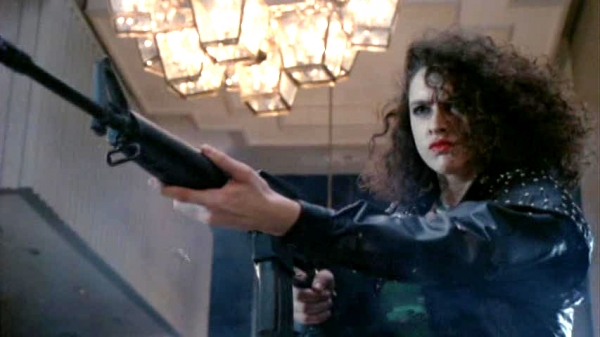
Barbara Anne Constable is LADY TERMINATOR. Studio Entertainment, 1989.

From that point onward, the film is a non-stop barrage of gunfire, vehicles exploding, sex, blood, nudity, bad pop music, sub-John Carpenter synthesizer score, atrocious dubbing, ridiculous dialogue, popped-collar Polo shirts, inexplicable decision-making, goofy romance, jewelry mix-ups, uncalled-for hotel room eye surgery…and I think that the narrator from the TALES FROM THE DARKSIDE television series shows up. We’re never exactly told why the titular Lady Terminator acts like a cyborg, nor why she can’t be killed, nor why she can shoot laser beams out of her eyes and create electrical energy with her hands. Possession is a mysterious thing. Maybe it’s got something to do with those eels. Maybe they’re electric eels.

It’s hard to give this film any kind of critical analysis or review. It escapes logical exploration. It exists in a place beyond human reasoning. It stubbornly dares you to justify itself. And while it’s true that few movies have so little reason to exist, fewer deliver on the goods the way that LADY TERMINATOR does in its own remarkably wrongheaded way. It manages to effortlessly accomplish what any number of Troma Entertainment productions go out of their way to attempt, and without any of the “hey, we’re trying to make a bad movie here!” winking that you get from Troma’s output. It may not be accomplished on any level, objectively speaking, but it’s never boring in the least. It’s fun. It’s insanely entertaining. And, really, shouldn’t that be the standard by which it’s judged?

LADY TERMINATOR is crap. But it’s really great crap.

Aleck Bennett is a writer, blogger, pug warden, pop culture enthusiast, raconteur and bon vivant from the greater Atlanta area. Visit his blog at doctorsardonicus.wordpress.com

Category: Retro Review | Tags: , , , , , , , , , , , , , , , , , , , , ,

Retro Review: THE ROAD WARRIOR Is the STAR WARS of the Post-Apocalypse and It’s Playing at the Plaza The Day Before Thanksgiving

Posted on: Nov 20th, 2012 By:

THE ROAD WARRIOR (1981); Dir: George Miller; Starring Mel Gibson, Bruce Spence, Kjell Nilsson; Wed. Nov. 21 9:30 p.m.; Plaza Theatre; Presented by Astrodog; trailer here.

By Andrew Kemp
Contributing Writer

George Miller’s THE ROAD WARRIOR is the STAR WARS of the post-apocalypse. The film didn’t invent the genre, but it seemed to perfect it and codify it for an entire generation of fans while simultaneously transforming Mel Gibson into a household name, and it’s returning to the big screen for one night only at the Plaza Theatre on November 21 at 9:30 p.m., presented by Astrodog.

One man alone in a wasteland. A growling convoy of modified trucks driven by thieves and thugs. A shantytown built from spare parts and spare people. We’ve seen these elements before, clichés of the post-apocalypse. Whenever we imagine a world-killing event, we tend to assume that society will give it about a week before we all start eating each other. It’s one of the oldest “what ifs” we have. What if tomorrow there was nothing left of the world but ruins, need and violent men?

But THE ROAD WARRIOR uses these familiar elements to create an action movie that transcends the grim parameters of its subject matter, making the end of the world thrilling, exciting, and even… fun. It’s the apocalypse-as-theme-park, but it completely, totally works, and although the film falls squarely in the middle of a larger franchise—the MAD MAX series—it’s easily the best of the bunch.

Gibson stars as Max, a lone warrior simply trying to survive in the aftermath of an unnamed apocalypse. Max’s world has been reduced to a barren desert (and one that looks awfully similar to the Australian outback), and vehicles have become as essential to survival as food and water. That means, naturally, gasoline (a suddenly non-renewable resource) is more precious than gold. In search of gas, Max enters an uneasy alliance with a rusty settlement of survivors, but he faces a tough choice when the town is besieged by brutal bandits led by the Lord Humongous (Nilsson). Will he abandon the town or put his life on the line to defend them? Hint: running away wouldn’t make for much of a movie.

It’s tough to look at Gibson today without getting tangled up in the headlines and scandals that have effectively ended his Hollywood career. It’s pretty clear at this point that Gibson has morphed into a fairly despicable person behind the camera, but his presence in front of the camera is impossible to deny. THE ROAD WARRIOR leaves no room for Max’s backstory, no tender moments to open up to the people around him. He’s nearly silent, a wandering ronin in the wrong place and time, but Gibson’s haunted eyes tell all the story you need. You can feel Max’s loneliness and pain even during the moments where he’s flint-hard. THE ROAD WARRIOR is a movie that doesn’t need its predecessor, but if you know that Max was once a cop and that he lost his family to thugs like Humongous, the extra layers start popping.

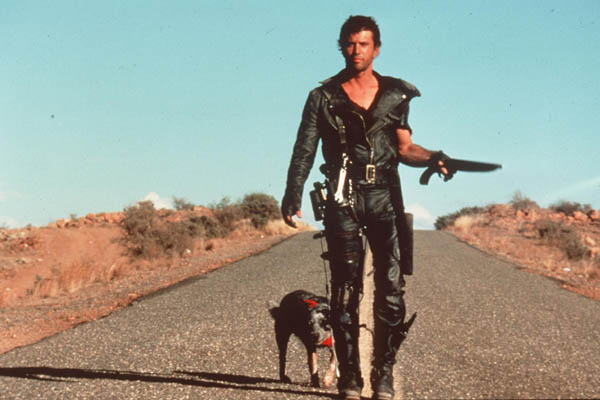
Mel Gibson as Mad Max in THE ROAD WARRIOR. Warner Brothers, 1981.

THE ROAD WARRIOR is also one of the crown jewels of raging car movies, a cinematic soulmate to films like DEATH RACE 2000 (1975) or VANISHING POINT (1971). George Miller arrived on the scene during the peak of “Ozploitation,” a golden age of Australian trash cinema that ran throughout the 1970s and ’80s and produced a slew of genre classics, from WAKE IN FRIGHT (1971), to LONG WEEKEND (1978) and DEAD END DRIVE-IN (1986). Miller was playing to an Aussie audience that knew their way around a car chase, and so he doesn’t skimp on the action, stuffing the film full of crunching metal, roaring engines, and cackling villains. The result is entertaining and often mythic. Stripped of its setting, THE ROAD WARRIOR is still a film about one man struggling against unbeatable odds for no other reason than it’s the right thing to do. The timelessness of the story has helped the movie age very well, and, if anything, it’s even more relevant today. Produced in the wake of the gas shortages and transportation nightmares of the 1970s, the film feels especially timely in a world of $4 a gallon gas and feasible projections that say we’ve either neared or reached (and passed) the peak of our oil production. The world of the future may belong to the likes of Humongous.

THE ROAD WARRIOR improved on its less-polished, more visceral predecessor MAD MAX (1979), but the series took a nose dive in the third film, MAD MAX BEYOND THUNDERDOME (1985). After that, Miller’s career went off into a variety of directions. Most recently, he’s been crafting thoughtful (if not entirely successful) fantasy films for children, producing Oscar-nominee BABE (1995) and directing its culty sequel, BABE: PIG IN THE CITY (1998) and both HAPPY FEET (2006) and HAPPY FEET TWO (2011). But that engine you’re hearing is the sound of that changing. Miller has been deep in production on the fourth film in his series, MAD MAX: FURY ROAD, for the last couple of years, replacing Gibson with the younger and suddenly very marketable Tom Hardy. Although the new film isn’t considered a remake or a reboot, it will still serve to introduce the franchise to a new generation of fans. For those who can’t wait that long, THE ROAD WARRIOR was born for the big screen.


Category: Retro Review | Tags: , , , , , , , , , , , , , , , , , , , , , , , , , , , ,

Retro Review: Darkness in Daylight: The Plaza Theatre Descends into Alfred Hitchcock’s VERTIGO

Posted on: Nov 19th, 2012 By:

VERTIGO (1958); Dir: Alfred Hitchcock; Starring James Stewart, Kim Novak and Barbara Bel Geddes; Fri. Nov. 23 – Sun. Nov. 25; Plaza Theatre (visit Plaza Theatre Website for showtimes and ticket prices); Trailer here.

If the film noir is defined by its most typical set-up—that of a doomed man swept up in events outside his control, often by a manipulative female figure—then Alfred Hitchcock’s towering VERTIGO is that most rare of films noir. It trades the genre’s high-contrast black-and-white for rich Technicolor. It places its characters not in the dimly-lit nightshade world of seedy bars, backrooms and private dicks’ offices; but in art museums, redwoods forests and the sunny streets of San Francisco. In the world of VERTIGO, the shadows of night may still hold mysterious threats, but the stark light of day reveals their constant presence all too clearly. There is, truly, no escape.

In this film, James Stewart paired with Hitchcock for their final collaboration. Stewart had long been one of Hitch’s archetypal actors. Whereas Cary Grant represented the Idealized Man in his cinematic world, Stewart was the Everyman. Grant was the go-to guy when Hitch needed a lead that viewers would either want to be or want to bed. Stewart was the guy next door, bringing a down-to-earth sensibility to his roles, and much of the attraction of him as a lead in Hitch’s films was in seeing this average Joe rise above his limitations to triumph at the end.

In VERTIGO, however, Stewart’s average Joe is taken far away from next door; his obsessions and fears exposed as he is broken beyond repair.

Stewart stars as former police detective John “Scottie” Ferguson, whose vertigo and fear of heights manifest in a rooftop police chase and result in the death of a fellow officer. Stricken by depression, he has retired from the force and struggles to overcome his fears. He is enlisted by an old college acquaintance, Gavin Elster, to trail his wife Madeleine (Kim Novak), whom he claims has been possessed by the spirit of the long-dead suicide victim Carlotta Valdes. Scottie witnesses Madeleine attempt to kill herself by jumping into San Francisco Bay and rescues her. They then become ensnared in an obsessive and doomed romance that can only result in death, a break with sanity, or both…

James Stewart and Kim Novak in VERTIGO. Paramount Pictures, 1958.

Kim Novak perfectly essays the role of a most unusual femme fatale: manipulative without being forceful, cool and reserved yet with a barely-concealed sexuality, strong yet fragile. However, Barbara Bel Geddes (whom viewers would later come to know as “Miss Ellie” Ewing on the TV series DALLAS) is perhaps the most overlooked character in the film: Scottie’s long-suffering ex-girlfriend Midge, a bohemian clothing designer, who represents the polar opposite of Madeleine. Where Madeleine is cool, Midge is warm. Where Madeleine is perfectly poised and elegant, Midge is natural and almost frumpily grounded. And where Madeleine represents everything that will tear down Scottie, Midge represents that lost potential for true happiness. Madeleine may be an impossible ideal, but Midge is real, there, now. And her love and devotion to Scottie may be the only path for his salvation, but how can he see that path with the dream that is Madeleine beckoning him from just beyond his reach?

The film was a critical and commercial failure upon release. Some felt it was too long and too complicated for a simple psychological mystery. Hitchcock believed that James Stewart’s age was a factor in the film’s failure, and replaced him with Cary Grant in the following year’s NORTH BY NORTHWEST (four years older than Stewart, true, but eternally youthful). Many, however, were disappointed that this movie was not another romantic mystery along the lines of 1956’s THE MAN WHO KNEW TOO MUCH. In fact, the mystery is practically subservient to the film’s depiction of obsession—it’s solved two thirds of the way through the movie. Hitchcock often referenced the term “MacGuffin”: the mechanical element that sets a story into motion, yet which is ultimately unimportant to the plot’s progression. In John Huston’s 1941 film THE MALTESE FALCON, for instance, it’s the titular sculpture. In NORTH BY NORTHWEST, it’s a cache of microfilm. In the case of VERTIGO, it’s the mystery itself. The whys and wherefores of how Scottie has become obsessed with Madeleine are not important; his fears and obsessions are, instead, the focal point, and how they emerge and re-emerge during the course of the story are what carries us along the inevitable path to the film’s particularly noir conclusion.

However it was dismissed in the past, in more recent years VERTIGO has been reevaluated. Beginning with Robin Wood’s seminal 1965 work HITCHCOCK’S FILMS, critics have paid closer attention to the film and what it attempts to accomplish. Many have come to regard the film in retrospect as Hitch’s most personal work: a fully-realized exploration of his own obsession with a particular “type” of woman, embodied in Grace Kelly, and his need to craft the images of his actresses to fit this particular model. This was an obsession, as depicted in Donald Spoto’s THE DARK SIDE OF GENIUS and the HBO original film THE GIRL, which would be ultimately destructive to his professional relationships with women. But despite the speculative personal aspect of VERTIGO, most have come to realize that as a film on its own merits, that it stands as a masterpiece. Indeed, it has topped the British Film Institute’s 2012 Sight & Sound critic’s poll as the greatest film ever made.

VERTIGO’s relative failure at the time meant that preservation wasn’t as much of an issue. Thankfully, the film was meticulously restored by film historian Robert A. Harris and his team, using materials ranging from the original camera negatives (which Harris notes “looked hideous”), to damaged black-and-white color separation masters, to fuzzy film prints as many as eight generations removed from the original negatives. Using all of the materials at their disposal (including a preserved green paint sample from a model of car featured in the film which was utilized for color timing), Harris and company worked miracles, producing an almost immaculate presentation of what many consider Hitchcock’s true masterpiece.

To see such an important film, preserved and restored so well, presented on the big screen is a treat to be savored by any film fan, whether casual or hardcore. And this treat is available at the Plaza Theatre for one weekend only. Some things simply should not be missed. Don’t let this one pass you by.

Aleck Bennett is a writer, blogger, pug warden, pop culture enthusiast, raconteur and bon vivant from the greater Atlanta area. Visit his blog at doctorsardonicus.wordpress.com

Category: Retro Review | Tags: , , , , , , , , , , , , , , , , , , , , , , , , , , , ,

Retro Review: John Boorman’s EXCALIBUR Delivers the King Arthur Legend Back to Its Epic, Mythic Roots at The Plaza

Posted on: Nov 13th, 2012 By:

EXCALIBUR (1981); Dir: John Boorman; Starring Nigel Terry, Nicol Williamson, Patrick Stewart, Helen Mirren, Liam Neeson, Gabriel Byrne, Corin Redgrave, Nicholas Clay; Mythic Movies Series presented by the Mythic Imagination Institute at the Plaza Theatre, Thurs. Nov. 15; 7:30 PM; Discussion following; $10; trailer here.

By Thomas Drake
Contributing Writer

“I think of the story, the history, as a myth. The film has to do with the mythical truth, not historical truth; it has to do with man taking over the world on his own terms for the first time.” 

  • Director John Boorman, EXCALIBUR

Short: “Merlin: STAND BACK! Be silent! Be still!… That’s it… and look upon this moment. Savor it! Rejoice with great gladness! Great gladness! Remember it always, for you are joined by it. You are One, under the stars. Remember it well, then… this night, this great victory. So that in the years ahead, you can say, ‘I was there that night, with Arthur, the King!’ For it is the doom of men that they forget.”

Medium: John Boorman’s EXCALIBUR returns to the roots of the Arthurian legend following the familiar epic storyline of Thomas Malory‘s LE MORTE D’ARTHUR with some modern twists. The wizard Merlin aids Uther Pendragon in King Arthur’s conception. Merlin then has Arthur claim the Sword in the Stone to certify his claim to kingship. The story fast-forwards to first meeting between Lancelot and Arthur, who in a fit of pride shatters the Sword in the Stone. The Lady in the Lake restores the sword and the Knights of the Round Table are forged. Lancelot and Guivere’s betrayal shatters the land forcing the knights to desperately search for the Holy Grail.

Maximum Verbosity: There is a lot to say about this movie; and it tends to evoke powerful feelings by those that like and dislike it. But even on the most neutral standpoint, the movie’s cast is absolutely astounding. Liam Nielson, Patrick Stewart, Kathrine Boorman all appeared as moderate unknowns with 1980s stars Nigel Terry (THE LION IN WINTER), Helen Mirren, Nicholas Clay and Nicol Williamson.

The visual style of EXCALIBUR is unique. Filmed in Ireland, British director John Boorman manages to capture a haunting fantasy in an era with stunning cinematography without CGI or advanced special effects. Boorman’s style is very reflective in this piece. He had originally hoped to do an adaptation of THE LORD OF THE RINGS, but was unable to find any backers for the project so he transferred the epic scope to Thomas Malory’s LE MORTE D’ARTHUR [Ed. note: which forms the foundation for most tellings of the Arthurian legend from T.H. White’s ONCE AND FUTURE KING to CAMELOT to MONTY PYTHON AND THE HOLY GRAIL]. Indeed, I do feel that while the Arthurian mythos has been told and retold, the heart of the tale is often lost with modern sensibilities. Camelot is very often updated with another theme in mind instead of how it was originally conceived, but Boorman manages to capture that older sensibility in EXCALIBUR. His attention to detail helped bring this iconic story to life, for example, the old Irish in the charm of making or some of the more obscure elements taken from Malory’s original work.

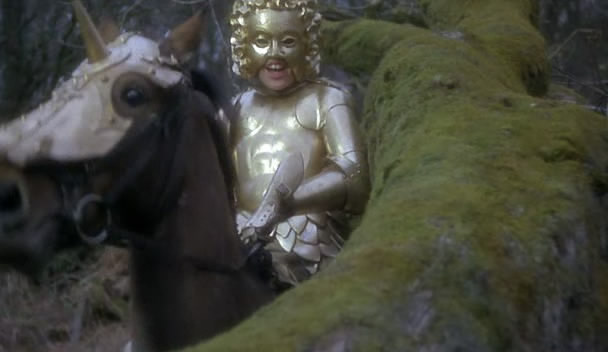
John Boorman's son Charlie played young Mordred in iconic golden armor in EXCALIBUR. Photo credit: Orion Pictures Corp., 1981

Some reviewers have criticized what they sense as a “rambling horrific dialog,” but Boorman’s quirky storytelling also includes many more elements of the original mythology than most modern retellings. Boorman is also well known for the acid-trippy science fiction film ZARDOZ (1974) starring Sean Connery, the timeless DELIVERANCE (1972) with its haunting banjo music and violent portrayal of the rural south, and  HOPE AND GLORY (1987), a semi-autobiographical World War II drama. Indeed, DELIVERANCE gave the director the street cred to get a budget sufficient to make EXCALIBUR. Though his career has often had as many misses as hits, EXCALIBUR did achieve Number One status at the box office when it was released. Still, his work is quite distinctive, and elements of EXCALIBUR have found their way into many other films, including enhancing the common understanding of the Arthurian mythos.

If you are a fan of Boorman, King Arthur or sword and sorcery, I cannot recommend this film enough.

Category: Retro Review | Tags: , , , , , , , , , , , , , , , , , , , , , , , , , , , , , , , , , , , , ,

Retro Review: Oh, Miyazaki!: Grab a Cat Bus Because The Studio Ghibli Collection is Coming to Landmark Midtown Art Cinema

Posted on: Nov 7th, 2012 By:

NAUSICAA OF THE VALLEY OF THE WIND (1984) and MY NEIGHBOR TOTORO (1988); Dir: Hayao Miyazaki; The Studio Ghibli Collection at Landmark Midtown Art Cinema, Fri. Nov. 9 through Thurs. Nov. 15; NAUSICAA plays November 9 at 1:45, 7:00 p.m., and 12:15 a.m.; MY NEIGHBOR TOTORO plays November 11 at 12:15, 5:00, and 9:40 p.m.; showtimes for additional movies here; all films presented in 35mm. NAUSICAA trailer here and MY NEIGHBOR TOTORO trailer here.

By Andrew Kemp
Contributing Writer

Landmark Midtown Art Cinema may not be the center of the known universe, but for film lovers and adventurous families from November 9-15, the theater may certainly feel like it. That’s because the Art Cinema is playing host to an incredibly special event that will see almost the entire Studio Ghibli collection light up the screens, each film proudly offered in an increasingly-elusive 35mm presentation. Some film nuts may just move into the building.

While Ghibli doesn’t have the widespread name recognition in America that, say, Pixar enjoys, Ghibli and co-founder/frequent director Hayao Miyazaki combine to form one of the biggest animation brands in the world, especially in the studio’s home country of Japan where Ghibli’s films routinely break box office records and land major awards. Here in the states, Ghibli films have competed favorably for critical attention with the mighty animation brands of Pixar and Dreamworks, winning the second-ever Best Animated Feature Oscar for SPIRITED AWAY in 2002 and scoring another nomination just a few years later for HOWL’S MOVING CASTLE (2004). In the world of animation, Miyazaki and Studio Ghibli are already considered legends, and they’re currently working at the peak of their talents.

So who is Hayao Miyazaki? An animator and artist, Miyazaki was already a 16-year veteran of the Japanese animation industry when he released his first full-length film, THE CASTLE OF CAGLIOSTRO (1979), based on the long-running LUPIN III manga and anime TV series. Miyazaki followed that success by moving into the world of manga—Japanese comics—where he created his own series about a girl caught between warring territories in a dying post-apocalyptic world. Miyazaki named his series NAUSICAA OF THE VALLEY OF THE WIND and he helmed a feature adaptation in 1984 that garnered enormous critical and commercial success in Japan and convinced Miyazaki and co-founders Isao Takahata and Toshio Suzuki to make the move to their own studio. So, while NAUSICAA is not officially a Studio Ghibli release, all things Ghibli began with that film and it holds a special spot of reverence in the collection.

Likewise, NAUSICAA is one of the crown jewels in the Ghibli film series playing at the Art Cinema because, frankly, it’s so rarely screened. Although widely available on DVD today, the original American release was marred by a lack of respect for the material. NAUSICAA received international distribution before Ghibli had made a name outside of Japan, and local producers didn’t hesitate to make massive cuts and add bad dubs to make the film “palatable” for their audiences. As a result, truly terrible versions of the film still exist out there (including an American hack job called WARRIORS OF THE WIND). Fans can finally see the original cut on 35mm and exactly as Miyazaki intended when NAUSICAA hits the screen on November 9.

Thanks to that highly public Oscar win, SPIRITED AWAY is perhaps Miyazaki’s most well-known film in America, but MY NEIGHBOR TOTORO is arguably his most popular. The third official Studio Ghibli release (and the second directed by Miyazaki), TOTORO is the story of two young girls who move to the country to be closer to their gravely-ill mother. Left largely to their own devices, the girls soon discover that the forest around them is teeming with fantastical creatures who become close companions just as the girls need them the most. Absolutely packed with Miyazaki’s trademark imagination, whimsy, and heart, TOTORO has become something of a signature film for Studio Ghibli, who adopted the film’s primary critter as their studio logo, and for fans who obsess over the film’s compelling fantasy elements (who doesn’t want to ride in a CatBus?) or create their own wild theories as to what it all means. (Don’t click here unless you’re ready for massive spoilers, possible lunacy). Bottom line, it’s hard to go wrong with any Studio Ghibli release, but if you’re only going to make it to one, MY NEIGHBOR TOTORO is a must-see.

The film series runs from November 9-15, and while movie fanatics and toon-heads will be arriving en masse, families looking for wholesome entertainment for their children have plenty to be excited about as well, especially parents of young girls. One of the trademarks of Miyazaki and all of Studio Ghibli is the presence of strong, complex, young female lead characters. In an American marketplace that mostly serves a particular princess archetype to girls, Ghibli is powerful counterprogramming. The sisters at the heart of TOTORO and the stoic leader of NAUSICAA are two great examples, but so are the brave heroes of SPIRITED AWAY, KIKI’S DELIVERY SERVICE (1989), and THE CAT RETURNS (2002). Children seeking action and adventure may take to the war and strong themes of PRINCESS MONONOKE (1997) and younger children will delight in the Ghibli’s PONYO (2008), a sweet-natured take on “The Little Mermaid” story. Just be aware that all films are presented in the original Japanese with English subtitles—many kids will enjoy reading along with the story, and those who can’t will have plenty of visual input to enjoy on the screen, and a lot of engaging questions to ask on the car ride home.

Overall, the Art Cinema’s film series is offering just about every film in Studio Ghibli’s catalog, including the little-seen MY NEIGHBORS THE YAMADAS (1989), a comedy from Takahata that diverges from the usual Studio Ghibli art style into something a bit more experimental. In fact, the only films that the Art Cinema isn’t screening are a few of the most recent Ghibli releases and the hefty post-war drama GRAVE OF THE FIREFLIES (1988), which is an extremely heavy film and is a bit more comfortable standing alone. Still, any established Ghibli fan or curious newcomer has plenty to choose from, and is highly unlikely to go home disappointed.

Andrew Kemp is a screenwriter and game writer who started talking about movies in 1984 and got stuck that way. He writes at www.thehollywoodprojects.com and hosts a bimonthly screening series of classic films at theaters around Atlanta.

Category: Retro Review | Tags: , , , , , , , , , , , , , , , , , , , , , , , , , , , , , , , ,

Kool Kat of the Week/Retro Review: Sex, Blood and Rock n Roll: Jesus Christ Superstar meets Grand Guignol in Not-To-Be-Missed Dracula The Rock Opera

Posted on: Oct 12th, 2012 By:

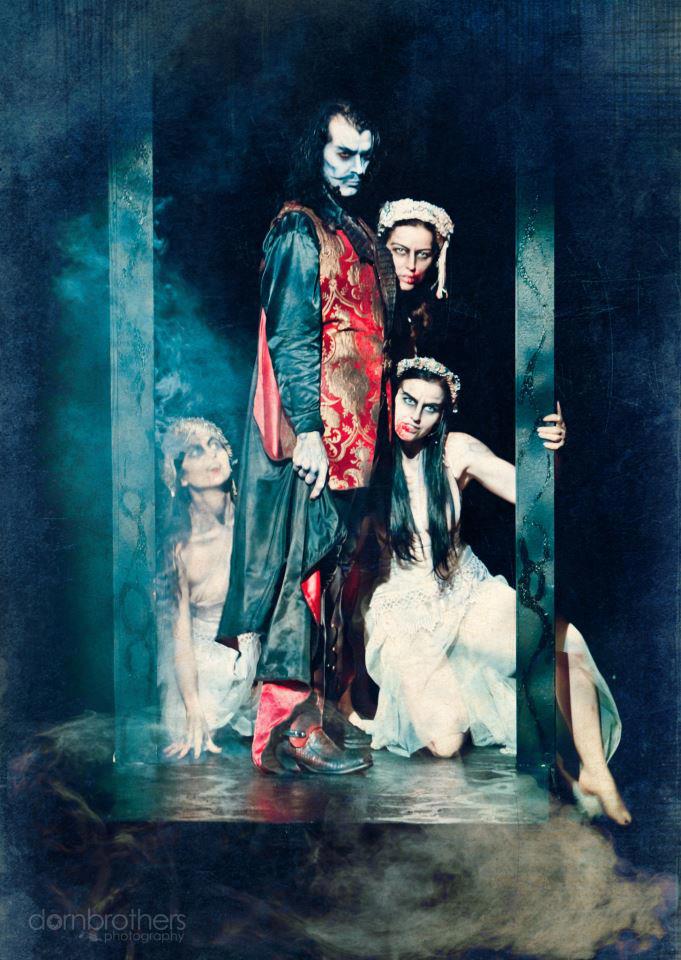
Dracula and his wives in DRACULA THE ROCK OPERA at 7 Stages; L-R: Jessika Cutts, Rob Thompson, Naomi Lavender, Madeline Brumby.

In this Week’s Kool Kat, we break the rules and give it to more than one person – those crazy kids in the Little Five Points Rock Star Orchestra.  Don’t miss DRACULA THE ROCK OPERA before it closes this Sunday, October 14 at 7 Stages. 

DRACULA THE ROCK OPERA melds JESUS CHRIST SUPERSTAR with Grand Guignol in a production that not only rocks hard and delivers a horrific, non-twinkly Nosferatu, but also is surprisingly true to Bram Stoker‘s original novel. Not to be missed, this DRACULA brings the rock opera genre into the 21st century with the energy, musical, acting and staging quality of an off-Broadway find. Seeing it is like discovering HEDWIG AND THE ANGRY ITCH in 1998 or THE ROCKY HORROR SHOW in a tiny upstairs theater in London in 1973. But hey, wait a second, this is Atlanta’s 7 Stages Theatre, not New York, not London, not even LA or Chicago. And it’s not Rob Zombie, but Rob Thompson. How the HELL did that happen?

The short answer is years of hard work by the Little Five Points Rock Star Orchestra, a motley crew of badass tattoo-covered Atlanta musicians, stage professionals and grassroots performance artists whom you haven’t heard of most likely unless you live here. If you don’t live in Atlanta, you probably won’t believe this gang of music misfits, most with ultra-light theater experience, has produced a libretto, lyrics, acting and staging that set DRACULA THE ROCK OPERA tooth and claw above community theater.Maybe you’ll be more convinced when I point out that they did have the benefit of Del Hamilton, a seasoned internationally acclaimed director, to guide them. DRACULA will be the last of 80 shows which he has directed before he steps down as artistic director of 7 Stages, building with Faye Allen, a reputation for this company as one of Atlanta’s most edgy. It’s a testament to Hamilton’s vision that he was willing to take on a venture in the pop culture/horror arena as his swan song (though he will continue to stay active in 7 Stages). Clearly Hamilton drove the cast and production crew to their highest potential, ably assisted by longtime Atlanta actor Justin Wellborn, who returned from Los Angeles to work on DRACULA.

Harker (Chris Love) receives a dire warning from a gypsy woman (Naomi Lavender).

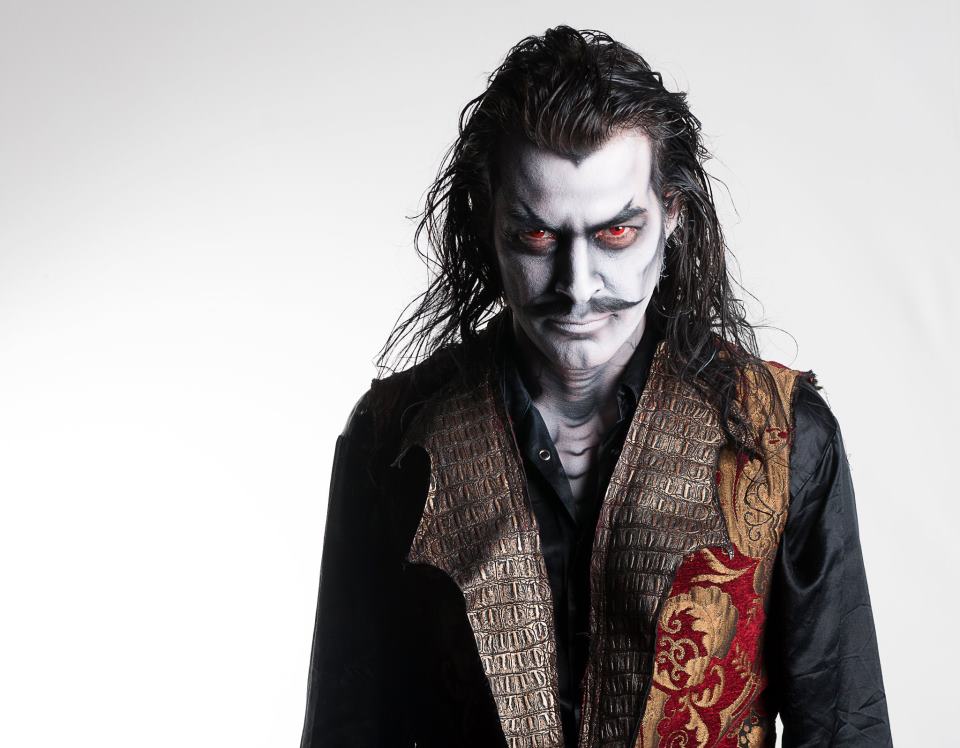
In JESUS CHRIST SUPERSTAR, the son of God is reborn as a rock star, and so likewise is the iconic vampire dark lord of fiction as Rob Thompson emerges on stage, dressed as Vlad the Impaler with a long dark mane, a Gothic red velvet vest so pointy it looks like it could cut you, and tight black leather pants. At first he is bending his fingers and arching his back, creating a shadow image creepily reminiscent of Max Schreck in the iconic silent NOSFERATU (1922). But soon recharged by the promise of a new feeding ground in England, he is re-uniformed in a blood-red cape, red and black boot chaps and a sword. With his petulance, cockiness and powerful voice, Jim Morrison meets Ozzy as Thompson emotes on the power of blood to a heavy beat right out of Black Sabbath.  This Count is no romantic sparkly vampire, but a black metal superstar of evil whose immortality is dependent on the death of humanity.

When ATLRetro reviewed the first act, then titled HAUS VON DRACUL, during a trial run last year, we called that review “Dracula Superstar but Love is the Answer.” That tagline still holds true in that DRACULA THE ROCK OPERA is unique among Dracula dramatizations for having a strong/non-wimpy rendition of Jonathan Harker in the transcendent voice and passionate mannerisms of African-American actor/musician Chris Love. With a lion’s mane of long black hair, Love is already a daring visual choice for a role too often played close-cropped and straight-laced. Now Thompson has caught up with Love, but Love, as Harker, continues to embody the everyman (us by proxy) as he arrives on stages and declares in a moving opening solo that “a good man is a true man”  and later a stranger in a strange land, “all alone away from Mina.” Bram Stoker’s novel is written in the epistolary form with characters expressing their ebbing terror through diary entries and letters, and this rock opera masterfully embraces that format, often taking lines directly from the book and making the audience a confidante. In Love’s hands, Harker’s predicament gets progressively lonelier, reminds us that the vampire is evil and not to be embraced, progressively raising the stakes and easing the first act towards a sense of doom with no hope and escape.

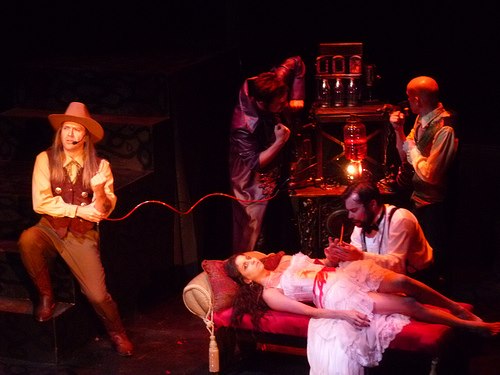
Van Helsing (Jeff Langston, center) and Lucy's three suitors, Quincey (Shane Morton), Seward (Chaz Pofahl) and Arthur (Jed Drummond) make a "vein" attempt to save Lucy's (Jessika Cutts) life with blood transfusions.

Beyond Dracula’s tight leather pants, the “sex” side of rock n roll comes center stage early in Harker’s seduction by Dracula’s three wives, played to a perfect sirenic pitch by Muleskinner MacQueen Trio chanteuse Naomi Lavender (who also plays a gypsy woman and Mina), Madeline Brumby (known in the neo-exploitation movie world for her breakout role in also-Atlanta-produced DEAR GOD! NO!) and Jessika Cutts (who also plays Lucy). Their breasts show through white diaphanous robes, a clear homage to the sexy female vampires of Universal, Hammer and the lesbian vampire B-movie genre, and this production ups their otherworldly quality by adding exotic Eastern European headpieces and dance moves reminiscent of a Kali ritual. The actresses achieve a chemistry in their ethereal voices and interplay that only heightens the erotic tension and also their profound loneliness, trapped in the castle with the Count.

The first act showcases how to effectively use minimalist sets, lighting and an ensemble cast. No coach is needed with just Harker sitting vulnerably on steps while a mad driver thrashes a long whip, a small herd of humans outfitted in haphazard fur pelts furiously keeping pace to a metal beat. Less is more is also well-executed in the similarly soundtracked (the beat always gets heavy when Dracula is at his most bloodthirsty) ship scene conveying the hopelessness of the captain (Rick Atkinson) trying in vain (vein?) to keep his ship afloat in a stormy sea while the Count devours his crew in one of the play’s bloodiest scenes (watch out, front row!).

Van Helsing (Jeff Langston), Vampire Slayer!

DRACULA THE ROCK OPERA has to introduce a lot of new characters rapidly in the second act, and this task is mostly achieved well, including characters who appear in the book but often excluded from screen and stage. In a poppy update of Cole Porter’s “Tom, Dick and Harry” from KISS ME KATE, Lucy (Jessika Cutts) enthusiastically emotes to her best friend Mina (Naomi Lavendar) about her three suitors, earnest, bowler-hat-wearing Arthur (musician Jed Drummond in his stage debut); Dr. Seward (Charlotte, NC-based actor Chaz Pofahl), who runs the asylum (how romantic!); and Quincey, an American cowboy played with appropriate “home-on-the-range” swagger and just the right nod of humor by Atlanta horror Renaissance man-about-town Shane Morton (Professor Morte of the Silver Scream Spookshow, DEAR GOD! NO!, Gargantua, etc.) against type – in other words, more country than rock (Note: because of Shane also being the mastermind of the Atlanta Zombie Apocalypse, Arnie Lowder is now playing this role Thurs-Sat for the last few weeks of the run).

We already have a sense of Mina from Harker’s songs about her. Like in so many Dracula dramatizations, she could be just a romantic foil and vampire victim but fortunately Lavender’s unique voice – Kate Bush meets Janis Joplin, with a twist of Jane Wiedlin?! – and sheer dynamic energy forestall that possibility, ultimately ensuring she will be an equal to the otherwise male vampire-hunting team. Renfield’s crazed obsessiveness with Dracula is portrayed with a manic frenzy and an appropriately metalhead of frizzy curly hair in a breakout performance by Rick Atkinson, who has been with the L5P Rockstar Orchestra since its first production of JESUS CHRIST SUPERSTAR in the mid 2000s.

Meanwhile, Dracula in London is more of an omnipresent villain, now re-energized by a city full of fresh blood into full throttle rock star and re-attired in a black leather jacket (think actual suit jacket – Steve Tyler, not Sid Vicious). Fortunately Thompson and company recognize that he needs a similarly rocked-out foil not a dawdling elderly professor. Not your mama’s Van Helsing, this vampire hunter in purple is Doctor Strange meets Freddie Mercury. Jeff Langston, of hard-rocking Atlanta-based bands Ledfoot Messiah and AM Gold,  is just the hard-edged leader to unite Lucy’s triad of suitors to try and save first her life (no, they don’t succeed despite a steampunky transfusion gizmo) and then Mina’s as the Count makes them his inevitable victims. Ultimately, the intrepid group must travel all the way back to Transylvania to finish the battle, and as for the end, if you’ve read the book, well, you know it. And if you haven’t, you may well be surprised.

Rob Thompson as Count Dracula/Vlad the Impaler.

Ultimately that DRACULA THE ROCK OPERA is bound and determined to be tightly faithful to Stoker’s novel is both its strength and an occasional weakness, however, because occasionally that fealty causes some dramatic challenges. For example, after act one, it seems impossible when Mina receives a letter from Jonathan Harker that he has somehow escaped Castle Dracula. (Maybe a side performance showing Harker escape in pantomime might clarify?). Another scene that felt like it needed a little more work was a city scene in which Harker spies the Count for the first time in London stalking female victims. But these really are only small complaints in what overall is a fantastic production. Let’s hope for an encore soon and more runs well beyond Atlanta.

All photos courtesy of 7 Stages and DRACULA THE ROCK OPERA and used with permission.


Category: Kool Kat of the Week, Retro Review | Tags: , , , , , , , , , , , , , , , , , , , , , , , , , , , , , , , , , , , , , , , ,

Slim’s Jukebox #4: Around the World with Slim!

Posted on: Aug 14th, 2012 By:

By James Kelly
Contributing Music Editor

While most of my favorite music comes from right here in the deep south, I still have a real taste for the British Invasion, the one that’s been constantly going on since the early ’60s. But over the years I have also had the great joy of discovering music from many other countries and regions, so this week’s column s dedicated to what is commonly referred to as “World Music.” I’m sure I listened to lots of different things as a kid, since my dad was such a music fanatic, but my first real connection to “world music” was when I heard Ravi Shankar performing with George Harrison. It opened my ears, and my mind. So, from the corners of the globe, here’s what has been making my feet shuffle.

Le Super Borgou de Parakou
THE BARIBA SOUND

Most of the music on this fine compilation originates in Benin, a small country in South Africa bordering Nigeria. Pulled from archives, a lot of this has never been heard in years, or even played outside Africa. Recorded between 1970-1976, the band was mostly led by the late Moussa Mama, who reportedly was exposed to a variety of western music by his dad. There’s a lot of ’60s pop influences heard in the 15 tracks, and the steady groove throughout is a perfect example of classic Afro-Beat. Throw in some rumba, pachanga and some “Bariba Soul,” and you have a nonstop dance party! The rhythms are incredibly infectious, and there is something celebratory about the beat that makes me smile. Unfortunately, I cannot understand a word they say, but it sounds great, has lots of energy and deserves some attention.

Paco de Lucía
EN VIVO CONCIERTOS – Live in Spain 2010

I first became familiar with legendary flamenco guitarist Paco de Lucía in the ’70s, after discovering an import copy of his amazing ENTRE DOS AGUAS in the cutouts at a record store in Memphis. Hearing the lightning fast playing, the intense rhythms and the start-stop precision for the first time was transformative, and Paco became a hero in my house. He later joined forces with noted Fusion Jazz guitarists John McLaughlin (Miles Davis, Mahavishnu Orchestra), and Larry Coryell, who was replaced by Al DiMeola (Return to Forever) in THE GUITAR TRIO. In addition to his own albums, Paco has recorded songs for films such as DON JUAN DEMARCO and more recently the beautiful soundtrack of VICKY CRISTINA BARCELONA. Fast forward 30 years from ENTRE DOS AGUAS, and Paco’s newest release is a double live CD, featuring a nice retrospective of his own compositions, and one piece by McLaughlin. With a second guitarist, harmonica, bass and two singers, it’s a foot-stomping, mind-boggling display of incredible Spanish/flamenco virtuosity. I’m still blown away by his playing.

The Touré́ -Raichel Collective
THE TEL AVIV SESSION

The combined talents of Israeli pianist Idan Raishel and Mali guitarist Vieux Farka Touré́́ take center stage on this unique and creative endeavor. These informally recorded jam sessions emerged over an afternoon, and the amazing improvisational collection is a celebration of rich musical culture and collaboration. Vieux displays an amazing and enchanting acoustic fingerpicking style, and Idan’s gentle keyboards accentuate and complement the delicate and melodic excursions. Joined by several other players and singer Cabra Casey (born in Israel, of Ethiopian descent), the music flows like a summer brook, hypnotic, magnetic and intensely beautiful. Each track begins with a subtle chord progression and, as each player gradually integrates into the groove, becomes a fully realized entity, with stylistic touches from all over the world, blending into a thing of real beauty. This is one of the most amazing records I have heard this year.

The Chieftains
VOICE OF AGES

Continuing a tradition that has produced some of their finest albums, Ireland’s Chieftains collaborate with a number of interesting and oddly matched singers to create another entertaining package of song. With lovely ballads by Imelda May and Lisa Hannigan, a raucous shouter featuring the incredibly talented (and currently very popular) Carolina Chocolate Drops, and, of course, a few of their own instrumentals, the Chieftains prove once again that music is universal. Particularly intriguing is the heartfelt take on “Hard Times Come Again No More” by Scotsman Paulo Nutini. Critically adored artists such as the Punch Brothers, the Decemberists and Bon Iver all make more than adequate contributions. While it’s not the best of this series, there’s not a lot to complain about.

Ian Tyson
RAVEN SINGER

While including a Canadian cowboy artist in a column on “world music” might seem like a stretch, last time I checked Canada was part of the “world.” Ian Tyson first made his mark in the music world as part of the ’60s “Great Folk Scare” duo Ian & Sylvia. Their gentle harmonies and knack for covering great songs made them one of the most popular acts of the era. Tyson eventually left music and became a real cowboy for many years, but his love of singing and the discovery of many great cowboy songs pulled him back into the business, but on his own terms. Sadly, he literally destroyed his once clear voice one fateful night, and now sounds more like early Tom Waits than an old folkie. But he still sounds great IMHO (I worship at the altar of Tom Waits), and the material on RAVEN SINGER works on several levels. Tyson is believable, for one thing. Even with what sounds like some strained vocal effort, he brings the stories to life, and gives each song a real sense of authenticity. At 78 years old, Ian Tyson is still making great music, with no plans to ride off into the sunset.

Category: Retro Review | Tags: , , , , , , , , , , , , , , , , , , , , , , , , , , , , , , , , , , , , , , , ,

Slim’s Jukebox: A Quintet of Essential Prestige/Riverside Jazz Collections by Five Masters

Posted on: Jul 5th, 2012 By:

By James Kelly
Contributing Music Editor

Imagine my good fortune when a package arrived at my door with five incredible jazz collections, each one by a true legend in the genre. As much as I love country music, every now and then I have to have a good jazz fix. When I was a wee lad, my Dad used to play some old Dixieland jazz records for me – Acker Bilk, Chris Barber and Ottilie Patterson, and many more, so the seeds were planted early. In the ’60s & ‘70s, I was  influenced by Frank Zappa’s jazz odysseys, and I eventually found a path back to the classics through the notorious Weather ReportMahavishnu “jazz fusion” enchantment of my high school years.  So here is a brief summary of five of the most essential artists in the history of jazz, all of whom have brand new compilations on the amazing Prestige/Riverside labels now under Concord Music Group. Please keep in mind that each of these greats has very deep catalogs, and these are mere samples of a certain time span in their illustrious careers.

Sonny Rollins
THE VERY BEST OF
From 1956 to 1958, tenor sax man Sonny Rollins released a series of tracks that stand as some of the finest cool jazz ever. Joined by a cavalcade of equally talented sidemen including drummer Max Roach (who whips out some stunning solos on this disc) and amazing trumpeter Clifford Brown, Rollins was equally melodic and experimental, combining his own material with classic standards and improvising with other legends such as the Modern Jazz Quartet and John Coltrane, whose duet with Rollins on a 12-minute jam called “Tenor Madness” is jaw-dropping good. Even the funky version of “I’m An Old Cowhand” shines with originality. His rich tone, precision playing and keen ear for great material coalesced into audio beauty, and while he continues to blaze new trails in his 80s, Rollins’ baseline set an incredibly high standard of excellence early on.

The Miles Davis Quintet
THE VERY BEST OF
Everybody loves Miles. He was a chameleon who followed his internal musical muse in whatever direction it took him, and sometimes he seemed a bit possessed. There is no shortage of great Davis compilations, and these tracks from 1954-1956 have been well documented in the past. The 10 cuts provide some insight into the transition Davis was making from a bebop player to a more mature, stylistically focused band leader. His Quintet at this time consisted of John Coltrane, Red Garland, Paul Chambers and Philly Joe Jones, basically a jazz supergroup. Garland’s hypnotizing piano solos permeate and complement Davis’ muted and buttery smooth tone, which eventually became his trademark sound. “’Round Midnight,” My Funny Valentine,” we’ve heard these plenty of times, but they never fail to generate a deep visceral feeling of being in a dark smoky club, whiskey on the rocks in hand, and the best band in the world playing just for you.

Wes Montgomery
THE VERY BEST OF
A life cut short too soon, Wes Montgomery’s work has been a standard by which all decent and respectful guitarists must compare themselves. His treatments of rock and pop classics on the CTI albums are legendary, and showcased his amazing improvisational skills. But this compilation is a real treasure, as it covers a lot of his lesser known early work on Riverside Records. Montgomery played with his thumb instead of a pick, which resulted in a very smooth tone that became immediately recognizable as his sound. Like his peers, Montgomery utilized the best of the best sidemen, which enhanced his own visibility. With Hank Jones on piano, Ron Carter on bass, the incredible Milt Jackson on vibes (where is Jackson’s “Best Of…” album?), and multiple drummers, Montgomery’s early work is a perfect example of the late ‘50s early ‘60s jazz groove – subtle but confident, melodic but challenging, and manna for the ears.

John Coltrane
THE VERY BEST OF: THE PRESTIGE ERA
He’s the other giant of modern Jazz, standing equally tall as his occasional bandmate Miles Davis. There is no need to elaborate on the importance and influence of Coltrane’s legacy. It permeates most real jazz that has been written and performed since he passed away. Captured here are 10 tracks from 1956 to 1958; each piece is a blast of confident control, a mini musical dissertation on how to make a perfect Jazz record. His time in the trenches with Davis and pianist Thelonious Monk had given Coltrane an education, and obviously inspired a push toward total excellence. With equal parts skill and soul, he blazed through multiple pieces of music, branding each as his own with a rich and powerful command of the saxophone, one that has not really been matched since then. His unique interplay with trumpeter Donald Byrd on “Lover Come Back To Me” is a schoolboy lesson in collaboration and exploration, and simply unforgettable. Fast, slow, jammy or moody, Coltrane could do it all.

Chet Baker
THE VERY BEST OF
He had it all – the looks, the sound, the charisma, the reputation, and sadly, the taste for dope.  Chet Baker has long been an icon, an incredible trumpet player and vocalist whose life circled down into a tragic tale of wasted talent and untimely death, eloquently reinvigorated in a fawning documentary by Bruce Weber (now almost impossible to find).  But putting aside the drama, Baker was a master, who sang and played like an impressionist painter, delivering the “essence” of a melody in a way that pulls you toward it, and allows you to construct the framework in your own mind. From his early 20s, working with Gerry Mulligan, Baker got noticed immediately by both other players and jazz aficionados, and the 14 tracks on this fine compilation give a fairly comprehensive and profoundly entertaining panorama of Baker’s skills.  His ability to turn standards into his own tunes was remarkable, and each cut is a treat. His tender half tempo version of “How High The Moon” is a prime example. As one of the very few jazzmen who also sang, Baker had a honey smooth voice that oozed sensuality. During these sessions, Baker played with an energy and smoothness that belied his impending battles with the demons of excess and temptation, and while he recorded sporadically in later years, he maintained that magic touch until the end.

Category: Retro Review | Tags: , , , , , , , , , , , , , , , , , , , , , , , , , , ,

Slim’s Jukebox: Willie Nelson, Mercyland, Todd Snider, Chelle Rose & Darrell Scott

Posted on: Jun 5th, 2012 By:

By James Kelly
Contributing Music Editor

There is so much great music coming out these days, and I will try to keep you posted on what I am listening to the most. This week’s column is a mix of legends, newbies, and a very nice compilation of sorta gospel songs. A lot of these are on small or independent labels, and don’t get the sort of publicity push that the horrible commercial radio crap has, so please spread the word if any of these hit your sweet spot.

Willie Nelson
HEROES
Legacy Recordings

Willie Nelson is my hero. He can pretty much do no wrong, and I do not know a soul who doesn’t appreciate his work. HEROES is a collection of duets and more, featuring his old pals Merle Haggard, on a rerecording of “A Horse Called Music,” and Ray Price on the classic “Cold War With You.” There’s a slew of cuts with Willie’s kid Lucas, and their voices are so similar it’s spooky. There are a few oddities here, but they work in Willie’s own peculiar way. The almost novelty song “Roll Me Up And Smoke Me When I Die” includes a few lines from Kris Kristofferson, hardcore honkytonker Jamey Johnson, and… Snoop Dogg? Yep, that Snoop. There’s a really nice take on Tom Waits’ “Come On Up To The House” with Sheryl Crow and son Lucas, but the show-stopper is Willie’s stunning version of Coldplay’s “The Scientist.” I’m not a Coldplay fan by any definition, but in Willie’s hands, this is a jewel.

[ Editor’s Note: Willie Nelson plays Chastain Park Amphitheatre with Jamey Johnson on Fri. June 15. Tickets here.]

Various Artists
MERCYLAND: HYMNS FOR THE REST OF US
Mercyland Records

Nashville is an interesting place. There are so many small music communities that have little or no relation to the mainstream industry, and what comes out of these enclaves inevitably is so much better than the major label drivel. One borderline fringe group consists of several really talented studio musicians and writers, who fit more into the “Americana” mold than anywhere else. And interestingly, most of them are Christians. Not the type that sit in pews every Sunday and listen to the good word, then treat people like crap the rest of the week, but Christians who are comfortable enough with their faith to be respectful and tolerant of others with different beliefs. They live it instead of simply talk it. Phil Madeira pulled a group of like-minded artists together and has constructed a wonderful collection of tunes that take a much different perspective on faith and spirituality than your usual “Gospel” record. From Buddy Miller’s plaintive “I Believe In You” to the very traditional “Lights In The Sun” by the Carolina Chocolate Drops, each song provides a unique and ultimately entertaining discourse on some aspect of faith. Atlanta’s own Shawn Mullins scores with “Give God The Blues,” and Madeira’s title track is a captivating slow groove. Even this card-carrying atheist felt a little spark of something, mostly respect.

Todd Snider
AGNOSTIC HYMNS & STONER FABLES
Aimless Records

A joker with a dark side, Todd Snider has been making provocative and polarizing music for over two decades, and on AGNOSTIC HYMNS, he takes a bit of a step out of his unusually wide comfort zones. Snider’s been on both major and indie labels, while never compromising the type of music he makes for anyone.  Over the years he has always had a fine backup band on deck, and the records always sounded really clean and neat in spite of his sometimes bizarre lyrics and stories. Well, this time around Snider sounds like he is backed up by a hillbilly punk band, with crashy drums, raw electric guitars and slightly dissonant harmony vocals. It’s all very primitive and deceptively simple sounding, but lyrically this is some of his roughest work. Life has been tough for everyone for the past few years, and obviously for Snider as well.  His provocative observations on life, love and the state of affairs in the world can be a bit depressing, if they weren’t so entertaining. Throw in a few bouncy acoustic tracks, crank it up, and appreciate Todd.

[Editor’s Note: Todd Snider performs at Variety Playhouse on Wed. June 13. ]

Chelle Rose
GHOST OF BROWDER HOLLER
Lil’ Damsel Records

After making a few ripples in the underground Nashville scene a decade ago, the bluesy-voiced Chelle Rose disappeared into motherhood for a few years, only to be recently rediscovered by the legendary Ray WylieHubbard, who produced this fine album. The original tunes on GHOST OF BROWDER HOLLER perfectly channel Rose’s Smoky Mountain heritage, and anybody who covers Julie Miller’s “I Need You” is OK in my book. Rose is bit grittier than Miller’s girlish sound, and gives the song a rock hard edge that works on all levels. Hubbard’s production (and the accompaniment of some of Texas’ finest) provide Rose with the perfect canvas, and even with 10 years of cobwebs and dust to knock off, she still has it.

Darrell Scott
LONG RIDE HOME
Full Light Records

A near-perfect songwriter, Darrell Scott has penned monster hits for people like the Dixie Chicks, Garth Brooks, Travis Tritt, and both Faith Hill and Tim McGraw. Lucky for us, he keeps the really good ones for himself. With the freedom to do whatever he wants, Scott decided to do a straight-up country record, and on this 16-track jewel, he nails it to the wall. Joined by a band of Nashville studio legends – Hargus “Pig” Robbins on piano,  drummer Kenny Malone, along with steel player Lloyd Green and harmonica master Charlie McCoy, Scott delivers an amazing collection of rich classic country tunes, not a clunker in the bunch. His duet with Guy Clark on “Out In The Parking Lot” actually improves on Guy’s original recording, and “You’re Everything I Want Love To Be” is a love song as country as it gets. Scott has a clear and comforting voice, a way with words, and has once again made a truly great album.

Category: Retro Review | Tags: , , , , , , , , , , , , , , , , , , , , , , , , , , , , , , , , , ,

PLANET OF THE APES-piration: Or Why You’re a Damn Dirty Idiot If You Don’t Make It to Rock N Roll Monster Bash 2012 at the Starlight Drive-In

Posted on: Jun 1st, 2012 By:

by Gene Kannenberg, Jr.
Guest Contributing Writer

PLANET OF THE APES (1968); Dir: Franklin J. Schaffner; Writer: Michael Wilson and Rod Serling; Starring Charlton Heston, Roddy McDowall, Kim Hunter, Maurice Evans; 10th annual Rock N Roll Monster Bash 2012, Starlight Drive-In, Sun. June 3; gates at 10 a.m. and movies at dusk; trailer herean all-day, all-night horror festival featuring Monstrosity Championship Wrestling hosted by the Silver Scream Spookshow‘s Professor Morte. Bands include X-ImpossiblesBigfootDead Elvisand more. Also playing: RETURN OF THE LIVING DEAD (1985)

I can barely remember a time when I did not know about PLANET OF THE APES (1968).

Watching the PLANET OF THE APES movies was a ritual for me when I was a boy in the early-to-mid 1970s. WVTV Channel 18, Milwaukee’s independent TV station, used to run POTA marathons at least once a year, it seemed; every Friday for five weeks in a row we’d get another installment, and I was always riveted to the screen, beginning, of course, with the original film directed by Franklin Schaffner and originally released in 1968.

After all, the idea of astronauts from Earth discovering a world ruled by talking animals is tailor-made for a child who has outgrown (for the time being) fairy tales but is fascinated by (1) the space program (we were still going the moon back then) and (2) dinosaurs and other monsters. The action was intense, the apes looked wonderful (some noble, others menacing), and the ideas were mind-expanding, thanks in no small part to script work by Rod Serling of THE TWILIGHT ZONE fame.

Was there ever a more effective introduction of menace into a film than the attack by the gorillas in the cornfield? The mute fear of the humans; the shots of the whips above the corn; Jerry Goldsmith’s harsh, urgent soundtrack; and the ultimate reveal of the gorillas on horseback, with the zoom-in on a gorilla’s face? It was breathtaking at the time, and it’s still a powerful moment today.

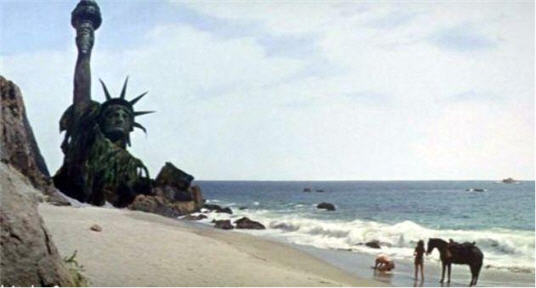
The famous Statue of Liberty scene in PLANET OF THE APES (20th Century Fox, 1968).

I wish I could tell you how shocked and stunned I was the first time that I, along with Taylor (Charlton Heston), discovered the half-buried Statue of Liberty and realized that the Planet of the Apes was, in fictional-fact, our own planet Earth. I wish I could, but I can’t; because I can’t remember ever not knowing this fact. I’m sure I was awestruck the first time around—how could a child not have been, after witnessing such a brutal, unfamiliar world? All I can remember is enjoying the ride each and every time I watched the movie—any of the movies, even the less-than-stellar BATTLE FOR THE PLANET OF THE APES (1973). (And that Statue of Liberty moment has, rightly, become one of the most famous in movie history – in fact, it was even included in a film better-known as being an adaptation of HAMLET )

Taylor (Charlton Heston), Zira (Kim Hunter) and the body of dead astronaut Stewart (Diane Stanley). PLANET OF THE APES (20th Century Fox, 1968)

I must admit that, to my young mind, one of the most mysterious and terrifying parts of the the movie came early on with the death of Stewart (an uncredited Diane Stanley), the female astronaut who doesn’t survive suspended animation. When Taylor discovers her corpse, it all happens so fast that I was never sure what was going on. In hindsight, it’s clear that her cryogenic capsule failed, and that her body mummified during the other astronauts’ long sleep. But when I was a child, I couldn’t understand why she looked the way she did. We only see her corpse for a second, so that added to the mystery. For the longest time, I thought that perhaps she had somehow been turned into an ape as some sort of warning. Now, I realize that doesn’t make any sense; but when you’re eight years old, sense is a precious, elusive quantity. Seeing her corpse as a warning of what was to come made perfect, terrible sense to me back then.

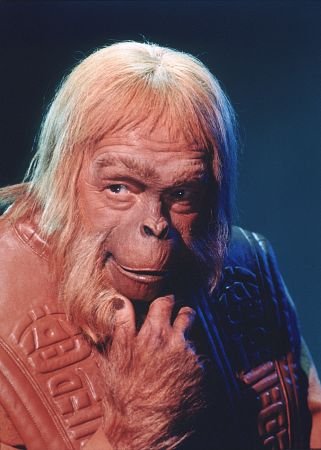
Watching these movies on TV also gave me my first taste of behind-the-scenes promotional films. Sometimes Channel 18 would pad out the movies to three hours, but even with commercials there would still be time left over before the 10 o’clock news. So they occasionally filled the extra minutes with “making-of” documentaries about either the POTA films or the short-lived live-action PLANET OF THE APES television series (1974). Here was my first glimpse into “movie magic,” and in particular, the fascinating world of prosthetic makeups. Nerdy kid that I was, I found myself amazed at the skill and ingenuity that makeup creator John Chambers and his crew demonstrated in slowly, slowly building up appliances onto the actors’ faces, transforming them into incredibly believable simians.

Maurice Evans as Dr. Zaius in PLANET OF THE APES (20th Century Fox, 1968)

I was so taken with the makeup process that I decided to try it myself. However, being eight years old (or so) and without access to latex and yak fur, I made do with what I had available: paper, crayons, scissors, and tape. Building upon what I’d seen in the documentaries, I made articulate ape masks for my younger brother John and myself. (I got to be a chimpanzee, natch; my brother became an orangutan. And when a cousin would visit, he or she’d have to settle with being a gorilla.)

First I’d create a somewhat triangular piece that surrounded the eyes and came down to create a nose. That was the easy part. The hard part was the mouth. I wanted it to look like the muzzles the apes had in the movies: That meant a mouth in two pieces, top and bottom, each a sort of quarter-sphere. I’d color a piece of paper “ape flesh” color (depending upon the type of ape) and then cut notches along the edges so that I could mold it into the proper hollow shape, securing the seams with tape, until they were (approximately) the right shape.

Finally came the miles of tape needed to attach the paper appliances to our faces. The only way to allow the mouths to open and close as we spoke was to affix the two pieces separately to our skin. This took a lot of tape (and made the eventual removal of the masks a little uncomfortable – but hey, this was art). Once the mouths were in place, then came the eye/nose pieces, with the descending noses laid atop the upper mouthpiece. (I remember that one time when I was feeling particularly ambitious, I added a third piece to the mouths: A piece of paper crayoned as black as I could make it, to cover our real mouths behind the muzzles; this way, when we spoke, you couldn’t see our real mouths inside the masks.)

The hair was trickier, but I had a solution. We had winter hats that covered our whole heads, with just a hole cut out in the front for our faces. Perfect! The fact that my hat was blue and my brother’s was green kind of spoiled the verisimilitude, but hey, that’s what imagination was for. The final touch was a triangular piece of paper on each side of our faces to approximate the facial cheek-hair that crept under the eyes and wrapped around the muzzles.

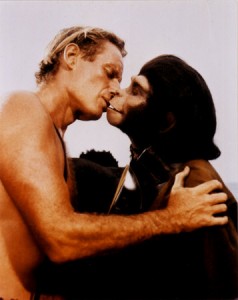
Taylor (Charlton Heston) and Zira (Kim Hunter) exchange a kiss in PLANET OF THE APES (20th Century Fox,1968).

Lord, how I wish I had photos of us in these masks. I’m sure they looked mostly ridiculous, but we loved them, and we would jump around the house, howling like apes.

But anyway, the Apes movies made a huge impression on me as a child. They instilled in me a love of science fiction, a love of movies, and a healthy dose of cynicism with regards to official structures of power. They were all “of their time,” that time being the late 1960s/early 1970s, and issues of discrimination were inescapable cultural touchstones, even for a young child. And the Apes films were, in their way, statements against discrimination and pleas for tolerance and understanding. (For more on this topic, see Eric Greene’s book PLANET OF THE APES AS AMERICAN MYTH: RACE, POLITICS, AND POPULAR CULTURE.)

Of course, the apes movies are also a whole lot of fun. Some of it might seem a bit campy nowadays, and of course, some of the lines have become cultural touchstones in their own right (“Get your stinking paws off me, you damned, dirty ape!”). But the films, the first in particular, still represent some of the best movie-making magic there ever was. I envy you Atlantans the chance to experience it on the big drive-in screen. Now, watch like Apes!

Category: Retro Review | Tags: , , , , , , , , , , , , , , , , , , , , , , , , , , , , , , , , , , ,

© 2025 ATLRetro. All Rights Reserved. This blog is powered by Wordpress